For a small business, SEO boils down to a few core benefits: showing up when highly qualified customers are searching, building real, sustainable growth without paying for every single click, and cementing your brand as a trusted authority in your local market. It’s about telling your story in a way that search engines understand, so the right people find you at the perfect moment.
Your Website Is Your Best Salesperson
Think about your website for a moment. Is it just a digital brochure? Or is it your hardest-working employee—the one who never sleeps, never takes a vacation, and works 24/7 to find your next best customer?
That’s the transformation that happens when you invest in Search Engine Optimization (SEO). It stops being a technical chore and becomes a core business strategy that turns your online presence into a predictable revenue stream.
I’ve seen this happen time and time again. Take a local contractor I know who used to rely entirely on word-of-mouth. Business was okay, but it was a rollercoaster. After focusing on SEO, they started telling their story online, showcasing their best projects and answering common homeowner questions. Soon, they were appearing on the first page of Google whenever someone searched for "kitchen remodel in [their city]." Suddenly, their phone started ringing with people who were actively looking for exactly what they offered.
That's the magic of SEO. It puts your story in front of the right person at the exact moment they’re ready to buy.
From Brochure to Lead-Generating Machine
This shift from a passive online flyer to an active, lead-generating machine is where the real value is unlocked. Good SEO isn't about chasing algorithms or trying to game the system. It’s about building a valuable, long-term asset that works for you day in and day out.
This concept map breaks down how an SEO-driven website becomes the central hub for your business's growth.
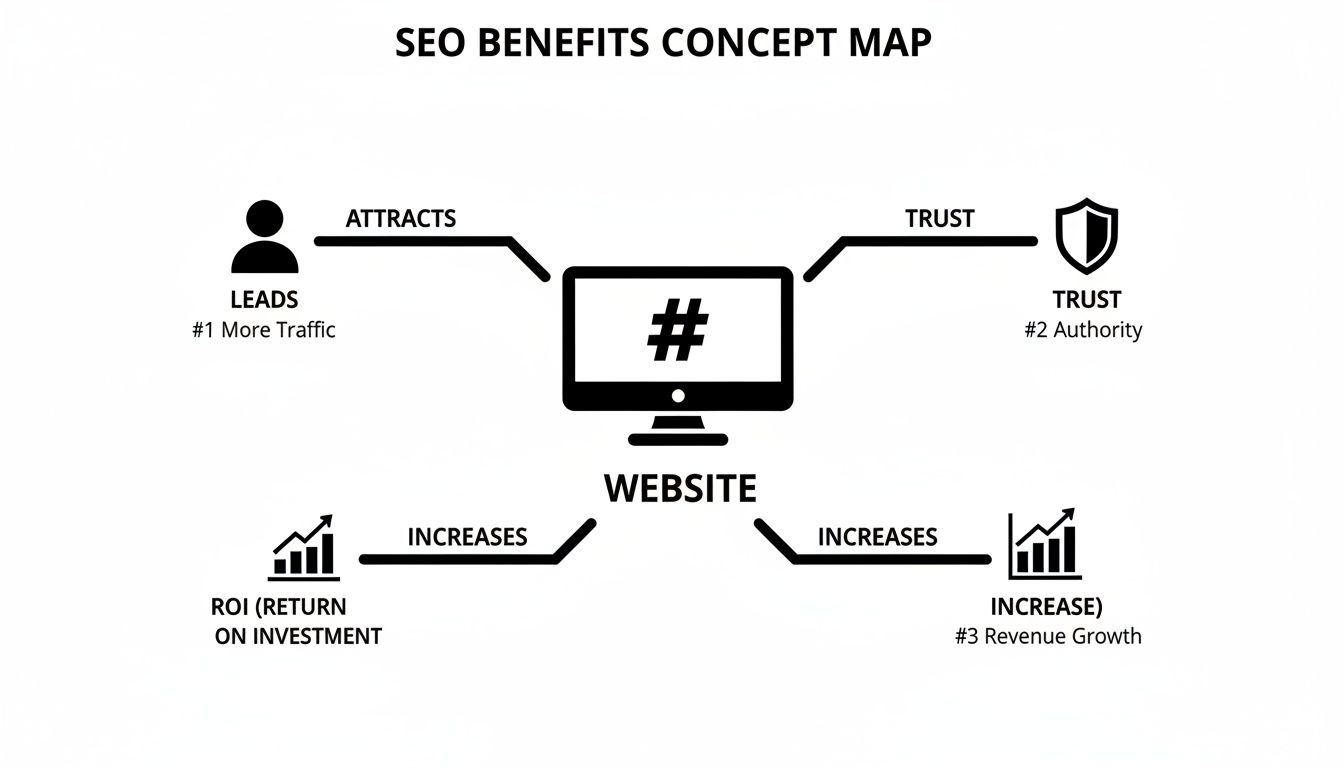
As you can see, a well-optimized site directly fuels your lead pipeline, builds critical trust with potential customers, and delivers a powerful return on your investment.
Here's a quick look at how these advantages stack up.
Key SEO Benefits at a Glance
This table summarizes the primary advantages SEO offers, showing the direct impact on key business metrics that matter most to small businesses.
| Benefit | Impact on Your Small Business |
|---|---|
| Increased Organic Traffic | Attracts visitors actively searching for your products or services, resulting in higher-quality leads. |
| Improved Local Visibility | Puts your business in front of local customers on Google Maps and in "near me" searches. |
| Lower Customer Acquisition Cost | Generates leads and sales without paying for every click, unlike paid ads. |
| Higher Conversion Rates | A better user experience and targeted content turn more visitors into paying customers. |
| Long-Term ROI | Your rankings and traffic can bring in business for months or years, creating a sustainable growth engine. |
These benefits demonstrate that SEO isn't just a marketing tactic; it's a foundational business investment.
This approach delivers something paid advertising just can't match on its own. The moment you stop paying for ads, they disappear. A strong organic presence, however, keeps attracting customers for months, even years. You’re building a foundation. Every piece of content you create and every optimization you make adds another brick to that foundation, making your position in the market that much stronger.
To take it a step further, you can learn how to improve website conversion rates and turn that hard-won traffic into loyal customers.
Dominate Your Neighborhood with Local SEO (GEO)
For most small businesses, your best customers aren’t halfway across the country—they're right around the corner. This is where Geographic SEO (GEO), or Local SEO, flexes its muscles, turning your business into the go-to expert in your immediate area. It's one of the most powerful benefits for any owner who relies on foot traffic or local service calls.
Think of a digital map of your town. Good GEO makes your business the brightest, most unmissable pin on it. It’s the strategy that ensures when someone nearby needs what you offer, your name is the first one they see.

From Invisible to In-Demand: A Dental Clinic's Story
Take a new dental clinic in a competitive city. At first, they were practically invisible online. They offered fantastic care, but bigger, more established practices buried them in the search results for terms like "dentist in [City]." Their story wasn't being heard.
Their breakthrough came when they zeroed in on local SEO. They started by claiming and meticulously optimizing their Google Business Profile (GBP). This meant telling their story through high-quality photos of the team and office, detailed service descriptions, and accurate hours. That simple step was like putting up a giant, digital billboard right where potential patients were looking.
Next, they encouraged happy patients to share their own stories by leaving honest reviews. Every positive comment acted as a powerful vote of confidence, signaling to both Google and prospective patients that this clinic was a trusted local provider. The final piece was creating location-specific content, like blog posts about "common dental issues for families in [Neighborhood]."
Within six months, their clinic shot into the coveted Google Map Pack—that box with three local listings right at the top of the search results. Their phone started ringing off the hook, and their appointment book filled up with new patients from their own community.
Your Action Plan for Local Dominance
This isn't some secret sauce reserved for a lucky few. You can get similar results by following a clear plan focused on building your local authority.
1. Claim and Optimize Your Google Business Profile
Your GBP is the cornerstone of local SEO. It's a free tool that lets you manage how your business shows up on Google Search and Maps, and it’s non-negotiable.
- Complete Every Section: Fill out your business name, address, phone number (NAP), hours, and website. Don't leave anything blank.
- Tell Your Story with Photos: Showcase your storefront, your team, and your work in action.
- Use the Q&A Feature: Proactively answer common questions potential customers might have.
"Think of your Google Business Profile as your digital storefront. An empty, outdated profile is like having a 'Closed' sign hanging on the door of an open business. A fully optimized profile invites customers inside."
2. Build Local Citations
A citation is any online mention of your business's name, address, and phone number (NAP). Consistent citations across directories like Yelp, Angie’s List, and industry-specific sites reinforce your location and legitimacy to Google. Consistency is key here; your NAP information must be identical everywhere.
3. Encourage and Manage Customer Reviews
Reviews are a massive ranking factor for local search. Actively encourage satisfied customers to leave feedback on your GBP and other relevant platforms. Just as importantly, respond to every single review—both the good and the bad—to show you're listening and you value customer feedback.
Local search has become the primary way people find and choose businesses today. Research shows that a staggering 98% of consumers use the internet to find information about local companies. Even better, 18% of local mobile searches lead to a sale within one day, a much higher conversion rate than non-local searches.
By mastering these elements, you ensure that when someone in your area searches "plumber near me" or "best coffee shop in town," your business isn't just an option—it's the obvious choice. If you're ready to dive deeper, you can also explore some of the best local SEO strategies to get a serious competitive edge.
Build Lasting Growth with a Powerful SEO Asset
Paid advertising is like renting an audience. The second you stop pumping money into ads, the traffic tap shuts off completely. SEO, on the other hand, is like buying the property. You're building a powerful digital asset that you actually own, and its value appreciates over time, delivering compounding returns that fuel real, sustainable growth.
This is easily one of the most powerful financial benefits of SEO, especially for small business owners. It’s all about creating a durable, long-term channel for attracting customers that doesn't demand a constant cost-per-click. Every single piece of optimized content is like laying another brick in your foundation, making your business more resilient and much harder to compete with.

From Paid Ads to an Organic Powerhouse
Let's look at a small e-commerce startup selling handmade leather goods. When they first launched, they leaned heavily on a small paid ad budget to get their initial sales. The ads worked, sure, but the cost to land each new customer was high, and the results were completely temporary.
Knowing this wasn't a long-term fix, they started dedicating time and effort to telling their brand's story through a solid SEO strategy. They began creating genuinely valuable blog content about topics their ideal customers were already searching for, like "how to care for a leather wallet" or "choosing the right messenger bag." At the same time, they worked on building backlinks by getting their story featured in style blogs and local artisan directories.
The progress was slow at first—that's the nature of SEO. But after about a year, the compounding effect really kicked in. Their blog posts started climbing to the first page of Google, bringing in a steady stream of visitors who were actively looking for information right before buying. Today, organic search drives over 70% of their total revenue, all without a direct per-click cost.
Lowering Your Customer Acquisition Cost Over Time
This story gets to the heart of a core financial advantage of SEO: it dramatically lowers your Customer Acquisition Cost (CAC) over the long haul. While paid ads have a fixed cost for every single click or impression, one well-written blog post can rank for years, attracting thousands of visitors and generating leads with no extra ad spend.
Think of it this way: a paid ad is a one-time transaction for attention. SEO is an investment in a machine that generates attention for you, 24/7. This creates a powerful competitive moat that is very difficult for competitors to overcome quickly.
The data consistently shows that SEO and content marketing provide a superior return. For marketers, website, blog, and SEO initiatives remain the top channels for generating ROI. In fact, small businesses are 23% more likely than average to see a return from their blog posts. This trend is so pronounced that for B2B small businesses, websites and SEO have become the undisputed leading ROI channels.
Building Your Content Asset Portfolio
Creating a powerful SEO asset isn't just about cranking out blog posts. It’s about building a diverse portfolio of content that answers questions and solves problems for your audience at every single stage of their journey.
- Pillar Pages and Guides: These are your comprehensive, deep-dive articles that cover a broad topic inside and out. They act as authoritative hubs that naturally attract links and can rank for some seriously competitive terms.
- Case Studies and Success Stories: Nothing builds trust like showing how your products or services have helped real customers. These are powerful pieces of social proof that can push hesitant buyers over the finish line.
- Video Content: Think about creating helpful tutorials, product demos, or behind-the-scenes videos. To get the most mileage, you can even convert YouTube videos to text for SEO, turning your visual content into a searchable, rankable asset right on your website.
Every piece of content you create adds to your digital real estate. It's an asset that works for you around the clock—attracting qualified customers, building trust, and driving revenue long after you hit "publish." This is how you stop renting an audience and start owning your growth.
Answer Customer Questions Before They Ask (AEO)
Modern search has completely changed. It’s no longer about cramming keywords onto a page. Today, winning at SEO means becoming the absolute best answer to your customers' most urgent questions.
This strategy, known as Answer Engine Optimization (AEO), is a game-changer for small businesses. It’s all about positioning your business as the go-to expert who has the exact solution people are looking for, told in a way that resonates.
Think about how you use Google. You're probably not just typing in single words. You're asking full questions, whether you're speaking to Siri or typing, "what's the best way to clean hardwood floors?" or "how much does it cost to fix a leaky faucet?"
When your website delivers the clearest, most helpful answer to those questions, you win. You start capturing valuable voice search traffic and can even snag a spot in Google's coveted Featured Snippets and "People Also Ask" boxes.
From Broad Keywords to Specific Answers
So many small businesses get burned out trying to compete for broad, crazy-expensive keywords. It’s a tough battle.
Take a local tech consultancy, for example. They found it was basically impossible to rank for a term like "IT services." They were up against massive corporations with bottomless marketing budgets. Frustrated, they decided to completely change their content strategy and start telling a different story—the story of their expertise.
Instead of chasing those huge keywords, they zeroed in on the highly specific questions their potential clients were asking every single day. They started creating detailed articles and guides answering real-world questions like:
- How do you securely migrate business data to the cloud?
- What are the first steps for setting up a small office network?
- What are the pros and cons of Microsoft 365 vs Google Workspace?
The results were incredible. Almost immediately, they started showing up in Google’s "People Also Ask" sections, pulling in clicks from businesses with very specific problems they needed to solve. Their content also began getting picked up by voice search, turning their website into a 24/7 resource for their ideal customers. This shift completely transformed their lead quality, practically overnight.
How to Become the Answer Engine
Adopting this mindset doesn't require a massive budget, but it does demand a shift in how you think. You have to stop thinking like a marketer and start thinking like your customer. The goal is to build out a library of content that directly solves their pain points, answers their curiosities, and addresses their challenges head-on.
"Your customers are not searching for your business; they are searching for solutions to their problems. When your content becomes the best solution, your business becomes the obvious choice."
This is where truly understanding your audience pays off big time. You need to put on your detective hat to figure out what those critical questions are. A great place to start is by digging into the fundamentals of how to do keyword research to see exactly what your audience is searching for online.
A Practical Framework for Answering Questions
Here’s a simple framework you can use to start identifying and answering your customers' questions. This will help you build authority and attract highly qualified traffic.
Identify the Core Questions: Go talk to your sales team. Look through your customer service emails. Browse online forums like Reddit or Quora where people in your industry hang out. What questions pop up again and again? Tools like AlsoAsked.com are also fantastic for seeing what Google's "People Also Ask" results are for any topic you can think of.
Structure Content for Clarity: Format your content in a clean Q&A style. Use the question itself as a subheading (H2 or H3) and give a short, direct answer right below it. Then you can expand with more detail, examples, or step-by-step instructions.
Use Conversational Language: Just write like you speak. It makes your content way more engaging and, as a bonus, it lines up perfectly with how people actually use voice search.
By making it your mission to provide the best answers, you build an incredible amount of trust and authority. You're not just selling something; you're offering real value long before you ever ask for the sale. This is how you build a loyal customer base and a powerful, lasting advantage in search.
Ready to Get Started? Here Are Your First Steps.
Feeling fired up but not quite sure where to begin? It's one thing to see the long-term potential of SEO, but it's the small, consistent actions that really build momentum. This section is your roadmap—a clear, straightforward plan to help you take control of your online growth without getting bogged down in technical jargon.

This isn't about trying to master everything at once. Far from it. The real goal here is to build a rock-solid foundation, one that will support your business for years to come through small, steady efforts that add up over time.
Your Five-Step Launch Plan
Think of this as your SEO starter kit. Each step is designed to give you a tangible win and set you up for what comes next. It’s a simple plan that cuts through the noise and focuses on high-impact moves you can make right now.
Run a Basic Website Audit: You can't fix what you don't know is broken. Use a free tool to check your site's mobile-friendliness and page speed. These two things are absolute cornerstones for a good user experience and, you guessed it, better rankings.
Fully Deck Out Your Google Business Profile: This is your digital storefront and the absolute heart of local SEO. Go through and fill out every single section, upload at least ten high-quality photos, and start making it a habit to ask your happy customers for reviews.
Find Your Top 5 "Money" Keywords: What are the five phrases a customer would type into Google right before they're ready to buy? You need to think specific. Instead of just "plumber," aim for something like "emergency plumber in downtown." These are your first targets.
Create Your First Piece of "Answer" Content: Look at those keywords you just found. What’s the biggest question your customers always ask related to them? Plan out a blog post that answers that question completely. This is your first real step into becoming the go-to answer in your niche.
Set Up Basic Tracking: Get Google Analytics installed on your website. You don't need to become a data wizard overnight, but just having it in place will let you see what's actually working as you start to make these changes.
"The journey of a thousand miles begins with a single step. For a small business, that first step into SEO is often the most important one. Taking action, no matter how small, is what separates the businesses that grow from those that get left behind."
To really hit the ground running, getting a handle on the foundational principles is key. Brushing up on the SEO basics for small business is a great place to start. Following this roadmap will put you on the right path to building a powerful, sustainable online presence that drives real growth.
The power is in your hands—go get started.
Got Questions About SEO? We've Got Answers.
Jumping into SEO can feel like learning a new language, and it's totally normal to have a few questions. When you're busy running your business, you need clear, no-nonsense answers. Here are some of the most common things we get asked by small business owners just like you.
How Long Does This SEO Thing Actually Take?
This is the big one, right? Unlike flipping a switch on a paid ad, SEO is more like planting a tree than a one-and-done task. It's a long-term play that builds on itself.
While you might see some positive signs in the first few months, you should plan on seeing a real, meaningful impact—we’re talking a noticeable jump in traffic and solid leads—within six to twelve months. That's the typical timeframe it takes for Google to see your consistent effort, trust your website, and start rewarding you for it. The initial work lays the foundation, but the real payoff comes from that steady, ongoing effort.
What's the Difference Between SEO, GEO, and AEO?
Great question. Think of them as layers of a single strategy to get your business found.
- SEO (Search Engine Optimization) is the overall practice of making your website friendly to search engines like Google.
- GEO (Geographic SEO, or Local SEO) is a part of SEO focused on ranking in your specific city or service area. It’s what helps you show up in "near me" searches and on Google Maps.
- AEO (Answer Engine Optimization) is another part of SEO focused on directly answering customer questions. It helps you rank for voice searches and in Google's "People Also Ask" boxes.
For almost any small business with a physical storefront or a defined service area, starting with GEO and AEO is the fastest way to get in front of people who are actively looking to buy what you sell.
Can I Do My Own SEO, or Should I Hire Someone?
You can absolutely get your hands dirty with SEO, and honestly, it’s a great way to understand the basics. Things like claiming and optimizing your Google Business Profile, figuring out some core keywords, and writing a helpful blog post are powerful first steps any business owner can manage.
But as you grow, bringing in an expert can seriously speed things up. An agency comes to the table with professional tools, deep technical know-how, and a team focused solely on this stuff. That frees you up to do what you're best at: running your business.
Ready to stop wondering and start ranking? The team at Jackson Digital lives and breathes this stuff. We build custom SEO plans that deliver real, measurable growth for small businesses. Request a free performance audit today and let's find out how we can get you more clicks, more customers, and a digital presence that works as hard as you do.