In a marketplace where visibility is currency, standing out is one of the biggest challenges for small businesses. You've built a great product or service, but how do you tell your story to the customers actively searching for it right now? The answer isn't just about spending more on ads; it's about building a sustainable, digital asset that works for you around the clock. This is where search engine optimization (SEO) transforms from a technical buzzword into your most powerful growth engine.
This article moves beyond generic advice and dives straight into the tangible benefits of SEO for small businesses. We'll explore how a strategic SEO plan can drive high-quality traffic, build lasting brand credibility, and give you a significant competitive advantage in your local market. You'll get real-world stories and actionable steps for ranking higher, from dominating local search (GEO) to providing the direct answers your customers crave (AEO – Answer Engine Optimization).
Each section is a mini-playbook, showing you how to turn search intent into measurable revenue. For those ready to start implementing these strategies immediately, a practical resource is available in this Small Business SEO Guide, which offers a clear plan for getting found online. Let's explore how to make your business the go-to answer for your ideal customer.
1. Increased Organic Web Traffic
One of the most significant benefits of SEO for small businesses is the ability to generate a steady stream of high-quality, organic web traffic. Unlike paid advertising where you pay for every single click, organic traffic is earned. When potential customers actively search for products or services you offer, SEO ensures your website appears prominently in the search results, drawing them in without a direct cost per visitor. This traffic is inherently more valuable because it consists of users with a specific intent who are already looking for a solution.

This process turns your website into a powerful, self-sustaining lead-generation machine. As your rankings improve for relevant keywords, you build brand authority and create a predictable pipeline of potential customers. This sustained visibility establishes your business as a trusted resource in your industry, fostering long-term growth.
Real-World Story
A local plumbing company in Dallas was struggling to get consistent service calls. The owner, Maria, decided to focus on SEO. She told the story of her business through blog posts like "A Day in the Life of an Emergency Plumber" and created helpful guides on "How to Fix a Leaky Faucet in 5 Minutes." By optimizing these for keywords like "emergency plumber Dallas," her website started ranking on the first page of Google. Now, her phone rings consistently with calls from local homeowners facing urgent plumbing issues, all without paying for ads.
How to Increase Your Organic Traffic
To start driving more organic traffic, focus on these actionable steps:
- Target Long-Tail Keywords: Instead of broad terms like "shoes," target specific phrases like "women's waterproof hiking boots for wide feet." These have less competition and higher conversion rates.
- Create Local Landing Pages: If you serve multiple areas, build dedicated pages for each location (e.g., "Plano Roofing Services," "Frisco Roofing Services") to capture local search traffic.
- Build Content Clusters: Develop a main "pillar" page for a core topic (e.g., "Home Security Systems") and link it to several related "cluster" blog posts (e.g., "Best DIY Security Cameras," "How to Install a Smart Lock"). This structure signals expertise to search engines.
2. Cost-Effective Marketing Strategy
For small businesses operating with tight budgets, SEO represents one of the most cost-effective marketing strategies available. Unlike paid advertising (PPC), where the flow of traffic stops the moment you stop paying, SEO builds a sustainable asset. The initial investment is primarily in expertise and time, but once rankings are achieved, your website continues to generate high-quality traffic and leads without a recurring cost for every click, delivering an exceptional return on investment (ROI).
This makes SEO an engine for long-term, predictable growth rather than a short-term expense. Every piece of content you create and every backlink you earn contributes to your site's authority, compounding its value over time. This approach allows bootstrapped companies and startups to compete with larger, established players by focusing on strategic optimization instead of massive ad budgets.
Real-World Story
A new SaaS startup, "TaskFlow," allocated a small budget to creating in-depth guides targeting problems their software solves. Their founder, Ben, told the story of how a disorganized project led him to create the tool. This personal narrative framed their blog posts. Within a year, they generated over 10,000 monthly visitors from organic search, acquiring customers at a 70% lower cost than their initial Google Ads campaigns, proving that a good story can be the most effective marketing tool.
How to Maximize Your SEO ROI
To leverage SEO as a cost-effective marketing channel, focus on these high-impact tactics:
- Prioritize High-Intent Keywords: Start by targeting keywords that signal a user is ready to buy or take action (e.g., "emergency AC repair near me" vs. "how does an air conditioner work").
- Utilize Free SEO Tools: Leverage powerful free resources like Google Search Console and Google Analytics to find keyword opportunities, track performance, and identify technical issues without any cost.
- Repurpose Existing Content: Turn a successful blog post into an infographic, a video, or a social media series. This maximizes the value of your initial content creation effort across multiple channels.
3. Improved Brand Credibility and Authority
One of the most powerful, yet often overlooked, benefits of SEO for small businesses is the ability to build significant brand credibility and authority. When your website consistently appears at the top of search results, users subconsciously associate your brand with trustworthiness and expertise. This digital "vote of confidence" from Google acts as a powerful endorsement, positioning your small business as a legitimate leader in its field and directly influencing purchasing decisions.
This process transforms your online presence from a simple digital brochure into an authoritative resource. As you rank for key industry terms, you are not just capturing traffic; you are building a reputation. This earned trust is invaluable, creating a strong foundation for customer loyalty and making it easier to convert leads into sales, as prospects arrive with a pre-existing positive perception of your brand.
Real-World Story
A small financial advisory firm wanted to stand out. Instead of just listing services, they created in-depth guides on topics like "retirement planning for freelancers," sharing stories of clients they helped navigate financial uncertainty. By ranking for these topics, they established themselves as compassionate, subject-matter experts. This attracted high-value clients who were looking for a knowledgeable, trustworthy advisor, not just the cheapest option.
How to Improve Your Brand Authority
To start building your brand's credibility through SEO, focus on these actionable steps:
- Publish Authoritative Content: This is your primary tool for AEO (Answer Engine Optimization). Create comprehensive guides that thoroughly answer your audience's most pressing questions. This demonstrates expertise and aligns with Google's E-E-A-T (Experience, Expertise, Authoritativeness, Trustworthiness) guidelines.
- Earn High-Quality Backlinks: Secure links from reputable industry websites and publications. A link from a trusted source acts as a direct endorsement of your authority. You can discover the importance of quality backlinks to learn more about this strategy.
- Showcase Trust Signals: Prominently display customer testimonials, case studies, industry certifications, and positive reviews on your website. These elements provide social proof and reinforce the trust you've built through high search rankings.
4. Better Understanding of Customer Intent
Beyond just driving traffic, one of the most powerful benefits of SEO for small businesses is the deep insight it provides into customer behavior. SEO forces you to analyze what your audience is searching for, the exact language they use, and the problems they need to solve. This process of keyword research and journey mapping is a direct window into your customers' minds, revealing their needs, pain points, and motivations in their own words.
This intelligence is invaluable for refining your marketing messages, developing new products, and aligning your entire business strategy with what customers actually want. Instead of guessing, you gain a data-driven understanding of market demand, allowing you to create content and offers that resonate perfectly. This proactive approach turns your marketing from a shot in the dark into a targeted, effective conversation with your ideal buyers.
Real-World Story
A local fitness studio owner, Chloe, noticed prospective members were searching "best home workouts for back pain" more than "gym membership near me." This insight changed her business. She started a blog and a YouTube channel telling the stories of clients who overcame back pain through her specialized programs. This directly addressed a specific pain point, attracting a highly motivated audience who saw her gym as the solution, not just another place to work out.
How to Better Understand Your Customers
Use these SEO-driven tactics to gain a clearer picture of your audience's intent:
- Analyze Google Search Console Queries: This tool shows the exact search terms people used to find your site. Look for unexpected phrases and questions to understand their true needs.
- Study Competitor Keywords: Use SEO tools to see what keywords your competitors rank for. This reveals the questions and problems they are successfully answering in your market.
- Focus on Intent Modifiers: When researching, add words like "how to," "best," "review," "price," or "near me" to your core terms to uncover different stages of the buyer's journey.
- Segment by Intent: Create separate content for users with informational intent (e.g., a "how-to" guide) and transactional intent (e.g., a product page with clear pricing and a "buy now" button).
5. Competitive Advantage in Local Markets
For small businesses, the primary battlefield is often their local community. GEO-optimization, or local SEO, provides tremendous leverage here, allowing a smaller, local player to outmaneuver large national corporations within a specific geographic area. By focusing on local SEO strategies, your business can dominate map results, the coveted Google "Local Pack," and location-specific searches, ensuring you are the first choice for nearby customers. This is one of the most powerful benefits of SEO for small businesses, turning proximity into a key advantage.
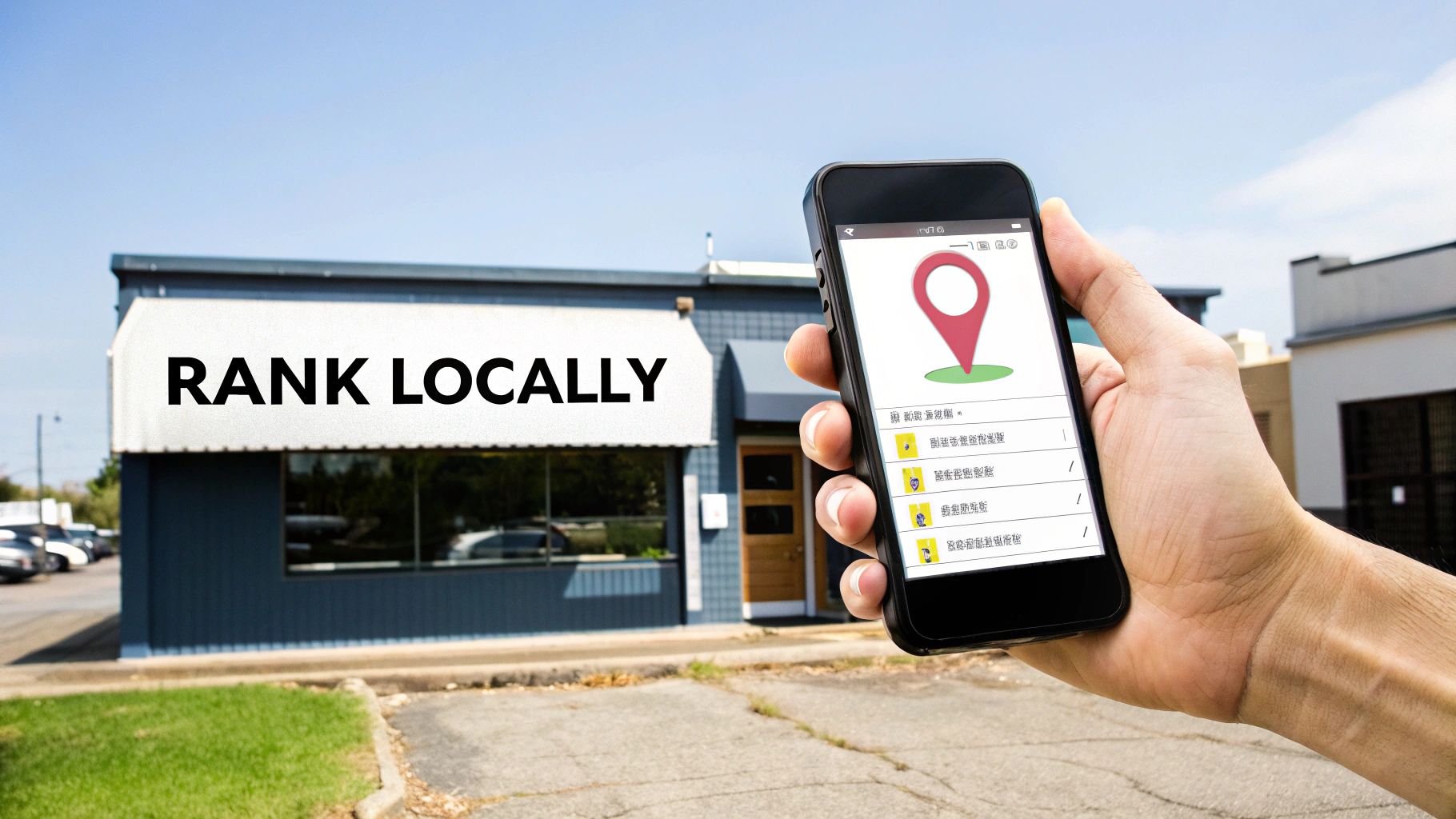
This hyper-focused approach allows you to connect directly with the highest-intent customers: those actively searching for a solution in your immediate vicinity. By appearing prominently for these searches, you build trust and establish your business as a pillar of the local community, effectively neutralizing the massive marketing budgets of larger competitors who often lack a genuine local presence.
Real-World Story
An independent pizza shop in Austin, "Tony's Slice," was being overshadowed by national chains. Tony optimized his Google Business Profile, sharing photos of his family making dough and telling the story of his grandfather's recipe. He gathered glowing local reviews. Soon, he began outranking Domino's and Pizza Hut for searches like "pizza delivery Austin" and "best pizza near me." His authentic story connected with the community, turning his small shop into a local favorite.
How to Gain a Local Competitive Advantage (GEO)
To start dominating your local market, focus on these essential GEO-optimization tactics:
- Optimize Your Google Business Profile: This is your local SEO cornerstone. Fill out every section completely. Use the "Updates" feature to tell mini-stories about your business, showcase new products, or share customer testimonials.
- Build Local Citations: Ensure your business name, address, and phone number (NAP) are consistent across key directories like Yelp, Yellow Pages, and industry-specific sites.
- Encourage and Manage Reviews: Actively request reviews from happy customers and respond professionally to all feedback, both positive and negative. This builds social proof and improves your map ranking. To dive deeper into these strategies, explore our comprehensive guide to SEO localization.
6. Higher Quality Lead Generation
SEO goes beyond just driving traffic; it excels at attracting leads who are actively searching for solutions at the precise moment they need them. Unlike disruptive advertising that targets a broad audience, SEO connects you with pre-qualified prospects who have already identified a problem and are seeking a provider. This "inbound" nature means the leads you generate are inherently higher quality, as they are driven by user intent, not interruption.
This targeted approach results in leads who are a better fit for your products or services and convert at a significantly higher rate. By answering their specific questions and addressing their pain points through optimized content, you build trust before they even make contact. This is a key reason why organic search is one of the most powerful benefits of SEO for small businesses looking for sustainable growth.
Real-World Story
A B2B software company specializing in project management tools wanted better leads. They created a blog post titled, "How a Small Agency Went from Chaos to Clarity," telling the story of a client who used their tool to manage a difficult project. By optimizing this story for "best Trello alternatives for small teams," they attracted businesses actively looking to switch platforms. The story resonated, delivering high-intent leads directly to their demo request page.
How to Generate Higher Quality Leads
To start attracting better, more qualified leads through SEO, focus on these actionable steps:
- Map Content to the Buyer's Journey: Create content for every stage, from "what is kitchen remodel cost" (awareness) to "best kitchen countertop materials" (consideration) and "kitchen remodeling contractors in [City]" (decision).
- Implement Clear Calls-to-Action (CTAs): Ensure high-traffic pages have prominent CTAs like "Get a Free Quote" or "Schedule a Consultation" to guide users to the next step.
- Use Content Offers to Capture Leads: Develop valuable resources like downloadable guides, cost calculators, or free assessments. Gate this content behind a simple form to capture lead information.
- Optimize for High-Intent Keywords: Analyze your analytics to identify which keywords bring in the best-converting leads and double down on creating content around those topics.
7. Long-Term Sustainability and Compound Growth
Unlike paid advertising, which stops delivering results the moment you turn off your budget, SEO creates a sustainable asset that generates value over the long term. Each piece of content you create and every backlink you earn acts like a small investment, building upon itself to deliver compounding returns. This consistent effort establishes a powerful competitive moat that becomes increasingly difficult for rivals to overcome, securing your market position for years to come.

This approach transforms your marketing from a recurring expense into a capital investment. As your website's authority grows, your rankings become more stable, and older content continues to generate leads and sales with minimal ongoing cost. This sustainable growth model is one of the most powerful benefits of SEO for small businesses, creating predictable revenue streams that aren't dependent on daily ad spend.
Real-World Story
A financial advisory firm published a comprehensive guide to "retirement planning for small business owners" five years ago. They invested time upfront, weaving in anonymous stories of clients who had successfully retired early. Today, that single article ranks consistently on page one, generating thousands of qualified visitors and dozens of high-value leads every month—a true testament to the compounding power of a well-told, helpful story.
How to Build Sustainable Growth
To harness the compounding power of SEO, focus on these long-term strategies:
- Invest in Evergreen Content: Create foundational guides, how-to articles, and resource pages that will remain relevant for years. Plan to update them annually to maintain freshness and accuracy.
- Systematize Link Building: Don't just acquire links sporadically. Develop an ongoing process for outreach, guest posting, and digital PR to steadily build your site's authority over time.
- Refresh High-Performing Content: Identify old blog posts that still receive traffic but have outdated information. Update statistics, add new insights, and republish them to boost their rankings and extend their lifespan.
8. Reduced Reliance on Paid Advertising and Improved Overall Marketing Efficiency
One of the most powerful long-term benefits of SEO for small businesses is achieving greater marketing independence and efficiency. By building a strong organic presence, you can significantly reduce your dependence on costly paid advertising channels like Google Ads. As your organic traffic grows into a reliable source of leads and sales, you gain the financial flexibility to reallocate your marketing budget to other critical growth areas. This strategic shift transforms your marketing from a cost center into a sustainable, self-perpetuating asset.
This diversification of traffic sources acts as a safety net for your business. Relying solely on paid ads makes you vulnerable to rising ad costs, algorithm changes, and increased competition. SEO builds a foundational layer of visibility that continues to deliver value long after an ad campaign ends, creating a more resilient and predictable marketing ecosystem.
Real-World Story
An e-commerce store that initially spent $5,000 per month on Google Shopping Ads to drive sales invested in SEO for a year. They told the story behind their products and optimized product pages. Their organic traffic now accounts for 50% of total revenue. They strategically reduced their ad spend by 40%, reallocating that $2,000 monthly budget toward developing a new product line. SEO didn't just save them money; it funded their growth.
How to Improve Your Marketing Efficiency
To leverage SEO for greater marketing efficiency, focus on these strategic steps:
- Track Channel ROI: Use analytics to clearly understand the return on investment from both paid and organic channels. This data will guide your budget allocation decisions. Learn more about how to improve your marketing ROI with Jackson Digital.
- Inform Paid Ads with Organic Data: Use insights from your top-performing organic keywords and content to create more effective, targeted paid ad campaigns with higher conversion rates.
- Gradually Shift Your Budget: As your organic rankings for key commercial terms improve, slowly decrease your ad spend on those same keywords. Keep paid ads active for highly competitive, bottom-of-funnel terms where you need immediate visibility.
8-Point Comparison of SEO Benefits for Small Businesses
| Benefit | Implementation Complexity 🔄 | Resource Requirements ⚡ | Expected Outcomes 📊⭐ | Ideal Use Cases 💡 | Key Advantages ⭐ |
|---|---|---|---|---|---|
| Increased Organic Web Traffic | 🔄 Medium — ongoing SEO work; results in 3–6 months | ⚡ Time + content creation, basic SEO tools | 📊 Steady, keyword-targeted visitor growth; higher intent conversions | 💡 Small e‑commerce, local services, niche blogs | ⭐ Cost-effective, compounding traffic; reduced CAC |
| Cost-Effective Marketing Strategy | 🔄 Low–Medium — upfront setup, then maintenance | ⚡ Primarily time/expertise; occasional tool or consultant fees | 📊 Improved ROI over time; lower long‑term CPA | 💡 Bootstrapped startups, SMBs with limited ad budgets | ⭐ High ROI vs. PPC; scalable with growth |
| Improved Brand Credibility and Authority | 🔄 Medium–High — content + link building required | ⚡ Quality content, outreach, PR and backlink investment | 📊 Enhanced trust, higher click‑through and conversion rates | 💡 Professional services, consultancies, thought leaders | ⭐ Stronger brand recognition; halo effect across channels |
| Better Understanding of Customer Intent | 🔄 Medium — continuous research & analysis | ⚡ Keyword tools, analytics, competitor audits, interviews | 📊 Clearer messaging, product fit, and content targeting | 💡 Product teams, marketers refining positioning | ⭐ Data-driven insights that reduce marketing waste |
| Competitive Advantage in Local Markets | 🔄 Low–Medium — local optimization and review management | ⚡ GMB setup, citation building, local content, review acquisition | 📊 Increased map visibility and foot/lead traffic locally | 💡 Local retailers, service providers, single‑market businesses | ⭐ Easier to outrank national competitors locally; high commercial intent |
| Higher Quality Lead Generation | 🔄 Medium — content + funnel + nurturing systems | ⚡ Landing pages, forms, CRM/automation, targeted content | 📊 More qualified, intent-driven leads with higher conversion | 💡 B2B, high‑value services, firms needing qualified prospects | ⭐ Better lead fit and lower acquisition cost per qualified lead |
| Long-Term Sustainability and Compound Growth | 🔄 Medium — requires consistent publishing & upkeep | ⚡ Ongoing content updates, link growth, strategy maintenance | 📊 Compounding traffic and authority over years; durable asset | 💡 Businesses planning multi‑year growth and valuation increases | ⭐ Sustainable competitive moat; long‑term reduced dependence on ads |
| Reduced Reliance on Paid Advertising & Improved Efficiency | 🔄 Medium — transition planning and overlap with paid channels | ⚡ Monitoring tools, integrated SEO+PPC coordination, phased budget shifts | 📊 Lower ad spend share; diversified traffic mix; better budget flexibility | 💡 E‑commerce, SaaS, agencies optimizing channel mix | ⭐ Frees budget, reduces platform risk, improves overall marketing ROI |
From Visibility to Value: Your Next Step in SEO
We've explored the significant ways SEO acts as a growth engine for small businesses. It's clear that this discipline is far more than a technical checklist for search engines; it’s a fundamental business strategy. The journey from near-invisibility to market leadership is paved with consistent, intelligent search engine optimization.
The benefits are not isolated wins. They are interconnected components of a powerful growth loop. Driving high-quality organic traffic (Benefit #1) directly leads to a more cost-effective marketing mix (Benefit #2). Building brand credibility (Benefit #3) not only fosters trust but also creates a competitive moat that is difficult for others to replicate, especially in tight local markets (Benefit #5). Each piece reinforces the others, creating a durable and scalable foundation for your business.
From Insight to Action: Making SEO Real
The true power of understanding the benefits of SEO for small businesses comes from translating knowledge into action. Many business owners see the potential but get stuck in "analysis paralysis." The key is to avoid trying to do everything at once. Instead, choose a starting point that aligns with your most pressing business need.
- If you need immediate local impact (GEO): Start with your Google Business Profile. Go through every section and optimize it completely. Begin a consistent campaign to acquire new, genuine reviews.
- If you need to build long-term authority (AEO): Identify one core question your customers always ask. Write the most comprehensive, helpful blog post on the internet that answers it.
- If you feel overwhelmed by data: Install a simple analytics tool like Google Analytics 4 and focus on one metric for 30 days, such as "Organic Users" or "Top Landing Pages."
The most important step is the first one. SEO is a long-term strategy where early efforts compound significantly over time. The story of your business's growth is written one optimization, one piece of content, and one new backlink at a time. The landscape is also constantly changing. To ensure your small business stays ahead in the evolving digital landscape, exploring the capabilities of modern SEO strategies and the tools that support them is crucial. Leveraging the best AI SEO tools to dominate search in 2025 can provide a significant competitive edge, automating research and accelerating content creation.
Ultimately, SEO empowers you to stop chasing customers and start attracting them. It connects you with people actively searching for your solutions, creating a sustainable stream of leads and sales that fuels your growth for years to come. Don't wait for the perfect moment; start building your search presence today.
Ready to turn these benefits into a measurable reality for your business? The team at Jackson Digital specializes in creating data-driven SEO strategies that drive predictable growth for small businesses. Request your free performance audit today and discover your single biggest opportunity to increase traffic and revenue.