In a competitive market, exceptional craftsmanship is no longer enough to guarantee a steady flow of high-value projects. Your potential clients are online, searching for reliable contractors, and your digital presence determines whether they find you or your competition. Succeeding requires a strategic marketing blueprint that elevates your visibility and builds unshakable trust before the first phone call even happens. This guide is designed to provide exactly that, moving beyond generic advice to deliver actionable construction company marketing ideas that generate real-world results.
We will unpack 8 proven strategies that fuse the technical precision of Search Engine Optimization (SEO) with the persuasive power of storytelling. You will learn how to dominate local search results (GEO) so clients in your service area see you first, and how to master Answer Engine Optimization (AEO) to become the definitive resource for your customers' most pressing questions. Each tactic is designed not just to help you rank higher on Google but to tell compelling stories about your work, showcasing your expertise and transforming your project portfolio into a powerful client acquisition tool.
This comprehensive listicle provides a step-by-step playbook to attract qualified leads, nurture them effectively, and convert them into profitable, long-term clients. Forget abstract theories; these are practical, implementation-focused strategies complete with examples, resource estimates, and key metrics to track your success. By the end of this article, you will have a clear, structured plan to build a marketing foundation that wins projects and establishes your company as the top choice in your market.
1. Local SEO and Google Business Profile Optimization
For construction companies, winning the local battle is everything. When a homeowner needs an emergency roof repair or a business seeks a general contractor for a new build, their first stop is a search engine. They type in "roofing contractor near me" or "commercial construction [city name]," and this is your moment to shine. Local Search Engine Optimization (GEO) is the engine that places your business at the top of these high-intent, location-based searches, making it one of the most powerful construction company marketing ideas available.
This strategy focuses on optimizing your digital presence to dominate local search results, especially the Google Maps "local pack." It’s about signaling to Google that your business is the most relevant, trustworthy, and authoritative choice for a specific service in a specific geographic area.
How to Implement This Strategy
Executing a successful local SEO campaign involves a multi-pronged approach:
- Google Business Profile (GBP) Mastery: Your GBP is your digital storefront. Fill out every single section completely: services, service areas, hours, photos, and Q&As. Regularly post updates about completed projects or company news. Most importantly, focus on generating a steady stream of positive customer reviews, as review quantity and quality are a top local ranking factor.
- On-Page Local Signals: Create dedicated service pages for each core offering (e.g., "Kitchen Remodeling in [City]") and location pages if you serve multiple distinct areas. Weave location-specific keywords naturally into your website's content, title tags, and meta descriptions. Mentioning local landmarks or neighborhood names can also strengthen these geographic signals.
- Citation Building and Consistency: A "citation" is any online mention of your company's Name, Address, and Phone number (NAP). Ensure your NAP is 100% consistent across all major directories like Yelp, Angi, and the Better Business Bureau. Inconsistent information confuses search engines and hurts your ranking potential.
Key Insight: The foundation of local SEO is consistency. Your business name, address, and phone number must be identical everywhere online, from your website to your Google Business Profile and every local directory. Even a small variation can dilute your ranking authority.
To maximize your local visibility, a data-driven guide on how to rank on Google Maps effectively is indispensable. It provides a deeper dive into the specific signals Google values most. For those looking to get started, you can learn more about the fundamentals of ranking higher in Google's local results.
2. Content Marketing with Project Portfolios and Case Studies
Your completed projects are your most powerful sales tool. Content marketing for construction companies isn't about generic blog posts; it's about transforming your finished work into compelling stories that build trust, showcase expertise, and attract ideal clients. A detailed project portfolio and in-depth case studies serve as tangible proof of your quality, moving beyond claims to provide concrete evidence of your capabilities. This strategy is central to any effective plan for construction company marketing ideas because it fuels nearly every other channel, from social media to SEO.
This approach involves systematically documenting your projects and presenting them in a structured, engaging format. By telling the story behind the build—the client's problem, your process, and the final result—you answer a potential client's biggest questions, building a narrative that resonates far more than a simple list of services.

How to Implement This Strategy
A successful content strategy is built on a repeatable process for capturing and showcasing your work.
- Systemize Project Documentation: Don't wait until the project is over. Build high-quality "before," "during," and "after" photography and videography into your project workflow from day one. Make photo permissions and testimonial requests part of your standard client agreement to streamline the process.
- Structure Compelling Case Studies: Go beyond a simple photo gallery. Structure each case study with a clear narrative: the client's initial problem or goal, your proposed solution and process, and the final result. Include quantifiable metrics where possible, such as "completed 10% under budget" or "finished 2 weeks ahead of schedule." This storytelling format is highly persuasive.
- Optimize for Search and Story: Each portfolio piece or case study is an opportunity to rank on search engines. Create a dedicated page for each project and optimize it with keywords a potential client would use, like "commercial office renovation [city]" or "custom home build [neighborhood]." Weave these terms naturally into the project description, image alt-text, and page titles to tell a story that both clients and search engines can understand.
Key Insight: Your portfolio is more than a gallery; it's a collection of problem-solving stories. Each case study should clearly articulate the client's challenge and position your company as the expert hero who delivered the perfect solution, building immense trust and credibility.
3. Paid Search (Google Ads/SEM) with Industry-Specific Keywords
While SEO is a long-term strategy for organic growth, Paid Search, also known as Search Engine Marketing (SEM), offers immediate visibility at the exact moment a potential client needs your services. By running targeted Google Ads, you can place your construction company at the very top of the search results for high-intent keywords like "emergency roof repair" or "general contractor for office build-out." This ensures you capture motivated buyers who are actively looking to hire.
This strategy complements organic efforts by guaranteeing a presence for your most profitable services. Instead of waiting to rank, you pay to appear instantly, driving qualified leads directly to your phone or website. For construction, where a single lead can be worth tens of thousands of dollars, the return on investment can be substantial, making this one of the most direct and measurable construction company marketing ideas.
How to Implement This Strategy
A successful paid search campaign requires precision, constant monitoring, and a deep understanding of your customer's search behavior.
- Structure Campaigns by Service and Location: Don't lump "kitchen remodeling" and "commercial roofing" into one campaign. Create separate campaigns for each core service and geographic area you target. This allows you to write highly relevant ad copy and landing pages, which improves your Quality Score and lowers your cost per click.
- Leverage Ad Extensions: Maximize your ad's real estate and impact. Use call extensions so mobile users can dial your number with one tap. Use location extensions to show your address and attract local clients. Sitelink extensions can direct users to specific pages like "Our Projects" or "Get a Quote," improving click-through rates.
- Implement Rigorous Conversion Tracking: You cannot manage what you don't measure. Set up conversion tracking for every lead action: phone calls from ads, contact form submissions, and quote requests. This data is critical for knowing which keywords and ads are actually generating business, allowing you to optimize your budget for maximum ROI.
Key Insight: Paid search is not a "set it and forget it" channel. The most successful campaigns involve continuous A/B testing of ad copy, ongoing keyword refinement (adding new terms and negative keywords), and bid adjustments based on performance data. Success is found in the details and the commitment to optimization.
To truly master this channel, it is essential to understand the nuances of campaign structure and bid management. Gaining a deeper understanding of managing PPC campaigns effectively can be the difference between a campaign that breaks even and one that drives significant profit.
4. Reputation Management and Review Generation System
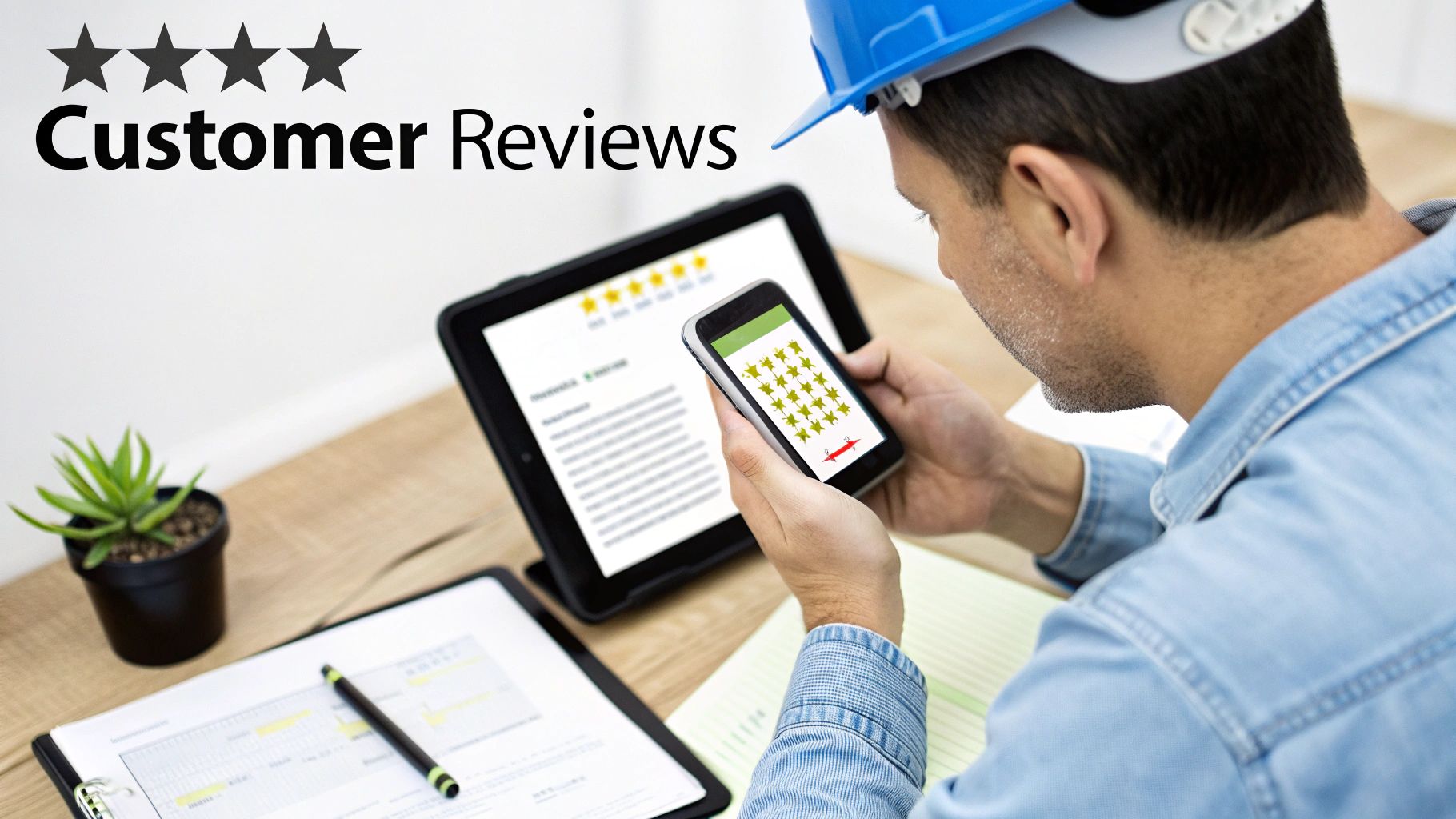
In the construction industry, trust is the foundation of every project. Before a client invests thousands of dollars, they need assurance they're hiring a reliable, high-quality company. This is where a systematic approach to reputation management becomes one of the most critical construction company marketing ideas. It’s about more than just getting a few good reviews; it's about building a powerful engine of social proof that fuels trust, improves search engine rankings, and drives qualified leads.
This strategy involves proactively generating customer reviews on key platforms like Google, Yelp, and Angi, while also monitoring your online reputation and responding to all feedback. A strong, positive review profile directly signals to both potential customers and search engines like Google that you are a top-tier choice in your local market.
How to Implement This Strategy
A successful reputation management system is proactive, not reactive. It requires a consistent process to encourage happy customers to share their stories online.
- Systemize the "Ask": Don't leave reviews to chance. Implement a process to request a review within 3-7 days of project completion, when client satisfaction is at its peak. Use a combination of SMS and email, providing direct links to your most important review profiles (like Google Business Profile) to make it as easy as possible for the customer.
- Engage with All Feedback: Respond to every single review, positive or negative, within 48 hours. Thank customers for positive feedback and address negative comments professionally. A thoughtful response to a bad review can often win over more new customers than a dozen five-star ratings, as it shows you are committed to customer satisfaction.
- Leverage Positive Reviews as SEO Content: Turn your best reviews into marketing assets. Feature glowing testimonials on your website's homepage, share them on your social media channels, and include them in sales proposals. Quote specific phrases from reviews on relevant service pages to add authentic, keyword-rich content that builds trust and boosts rankings. For a comprehensive approach, exploring dedicated reputation management services for contractors can be invaluable.
Key Insight: Don't fear negative reviews; treat them as free market research. They provide direct, unfiltered feedback on where your processes or communication can improve. Responding publicly shows accountability and a commitment to excellence.
5. Social Media Strategy (YouTube, Instagram, Facebook) with Visual Storytelling
Construction is an inherently visual industry, turning blueprints into tangible, impressive structures. A robust social media strategy allows you to translate this visual power into compelling stories that build brand trust, attract leads, and showcase your expertise. Platforms like YouTube, Instagram, and Facebook are perfect for documenting project transformations and giving potential clients a behind-the-scenes look at your craftsmanship and team culture.
This strategy moves beyond simply having a social presence; it's about using visual storytelling to create an engaged community and a portfolio that works for you 24/7. High-quality video and photo content serves as powerful social proof, humanizes your brand, and provides versatile assets that can be repurposed for your website, email campaigns, and paid advertisements.
How to Implement This Strategy
A successful visual social media campaign requires consistency and a focus on what your audience finds valuable and engaging:
- Platform-Specific Content: Tailor your content for each platform. Use YouTube for long-form project deep-dives, detailed walkthroughs, and educational "how-it's-done" videos that answer common customer questions (AEO). Leverage Instagram and Facebook for high-impact before-and-after photos, short-form video Reels showing project progress, and posts celebrating team milestones.
- Embrace Short-Form Video: Create vertical videos optimized for mobile viewing on Reels, TikTok, and YouTube Shorts. These can be quick time-lapses of a build, satisfying clips of tile being laid, or a short testimonial from a happy client. Remember that most users watch without sound, so use clear captions and text overlays.
- Consistent Posting Schedule: Aim for a minimum of 3-5 posts per week to stay relevant in social media algorithms and keep your audience engaged. A content calendar can help plan topics in advance, ensuring a steady stream of updates from different job sites and project stages.
Key Insight: Don't just show the finished product; show the process. Documenting the journey from demolition to final reveal tells a much more compelling story. This transparency builds trust and highlights the skill and hard work that goes into every project, justifying your value proposition.
6. Email Marketing and Lead Nurturing Campaigns
While many marketing efforts focus on attracting new leads, retaining and nurturing existing relationships is where significant, long-term profit is made. Email marketing is your direct line to prospects and past clients, offering the highest ROI of nearly any digital channel. For construction companies with long sales cycles and high-value projects, staying top-of-mind isn't just helpful; it's essential. This is one of the most cost-effective construction company marketing ideas for building authority and driving repeat business.
This strategy involves systematically collecting email addresses and sending targeted, valuable content to nurture leads from initial interest to a signed contract. It also keeps your brand in front of past clients, making you the first and only call for their next project or referral. It's about building a community, not just a customer list.
How to Implement This Strategy
A powerful email marketing program is built on value, segmentation, and automation:
- Build Your List with a "Lead Magnet": No one gives away their email for free. Offer something valuable in exchange, like a downloadable PDF ("The Ultimate Home Renovation Timeline") or a "Pre-Construction Project Checklist." This positions you as an expert resource from the very first interaction.
- Segment Your Audience: Don't send the same email to everyone. Group your contacts into lists like "Past Residential Clients," "Active Commercial Leads," or "Prospects Interested in Kitchen Remodels." This allows you to send highly relevant content and case study stories that resonate with each group's specific needs.
- Create Nurturing "Sequences": Automate a series of emails for new subscribers. A typical "welcome sequence" might include an initial email delivering the lead magnet, a second email introducing your company's story and values, and a third showcasing a relevant case study. This builds trust and rapport automatically.
Key Insight: The goal of email marketing is to provide so much value and expertise that when a prospect is finally ready to start a project, your company is the only one they consider. Focus 80% of your content on education and helpful tips, and only 20% on direct sales pitches.
For a deeper dive into creating automated email workflows that convert, exploring resources on drip marketing campaigns can provide a solid foundation. To understand the art of crafting compelling email content, learning about email copywriting best practices is also highly recommended.
7. Link Building and Authority Development for SEO
If local SEO is the foundation of your digital presence, link building is the steel framework that gives it strength and authority. A "backlink" is a link from another website to yours, and search engines like Google view them as votes of confidence. When a reputable industry blog, local news outlet, or trade association links to your construction company's website, it signals to Google that you are a credible and trustworthy expert in your field. This is a critical component of any serious marketing plan for construction companies.
This strategy is about earning these high-quality "votes" to build your website's Domain Authority. A higher authority score directly correlates with better search engine rankings, not just locally but for broader, more competitive terms. It's how you move from being a recognized local name to an established industry leader online.
How to Implement This Strategy
A successful link-building campaign focuses on quality and relevance over sheer quantity. It's a long-term investment in your brand's digital reputation.
- Create "Linkable" Assets: Develop content that others will want to link to naturally. This could be a detailed guide on "Choosing the Right Materials for a Kitchen Remodel in [Your State]," an original infographic about local building permit trends, or a comprehensive case study of a major commercial project you completed. These assets help you become the answer (AEO) to industry questions.
- Strategic Outreach and Guest Posting: Identify relevant industry blogs, home improvement websites, or real estate publications and offer to write a guest article for them. For example, a roofing company could pitch an article about "5 Signs of Storm Damage Homeowners Miss" to a local real estate blog, including a link back to their own site in the author bio.
- Leverage Local and Industry Associations: Join your local Chamber of Commerce, the National Association of Home Builders (NAHB), or other trade-specific organizations. Most of these groups have member directories that provide a high-quality, geographically relevant backlink and also serve as a referral source.
Key Insight: The most powerful backlinks come from websites that are both topically relevant (construction, home improvement, real estate) and geographically relevant (local news, city directories, community blogs). One link from a major industry publication is worth more than a hundred low-quality, irrelevant links.
To learn more about identifying valuable link opportunities, you can explore Ahrefs' beginner-friendly guide to link building. For a deeper dive into content-led strategies, Backlinko offers an excellent resource on creating linkable assets.
8. Conversion Rate Optimization (CRO) and Landing Page Testing
Driving traffic to your website is only half the battle. If visitors arrive but don’t take action, your marketing investment is wasted. Conversion Rate Optimization (CRO) is the systematic process of improving your website and landing pages to increase the percentage of visitors who become a lead. This means getting more calls, form submissions, and quote requests from the same amount of traffic, making it a high-impact construction company marketing idea.
This strategy moves beyond simply attracting visitors and focuses on their on-site experience, using data to understand their behavior and remove friction points. By methodically testing changes to headlines, calls-to-action, and even the stories you feature, you can transform your website from a digital brochure into a powerful lead-generation machine.

How to Implement This Strategy
A successful CRO program is built on continuous testing and data analysis. The goal is to make informed decisions, not just guesses, about what your potential customers want to see.
- Establish a Baseline: Before you change anything, you must know your starting point. Use analytics to identify your current conversion rate (e.g., number of form fills divided by total page visitors). This baseline will be your benchmark for measuring success.
- Hypothesize and A/B Test: Identify a single element to change based on user behavior data (like heatmaps) or a strong hypothesis. For example, a remodeler might test a testimonial-focused headline against one that emphasizes a "Free Design Consultation." You then create two versions of the page (A and B) and split traffic between them to see which story performs better.
- Analyze and Iterate: Run tests long enough to achieve statistical significance (usually a few weeks or a minimum of 100 conversions). Once a winner is declared, implement the winning variation for all traffic. The key is to then move on to the next test, constantly seeking incremental improvements. For example, after finding the best headline, you could test the button's color or placement.
Key Insight: Start your CRO efforts on your highest-traffic pages. A 1% conversion lift on a page that gets 5,000 visitors per month is far more impactful than a 10% lift on a page that only gets 100. This approach maximizes your return on effort and provides data faster.
To get a comprehensive overview of how to build a testing roadmap and analyze results, you can explore these detailed conversion rate optimization best practices for a deeper dive.
Construction Marketing: 8-Strategy Comparison
| Strategy | 🔄 Implementation Complexity | ⚡ Resource Requirements & Speed | ⭐ Expected Outcomes | 📊 Ideal Use Cases | 💡 Key Advantages / Tips |
|---|---|---|---|---|---|
| Local SEO and Google Business Profile Optimization | Medium — ongoing citation audits & GBP management | Low–Medium effort; slow to compound (3–6 months) ⚡ | ⭐⭐⭐⭐ High local visibility and qualified, high-intent leads | Service-area contractors; multi-location businesses targeting map pack | 💡 Audit NAP consistency; prioritize review management and local links |
| Content Marketing with Project Portfolios and Case Studies | Medium–High — requires storytelling, permissions, and production | High time and creative resources; slow organic payoff ⚡ | ⭐⭐⭐⭐ Builds credibility, long-tail traffic, and sales enablement | Contractors with visual projects (remodels, restorations) | 💡 Use measurable case studies; require client sign-off and quarterly updates |
| Paid Search (Google Ads/SEM) with Industry-Specific Keywords | Medium — ongoing bid and copy optimization | High budget & management; immediate visibility ⚡ | ⭐⭐⭐ Immediate, measurable lead generation while running ads | Emergency services, seasonal demand, high-intent queries | 💡 Segment campaigns by service, enable call extensions, track conversions |
| Reputation Management and Review Generation System | Medium — process-driven setup and monitoring | Low–Medium tools/process; effects build as reviews accumulate ⚡ | ⭐⭐⭐⭐ Improves CTR, local rankings, and trust with recent positive reviews | Local businesses competing on trust and ratings | 💡 Request reviews 3–7 days post-job, respond to all within 48 hrs |
| Social Media Strategy (YouTube, Instagram, Facebook) with Visual Storytelling | Medium–High — consistent creative output and community management | Medium–High production resources; organic reach is slow without ads ⚡ | ⭐⭐⭐ Increases brand awareness, engagement, and repurposable assets | Visual project portfolios, recruiting, brand-building campaigns | 💡 Post consistently (3x/week), prioritize vertical video and captions |
| Email Marketing and Lead Nurturing Campaigns | Medium — setup automation and segmentation | Low–Medium ongoing effort; high ROI; effective over sales cycles ⚡ | ⭐⭐⭐⭐ High ROI, stronger lead nurturing and repeat business | Long sales-cycle services; past customers and leads | 💡 Use segmented welcome flows, lead magnets, and clear CTAs |
| Link Building and Authority Development for SEO | High — outreach, content creation, and relationship-building | Medium–High effort; slow, long-term impact ⚡ | ⭐⭐⭐⭐ Long-term ranking and referral traffic gains (top-3 ranking factor) | Businesses aiming to improve organic domain authority | 💡 Create linkable assets, prioritize quality over quantity, monitor backlinks |
| Conversion Rate Optimization (CRO) and Landing Page Testing | Medium — iterative testing and analytics setup | Medium tools and technical setup; tests need traffic and 1–2+ weeks ⚡ | ⭐⭐⭐ Improves lead volume/quality without increasing traffic | Sites with steady traffic (ads/SEO) seeking better ROI | 💡 Test one element at a time, start on high-traffic pages, use heatmaps |
From Blueprint to Reality: Executing Your Growth Strategy
We’ve laid out a comprehensive blueprint covering a wide range of powerful construction company marketing ideas, from mastering local SEO to telling compelling visual stories on social media. The foundation is set, but the real work begins now. Executing these strategies is what separates a company that survives from one that truly thrives and dominates its local market.
The central theme connecting every tactic, from Google Business Profile optimization to building a stunning project portfolio, is the dual need for technical precision and authentic storytelling. Ranking on search engines is a science; it requires understanding algorithms, keywords, and authority signals. But connecting with a potential client, earning their trust, and convincing them you're the right builder for their dream project is an art. Your marketing must do both.
Integrating Your Marketing Toolkit
The most significant takeaway should be this: these marketing ideas are not isolated tactics to be tried one at a time. They are interlocking components of a single, powerful growth engine.
- Your Project Portfolios are not just website content; they are the fuel for your social media channels, the visual proof in your email newsletters, and the cornerstone of your case studies that answer key customer questions.
- Strong Local SEO and a perfectly optimized Google Business Profile don't just exist in a vacuum; they drive targeted, high-intent traffic directly to the landing pages and portfolios you’ve meticulously built.
- A Proactive Review Generation System builds the social proof that supercharges every other channel. Those five-star reviews make your Google Ads more credible, your social media posts more trustworthy, and your website CTAs more persuasive.
Think of it like a well-run job site. The framers, electricians, and plumbers must work in a coordinated sequence for the project to succeed. Similarly, your content marketing efforts must support your SEO goals, and your paid search campaigns should be informed by the data you gather from your website's conversion rate optimization tests. This integrated approach creates a powerful flywheel effect where each component makes the others more effective, maximizing your return on investment.
From Ideas to Actionable Next Steps
Reading this list is the easy part. The challenge is implementation. To avoid feeling overwhelmed, start by focusing on the foundational elements that provide the biggest immediate impact.
- Audit Your Foundation: Before you spend a dollar on ads, conduct a thorough audit of your digital presence. Is your Google Business Profile complete and accurate? Is your website mobile-friendly and easy to navigate? Fix the cracks in your foundation first.
- Choose Your "One Thing": Pick one high-impact area to master this quarter. If you get a lot of referral business but have no online visibility, make Local SEO (GEO) your top priority. If your website gets traffic but few leads, focus intensely on Conversion Rate Optimization.
- Commit to Storytelling: Begin documenting every project with high-quality photos and videos. Even if you don’t have a full content strategy yet, gathering these assets is critical. Start telling the human story behind the build: the client's problem, your innovative solution, and the incredible final result. This is how you move from being a commodity to becoming a sought-after brand.
Ultimately, mastering these construction company marketing ideas is about building a predictable and sustainable pipeline of high-quality leads. It's about taking control of your company's growth, ensuring your crews stay busy, and allowing you to be more selective about the projects you take on. By blending the technical precision of search engine optimization with the art of brand storytelling, you are not just marketing your business; you are building an asset that will pay dividends for years to come.
Building a comprehensive, integrated marketing system takes specialized expertise and dedicated resources. If you want a partner to help design and execute a strategy that combines data-driven SEO with compelling creative, Jackson Digital offers industry-specific playbooks tailored for construction companies. Request a free performance audit at Jackson Digital to see where your biggest opportunities lie and start turning these ideas into your next big project win.