A data-driven digital marketing agency is one that uses hard numbers and performance analytics—not just gut feelings—to build and execute its strategies. They’re experts at turning raw data into compelling customer stories, creating campaigns that deliver a measurable return on investment (ROI). It's the only way to consistently rank higher and truly connect with the right audience.
Moving Beyond Guesswork in Digital Marketing
Forget marketing based on hunches. Think about it like this: would you rather navigate a cross-country road trip with an old paper map or a live GPS? The map gives you a general direction, sure. But the GPS uses real-time data—traffic jams, road closures, and faster routes—to guide you precisely where you need to go. A data-driven digital marketing agency is that advanced GPS for your business.
This data-first mindset is no longer a luxury; it’s a necessity. The global digital marketing market was pegged at roughly $667 billion in 2024 and is on track to blow past $900 billion by 2025. This explosive growth is driven by a massive budget shift, with 60–70% of total ad spend now flowing into digital channels.
That kind of spending puts immense pressure on brands. You have to find a partner who can justify every single dollar with cold, hard proof of its impact. If you want the full picture of this industry boom, you can dig into more digital marketing statistics here.
What Does "Data-Driven" Actually Mean?
At its core, being "data-driven" means every single decision is backed by evidence. It’s about answering critical business questions with numbers, not opinions. Instead of guessing which ad headline will perform best, a data-driven agency A/B tests multiple versions to find a clear winner. Instead of just assuming who their target audience is, they dive into user behavior analytics to build precise customer profiles.
This process involves using data to:
- Understand Customer Intent: Pinpoint exactly what your audience is searching for and why, so you can create content that directly answers their questions.
- Optimize for Search Engines: Fuel powerful strategies for SEO (Search Engine Optimization), GEO (local search), and AEO (Answer Engine Optimization) to dominate the rankings.
- Tell Compelling Stories: Use insights from analytics to craft messages that genuinely resonate with your ideal customers, turning clicks into conversions.
- Prove Campaign Value: Connect every marketing action—from a blog post to a PPC ad—directly to business outcomes like leads, sales, and revenue.
In short, a data-driven agency doesn’t just launch campaigns and hope for the best. They build a constant feedback loop. Performance data from today's campaigns continuously informs and improves tomorrow's strategies, creating a powerful cycle of predictable growth.
Let's break down the fundamental shift in thinking. The old way of doing things just doesn't cut it anymore.
Traditional Marketing vs. Data-Driven Marketing
| Aspect | Traditional Marketing Agency | Data-Driven Digital Marketing Agency |
|---|---|---|
| Strategy | Based on intuition, past experience, and broad demographic assumptions. | Built on real-time analytics, user behavior data, and predictive modeling. |
| Execution | "Set it and forget it" campaigns. A single creative is launched and runs its course. | Iterative campaigns. Constant A/B testing and optimization based on live performance data. |
| Targeting | Broad segments like "women aged 25-40." | Hyper-specific audiences based on search history, online behavior, and purchase intent. |
| Measurement | Focuses on vanity metrics like impressions, reach, or brand awareness surveys. | Measures what matters: Cost Per Acquisition (CPA), Return on Ad Spend (ROAS), and Lifetime Value (LTV). |
| Reporting | Monthly reports showing surface-level activity. | Live dashboards and detailed performance reports that tie marketing spend directly to revenue. |
| ROI | Difficult to calculate and often estimated. | Clear, defensible, and directly attributable to specific campaigns and channels. |
As you can see, the difference is night and day. One approach relies on guesswork, while the other is built on a foundation of verifiable proof.
This guide will pull back the curtain on how these agencies work, what makes them so effective, and how to spot a true data expert from someone just throwing around buzzwords. We’ll explore the tools, tactics, and mindset that turn raw information into tangible results, like a higher ROI and a stronger, more loyal customer base.
The Four Pillars of a Data-Driven Strategy
To turn a pile of raw numbers into a winning strategy, a data-driven digital marketing agency needs a powerful engine. This engine is built from four interconnected parts—think of it as the ultimate toolkit for turning insights into real-world action.
When these four pillars work together, they create a system that doesn't just help you rank on search engines. It helps you tell stories that connect with your audience on a much deeper level. Each pillar answers a fundamental marketing question, moving your strategy from confusion to clarity.
This concept map shows how a central hub of data directly fuels every branch of a modern search strategy, including SEO, GEO (local search), and AEO (answer engine optimization).
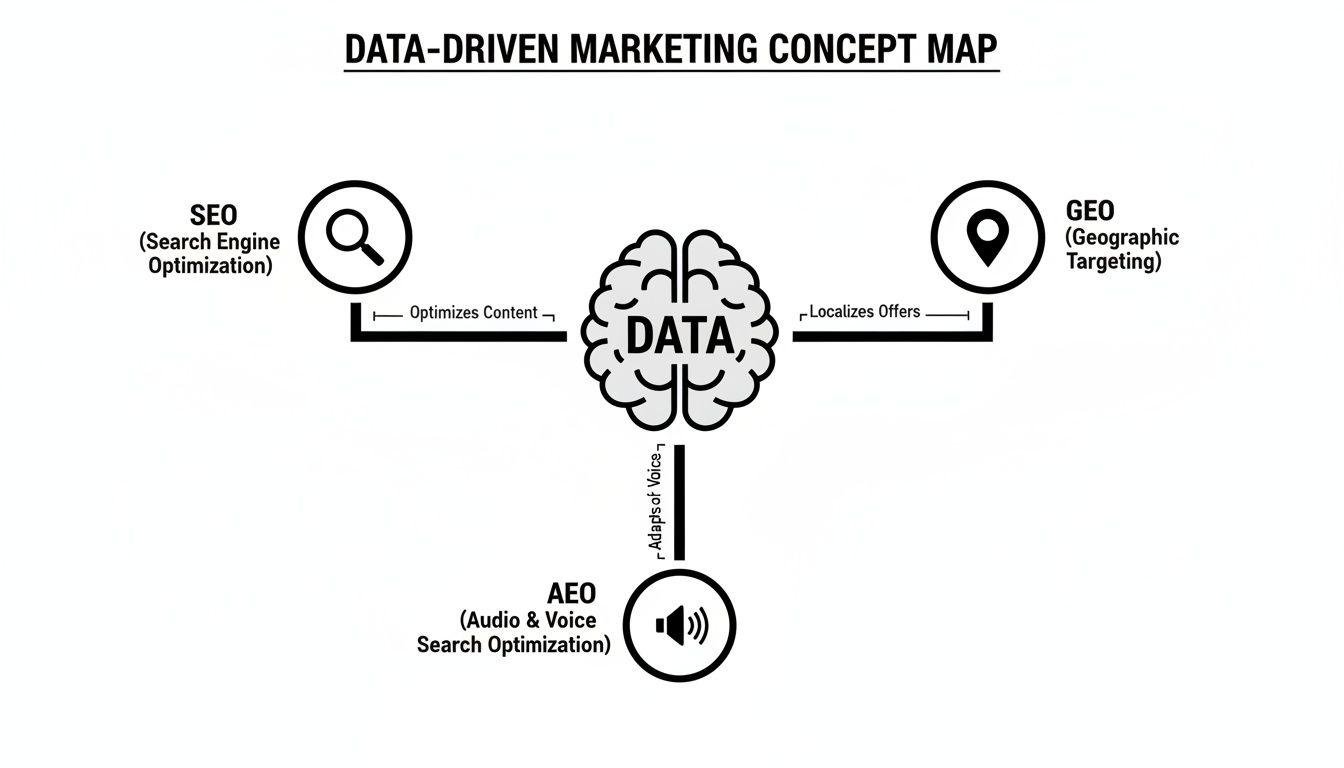
As you can see, without a solid foundation in data, your efforts in search are disconnected and just plain less effective.
Pillar 1: Analytics and Measurement
The first pillar, Analytics & Measurement, answers a simple question: "What is happening?"
Think of this as the dashboard in your car. It gives you all the essential, real-time info you need: your speed, your fuel level, and whether the engine is running hot. Without it, you’re just driving blind.
In marketing, this means taking the flood of raw clicks, impressions, and visits and turning it into clear business intelligence. It’s all about tracking the key performance indicators (KPIs) that really show the health of your campaigns.
This isn’t just about collecting numbers; it’s about giving them context. Knowing you had 10,000 website visitors is one thing. But knowing that 70% of them came from a single blog post and that those visitors convert at twice the average rate? Now that's a story you can act on. This pillar provides the foundational facts for every other decision you make.
Pillar 2: A/B Testing and Experimentation
Once you know what is happening, the next logical question is, "Why is it happening?" This is where A/B Testing & Experimentation comes into play.
If analytics is your car’s dashboard, experimentation is like testing different routes on your GPS to find the fastest one. You form a hypothesis—"I think this road is faster"—and then you test it.
A true data-driven agency applies this same scientific method to your campaigns. Instead of guessing which ad copy, headline, or call-to-action button will work best, they test them.
- Version A: "Buy Now and Save 20%"
- Version B: "Get 20% Off Your Order Today"
By showing each version to a different segment of your audience, you can see which one actually generates more clicks or sales. This process replaces assumptions with cold, hard proof, confirming which messages truly resonate with your customers.
A culture of experimentation means you’re always learning and always improving. You stop debating opinions in meetings and start letting your customers' behavior tell you what works.
Pillar 3: Attribution Modeling
The third pillar, Attribution Modeling, tackles the crucial question, "How did they get here?"
A customer’s journey is rarely a straight line. They might see a Facebook ad, read a blog post a week later, get an email, and then finally make a purchase after a Google search. So, which touchpoint gets the credit?
Attribution is the process of mapping that entire journey and assigning value to each step along the way. It’s like reviewing the game tape after a touchdown; you see the initial pass, the key block, and the final run into the end zone. Every action was critical to the final score.
Without proper attribution, you might mistakenly slash the budget for a channel that plays a vital early role, simply because it doesn't get that final click. A sophisticated data-driven agency uses attribution to understand the full customer story, making sure every marketing dollar is invested wisely.
Pillar 4: Conversion Rate Optimization
Finally, Conversion Rate Optimization (CRO) focuses on the most important question of all: "How can we improve this?"
This pillar takes all the insights from the other three and puts them into action, fine-tuning your marketing engine for maximum efficiency. It’s about making systematic, data-backed improvements to your website and landing pages to turn more visitors into actual customers.
If your analytics show a high bounce rate on a key page, CRO is the process of figuring out why and fixing it. This could involve A/B testing a new layout, simplifying a form, or clarifying your value proposition. Even tiny changes, like tweaking a button color or headline, can lead to significant jumps in conversions. It’s the final, critical step that ensures all your hard-earned traffic translates into tangible business growth.
Actionable Playbooks for SEO, GEO, and AEO
Data is just a pile of numbers until you do something with it. This is where a data-driven digital marketing agency really shines—turning raw analysis into practical, story-driven playbooks designed to dominate search rankings. These aren't just checklists. Think of them as strategic roadmaps, built from a deep understanding of what your audience actually wants and how they look for it online.

These playbooks are the "how-to" guides for getting your business found. They translate complex analytics into clear, repeatable steps for winning in three crucial areas of search: SEO (Search Engine Optimization), GEO (Geographic Engine Optimization), and AEO (Answer Engine Optimization).
Let's break down how data fuels each one.
The Modern SEO Playbook: Uncovering User Intent
Old-school SEO was all about cramming keywords onto a page and hoping for the best. The modern, data-driven approach is a whole lot smarter. It’s about understanding the story behind a search query. Why did someone type that phrase? What problem are they trying to solve right now?
A data-driven agency starts by digging into user search data, not just isolated keywords. We look at query patterns, click-through rates on different types of results, and the "People Also Ask" sections to build a complete picture of what a user is really looking for.
Mini Case Study: A National Ecommerce Brand
Imagine a national ecommerce brand selling running shoes. A surface-level strategy would be to just target the term "best running shoes." But the data tells a much deeper story. Search queries show people are also looking for "best running shoes for flat feet," "running shoes for marathon training," and "how to choose running shoes online."
- Actionable Playbook: Instead of one generic page, the agency builds a complete content hub. This includes a detailed guide on choosing shoes for different foot types, a training plan that links to marathon-specific shoes, and even an interactive quiz to help users find their perfect fit.
- The Result: By answering these specific, intent-driven questions, the brand starts attracting highly qualified traffic. They're no longer just competing on a generic term; they're owning the niche conversations their customers are having. This leads directly to higher rankings and, more importantly, more sales. This is a core function of a top-tier data driven digital marketing agency.
The GEO Playbook: Winning the Local Market
For any business that serves a specific geographic area, GEO is everything. This goes way beyond just setting up a Google Business Profile. It's about telling a powerful local story, and data is your narrator.
We use location data to figure out how customers search for services in a specific city or even a neighborhood. This involves analyzing "near me" search trends, seeing how competitors are performing in the map pack, and digging into local review sentiment. The goal is to prove to Google that you are the most relevant, authoritative answer for a local search.
Data reveals the unique language of a local market. A plumber in Miami might see searches for "emergency AC and plumbing," while one in Seattle sees "pipe winterization services." This data dictates the content and service pages you create.
Mini Case Study: A Local Service Business
Let's take a roofing company in Denver. Data analysis shows a huge spike in searches for "hail damage roof repair" and "roof inspection after storm" between April and September. The data also reveals that customers in the Highlands neighborhood frequently mention "historic home roof repair" in their online reviews and search queries.
- Actionable Playbook:
- Seasonal Content: Create and promote a detailed guide on identifying hail damage, pushing it hard during storm season.
- Hyper-Local Landing Pages: Develop a specific service page for "Highlands Historic Roof Repair," showcasing testimonials and project photos from that exact area.
- Google Business Profile Optimization: Update posts weekly with photos of recent local jobs and pre-populate the Q&A section with answers about hail damage and insurance claims.
- The Result: The roofer now ranks in the top 3 of the local map pack for high-value, seasonal keywords. They've become the go-to expert for a specific, profitable niche within their service area—all because they listened to what the local data was telling them.
The AEO Playbook: Capturing Voice and Answer Traffic
AEO, or Answer Engine Optimization, is the game plan for ranking in a world of voice assistants and featured snippets. Search engines like Google aren't just lists of links anymore; they're answer providers. Data is what helps you become the source of those answers.
This playbook is all about analyzing the common questions your audience asks. We use tools to scrape "People Also Ask" boxes, online forums, and even customer service logs to find the exact phrasing people use when they speak their searches aloud. The strategy is to structure your content to directly answer these questions in a clear, authoritative way. To truly master the nuances of AI-driven search, a deep dive into Answer Engine Optimization (AEO) is indispensable for crafting effective playbooks.
By formatting content with clear headings, bulleted lists, and FAQ sections, you make it incredibly easy for search engines to pull your content directly into a featured snippet or use it as a voice search response. This data-backed approach puts your brand front and center at the user's exact moment of need.
Measuring Success with Metrics That Matter
Impressions and social media likes feel good, but they don't pay the bills. A real data-driven digital marketing agency knows the difference between looking busy and actually driving growth. We cut straight through the noise of these "vanity metrics" to focus on the numbers that prove a return on your investment.
Success isn't about bragging rights; it's about revenue.

This is where the conversation shifts from clicks to customers. Instead of just showing you a chart of website traffic, we tell the financial story of your marketing—a story written with metrics that connect every single action directly to your bottom line.
The Three Core Business Metrics
To truly get a handle on how your campaigns are performing, you have to master three foundational metrics. They work together, giving you a complete picture of your marketing's financial health by showing you not just what you're spending, but what you're earning back.
-
Customer Acquisition Cost (CAC): Simply put, this is what it costs you in sales and marketing dollars to land one new customer. The lower your CAC, the more efficient your machine.
-
Customer Lifetime Value (LTV): This is the total amount of money you can expect to earn from a single customer over the entire time they do business with you. A high LTV is the sign of a healthy, profitable customer base.
-
Return on Ad Spend (ROAS): For every dollar you put into advertising, how much revenue do you get back? That's your ROAS. A high number here means your ad campaigns are hitting the mark.
These aren't just numbers to plug into a spreadsheet. They tell a dynamic story about your company's growth engine. The ultimate goal is to get to a place where your LTV is consistently higher than your CAC.
Think of it this way: If you spend $100 to acquire a new customer (your CAC) but that customer only ever spends $80 with you (their LTV), your business is losing money with every "successful" conversion. The goal is to lower your CAC while simultaneously increasing your LTV.
Connecting Actions to Revenue
So, how do you trace a specific SEO campaign or a single paid ad all the way back to these big-picture business metrics? It comes down to meticulous tracking and completely transparent reporting. Every marketing action must have a clear, measurable outcome tied directly to revenue.
Done right, the results are powerful. Agencies using advanced analytics can deliver an average year-over-year campaign performance boost of 10–30%. For e-commerce brands, that translates into A/B testing that can increase ROAS between 1.2x and 2.5x. At the same time, unified measurement can slash wasted ad spend by up to 40% by showing you exactly what’s working and what isn’t.
A Real-World Performance Report Example
Let's walk through what this looks like in a real performance report. Imagine a local HVAC company invests in a geo-targeted Google Ads campaign.
- Initial Data Points: The campaign spends $5,000 and generates 250 phone calls.
- Tracking and Qualification: Call tracking software kicks in, revealing that of those 250 calls, 50 were qualified leads (homeowners asking for a quote on a new AC unit).
- Connecting to Sales: The HVAC company’s CRM data shows that 10 of those leads became paying customers.
- Calculating the Metrics:
- CAC: The total ad spend ($5,000) divided by the number of new customers (10) equals a CAC of $500. You can play with your own numbers using our customer acquisition cost calculator.
- LTV: The average new AC installation is worth $6,000 to the business.
- ROAS: The total revenue generated ($6,000 x 10 customers = $60,000) divided by the ad spend ($5,000) equals a ROAS of 12x.
This report tells a crystal-clear story: for every $1 the business spent, it got $12 back. This is the kind of clarity that empowers smart decisions about where to put your marketing budget next. To get more granular on the formulas, you might want to explore how to calculate marketing ROI.
How to Choose the Right Agency Partner
Picking the right agency is easily one of the most critical decisions you'll make for your business. The right partner can pour fuel on your growth, while a bad fit will burn through your budget, time, and valuable opportunities. To find a true data driven digital marketing agency, you have to look past the slick sales deck and really dig into how they work.
It's about asking the tough questions—the ones that peel back the curtain on their processes, their team's real-world expertise, and the results they've actually delivered. This isn't about playing "gotcha." It's about making sure their approach is built to hit your specific goals, whether that's dominating search results or telling a brand story that connects.
Key Evaluation Criteria for Agencies
Before you even hop on a discovery call, you need a checklist. Think of it like a pre-purchase inspection for a high-performance car; you're not just kicking the tires, you're looking under the hood to see what it's really made of.
Focus your evaluation on these four core areas:
- Technology Stack: What tools are they actually using to gather, analyze, and report on data? You should hear names like Google Analytics 4, SEMrush, and Looker Studio. An agency that can't show you its tech stack is essentially flying blind.
- Team Expertise: Is the team made up of actual data analysts, conversion strategists, and technical SEO pros, or is it just a room full of account managers? Ask them to break down who, specifically, will have their hands on your account.
- Reporting Transparency: Ask to see a sample report. A real data-driven partner will give you reports that are clear, actionable, and tie every single marketing dollar to meaningful business outcomes like leads and revenue—not just fluff metrics like clicks and impressions.
- Proven Case Studies: Can they show you measurable, bottom-line results for businesses similar to yours? You want to see case studies that lay out the initial challenge, the data-backed strategy they rolled out, and the specific, quantifiable results they achieved.
There’s a massive skills gap out there. Reports show that 60–70% of marketing teams feel their agency partners lack the necessary analytics and data engineering skills. For clients, the top three must-haves are now advanced measurement, privacy-first data strategies, and AI-driven personalization. This just goes to show how critical it is to vet potential partners carefully. You can find more insights about these digital marketing skills gaps on businessresearchinsights.com.
Questions That Reveal True Data Expertise
Once you've got a shortlist, it's interview time. Canned questions get canned answers. If you want to find out who really walks the walk, you have to ask questions that test their problem-solving chops and their commitment to evidence-based marketing.
Here are a few powerful questions to get the ball rolling:
1. "How do you approach attribution modeling in a cookieless world?"
This question cuts right to the chase. It tests whether they're up-to-date on modern privacy challenges and can still track a customer journey without old-school third-party cookies. A good answer will immediately pivot to first-party data strategies and things like server-side tracking.
2. "Describe a time an experiment or A/B test failed. What did your team learn from it?"
A great agency doesn't hide its failures; it learns from them. This question reveals their culture around testing and iteration. You're listening for an answer that focuses on the insights they gained and how it made their next test smarter, not one that makes excuses.
A partner who can't talk about their failures probably hasn't run enough experiments to have any real successes. Data-driven marketing is a process of learning, and learning involves testing hypotheses that don't always pan out.
3. "Walk me through how you would diagnose a sudden drop in organic traffic for a client."
This is where you see if they have a process or just a playbook of guesses. A strong answer will sound methodical. They should talk about checking Google Search Console for penalties, digging into keyword ranking changes, running a technical SEO audit, and analyzing what competitors are doing. It proves they follow the data to find the root cause of a problem instead of just throwing solutions at the wall.
Ready to Start Your Own Data-Driven Growth Journey?
So now you see what a truly data-driven approach looks like. It's time to put all that theory into action. Here at Jackson Digital, we don’t just stare at spreadsheets; we use your data to tell your brand’s unique story and drive real, measurable growth—especially when it comes to SEO, GEO, and AEO.
This isn’t about chasing vanity metrics. It’s about turning raw insights into a clear narrative that helps you climb the rankings and genuinely connect with the people you want to reach. Our whole philosophy boils down to blending hard data science with smart, creative strategy. We believe in showing our work and proving our value every step of the way, making us the kind of data-driven digital marketing agency you can actually trust.
Your Path to Measurable Results
We have a clear, no-nonsense plan to get you from where you are to where you want to be. It starts with a deep dive into your data to find hidden opportunities and continues with relentless optimization to keep you ahead.
- Initial Data Audit: First things first, we dig deep into your current performance. We’re looking for the quick wins and long-term growth opportunities that most agencies completely miss.
- Custom Strategy: Armed with those insights, we build a playbook specifically for your business. No cookie-cutter solutions here. We focus on the exact SEO, GEO, and AEO tactics that will move the needle for you.
- Transparent Reporting: You get reports that make sense. No confusing jargon, just a clear line connecting every action we take directly to your bottom line. You'll see the ROI, plain and simple.
A data-driven strategy isn't about guesswork; it's about building a predictable engine for growth. By focusing on metrics that matter, we help businesses rank higher on search engines and turn visibility into profit.
Ready to find out what your data has been trying to tell you all this time?
It’s time to stop guessing and start growing. Let's work together to uncover the stories hidden in your numbers and finally put you on the path to predictable, scalable success.
Have Questions? We Have Answers.
Stepping into the world of data analytics and digital marketing can feel a bit like learning a new language. It's natural to have questions. Here are some of the most common ones we hear from businesses thinking about partnering with a data-driven digital marketing agency.
What’s the First Thing You’ll Do?
Before we touch a single campaign, we start with a deep-dive data audit. It’s the only way to fly. We need to get under the hood and understand exactly what’s happening with your current performance before we can map out a strategy for SEO, GEO, or AEO.
This isn't just a quick glance, either. We're talking about a thorough analysis of your website traffic, conversion rates, and existing customer data. This process gives us a clear baseline and often uncovers hidden opportunities for growth and better storytelling right from the get-go.
How Long Until I See Real Results?
This is the big question, and the honest answer is: it varies. But one thing is certain—it’s not an overnight fix.
For things like SEO and content marketing, you're building a long-term asset. It usually takes about three to six months to see meaningful traction in your rankings and organic traffic. Paid media campaigns, on the other hand, can start delivering results much faster, often within the first month. A good agency will be upfront about this, setting clear expectations and a realistic timeline based on your specific goals.
The goal is sustainable growth, not just a temporary spike in traffic. Building a strong foundation through data-driven SEO and content creates long-term assets that continue to deliver value over time, helping you rank consistently.
How Does Data Actually Help with Local SEO?
Data is the absolute engine for effective local SEO (or GEO, as we sometimes call it). An agency worth its salt will analyze local search trends, see how your competitors are ranking in the map pack, and dig into customer review data to build a strategy that’s laser-focused on your community.
For instance, the data might show that customers in a specific neighborhood are all searching for "emergency roof repair." That’s our cue to create a dedicated landing page that speaks directly to that urgent need. This data-backed approach ensures you’re telling the right story to the right local audience, every time.
Is My Business Too Small for This?
Not a chance. In fact, you could argue a data-driven approach is even more critical for small businesses working with tight budgets.
When you use data to inform every decision, you ensure every single dollar is spent as efficiently as possible on the marketing activities most likely to drive revenue. It completely eliminates the guesswork and maximizes your return on a smaller investment, making it the perfect fit for a business of any size looking to grow smarter, not just bigger.
Ready to stop guessing and start growing with a strategy built on proof? Jackson Digital uses data to tell compelling brand stories and deliver measurable results. Let's uncover what your data is trying to tell you. Request your free performance audit today.