So, what exactly is a data-driven marketing agency? Think of them as a strategic partner who swaps guesswork for hard evidence. They dive into your customer data and analytics to make smart, informed decisions that lead to real, measurable growth. It's about turning all those raw numbers from your website, ads, and sales funnels into a crystal-clear roadmap for winning more customers—profitably.
This entire approach is built on a simple premise: evidence over intuition. It ensures every dollar in your marketing budget is put to its best possible use.
Moving Beyond Guesswork to Data-Driven Growth
Ever find yourself staring at a pile of marketing reports, just guessing what to do next? You're definitely not alone. Too many businesses get caught in the "spray and pray" trap—a costly cycle that burns through budgets and delivers fuzzy, unpredictable results at best. The alternative is a much more methodical, almost scientific, approach to growing your business.
Imagine your marketing operating less like a traditional ad campaign and more like a growth laboratory. That's the core idea behind working with a data-driven marketing agency. They connect every single action to a measurable outcome, transforming abstract numbers into a reliable plan for boosting your revenue.
The Power of Informed Decisions
The biggest win here is making decisions with confidence. Instead of just wondering if a campaign worked, you'll know exactly why it worked and how to do it again. This shift is a game-changer for any business, whether you're a local service provider trying to own your city or a national e-commerce brand ready to scale up.
A true data-driven partner helps you:
- Really Understand Your Customers: They analyze behavior to uncover what truly motivates your audience to click, call, or buy.
- Tell Brand Stories That Stick: They use insights from search data (SEO) and user engagement to craft messages that actually resonate with people and help you rank higher.
- Get Predictable Results: The focus shifts to the metrics that actually matter, like generating more qualified leads and driving down your customer acquisition costs.
The goal is to move from reactive marketing—constantly putting out fires—to a proactive strategy. By analyzing past performance and spotting future trends, you can get ahead of customer needs and jump on market opportunities before your competitors even see them coming.
From Raw Data to a Clear Roadmap
So how does it work? The process kicks off by bringing all your data sources together. An expert agency will pull in information from your website analytics, ad platforms like Google and Facebook, and your CRM, creating a single, coherent picture of what's going on. It's only then that they can spot the patterns and opportunities that were hiding in plain sight.
For instance, the data might reveal that your most profitable customers all come from a specific city, allowing you to double down on your ad spend there (GEO). Or, it could show that people asking certain questions on Google are way more likely to convert, giving you a clear direction for your content and SEO strategy (AEO).
This deep-dive analysis is the foundation for every strategic move that follows. You can get a better feel for this by checking out what's included in professional digital marketing audits. This crucial first step is what turns scattered bits of information into an actionable plan for growth.
How a Data Driven Agency Actually Works
So, what does a data driven marketing agency really do day-to-day? Forget the image of frantic creatives throwing ideas at a wall hoping something sticks. Instead, picture a team of business growth scientists, working from a clear, methodical framework. They don't just launch campaigns; they form hypotheses, run controlled experiments, and analyze the results to find the most effective formulas for your success.
This process isn't about chasing fleeting trends or relying on gut feelings. It’s a disciplined cycle designed to produce predictable, scalable growth. Everything begins with a fundamental question: "What does the data tell us?" From there, a strategic story begins to unfold—one that is unique to your business and your customers.
Let's break down how that actually happens.
The Foundation: Data Collection and Unification
Before any strategy can be built, an agency has to become a master architect of your data. The very first step is gathering clean, reliable information from all your digital touchpoints. It’s like trying to cook a complex meal—if your ingredients are missing or low-quality, the final dish is guaranteed to be a flop.
These sources often include:
- Website Analytics: Tools like Google Analytics reveal how users find your site and what they do once they get there.
- CRM Data: Your customer relationship management system holds the story of every lead, every interaction, and every sale.
- Ad Platforms: Accounts like Google Ads and social media platforms show which messages are driving clicks and, more importantly, conversions.
The goal here is to create a single source of truth. By pulling all this scattered information together, the agency can finally see the entire customer journey, from the first ad they saw to the blog post that finally convinced them to buy. This comprehensive view is the bedrock of every decision that follows.
The Core: Uncovering Actionable Insights
With a unified dataset in hand, the real detective work begins. A data driven marketing agency dives deep into the numbers to uncover hidden patterns and opportunities. This is where raw data transforms into actionable intelligence, answering critical business questions that guide strategy for SEO, geographic targeting (GEO), and even what questions your content should answer (AEO).
For example, analysis might reveal that your highest-value customers aren't coming from the keywords you thought were important. Instead, they’re finding you through very specific, long-tail search queries. This insight is a goldmine for an SEO strategy. It tells the agency exactly what kind of content to create to attract more of your ideal buyers.
A classic story we see is a local roofer spending thousands on broad ads for "roofing services." After a deep dive into their data, we discover their most profitable jobs actually come from homeowners searching "hail damage roof repair near me." This single insight allows us to pivot their entire strategy, focusing on GEO-targeted content and ads that address this specific, urgent need, helping them rank for a term that actually makes them money.
The Engine: Building and Refining Your Growth Strategy
Finally, those insights are put into action. This is the most visible part of the process, where the agency builds, tests, and continuously refines your marketing campaigns. Using our "hail damage" example, the agency would now build dedicated landing pages, informative blog posts, and hyper-local ads—all centered on that high-value keyword.
But they don't stop there. This is where the real magic happens. They'll A/B test headlines, experiment with different calls-to-action, and monitor rankings daily. Each action generates new data, which feeds right back into the analysis step, creating a powerful growth loop. For a deeper dive into how specialized tools cater to these specific use cases for agencies, further resources are available.
This iterative process of build, measure, learn ensures your marketing spend becomes more efficient over time, directly improving SEO rankings and driving higher conversion rates.
To put it all in perspective, let’s look at how this modern approach stacks up against older, more traditional methods.
Traditional Marketing vs Data Driven Marketing
| Aspect | Traditional Marketing Approach | Data Driven Marketing Approach |
|---|---|---|
| Strategy | Based on assumptions, past experiences, and "gut feelings." Campaigns are often broad and untargeted. | Based on customer data, behavior analysis, and real-time feedback. Campaigns are highly targeted and personalized. |
| Measurement | Relies on indirect metrics like brand awareness, reach, or circulation. Difficult to tie directly to revenue. | Focuses on concrete KPIs like conversion rate, cost per acquisition (CPA), and customer lifetime value (CLV). |
| Optimization | Campaigns are planned and executed with minimal changes. "Set it and forget it" is common. | Campaigns are continuously tested, measured, and refined through A/B testing and performance analysis. |
| Customer View | Views customers as broad demographic groups (e.g., "males 25-40"). | Creates detailed customer personas and segments based on actual behavior, interests, and purchase history. |
| ROI | Difficult to calculate accurately. Success is often subjective and hard to prove. | Highly measurable and predictable. Every dollar spent can be tracked and its return calculated. |
As you can see, the difference is night and day. Traditional marketing throws things at the wall to see what sticks, while a data-driven approach builds a ladder to climb the wall, one carefully measured step at a time.
Core Services That Fuel Measurable Business Growth
A top-tier data-driven marketing agency doesn't just throw a long menu of disconnected services at you. Instead, they operate an integrated system designed for one single purpose: creating predictable, measurable growth for your business. This system is built on a few core capabilities that work together to turn raw data into real revenue.
This simple flow shows how a data-driven agency turns a pile of information into a refined, high-performance strategy.
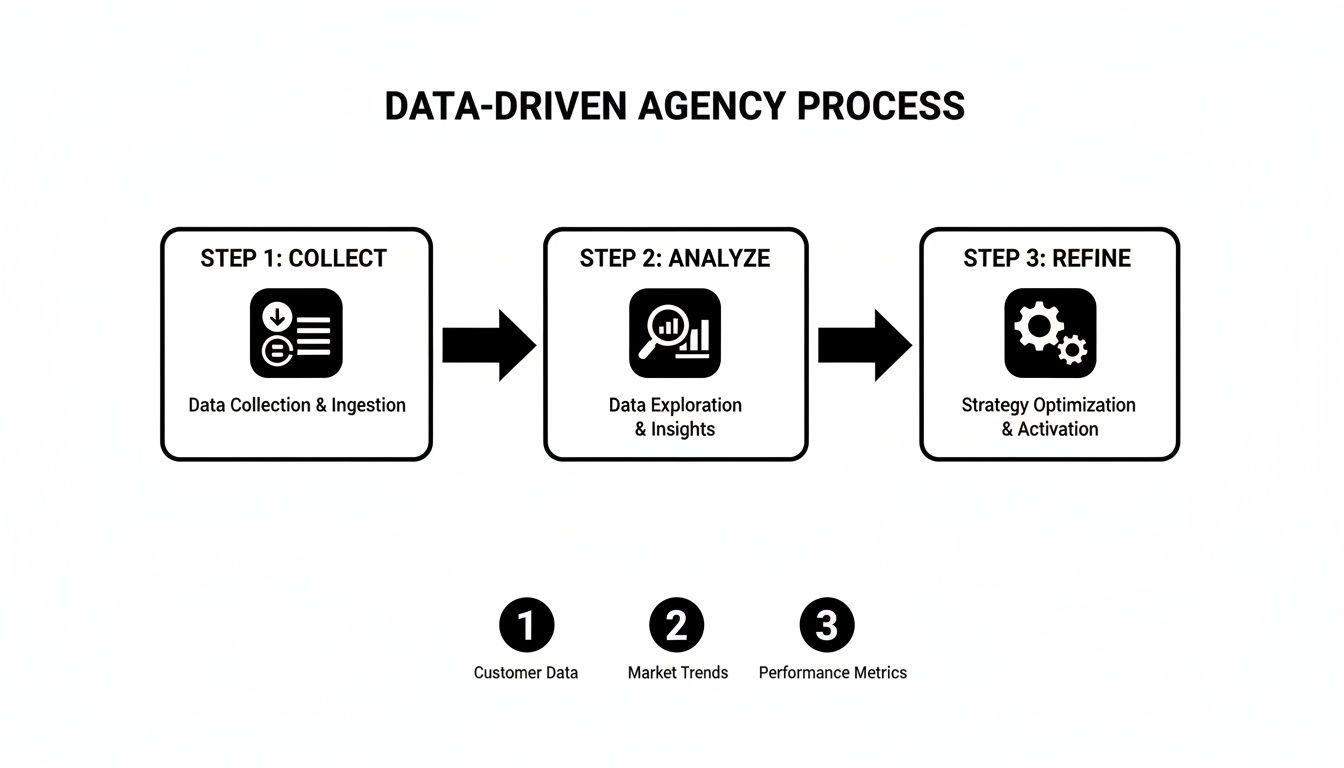
It’s a continuous loop: collect data, analyze it for insights, and then use those insights to make your marketing campaigns even better.
Advanced Analytics and Attribution
The first pillar is moving way beyond surface-level metrics. So many businesses fall into the "last-click" trap, giving 100% of the credit for a sale to the very last thing a customer did before converting. For example, if someone clicks a Google Ad and buys, the ad gets all the glory.
But what about the three blog posts they read last week? The email newsletter they opened yesterday? Or the social media video they watched this morning? A true data-driven agency understands the customer journey is almost never a straight line.
They use advanced analytics and attribution models to assign the proper value to each of those touchpoints. This gives you a complete, honest picture of what’s actually working. From there, they can invest your budget into the channels that influence customers at every stage of their journey, not just the final step.
Systematic Testing and Optimization
Once you understand what's working, the next job is to make it work even better. This is where systematic testing comes in—it’s the core function that separates guessing from knowing. We're talking about making small, calculated changes and measuring the impact to achieve significant, compounding gains over time.
Think of it like a scientist running controlled experiments in a lab. Instead of just launching a new landing page and hoping for the best, a smart agency will run an A/B test.
- Version A: The original headline.
- Version B: A new headline, informed by customer data.
They send half the traffic to Version A and the other half to Version B. The data will clearly show which headline generates more leads or sales. This exact process is applied to everything: ad copy, button colors, page layouts, and email subject lines. Each winning test delivers a small lift in performance, creating a powerful growth engine for your business.
This methodical approach pulls ego and opinion out of marketing decisions. The data—not the highest-paid person's opinion—determines the winning strategy. Every change becomes a step toward better results.
Integrated SEO and Paid Media
Finally, one of the most powerful things a data-driven agency does is create synergy between Search Engine Optimization (SEO) and paid media. Many agencies treat these as separate departments, but a data-focused team knows they are two sides of the same coin. They create a powerful feedback loop where insights from one channel directly fuel the strategy for the other.
A paid search campaign, for example, can generate data almost instantly. Within days, you can learn which keywords convert into actual customers at the highest rate. This isn't just valuable for your ad budget; it's a goldmine for your long-term SEO strategy.
The agency can then prioritize creating high-quality content and building authority around those proven, high-converting keywords. This approach helps your business start ranking organically for terms you already know drive revenue.
This integration delivers some powerful benefits:
- Faster SEO Results: You get to skip the guesswork and target proven keywords from day one.
- Lower Acquisition Costs: As your organic rankings improve, you can pull back on paid ads, lowering your overall customer acquisition cost (CAC).
- Market Domination: You start appearing in both the paid and organic sections of search results, building immense brand authority and capturing way more traffic.
This integrated approach is a key reason why data-driven agencies are seeing such strong results. In fact, the average annual growth rate for digital agencies has hit 12% in recent years, outpacing the 10% average for all U.S. publicly traded sectors. This growth is largely fueled by renewed demand for integrated services like SEO and paid media. You can dive deeper into these industry trends in the full Promethean Research report on 2025 digital agency growth.
Using Search Data to Tell Your Brand Story
Effective SEO isn't about stuffing keywords onto a page and crossing your fingers anymore. Those days are long gone. Today, it’s about telling a compelling story that resonates with both search engines and your actual customers. A true data-driven marketing agency is like a translator—decoding the language of search to figure out what people are really looking for.
With those insights, they can craft a brand narrative that meets those exact needs.
This flips your marketing from a one-way sales pitch into a genuine conversation. Instead of just shouting, "Buy our stuff!" you’re answering questions, solving problems, and building trust with every single search. It’s a huge shift from interrupting people to attracting them.
From Keywords to Customer Intent
The first step in telling a great story is understanding search intent. Every single phrase someone types into Google is a tiny window into their world—it represents a question, a need, or a problem they're trying to solve. A data-driven agency digs deeper than just keyword volume; they analyze the why behind the search.
Are people just gathering information? Are they comparing their options? Or are they ready to pull out their wallets? Knowing the answer is everything. For example, the intent behind "best running shoes for flat feet" is worlds away from "Nike Air Zoom price."
This deep dive allows an agency to map out a content strategy that perfectly aligns with where a customer is in their journey. For businesses looking to get a handle on this initial discovery phase, our guide on how to do keyword research is a great place to start. This whole approach positions your brand as the go-to expert with the best answers, which is the core of what we call Answer Engine Optimization (AEO).
AEO is the practice of optimizing your content to directly answer the specific questions your audience is asking. When you consistently provide the best, most direct answer, search engines like Google reward you with higher visibility and featured snippets.
Dominating Local Search with Geographic Data
For so many businesses, the brand story has to hit home—literally. Think of a dentist in Denver or a roofer in Raleigh. Their success lives and dies by being the obvious choice for their local community. This is where Geographic Data (GEO) becomes an agency’s secret weapon for storytelling and ranking.
By analyzing local search data, an agency can spot patterns unique to a specific city or even a single neighborhood. They might discover that searches for "emergency plumber" spike after midnight in one part of town, or that a new housing development has caused a surge in searches for "landscaping services."
This kind of GEO data lets them craft a story of local expertise and community trust.
- Hyper-Local Content: Creating pages and articles that speak directly to local landmarks, events, and common concerns to rank for "near me" searches.
- Targeted Google Business Profile: Optimizing the business profile with GEO-specific keywords, services, and photos that scream "local."
- Localized Link Building: Earning links and mentions from other local businesses, news outlets, and community organizations to build local authority.
This strategy tells Google—and your potential customers—that you're not just a business, you're the community's trusted provider.
Building a Brand People Search for by Name
When all is said and done, the real goal of data-informed storytelling is to build a brand so strong that customers start looking for you by name. This is the holy grail of modern SEO. When people stop searching for "plumber near me" and start searching for "Jackson Digital Plumbing," you know you've won.
This doesn't happen by accident. It’s the natural outcome of consistently using data to tell a trustworthy story. Every answered question, every helpful blog post, and every glowing local review builds your authority. That authority, in turn, earns you valuable backlinks from other reputable sites, creating a powerful cycle of trust and visibility that drives rankings. To really get this right, an agency needs solid methods for gathering this data in the first place. You can check out this practical guide on how to scrape Google Search Results to see how the sausage is made.
A data-driven marketing agency uses this feedback loop to turn your SEO from a technical chore into a true brand-building engine.
Choosing the Right Agency and Measuring Success
Picking the right data-driven marketing agency is a massive decision, one that can make or break your growth for the next few years. This shouldn't feel like a shot in the dark. It needs to be a methodical process of finding a true partner who gets your business goals, not just someone with a slick sales pitch.
The first step, though, starts with you. You have to change how you think about success. It’s way too easy to get caught up in vanity metrics—things like clicks, impressions, or how many likes a post gets. They aren't totally useless, but they don't pay the bills. A real data-driven partner will immediately shift the conversation to the numbers that actually move the needle for your business.
KPIs That Actually Drive Business Growth
To really measure success, you have to track the metrics that tie directly to revenue and profit. Any agency worth its salt will build its entire strategy around improving these core numbers, not just fluffing up stats that look good on a report.
Here are the essential KPIs that should be your North Star:
- Customer Acquisition Cost (CAC): This is the bottom-line cost of everything it takes—sales, marketing, you name it—to land one new customer. The goal is simple: get this number trending down, consistently.
- Customer Lifetime Value (LTV): This is the total amount of money you can expect to make from a customer over the entire time they do business with you. When LTV is climbing, it means you're attracting and keeping the right kind of customers.
- Return on Ad Spend (ROAS): For every single dollar you put into ads, how much revenue comes back? ROAS gives you a crystal-clear, immediate read on whether your paid campaigns are actually profitable.
Think of these three as a package deal. A healthy business is one where your LTV is way higher than your CAC, and a strong ROAS confirms you’re not just throwing money into a black hole. This laser focus is why paid media has become such a critical service for modern agencies.
In fact, paid media is the powerhouse channel for data-driven marketing agencies in 2025. 68% of agency leaders see it as their biggest opportunity for growth. This is a big shift from a few years ago when SEO and web design were the main focus. Now, a whopping 89% of agencies say paid advertising is their core service, because it offers controllable, fast results in a world of AI disruption and crazy algorithm changes. You can dive deeper into the study and see the 2025 marketing agency benchmarks on AgencyAnalytics.com.
Critical Questions to Vet Potential Partners
Once you know what KPIs matter, you need a solid game plan for vetting potential agencies. The quality of your questions will dictate the quality of the partnership you end up with. You have to go deeper than just asking, "What results can you get me?" and start digging into how they work.
Asking "how" an agency achieves results is far more revealing than asking "what" results they promise. Their process, from data analysis to campaign execution, is the best predictor of future success.
Here is a checklist of must-ask questions for any data-driven marketing agency you’re considering:
- How do you approach attribution modeling beyond last-click? This question immediately tells you if they understand the entire customer journey or if they’re just looking at the very last touchpoint. You need a partner who can see the whole picture.
- Can you walk me through your A/B testing and optimization process? A solid, detailed answer here shows they have a system for improving performance, not just launching campaigns and crossing their fingers.
- What is your process for integrating insights from paid media into our SEO strategy? This is a killer question. It tests whether they think in silos or if they can create a true growth loop, using short-term paid data to fuel long-term organic wins.
- How will you report on the KPIs that matter most to my business, like CAC and LTV? Their response should prove they’re committed to reporting on business outcomes, not just surface-level campaign metrics.
These conversations will quickly separate the agencies that just talk a good game from the ones that have a proven, data-centric process. For an even more comprehensive list, check out our guide on other important questions to ask a marketing agency before you sign anything. Arming yourself with the right questions is the best way to confidently choose a partner who can deliver results you can actually measure.
Where Do You Go From Here?
Information is great, but it’s only powerful when you act on it. We've just walked through how a data-driven marketing agency gets you out of the guessing game and into building a reliable growth engine for your business. If there's one thing to take away, it's this: data-driven marketing isn't some abstract theory. It’s a hands-on, practical way to make every single marketing dollar work harder and deliver predictable results.
The journey doesn't start with some massive, intimidating overhaul. It starts with a single, focused step. It’s all about closing the gap between knowing and doing.
Start With a Simple Audit
Your first move doesn't require a fancy suite of tools or a PhD in statistics. Just start by taking an honest look at your current analytics. Log into your Google Analytics account and ask one foundational question: "Where do my best customers actually come from?"
Forget total traffic numbers for a minute. Pinpoint the top 2-3 channels that are driving actual conversions—whether that’s a form submission, a phone call, or a sale. This tiny exercise often unearths some surprising truths about what is (and isn’t) working, giving you immediate clarity.
Identify One Key Business Question
Next, let's get specific. Vague goals like "more leads" are impossible to measure. Instead, frame your objective as a question that data can actually answer.
- Which one of our services brings in the most profitable leads from organic search?
- What’s the real customer lifetime value from a Facebook ad lead versus a Google ad lead?
- Where exactly in our website funnel are we losing the most potential customers?
Choosing one critical question transforms a confusing sea of numbers into a focused tool for solving a real problem. It gives your analysis a clear purpose and a measurable outcome, which makes your efforts infinitely more impactful.
This disciplined focus is the very heart of data-driven marketing.
Take Your First Step Today
Shifting to a data-driven approach is a series of deliberate, informed steps, not a giant leap of faith. By starting with a simple channel audit and zeroing in on one key question, you're already starting to think like a data-driven marketer.
From here, you can start to see how a dedicated partner could pour gas on the fire. A skilled data-driven marketing agency takes these initial insights and builds a full-blown strategy around them, turning your foundational questions into a roadmap for sustainable growth. The end game is a system where every decision is backed by solid evidence, leading to far more predictable outcomes and a much stronger bottom line.
Common Questions About Data-Driven Agencies
Making the leap to a more analytical marketing approach naturally stirs up a few questions. Let's walk through some of the most common things business owners ask when they're thinking about partnering with a data-driven agency. This should help you make a much more informed decision.
What's the Real Difference Between a Regular and a Data-Driven Agency?
A traditional agency usually leads with creative. They'll design beautiful ads, write snappy copy, and manage social media based on their experience and what's worked before. They essentially build the campaign and then look back to see what happened.
A data-driven marketing agency completely flips that script. They start with the data to form a hypothesis, and then they build a campaign as a controlled experiment. Every single decision—from which audience to target with an ad to the exact headline on a blog post—is grounded in analytics and built to be tested. It’s the difference between being a campaign artist and a growth scientist.
The core distinction is the feedback loop. A data-driven partner doesn't just report on results; they use those results to systematically refine and improve every subsequent action, creating compounding returns on your investment.
How Long Does It Take to See Results?
This is the big one, and the honest answer is: it depends on the strategy. A smart, data-driven approach is designed to deliver results on two different timelines, giving you both immediate traction and long-term, sustainable growth.
- Short-Term Wins (1-3 Months): Paid media campaigns, like ads on Google or social media, can start generating data and leads almost instantly. An agency can quickly test different messages and targeting options to find what works, often showing a positive Return on Ad Spend (ROAS) within the first quarter.
- Long-Term Growth (6+ Months): Building organic authority through SEO is a marathon, not a sprint. It's about creating genuinely helpful content based on search data, earning trust with search engines, and building a strong backlink profile. The initial results are slower, but the payoff is huge—a steady stream of "free," high-intent traffic that becomes a durable asset for your business.
Is a Data-Driven Agency Affordable for Small Businesses?
That's a very common concern, but it frames the question backward. The real question is, "Can you afford unfocused marketing?" Pouring money into campaigns without clear measurement is one of the fastest ways for a small business to burn through its budget with little to show for it.
A data-driven marketing agency is often more cost-effective because their entire model is built around maximizing ROI. By spotting and cutting wasteful ad spend, doubling down on the most profitable channels, and constantly optimizing for conversions, they make sure every dollar works as hard as it possibly can. The goal isn't just to spend your budget; it's to turn it into a predictable engine for revenue, making it a true investment rather than just an expense.
Ready to stop guessing and start growing with a strategy backed by real data? The team at Jackson Digital builds predictable growth engines for businesses like yours. Request your free performance audit today and discover what a data-driven approach can do for your bottom line.