
A digital marketing audit is a comprehensive health check for your entire online presence. It's a systematic review of all your digital channels—from your website's SEO to your social media performance. The whole point is to stop you from wasting money on tactics that don’t work and to tell a clearer story that helps you rank on search engines.
Think of it as a strategic roadmap to getting better results.
Why a Digital Marketing Audit Is Your Secret Weapon
Let’s be honest, this story probably sounds familiar. You’re a local service business—maybe a plumber or a dentist—and you’ve done everything you were told to do. You have a professional website. You post on social media. You might even be spending a bit on ads.
Yet, the phone isn't ringing, and your online presence feels invisible. Leads are trickling in, if they're coming in at all.
This is a frustratingly common scenario. So many businesses invest time and money into their marketing without a clear understanding of what’s actually moving the needle. You're essentially throwing things at a wall to see what sticks, which is a terrible strategy for sustainable growth.

From Guesswork to a Growth Blueprint
A solid digital marketing audit transforms your approach from reactive to proactive. Instead of guessing, you get a clear, data-backed picture of where your marketing truly stands. It’s not just some tedious task; it’s your secret weapon for making smarter decisions that help you rank higher and tell better stories.
An audit gives you the power to:
- Pinpoint Inefficiencies: Discover exactly where your budget is being wasted on underperforming campaigns or outdated strategies.
- Uncover Hidden Opportunities: Find untapped keywords, new audience segments, or content gaps your competitors are completely ignoring.
- Align with Business Goals: Ensure every marketing activity directly contributes to what you actually care about, like ranking for valuable keywords and generating qualified leads.
- Boost Your ROI: Make informed adjustments that improve performance across all your channels, leading to a much better return on your investment.
A proper audit isn't about finding blame; it's about finding clarity. It provides a definitive answer to "What's next?" and gives you a prioritized action plan to drive real, measurable results.
In the fast-paced marketing world, regular audits are absolutely essential for staying competitive. The global digital ad market has ballooned to $740.3 billion, with search advertising gobbling up a massive $202.4 billion of that.
Without an audit, you risk throwing away your portion of this spend. It's estimated that 30-40% of campaigns underperform due to simple, fixable issues like poor targeting. That's a lot of money left on the table.
Connecting Actions to Real-World Results
The real value of an audit is in connecting technical fixes to actual business outcomes. It’s how you optimize for the way people search today, covering SEO (search engine optimization), GEO (geographic or local search), and AEO (answer engine optimization for voice search). This isn't just about keywords; it's about telling a story that answers your customers' questions at the exact moment they ask them.
For a local business, this means showing up when someone asks Siri for the "best plumber near me." For an e-commerce brand, it means figuring out the story your data is telling about why customers are abandoning their carts. Every single insight helps you lower your expenses, increase your rankings, and grow your revenue.
If you want to get a handle on the numbers, you might find our customer acquisition cost calculator extremely useful. Ultimately, an audit provides the strategic foundation needed to turn your digital presence into a reliable engine for growth.
Getting Your Ducks in a Row Before the Audit
Look, before you even think about opening a single tool or spreadsheet, the most crucial part of any successful audit is hitting pause. You need to ask one simple, powerful question: “What are we actually trying to achieve here?”
If you skip this step, your audit just becomes a massive data-gathering exercise. It’s a box-checking activity, not a real roadmap for growth.
Think of it this way. A local bakery’s goal isn’t to “get better at SEO.” It’s to tell a story that makes them show up first when someone Googles “best sourdough near me” and get more people walking through the door. An e-commerce brand doesn’t just want to “analyze social media”; they want to understand the customer journey story hidden in their 69% average cart abandonment rate to actually sell more stuff. The goals you set right now will steer the entire audit.
This isn’t about fuzzy objectives like “increase brand awareness.” We need to tie every single thing we analyze back to a real business result, like ranking higher on search engines. Getting this right from the start is what turns a tedious audit into a genuinely powerful strategic weapon.
What Does a “Good” Goal Actually Look Like?
To make your audit count, you need specific, measurable goals focused on ranking and telling your story. Let's ditch the abstract jargon and look at what this means for a few different businesses.
- For a Local Plumber: A solid goal would be to generate 15 more qualified phone calls each month from organic search. Right away, that tells us the audit needs to be laser-focused on local SEO (GEO), optimizing their Google Business Profile, and crafting content that answers urgent questions like "what to do with a burst pipe."
- For a National E-commerce Store: Their objective might be to slash customer acquisition costs by 20% in the next six months. So, the audit would immediately zoom in on paid ad performance, conversion rate optimization on product pages, and the technical SEO that drives organic traffic to their most profitable items.
- For a B2B SaaS Company: They might want to increase marketing-qualified leads from their blog by 30%. This means the audit would have to go deep on a content analysis, an on-page SEO review, and telling a more compelling story through their lead capture forms and follow-up sequences.
Think of these goals as your compass. With so much data available, it's incredibly easy to get lost in a sea of metrics that don't matter. A clear goal ensures you only focus on the numbers that help you make decisions to grow the business.
Gearing Up: Your Audit Toolkit
Once your goals are locked in, it’s time to assemble your tools. The good news? You don't need a huge budget to get started. Some of the most potent tools out there are completely free.
Here’s the essential toolkit I’d recommend:
| Tool Category | Examples | What It Tells You |
|---|---|---|
| Analytics Platforms | Google Analytics 4 (GA4) | How people find your site, what they do when they get there, and where they drop off. |
| Search Performance | Google Search Console | The exact keywords you rank for, technical site errors, and click-through rates from search. |
| All-in-One SEO Suites | Semrush, Ahrefs (Paid) | Deep dives into competitor strategy, your backlink profile, and overall site health. |
| Local Search Tools | Google Business Profile | How you appear in local search (GEO), customer reviews, photo engagement, and business info consistency. |
| Website Crawlers | Screaming Frog | Finds the nitty-gritty technical stuff like broken links, redirect chains, and duplicate content. |
Before you start pulling any data, make a quick checklist to confirm you have login access to all these platforms. It sounds simple, but you’d be surprised how much time is wasted chasing down passwords. A little prep work here makes the whole process run a lot smoother.
The Core Areas of Your Digital Marketing Audit
Alright, let's get to the good stuff—rolling up our sleeves and digging into the heart of your digital marketing. This isn't about ticking boxes on some sterile checklist. Think of this as a series of investigations, each one designed to uncover specific clues about what’s driving growth, what's hurting your search engine rankings, and what’s secretly holding you back.
Each channel tells a piece of the story. Your technical SEO shows how easily search engines can understand your site. Your content reveals whether you're actually answering your customers' questions. And your backlinks act as a direct measure of your online authority.
Before you can dive in, though, a little prep work goes a long way. Setting clear goals, grabbing the right tools, and pulling the necessary data is the foundation for a useful audit.
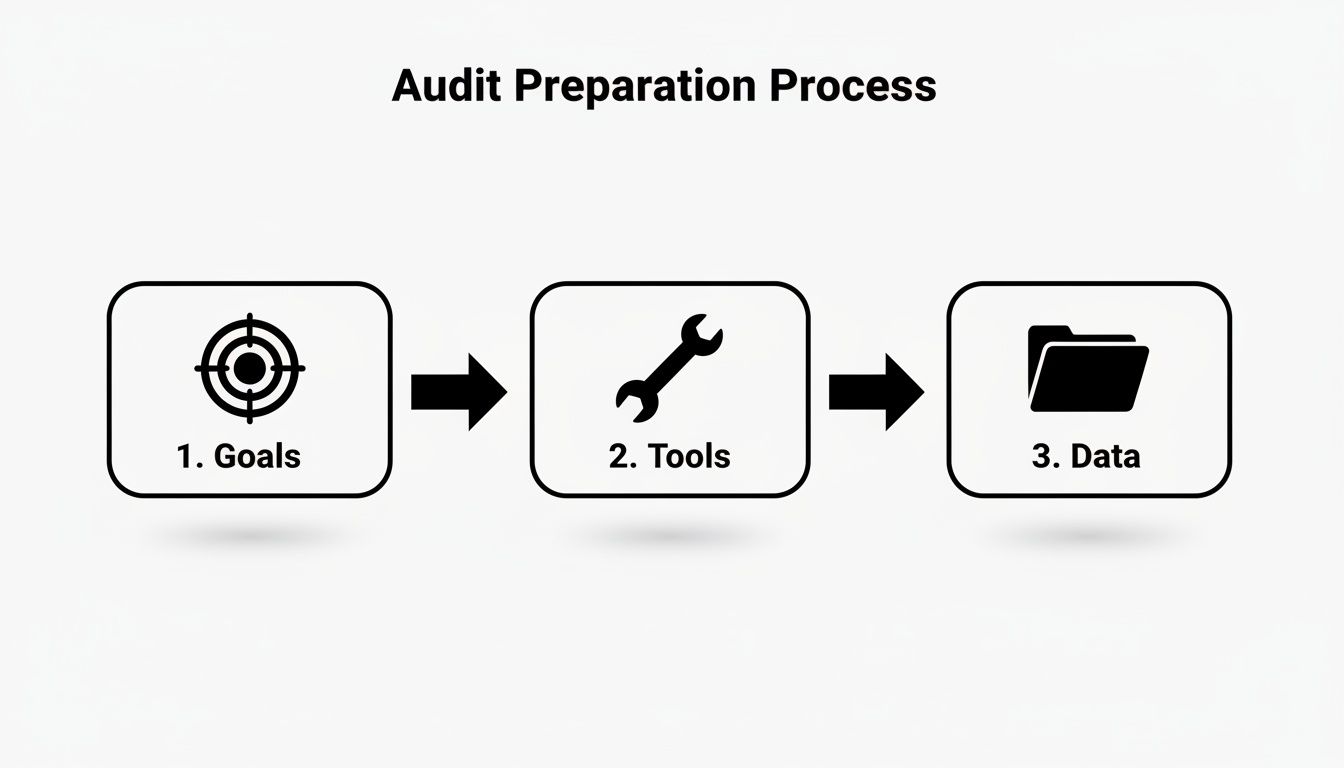
This structured approach makes sure every insight you uncover is tied directly to a real business outcome.
Technical SEO: The Ghosts in the Machine
Think of technical SEO as the foundation of your house. If it has cracks, it doesn’t matter how great the rest of it looks; you have a serious problem. These technical issues can completely sabotage your ranking efforts and are critical for SEO, GEO, and AEO. A solid technical audit is all about making your site a place Google loves to crawl and index.
Here’s a real-world story: A local plumbing company has fantastic content about "emergency pipe repair," but their page takes eight seconds to load on a phone. That potential customer, standing ankle-deep in water, isn't waiting. They're hitting the back button, and Google takes note. That slow load time is a technical ghost, and it's costing them business and search rankings.
Your investigation should zero in on a few key culprits:
- Site Speed: How fast does your site load on desktop and mobile? Use a tool like Google's PageSpeed Insights to get a baseline. Slow sites get punished in rankings and kill conversions.
- Mobile-Friendliness: Is your site a pain to use on a smartphone? With more than half of all web traffic now on mobile, a clunky experience is a deal-breaker for both users and search engines.
- Crawlability & Indexability: Can search engines even find and read your pages? Hop into Google Search Console to check for "robots.txt" errors or misplaced "noindex" tags that are telling Google to stay away.
- Site Architecture: Is your site laid out logically? A messy site map or tangled internal linking makes it tough for both people and search engines to find what they need, which directly impacts your ability to rank.
Content and On-Page SEO: Answering the Right Questions
If technical SEO is the foundation, your content is the story you tell. This part of the audit shifts from code to communication. It boils down to one simple question: How well are you answering your customers' real questions to rank on search engines?
Every single piece of content must have a purpose that supports your SEO, GEO, and AEO goals. It needs to connect directly with what your audience is searching for—their problems, their curiosities, and their immediate needs.
Another story for you. A roofer in a storm-prone area writes a blog post called "Our Company History." It gets crickets. The audit reveals their customers are actually searching for things like "how to spot hail damage on roof" and "what to do after a storm."
By pivoting their content to answer these urgent questions, they started attracting qualified, local traffic ready to make a call. That's the power of a content audit. You stop talking at your audience and start having a conversation with them that search engines reward.
When you review your content and on-page elements, analyze:
- Keyword Targeting: Are your pages actually optimized for the phrases your customers use to find businesses like yours?
- Search Intent Alignment: Does your page match the reason for the search? Someone looking for "best running shoes" (commercial) needs a different page than someone searching "how to tie shoes" (informational).
- Content Quality: Is your content genuinely helpful? Does it tell a better story or provide more insight than what your competitors are putting out?
- On-Page Elements: Are your title tags, meta descriptions, and headers clear, compelling, and properly optimized to improve your rankings?
Backlinks and Online Reputation: Who Is Vouching for You?
Think of your backlink profile as your online reputation. Every link pointing to your site from another website is a vote of confidence, signaling to search engines that your content is trustworthy and that you are an authority. A backlink audit isn't just a numbers game; it's about the quality of those votes.
Are you getting links from the local chamber of commerce, or from spammy, irrelevant online directories? The difference is night and day. A handful of high-quality links will do more for your SEO than a thousand junk links. This is where tools like Ahrefs or Semrush become essential, showing you exactly who is linking to you and how authoritative they are.
Done right, an audit is a strategic powerhouse. It's no wonder companies that perform them report a 35% average increase in conversion rates. With global digital ad spend hitting $526.17 billion, every dollar has to count. An audit helps you understand why 93% of online experiences begin with a search engine and how you can capture that traffic—preventing the kind of brand missteps that cause 51% of users to unfollow brands on social media.
Paid Ads and Conversion Paths: Following the Money
Finally, it's time to follow the money. If you're running any paid campaigns—like Google Ads or paid social—your audit needs to put every dollar under the microscope. This means looking past vanity metrics like clicks and impressions and focusing on what moves the needle: cost per lead and return on ad spend (ROAS).
Are your ads hitting the right audience? Is the ad copy compelling? Crucially, what happens after the click? Your audit has to trace the entire user journey, from the ad to the landing page and all the way through the conversion. A brilliant ad campaign can be completely torpedoed by a clunky landing page that tells the wrong story or a confusing contact form.
This is also where you double-check your analytics setup. Are your tracking codes firing correctly? Are you measuring conversions accurately? Without clean data, you're just guessing. A thorough audit ensures your data is reliable, giving you the confidence to invest your budget where it will have the most impact. For anyone wanting to dig deeper into the nuts and bolts, you can learn more about the science behind technical SEO in our detailed guide.
To help you get started, here's a quick checklist that breaks down the key areas to investigate across the major channels.
Digital Marketing Audit Checklist by Channel
This table provides a high-level overview of what to look for in each part of your audit. Use it as a starting point to guide your investigation.
| Channel | Key Areas to Audit | Example Metric to Check |
|---|---|---|
| Technical SEO | Site speed, mobile-friendliness, crawlability, indexability, site architecture, structured data. | Page Load Time (in seconds) via Google PageSpeed Insights. |
| On-Page & Content | Keyword targeting, search intent alignment, content quality, readability, title tags, meta descriptions. | Organic Click-Through Rate (CTR) for top pages in Google Search Console. |
| Backlinks | Number of referring domains, backlink quality and authority, anchor text distribution, toxic link profile. | Domain Rating (DR) or Authority Score of linking websites. |
| Paid Media (PPC) | Campaign structure, keyword targeting, ad copy relevance, landing page experience, conversion tracking. | Cost Per Acquisition (CPA) or Return On Ad Spend (ROAS). |
| Analytics & Tracking | Correct implementation of tracking codes (GA4), goal/conversion setup, data accuracy, event tracking. | Goal Completion Rate in Google Analytics. |
| Conversion Rate Optimization | User experience (UX) flow, call-to-action (CTA) clarity, form usability, mobile conversion path. | Conversion Rate for key landing pages. |
| Local/Ecommerce SEO | Google Business Profile optimization, local citations, online reviews, product page SEO, checkout process. | Local Pack Rankings or Shopping Cart Abandonment Rate. |
While this isn't exhaustive, it covers the most critical components you'll need to assess. Each of these areas could be a deep dive on its own, but reviewing them together gives you a complete picture of your digital health.
Auditing for Local and Ecommerce Success
The general principles of a digital marketing audit apply to pretty much everyone, but the real magic happens when you zoom in on SEO and GEO. You have to tailor your investigation to your specific business model and how your customers find you on search engines.
For local service businesses and e-commerce stores, this focus is the difference between simply existing online and actually dominating your market. It's all about seeing things from your customer's perspective and telling a story that resonates.
Let's imagine two different customers. One is frantically searching "emergency plumber near me" on their phone. The other is casually browsing for a new pair of hiking boots on their laptop. An audit for these businesses must trace those unique search journeys and pinpoint every friction point where a sale—and a top ranking—could be lost.

Winning the Neighborhood: A Local Business Audit
For a local business, the audit is a battle for proximity and trust, which is the heart of GEO (geographic optimization). Your goal is to become the undeniable go-to choice in your neighborhood. That means your digital presence has to scream reliability and convenience to both search engines and potential customers.
The story almost always begins with a search. Someone needs a service, and they need it now. Your audit should focus on exactly what they see in that critical moment.
- Google Business Profile (GBP) Deep Dive: This isn't just a listing; it's your digital storefront and the most important tool for GEO. Your audit must verify every single detail is complete and optimized—correct hours, service categories, and a compelling business description that tells your story. Are you using GBP Posts to announce specials? Are your photos high-quality and recent?
- NAP Consistency Check: Your Name, Address, and Phone number (NAP) has to be identical everywhere online. Discrepancies across directories like Yelp, Angie's List, and local chamber sites confuse search engines and kill trust, hurting your local rankings. Tools like Moz Local can help you get a quick read on this consistency.
- Review and Reputation Analysis: What story are your customers telling about you? A proper audit means analyzing the sentiment, frequency, and your response rate to reviews. A strategy for actively generating authentic, positive reviews is a direct, and powerful, outcome of a good local audit that boosts rankings.
Your local audit is fundamentally about ensuring that when a customer in your service area needs you, you are the most visible, credible, and trustworthy option available. It's about winning that "near me" search every single time.
For companies managing multiple physical locations, this process becomes even more critical. You have to make sure each storefront has its own optimized presence. Our guide on local SEO for multiple locations offers a deeper look into that specific challenge.
The Ecommerce Customer Journey Audit
For an e-commerce store, the audit follows a customer from the moment of discovery all the way to checkout. Every click is a potential exit point, and your job is to make the path to purchase as smooth as possible. A lost sale is often the result of a small, overlooked detail that an audit can easily uncover.
This kind of precision is essential. By 2026, the global digital market is projected to hit $786.2 billion. An audit makes sure your piece of that pie isn't lost to simple inefficiency, especially when a staggering 97% of consumers check out a business's online presence before making a purchase. This is where your audit really proves its worth.
Key Checkpoints for Ecommerce Audits
Your e-commerce audit should be a meticulous walkthrough of the customer's journey, zeroing in on any and all barriers to conversion and opportunities to improve your SEO.
- Product Page Perfection: Go beyond just photos and a price. Your audit must check for compelling product descriptions that tell a story, clear calls-to-action, social proof like reviews, and trust signals like shipping information and return policies.
- Technical Ecommerce SEO: This is a big one. Your audit needs to verify the implementation of product schema markup. This special code helps search engines understand details like price, availability, and review ratings, which can then be displayed directly in search results, helping you rank higher.
- Checkout Process Friction: The checkout is where sales are most often lost. You have to audit this process step-by-step. Is guest checkout an option? Are there unexpected shipping costs popping up at the last minute? Is the form too long or complicated on mobile? Each extra step or moment of confusion drives your cart abandonment rate through the roof.
By approaching the audit from the customer's point of view—whether they're down the street or across the country—you transform it from a technical checklist into a powerful tool for empathy and growth. You start fixing problems that don't just matter to search engines, but matter to the people who actually buy from you.
Turning Your Audit Findings Into an Action Plan
Okay, so you’ve waded through mountains of data. You’ve analyzed every channel and uncovered a ton of insights. Now what?
All that work is completely worthless if it just sits in a report on a shared drive, gathering digital dust. An audit that doesn't lead to action is just a wasted exercise. The whole point of this deep dive is to drive meaningful, profitable change in your search rankings.
This is the moment your audit transforms from a simple diagnostic tool into a strategic roadmap for growth. We're shifting gears from "what's broken" to "here's how we fix it to rank better and tell our story." Let’s build a powerful blueprint that turns those findings into real results.
The Impact vs. Effort Framework
Staring at a long list of recommendations is overwhelming. Should you fix the slow mobile page speed first? Or maybe optimize your Google Business Profile? What about that new content idea?
Trying to tackle everything at once is a surefire recipe for burnout and getting nothing meaningful done.
This is where prioritization becomes your absolute best friend. One of the simplest and most effective ways I've seen teams do this is with an Impact vs. Effort framework.
It's a straightforward approach. You just score each recommendation on two scales:
- Potential Impact: How much will this actually move the needle on your business goals (more leads, more sales, better rankings)?
- Required Effort: How much time, money, and manpower will it take to get this done?
When you plot these out, the path forward becomes crystal clear.
Your first priority should always be the High-Impact, Low-Effort tasks. These are your "quick wins"—the low-hanging fruit that builds momentum, shows immediate progress, and gets everyone on board with the audit's value.
A perfect example? Updating the title tags on your top five service pages. It’s a low-effort task that can have a surprisingly high impact on click-through rates from search results. A full website redesign, on the other hand, is a high-effort beast that needs serious planning. See the difference?
Building Your Action Plan Template
Once you've sorted your list, it's time to build the actual action plan. Forget fancy software; a simple spreadsheet is all you need to create a roadmap that fosters clarity and accountability.
But this isn't just a to-do list. This is a commitment.
Your action plan has to be more than a list of tasks. For every single item, you need to define what success actually looks like. This is how you turn vague goals into measurable outcomes that stakeholders can understand.
Here’s a simple structure you can borrow:
| Task | Priority | Owner | Deadline | Success Metric (KPI) |
|---|---|---|---|---|
| Optimize Google Business Profile Photos | High-Impact, Low-Effort | Sarah M. | Next Friday | 20% increase in photo views |
| Fix 404 'Page Not Found' Errors | High-Impact, Low-Effort | Tech Team | End of Month | Zero 404 errors in Search Console |
| Rewrite Content on Top 5 Service Pages | High-Impact, High-Effort | Alex C. | End of Q2 | 15% increase in organic traffic |
| Implement Product Schema on All Items | Med-Impact, Med-Effort | Web Dev | Within 60 Days | Rich snippets appear in SERPs |
From Plan to Progress
This kind of structured approach accomplishes a few critical things.
First, it assigns clear ownership. You'd be amazed how much faster things get done when a specific person's name is next to a task.
Second, it establishes realistic deadlines. This keeps important projects from getting pushed to the back burner indefinitely.
Most importantly, it defines success metrics from day one. You'll know exactly how to measure the effectiveness of every action you take. This is crucial for proving the ROI of your audit and getting the buy-in you need for future projects. This document becomes your team's single source of truth, guiding every move with purpose.
Your Top Digital Marketing Audit Questions, Answered
Even with a clear roadmap, it's totally normal to have a few questions floating around. The whole idea of a "digital marketing audit" can sound pretty intimidating, but once you get the hang of the core concepts, it's a lot less mysterious.
Let's dive into a couple of the most common questions I hear from business owners who are ready to ditch the guesswork and get serious about growth.
How Often Should I Run a Digital Marketing Audit?
A full-blown, deep-dive audit is a fantastic thing to do once a year. Think of it as a complete annual physical for your entire online presence. It gives you a crystal-clear baseline and helps you map out your strategy for the next 12 months.
But here's the thing: digital marketing and search engine algorithms move at lightning speed. To keep up, I strongly recommend doing quarterly "mini-audits" that zero in on specific channels.
Maybe one quarter you dig into your technical SEO. The next, you scrutinize your paid ad campaigns. After that, you could focus entirely on your local search (GEO) and Google Business Profile performance. This approach is great because it stops tiny issues from hurting your rankings and keeps your strategy nimble.
Can I Do This Myself, or Should I Hire Someone?
Honestly, you can absolutely do a powerful audit on your own. This guide, combined with incredible free tools from Google like Analytics and Search Console, gives you everything you need. A DIY audit is perfect for understanding your baseline and spotting the obvious, low-hanging fruit. It’s the best way to really get your hands dirty and learn what makes your marketing tick.
That said, there are times when calling in an expert is the smart move. If you're dealing with complex issues—like diagnosing a stubborn technical SEO problem, running a deep competitive backlink analysis, or trying to bounce back from a Google penalty—a seasoned pro brings a ton of value. They’ve got access to specialized software and, just as important, an unbiased outside view that can spot opportunities you're simply too close to see.
The single biggest mistake I see people make is collecting tons of data with no real purpose. It’s so easy to get lost in hundreds of different metrics and end up with "analysis paralysis"—you're drowning in information but have no idea what to do next.
A great audit always ties every single finding back to a real business goal like ranking higher or telling a better story. Instead of just making a long laundry list of problems, it prioritizes them based on what will actually get you more customers and drive revenue. Always, always start your audit with your goals, not with the data.
Ready to stop guessing and start growing? The team at Jackson Digital provides in-depth performance audits that turn data into a clear action plan. Request a free consultation today and discover your path to predictable growth.