When a homeowner has a pipe burst at 2 AM, they don't dust off the Yellow Pages. They grab their phone and frantically search for "emergency plumber near me."
Digital marketing for plumbers is all about showing up in that exact moment of need. It’s the strategy of using tools like search engine optimization (SEO), local search ads, and a high-converting website to connect with local customers right when they’re searching for your services. It turns their panicked search into your next scheduled job.
Why Your Plumbing Business Is Invisible Without Digital Marketing
Imagine you're the best plumber in town, but your shop is tucked away in an unmarked alley with no sign. That’s exactly what it’s like running a plumbing business today if you don't have a strong online presence.
The old ways are gone. Today's customer journey starts on a tiny screen, usually in a moment of sheer panic.
If your business doesn't pop up on the first page of Google, you're functionally invisible. For a plumber, being easy to find online isn’t just a "nice-to-have"—it's the single most critical factor for getting calls and growing your business.
The Shift from Print to Pixels
The demand for plumbers is solid, with projections showing a steady 4% industry growth over the next eight years. The opportunity is there for the taking. Yet, there's a huge disconnect. A staggering 70% of plumbers who hire marketing agencies report being dissatisfied, usually because they get generic strategies that don't generate actual leads.
You can read the full research about these plumbing industry statistics to get a better feel for the competitive landscape. This gap proves why a specialized approach—one that understands how your customers think and search—is so important.
Your digital presence is your 24/7 salesperson. It answers questions, builds trust, and makes it incredibly easy for a stressed-out customer to call you for help, day or night.
To win, you have to meet customers where they already are: online. It’s time to move beyond outdated methods and embrace the digital channels that connect you directly with homeowners who need your help right now. These aren't just marketing channels; they're lifelines to your next customer.
To see how these channels translate into actual business, let's break down the most effective ones and the direct impact they have on your bottom line.
How Digital Channels Drive Plumbing Leads
| Digital Channel | Primary Goal | Direct Business Impact |
|---|---|---|
| Local SEO | Rank high in local search results and map packs | More organic calls and website visits from nearby customers actively seeking services. |
| Google Business Profile | Provide instant info (reviews, hours, phone) | Increases direct calls from search results, often before a user even clicks on your website. |
| Paid Ads (LSA & Google Ads) | Get immediate, top-of-page visibility | Generates qualified leads and phone calls quickly from high-intent customers ready to hire now. |
| Website & CRO | Convert visitors into paying customers | Turns website traffic into scheduled jobs and quote requests by making it easy to contact you. |
| Content Marketing | Build trust and answer customer questions | Attracts customers earlier in their journey and establishes your company as the local authority. |
| Review Management | Build a 5-star reputation | Convinces potential customers to choose you over competitors by showcasing social proof. |
This table shows it's not about being everywhere at once. It's about mastering the right channels that consistently bring in calls and build a predictable pipeline of jobs.
Core Channels That Drive Immediate Calls
Effective digital marketing for plumbers isn't complicated. It’s about focusing on the handful of channels that directly impact your phone ringing.
Here’s a breakdown of what truly matters:
- Local SEO: This is the art of getting your business to show up for local searches like "drain cleaning in Dallas." It’s how you appear in Google's map results and organic listings, which is exactly where most of your future customers are clicking.
- Google Business Profile (GBP): Think of your Google Business Profile as your digital storefront. A well-managed profile puts your phone number, service hours, and glowing customer reviews right there in the search results. This often leads to a call without someone ever having to visit your website.
- Paid Ads (LSA & Google Ads): While SEO is a long-term game, paid ads deliver immediate results. Google Local Services Ads (LSAs) and targeted search ads place you at the very top of the page for urgent keywords, generating calls from homeowners who are ready to hire today.
Mastering the Search Trifecta For Local Dominance
To truly dominate local search, you need to master three key disciplines. Think of it as a fishing trip. You need the right gear (SEO), you need to know the best spots on the lake (GEO), and you need to use the exact bait the fish are biting on (AEO). Get all three right, and you'll consistently bring home a full cooler.
In the world of digital marketing for plumbers, this trifecta is made up of SEO, GEO, and AEO.
- SEO (Search Engine Optimization) is your gear. It's the technical work of building a fast, reliable website and signaling to Google that you're a credible, authoritative choice that deserves to rank.
- GEO (Geo-Targeted Optimization) is knowing where to fish. This is how you prove to Google that you serve specific neighborhoods and towns, ensuring you show up for "plumber near me" searches.
- AEO (Answer Engine Optimization) is the bait. It’s about creating content that directly answers your customers' questions, building trust, and telling stories that resonate.
When you master these three pillars, you're not just visible online. You become visible to the right people, in the right places, at the exact moment they need a plumber.
SEO: The Foundation of Being Found
Search Engine Optimization is the technical backbone of your online presence. It's about making your website attractive to search engines like Google. For a plumber, this means structuring your site to prove your expertise.
For example, imagine a homeowner in Dallas with a clogged drain. They don't just search "plumber"; they search "drain cleaning Dallas." If your website has a dedicated page for "Drain Cleaning Services in Dallas," you are immediately more relevant than a competitor with a generic "Services" page. Google sees this specific, helpful content and ranks you higher for that search.
Actionable Steps:
- Create Service Pages: Build a unique page on your website for each core service you offer (e.g., Water Heater Repair, Leak Detection, Emergency Services).
- Optimize for Mobile: Ensure your site loads quickly and is easy to navigate on a smartphone. A customer standing in a puddle won't wait for a slow site.
- Use Clear Headings: Structure your pages with clear H2s and H3s that include keywords like "[Service] in [City]".
SEO isn't a one-and-done trick. It's an ongoing process of proving your relevance and authority to Google. You're building a digital reputation that tells both search engines and potential customers that you are the best solution to their problem.
GEO: Putting Your Business on the Map
Geo-targeted optimization is how you win the local game. You aren't trying to rank nationally; you want to be the top result for someone five miles away with a flooding basement. This is about proving your local presence to Google.
The most critical step is managing your citations—mentions of your business's Name, Address, and Phone number (NAP) across the web. Think of each consistent citation as a vote of confidence for Google that you are a legitimate local business.
Actionable Steps:
- Claim Your Google Business Profile: This is your most important citation. Fill out every section completely and ensure your NAP is 100% accurate.
- Build Local Citations: Get your business listed on key directories like Yelp, Angi, and your local Chamber of Commerce. Consistency is key—the NAP must be identical everywhere.
- Create Location Pages: If you serve multiple towns, build a specific page on your site for each one. Talk about a job you did in that town or mention local landmarks. This tells a story and proves your connection to the community.
AEO: Answering Your Customer's Questions
Answer Engine Optimization is where you build trust and tell stories. Search engines are no longer just directories; they are answer machines. Your goal is to provide the best answer to your customers' plumbing questions.
A customer might not search for "hydro jetting services." Instead, they’ll ask Google, "how to clear a badly clogged drain." If you have a blog post titled "A Plumber's Guide to Clearing Stubborn Clogs," you're not just a service provider—you're the helpful expert.
Actionable Steps:
- Identify Customer Questions: Brainstorm a list of the top 10 questions you get from customers on the phone. These are your first blog post ideas.
- Write Helpful Content: Create short blog posts or FAQ pages answering these questions. Use simple language, not technical jargon. Tell a short story: "Last week, we helped a customer in [Town] who had this exact problem…"
- Use Video: Create a short 2-minute video on your phone explaining how to shut off a home's main water valve. This is incredibly helpful content that builds instant trust.
If you really want to get a handle on this, a great next step is diving into a beginner's guide to winning the SEO game. By combining SEO, GEO, and AEO, you create a powerful system that attracts local customers, builds real trust, and keeps your phone ringing.
Transforming Your Google Business Profile Into A Lead Machine
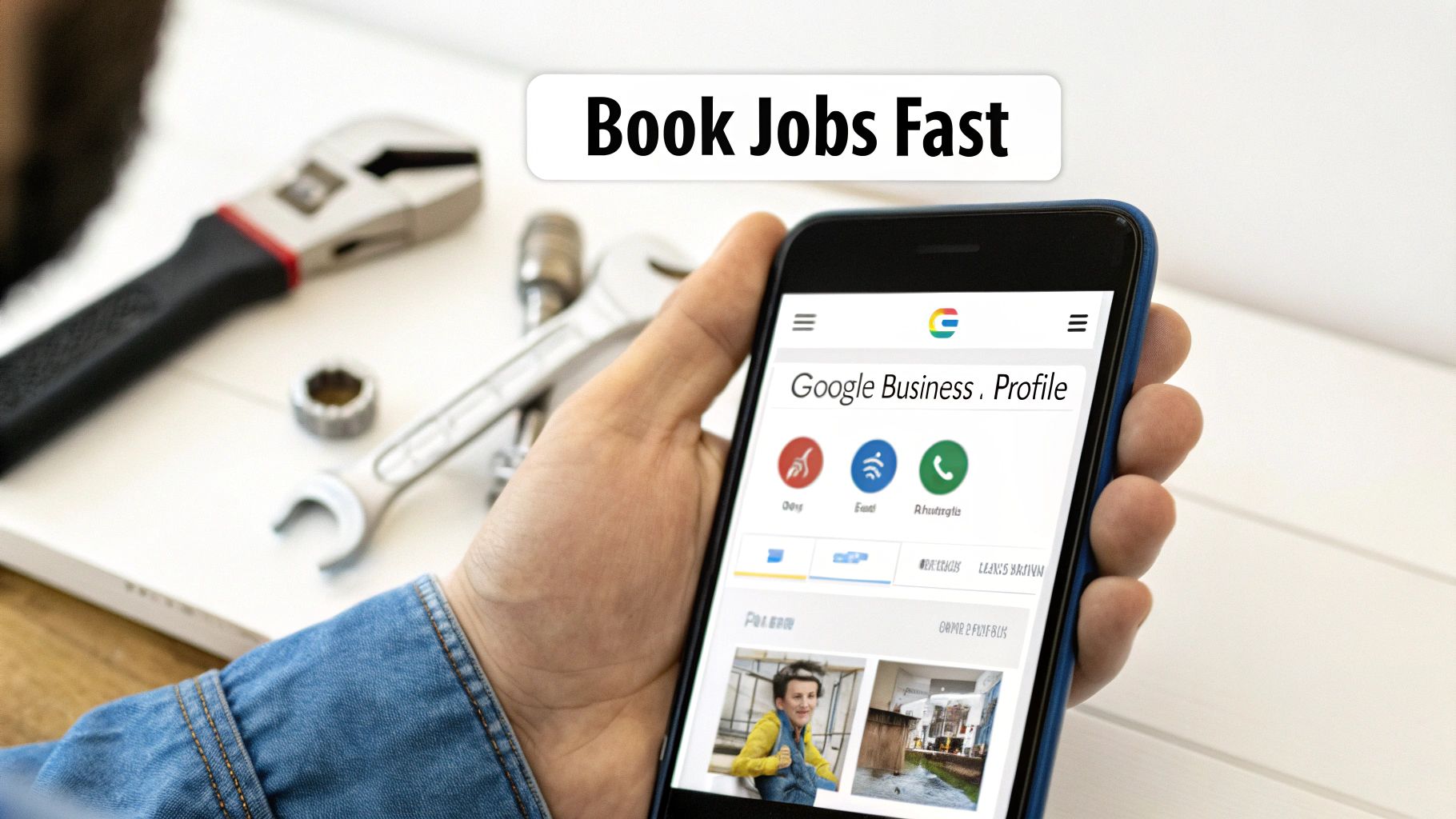
Your Google Business Profile (GBP) is way more than just a map listing—it's your most powerful digital storefront. For a plumber, it’s the modern version of having the biggest, brightest sign on the busiest road in town. When you dial it in correctly, it can generate calls and book jobs directly from Google, often before a potential customer even bothers to visit your website.
Think of it as the ultimate first impression. This is where a panicked homeowner with a burst pipe will instantly see your reviews, your phone number, and your service hours. An incomplete or neglected profile is a massive missed opportunity. It basically tells that customer you might not be the most professional or reliable choice for their emergency.
From Simple Listing To Interactive Hub
To turn your profile into a genuine lead-generating asset, you need to treat it like a mini-website. This means filling out every single section with accurate, compelling information that answers a potential customer’s immediate questions. This isn't just busywork; it's a critical piece of any effective plumbing marketing strategy because it directly impacts your visibility in the local map pack.
The hard truth is that over 70% of clicks for plumbing services come from the Google Maps 3-Pack or the top organic search results. This is why mastering your GBP isn't optional—it’s the primary driver of high-intent local leads from people who need you right now.
Your GBP is where trust is built in seconds. A customer sees your star rating, photos of your team, and a clickable phone number, making the decision to call you almost effortless.
Here's how to start optimizing your profile for maximum impact and turn those views into profitable jobs.
Key Optimizations That Drive Calls
Start by getting the foundational information perfect. This includes your business name, address, phone number, and service areas. But don't stop there. The details are what separate the top-ranking plumbers from everyone else.
- Select The Right Categories: Choose "Plumber" as your primary category, of course. But then add secondary categories for all your specialties, like "Drain cleaning service," "Water heater installation," or "Sewer contractor."
- Showcase Your Work with Photos: Upload high-quality photos regularly. I’m talking about pictures of your team in uniform, your branded trucks, and—most importantly—before-and-after shots of completed jobs. This visual proof builds immense trust.
- Use Google Posts for Updates: Think of Google Posts as free ad space right on the search results page. Announce a special on water heater inspections, highlight your 24/7 emergency availability during a cold snap, or share a link to a helpful blog post. These posts expire, so you've got to keep them fresh.
- Enable Messaging and Booking: Make it ridiculously easy for customers to contact you. Turn on the messaging feature to allow for quick questions and answers directly through your profile. If you use scheduling software, integrate a booking button.
Once your Google Business Profile starts generating leads, having a reliable plumbing virtual receptionist to answer calls and book appointments becomes indispensable for converting that interest into actual business.
A Real-World Success Story
Let me tell you about a plumber in a competitive Midwest city. They were getting decent daytime calls but missing out entirely on the lucrative after-hours emergency market. Their GBP simply listed their hours as 9-5, even though they had a tech on call 24/7.
They made a simple but powerful change: they updated their GBP hours to "Open 24 hours." They also started using Google Posts every weekend to reinforce their "24/7 Emergency Service" availability.
The result? Within two months, they saw a 50% increase in after-hours emergency calls. Customers searching late at night saw their "Open 24 hours" status and called them without a second thought. This small tweak transformed their profile from a simple business listing into a round-the-clock lead machine.
Building Unbreakable Trust with Reviews and a High-Converting Website
When a pipe bursts under the kitchen sink, a homeowner isn't shopping for a bargain. They're looking for a hero—someone trustworthy they can call in a complete panic. In the plumbing business, trust isn't just a nice-to-have; it's the currency that gets your phone to ring instead of the other guy's. This is where your digital reputation and your website have to work in perfect harmony.
Think of it this way: your marketing is all about building that trust at scale, starting with a steady stream of five-star reviews. Those reviews are today's word-of-mouth, acting as powerful social proof that you're reliable, professional, and the right plumber for the job.
A Simple System for Five-Star Reviews
Getting great reviews doesn't have to be complicated or feel awkward. All it takes is a simple, repeatable system that makes it incredibly easy for happy customers to share their experience. The goal here is simple: ask every single satisfied customer for a review, every single time.
This process starts with your technicians in the field. Train them to mention it right at the end of a successful job.
Here's a simple script they can adapt:
"Mr. Johnson, we're all wrapped up and everything's working perfectly now. We're a local business and honestly, feedback from customers like you is how we grow. If you were happy with the service today, would you mind taking a minute to leave us a review on Google?"
That personal touch is incredibly effective. The real key, though, is the immediate follow-up. While the great experience is still fresh in their mind, send a text or email with a direct link to your Google review page. This removes all the friction and makes a huge difference in your success rate.
Turning Trust into Action on Your Website
Once those glowing reviews build the initial trust, your website's job is to turn that feeling into an immediate phone call. This is where Conversion Rate Optimization (CRO) comes into play. It’s the art and science of making your website as easy as possible for a frantic customer to use.
Picture this: a potential customer lands on your site from their phone. They're stressed, impatient, and their basement might be flooding. They aren't there to browse; they need help, and they need it now. Your website has to solve their problem in seconds. In fact, research shows that 69% of smartphone users are more likely to book with companies that have mobile sites that directly address their urgent needs.
A high-converting website for a plumber isn't about flashy design. It's a purpose-built tool designed for one thing: to make the journey from panic to 'problem solved' as fast and frictionless as possible.
To make this happen, every element of your website must be built around the urgent needs of your customer. We dig into the nitty-gritty of this in our complete guide on how to improve website conversion rate.
The Anatomy of a High-Converting Plumber Website
To turn your website into a true lead-generating machine, you need to focus on a few essential elements. These aren't just design choices; they are conversion triggers that speak directly to a customer's state of mind during a plumbing emergency.
-
A Massive, Click-to-Call Phone Number: Your phone number should be the most obvious thing on the page, especially on mobile. Make it a large, clickable button that stays "stuck" to the top or bottom of the screen as someone scrolls. No hunting allowed.
-
Crystal-Clear Service Descriptions: Don't make people guess what you do. Use simple, direct language. You should have dedicated pages for your core services like "Emergency Leak Repair," "Drain Cleaning," and "Water Heater Installation."
-
Prominent Trust Badges: Display visual cues that instantly build credibility. Think badges for "Licensed & Insured," "24/7 Emergency Service," "Family Owned & Operated," or any local certifications and awards you hold.
-
Simple, Short Contact Forms: For any non-emergency inquiries, keep your contact forms ridiculously simple. All you need is a name, phone number, and a quick description of the issue. A long, complicated form is a guaranteed way to lose a potential job.
By pairing a stellar online reputation with a website that’s built for action, you create a powerful system that doesn't just attract customers—it efficiently converts them into scheduled jobs.
Using Paid Ads to Generate Immediate Calls
Look, SEO is the long game. It builds trust and authority, but sometimes you just need the phone to ring right now. A customer with a burst pipe in their basement isn't going to wait for your website to climb the rankings. This is where paid ads come in, letting you jump to the very front of the line for your most profitable services.
The goal isn't just to get clicks; it's to get immediate, qualified phone calls from homeowners who are in the middle of a crisis. We're talking about strategies designed to connect you with people who have a credit card in one hand and their phone in the other, ready to hire the first credible plumber they find.
The Power of Google Local Services Ads
The absolute fastest way to get those calls is with Google Local Services Ads (LSAs). You’ve seen them—they're the ads sitting right at the very top of the search results, even above the traditional paid ads and organic listings. More importantly, they have that coveted "Google Guaranteed" badge.
That little green checkmark is an instant trust signal. It tells a stressed-out homeowner that Google has already vetted your business, which gives them the confidence to call. The best part? LSAs are pay-per-lead. You only pay when a real customer actually calls you through the ad, which takes a huge amount of financial risk off the table.
Creating Hyper-Targeted Google Ads
Just below LSAs are the traditional Google Ads. While they take a bit more hands-on management, they give you incredible control to target specific, high-intent keywords. Think like a customer in a panic. What would they type?
- "Burst pipe repair [Your City]"
- "Emergency water heater replacement"
- "24-hour plumber near me"
By bidding on these urgent phrases, you make sure your ad is the first thing they see at the exact moment they need you. In major U.S. markets, where 39% of consumers estimate that over 40% of their searches are for local businesses, not running paid ads makes you invisible during these money-making moments. You can discover more insights about plumbing customer search habits to see just how critical this visibility is.
Paid advertising is like flipping a switch. When a plumbing emergency hits your town, you can instantly put your business in front of every desperate homeowner, generating profitable jobs that very same day.
A well-built campaign is a powerful lever for instant growth. If you want to get into the nitty-gritty, our guide explains the fundamentals of what is paid search advertising and how it all works.
From a Deep Freeze to a Massive ROI
Let me tell you about a plumber we know in a northern state. He had a small Google Ads budget he’d turn on every now and then. Then, a surprise arctic blast hit, sending temperatures plunging and freezing pipes all over his service area.
He saw the opportunity and made a gutsy move: he dumped his entire monthly ad budget into a single week. He quickly built a new campaign targeting keywords like "frozen pipe thawing service" and "emergency burst pipe plumber." His ads were simple and direct, highlighting his 24/7 availability and rapid response time.
The result was immediate and frankly, overwhelming. His phone rang off the hook for three days straight, leading to the single most profitable week in his company's history. This just goes to show that smart ad spending isn't an expense—it's a powerful investment that can turn a local crisis into a huge business opportunity.
Your 90-Day Digital Marketing Action Plan
Knowing what to do is one thing, but actually putting it into practice is what gets the phone ringing. Let's break down everything we’ve covered into a clear, 90-day action plan.
Think of this as your blueprint. We're going to build a strong foundation first, then layer on the strategies that build trust and drive real growth. Follow these steps, and you'll create a system that consistently brings in new leads.
Month 1: The Foundation Phase
The first 30 days are all about getting your digital house in order. The goal here is simple: make your business incredibly easy to find and completely trustworthy in the eyes of both Google and your potential customers.
- Task 1: Complete GBP Optimization: Go through your Google Business Profile and fill out every single section. This means adding all your service categories, uploading at least 10 high-quality photos of your team and your work, and writing a business description packed with your top keywords.
- Task 2: Website Essentials: Make sure your website has a massive, click-to-call phone number that's impossible to miss on every single page. You'll also want to add trust badges like "Licensed & Insured" and "24/7 Service" right on your homepage.
- Metric to Track: Leads from Google Business Profile.
Month 2: The Trust Building Phase
With a solid foundation in place, Month 2 is all about building social proof and making sure your website is a lead-generating machine. This is where you prove to visitors that you're the absolute best choice for the job.
- Task 1: Launch Review Generation: Start asking every single happy customer for a review. As soon as you finish a job, send a quick text or email with a direct link to your Google review page. Timing is everything.
- Task 2: Optimize Service Pages: Pick your top three service pages and give them an upgrade. Add real customer testimonials and punchy, clear calls to action to each one. For a deeper dive, check out our guide on how to get more plumbing leads.
- Metric to Track: Number of new 5-star Google reviews.
Month 3: The Acceleration Phase
Alright, it's time to step on the gas. In Month 3, we're going to use paid ads to get the phone ringing right now while we plan out future content to keep that momentum going strong.
This timeline shows you the smart way to roll out your paid ads—starting with your SEO foundation before jumping into LSAs and then broader Google Ads.
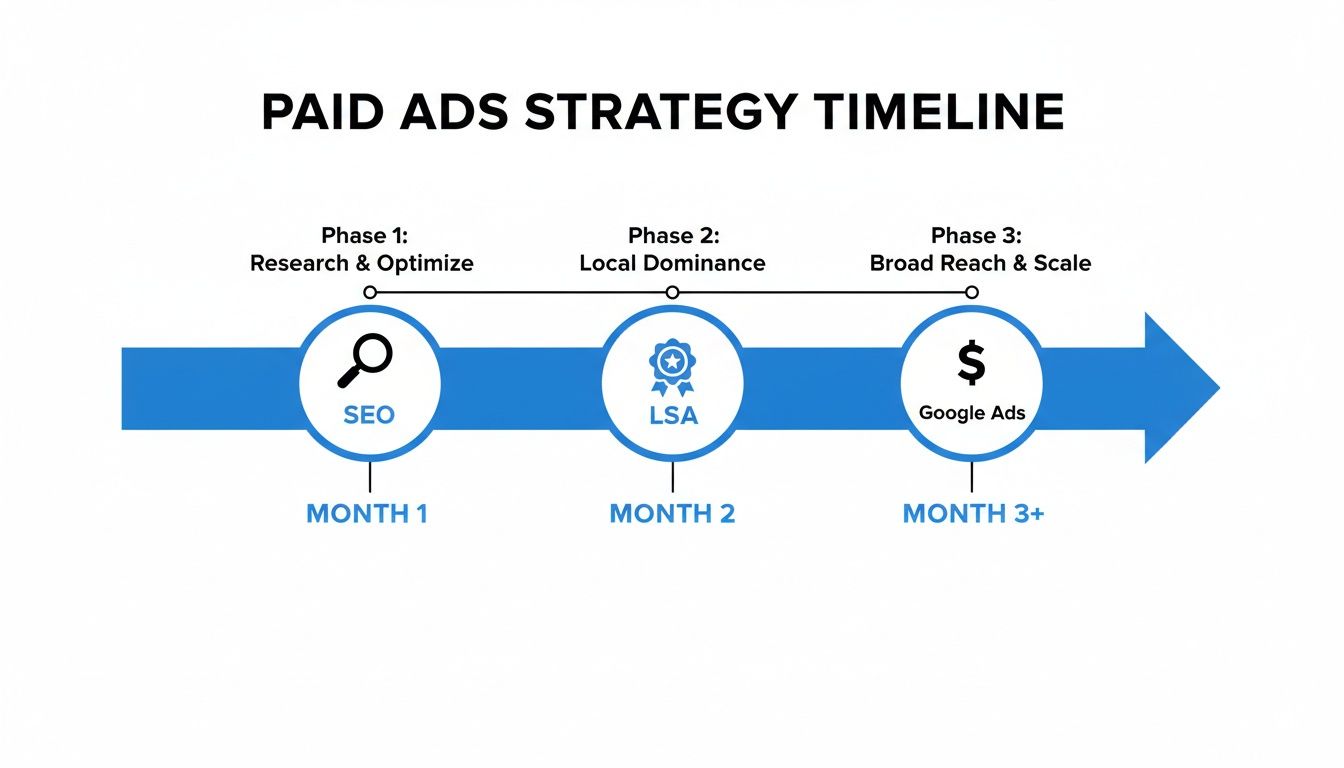
Following this sequence makes sure your ad budget is spent as efficiently as possible, grabbing those high-intent leads first.
- Task 1: Launch Google LSAs: Get your Google Local Services Ads campaign up and running. This is the fastest way to start generating immediate, pay-per-lead phone calls from customers who need help now.
- Task 2: Plan Future Content: Map out three blog post topics that answer the questions your customers are actually asking. Think things like, "Why is my garbage disposal humming?" or "How can I prevent my pipes from freezing this winter?"
- Metric to Track: Phone calls from your website.
Got Questions About Marketing Your Plumbing Business? We Have Answers.
Jumping into digital marketing can feel like you're trying to fix a leak in the dark. A lot of questions come up. Here are some of the most common ones we hear from plumbers, with straight-up, no-fluff answers to help you get moving.
How Much Should We Really Be Budgeting For Marketing?
The textbook answer is 7-10% of your total revenue. But let's be realistic—that's a pretty wide range. A much better way to think about it is to work backward from how many leads you actually need.
For most plumbing shops, a starting budget between $1,500 and $4,000 per month is a solid place to begin. That's enough to run a smart local SEO campaign and get your feet wet with some Google Ads. The absolute key, though, is to track your return like a hawk. If you spend $2,000 and it brings in $10,000 worth of jobs, that budget just paid for itself five times over. Start with what you can comfortably invest, measure everything, and double down on what's working.
What's More Important: SEO or Paid Ads?
This is a classic, but they’re not really competing—they're two different tools for the same job. They actually work best when you use them together.
Think of SEO as buying a house. It's your long-term asset. You put in the work upfront, build equity over time, and eventually, it generates leads for you without you having to pay for every single click. It's the foundation of a sustainable business.
Paid ads are like renting a massive billboard on the busiest highway in your city. It gets you immediate attention and phone calls right now. For a plumber who needs the phone to ring today, the best approach is to launch paid ads for those instant results while you simultaneously build your SEO foundation. The ads bring in the cash flow you need today, which in turn helps fund the long-term, powerhouse growth that SEO delivers.
How Long Does It Really Take For SEO To Start Working?
You might see a few small positive signs in the first month or two, but you need to be patient. Real, meaningful results from local SEO—the kind that brings in a steady stream of calls—typically take 4-6 months to really kick in. This isn't a quick fix; it's a marathon, not a sprint.
You can't rush trust with Google. This timeframe is what it takes to consistently prove that you're the most relevant, reliable, and authoritative plumber in your service area. That proof comes from optimizing your site, building out local directory listings, and earning great customer reviews.
Be extremely wary of anyone who promises you #1 rankings in 30 days. That's just not how it works. Consistent, methodical effort is what builds a dominant presence in local search that will pay you back for years.
Ready to stop guessing and start getting more calls? The team at Jackson Digital builds custom marketing playbooks that turn online visibility into predictable jobs for plumbers. Request your free performance audit to see where your biggest opportunities are hiding.