Digital marketing for small businesses isn't some dark art. It’s about using online tools like Google, social media, and email to find new customers and keep the ones you have. It’s the most powerful and budget-friendly way to tell your story, get leads, and grow your business.
Think of it as your digital storefront—it’s always open and always working for you.
Your Digital Marketing Starting Point

If you've ever felt completely swamped by the idea of online marketing, you're not alone. So many business owners see it as a tangled mess of acronyms and rules that change every other week.
But here’s the reality: digital marketing is just about meeting your customers where they already spend their time—online. It’s about telling your story in a way that connects with them and makes your business the only logical choice.
Picture this: a potential customer needs a plumber. A decade ago, they'd flip through the Yellow Pages. Today, they pull out their phone and type "plumber near me" into Google. This is where your digital journey starts. It isn't just about having a website; it's about making sure that website shows up when it actually matters.
Why Your Business Needs to Be Online
Being visible online isn't a "nice-to-have" anymore. It's flat-out essential for survival and growth. A smart digital strategy does more than just advertise; it builds trust, positions you as an expert, and opens a direct line of communication with your audience.
The shift is massive and undeniable. The global digital marketing market is on track to hit $786 billion by 2026 as advertising dollars continue to pour into online channels. More importantly, 94% of small businesses are planning to invest more in their digital marketing next year, showing you exactly where the puck is headed.
At its core, digital marketing for small businesses is about being the best answer to a customer's problem at the exact moment they are looking for a solution.
Building Your Foundation for Success
Before you jump into tactics, you need a clear direction. A winning strategy isn't about blasting your message across every platform you can think of. It's about figuring out the handful of channels that will deliver the biggest punch for your specific business.
This guide will break down the key pieces of digital marketing for small businesses, with a focus on practical steps to help you rank on search engines:
- Search Engine Optimization (SEO): The art and science of getting your website to rank higher on Google.
- Local SEO (GEO): How to completely own the search results in your specific city or service area.
- Answer Engine Optimization (AEO): Becoming the direct answer to questions people type into search engines.
To see real growth in today's market, every small business needs a solid plan. For some great foundational ideas, check out these powerful small business marketing strategies.
Getting Found on Google and Beyond
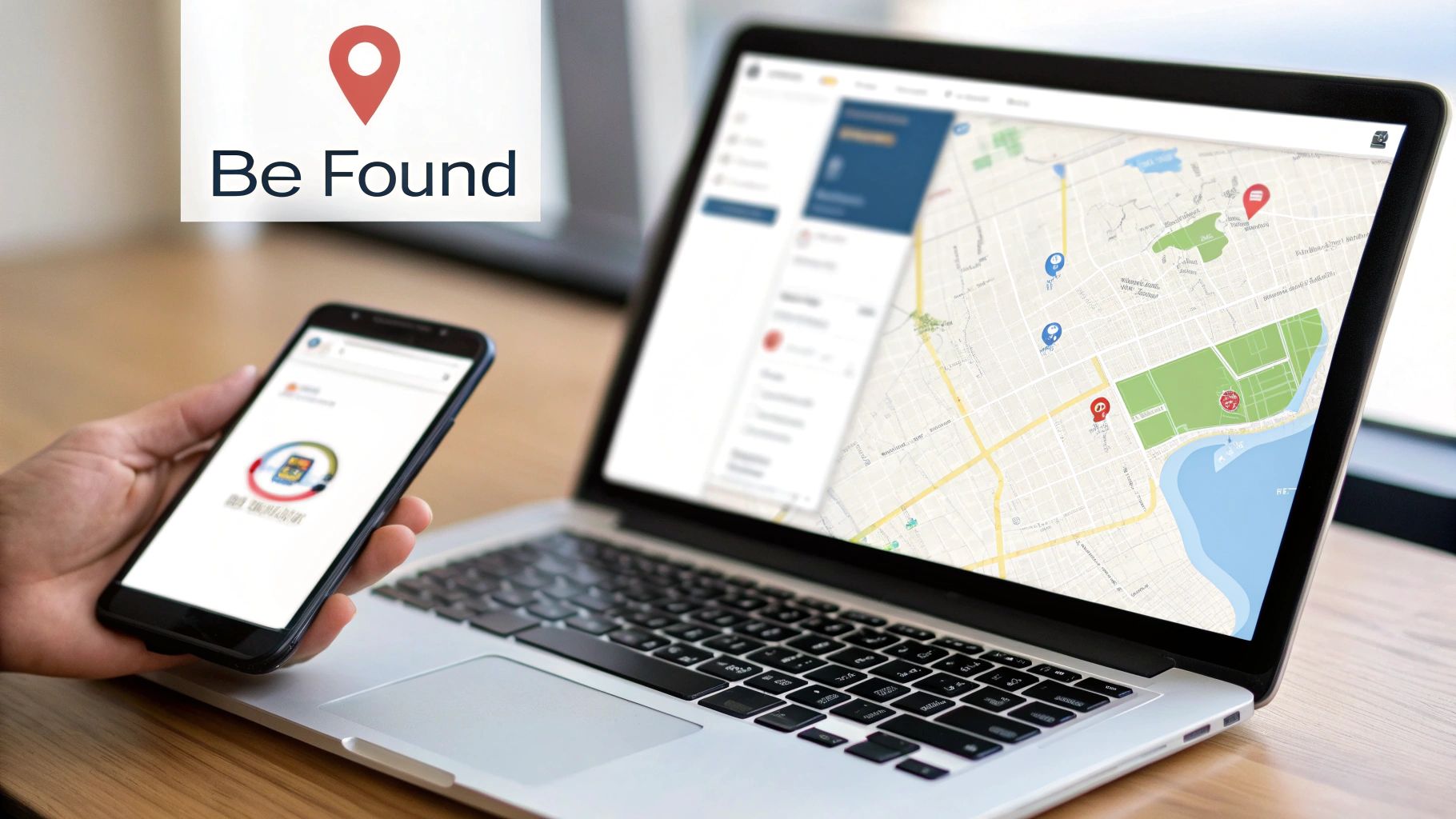
Look, just having a website doesn't cut it anymore. If customers can't find you when they search, you might as well be invisible. This is where search visibility comes in—and it's not about learning secret technical voodoo. It's about making your business the most helpful, relevant answer for whatever a potential customer is looking for on Google.
To really nail this, we're going to break it down into three core pillars. Think of them as different tools in your toolbox, each perfect for a specific job but working together to build a powerful online presence.
SEO: Telling Your Story to Google
Search Engine Optimization (SEO) is the process of structuring your website and content so search engines understand what you do and see you as an authority. Think of it as telling a compelling story not just to your customers, but to Google itself. When Google understands your story and trusts your expertise, it recommends you to its users.
This is a long-term strategy that builds real, lasting value. A site with strong SEO doesn't just rank higher—it provides a better experience for visitors, turning searchers into customers.
Actionable Tip: Start with your website's page titles and headings. Make sure the title of your homepage isn't just "Home," but something descriptive like "Artisan Bakery in Springfield | Fresh Sourdough & Pastries." This simple change tells a clearer story to both users and search engines about who you are and what you offer.
GEO: Winning Your Neighborhood
While SEO tells your broader story, GEO, or local search optimization, shouts it from the rooftops in your specific service area. If you have a physical location or serve a local community, this is your top priority. It’s how you appear when someone searches for "best tacos near me" or "emergency plumber in Austin."
The absolute linchpin for this is your Google Business Profile (GBP). This free listing is your official home base on Google Search and Maps.
An optimized Google Business Profile is arguably the single most important piece of digital marketing for any business that relies on local customers. It's your digital storefront, phone book listing, and review platform all rolled into one.
Actionable Tip: Actively solicit reviews from every happy customer. Send them a direct link to your GBP review section. Each positive review is a powerful signal to Google that you’re a trusted local business, which directly helps you rank higher in local map results. If you want to really dig in, you can learn more about how to master digital marketing for local businesses and own your turf.
AEO: Answering Your Customers' Questions
Finally, let's talk about AEO, or Answer Engine Optimization. Search is becoming more conversational. People don't just type keywords; they ask full questions like, "How do I know if my furnace filter needs changing?" AEO is about creating content that directly answers these questions.
Being the best answer positions you as an expert and builds trust before a customer even thinks about making a purchase.
Actionable Tip: Create a "Frequently Asked Questions" page on your website. Use the actual questions your customers ask you. Structure each question as a heading (H2 or H3) and provide a clear, concise answer directly below it. This format makes it incredibly easy for Google to pull your content into a featured snippet or use it for a voice search result.
Comparing SEO, GEO, and AEO Focus Areas
To make it even clearer, let's break down how these three pillars differ and where your business fits in.
| Pillar | Primary Goal | Key Tactics | Best For |
|---|---|---|---|
| SEO | Rank for broad industry terms and build long-term authority. | Keyword research, on-page optimization, quality content creation. | All businesses, especially those with a national or e-commerce focus. |
| GEO | Appear in local map packs and "near me" searches. | Google Business Profile optimization, local citations, customer reviews. | Brick-and-mortar stores, restaurants, and service-area businesses. |
| AEO | Be the direct answer in featured snippets and voice search. | Q&A-formatted content, structured data, conversational language. | Businesses that can answer common customer questions and establish expertise. |
Each pillar serves a unique purpose, but they work best when they work together. A strong SEO foundation makes your GEO and AEO efforts more effective, and great local and answer-focused content will, in turn, boost your overall authority.
Building Your Customer Connection Engine
Getting found on Google is a huge win, but it’s just the start. To build a business that can weather any storm, you need direct lines of communication with your customers—the people who actually buy from you. Think of it as building your own customer connection engine, a system that works across different channels to pull new people in and turn them into loyal fans.
This doesn't mean you need to be everywhere at once. The real key is being smart and strategic, picking the spots online where your message will hit home the hardest. We're going to focus on three of the most powerful channels for this: social media, email marketing, and paid ads.
Meet Customers Where They Are on Social Media
Social media isn't just for sharing vacation photos anymore; it's a legitimate engine for business growth. It's the perfect place to tell your brand's story, build a real community, and chat directly with potential customers in a way that feels natural and human.
The biggest mistake small businesses make is spreading themselves too thin. Don't try to master every single platform. Instead, pick one or two where you know your ideal customer hangs out.
A local boutique selling handmade jewelry, for example, is all about aesthetics. Their audience is visual. For them, platforms like Instagram and Pinterest are a no-brainer for showing off their beautiful products with great photos and short videos. On the flip side, a B2B consultant will get far more traction on LinkedIn, where they can share industry insights and network with other professionals.
The goal of social media isn't just to rack up followers. It's about building a genuine community. You're trying to start conversations that turn casual scrollers into paying customers and, eventually, your biggest advocates.
Create Content That Builds Community
Once you’ve picked your platforms, the game shifts to creating content that actually helps people. Stop just posting sales pitches. Give them a peek behind the scenes, offer useful tips related to your industry, or share the stories of happy customers.
Here's a simple content framework to get you rolling:
- Educate: Share tips, how-to guides, or answer frequently asked questions. A local accounting firm could do a weekly "Tax Tip Tuesday."
- Entertain: Let your brand's personality shine. Use a little humor, tell an interesting story, or post a cool-looking photo. A coffee shop could film a time-lapse video of their baristas making latte art.
- Engage: Ask questions, run polls, and—this is critical—respond to every single comment. That back-and-forth is how you build real relationships.
The data backs this up. A recent survey found that a whopping 91% of small businesses now use multiple channels to market or sell, and social media is leading the charge. Platforms like Facebook (59% usage), Instagram (43%), and even TikTok (33%) are driving real sales. In fact, nearly half of business owners say these channels bring in over 20% of their total revenue. You can see more on how small businesses are adapting at sbecouncil.org.
Drive Sales with Email and Paid Ads
While social media is fantastic for building a community, email and paid ads are your power tools for getting people to take action right now.
Email is a channel you completely own. It's a direct line to your most engaged fans, and no algorithm can get in the way. Use it to follow up with leads, announce new products, send out exclusive offers, and keep customers coming back. If you're not sure where to start, you can learn more about building a system that works in our guide on how to generate leads online.
Paid advertising, or Pay-Per-Click (PPC), is like taking the express lane. It lets you put your message in front of a super-specific audience almost instantly. You don't need a huge budget to get started, either. A small, targeted ad campaign on Google or Facebook can give you immediate feedback on what messages and offers are working, so you know where to put your money as you grow.
This one-two punch of long-term relationship building (social, email) and short-term lead generation (PPC) is a cornerstone of smart digital marketing.
Digital Marketing Playbooks for Your Industry
General advice is a decent starting point, but the best digital marketing strategies are never one-size-fits-all. The tactics that work for a local dentist are worlds away from what a national e-commerce brand needs to succeed. This is where having an industry-specific playbook makes all the difference, giving you a focused game plan that actually gets results.
Let's break down some actionable mini-playbooks for three common business types. Each one zeroes in on the marketing tactics that deliver the biggest impact, helping you cut through the noise and focus on what truly grows your business.
Local Services Playbook: The GEO-Heavy Strategy
If you're a plumber, roofer, dentist, or cleaner, the entire game is about dominating local search results. Your customer isn't across the country; they're down the street, frantically typing "emergency plumber near me" into their phone. Your strategy has to be laser-focused on GEO (local search optimization).
The absolute cornerstone of this playbook is your Google Business Profile (GBP). Think of this free listing as your digital storefront on Google Search and Maps. It’s non-negotiable.
Here’s your action plan:
- Complete Profile Optimization: Fill out every single section of your GBP—services, hours, photos, Q&A, business description, you name it. The more information you feed Google, the more confidently it will recommend you to searchers.
- Aggressive Review Generation: You have to actively ask every happy customer for a review. Positive reviews are one of the most powerful signals for ranking high in the local map pack.
- Location-Specific Content: Create dedicated pages on your website for each town or neighborhood you serve. This explicitly tells Google where you operate and helps you show up for those valuable "service in [city]" searches.
This is what a Google Business Profile looks like—it's the central hub for your local online presence.
This interface is your command center. It’s where you manage how customers see you on Google, from updating your hours to responding directly to reviews.
If your business is in the cleaning sector, there are specific strategies for attracting new clientele, including a mix of online marketing for cleaning businesses and local partnerships.
E-commerce Playbook: The Visual and Retargeting Focus
For e-commerce brands, the battle is won or lost on product pages and in shopping carts. Your playbook needs to be a potent mix of strong SEO, a visually captivating social media presence, and smart advertising that reels customers back in.
For an online store, a sale isn't just a transaction; it's the result of a customer journey that often spans multiple touchpoints, from a social media ad to a well-optimized product page.
Your e-commerce action plan centers on these three pillars:
- Product Page SEO: Optimize every single product title, description, and image alt-text with the keywords customers actually use to find what you sell. This is how your products show up in both standard Google searches and Google Shopping results.
- Visual Social Media: Lean heavily on platforms like Instagram and Pinterest. Use them to showcase your products with high-quality photos and videos. Even better, feature user-generated content by sharing pictures from real customers—it’s pure gold for building trust.
- Abandoned Cart Retargeting: A mind-boggling 70% of online shopping carts are abandoned. Set up simple retargeting ads on platforms like Facebook or Google that show these potential customers the exact products they left behind. Tossing in a small discount is often all it takes to entice them back.
B2B Company Playbook: The Content and Authority Game
For B2B companies selling services or software to other businesses, the sales cycle is longer. It's built on a foundation of trust and expertise. Your playbook isn't about chasing quick sales; it's about patiently nurturing long-term relationships with incredibly valuable content.
This strategy is a marathon, not a sprint. The goal is to prove you're the undisputed expert in your field.
Here are the key moves in the B2B playbook:
- In-Depth Blog Content: Write detailed articles that solve your target clients' biggest, most painful problems. A cybersecurity firm, for example, might publish a definitive guide on "How to Create a Data Breach Response Plan," positioning themselves as a trusted advisor, not just a vendor.
- LinkedIn Engagement: LinkedIn is your primary social platform. Share your blog content, post insightful commentary on industry news, and engage directly with potential clients in a professional setting. It’s where your customers are.
- Lead Nurturing with Email: Use your amazing content to capture email addresses (e.g., offer a downloadable guide or a webinar recording). From there, an automated email sequence can send more helpful content over weeks or months, building trust until they're finally ready for a sales conversation.
Measuring What Matters to Your Business
Marketing without a way to measure it is just guesswork. It's like driving blindfolded—sure, you're moving, but you have no idea if you're actually getting closer to your destination. This is all about taking off the blindfold, looking at the data that truly matters, and figuring out what’s working, what's not, and where to put your money for the best return.
You don't need to drown in a sea of spreadsheets filled with confusing numbers. The real goal is to zero in on just a handful of key performance indicators (KPIs) for each of your marketing channels. These are the specific metrics that tell a story about your business and connect your marketing efforts directly to your bottom line.
Your Digital Marketing Dashboard
You don't need to shell out big bucks for fancy software to get started. Two free tools from Google are the perfect starting point for any small business: Google Analytics 4 and Google Search Console. Think of them as the dashboard for your website.
-
Google Search Console (GSC): This is your direct line of communication with Google. It tells you exactly how your site is performing in Google Search—which keywords people are using to find you, which of your pages get the most clicks, and if there are any technical glitches holding you back.
-
Google Analytics 4 (GA4): If GSC shows you how people get to your site, GA4 shows you what they do once they're there. You can see your most popular pages, how long visitors stick around, and—most importantly—which actions they take that actually turn into a sale or a lead.
These two tools work in tandem to paint a crystal-clear picture. GSC might show you that your blog post on "emergency roof repair" is getting tons of clicks, and GA4 can then show you that visitors landing on that post are filling out your contact form at an incredible rate. That's how you prove your marketing is actually making you money.
Key Metrics for Each Channel
Every marketing channel tells a different part of your growth story, and each has its own set of numbers that matter. If you focus on these specific metrics, you can avoid feeling overwhelmed and start making smart, data-driven decisions instead of just winging it.
Here’s a breakdown of the essentials:
-
SEO & Content: The main goal here is to pull in qualified traffic from search engines. You'll want to watch your Organic Traffic (how many visitors you get from search), your Keyword Rankings (where you show up for your most important search terms), and your Conversion Rate (the percentage of those visitors who take a desired action, like buying something or filling out a form).
-
Email Marketing: This channel is all about building and nurturing relationships. Keep an eye on your Open Rate (how many people actually open your emails), Click-Through Rate (CTR) (how many click a link inside), and your Unsubscribe Rate. For example, a super high open rate with a pitifully low CTR probably means your subject line was killer, but the content inside didn't deliver.
-
Paid Ads (PPC): When you're paying for traffic, efficiency is everything. The metrics you can't ignore are your Cost Per Click (CPC), your ad's Click-Through Rate (CTR), and your Conversion Rate. At the end of the day, all these numbers funnel into your Customer Acquisition Cost (CAC)—the total amount you have to spend to get one brand new paying customer.
By focusing on the data that directly impacts revenue, you can stop guessing and start making strategic decisions. Measurement turns your marketing from an expense into a predictable engine for growth.
Getting a handle on these numbers helps you put your budget where it will do the most good. Knowing your CAC, for instance, is absolutely critical for staying profitable. You can figure this out with a simple customer acquisition cost calculator to see what your business can sustain. This one calculation can completely change how you see your marketing spend, making sure every single dollar is working hard for you.
Your 90-Day Digital Marketing Action Plan
All this knowledge is great, but turning it into actual growth requires a clear, actionable plan. Let's make this happen.
A 90-day roadmap is the perfect way to build momentum and see real progress without getting bogged down. Think of it less like a rigid rulebook and more like a series of focused sprints. Each sprint builds on the last, creating a powerful marketing foundation for your small business.
This approach breaks the massive task of online marketing into manageable, 30-day chunks. It cuts through the "paralysis by analysis" and gets you moving, collecting real data you can use to make smarter decisions down the line.
Month 1: The Foundation Phase
Your first 30 days are all about laying the groundwork for everything that comes next. This is your chance to stake your claim online and set up the tools you'll need to measure what actually works. Your primary mission is to get your digital house in order.
Here are your key actions for month one:
- Claim and Optimize Your Google Business Profile: For any business with a local footprint, this is the single most important first step. Fill out every single section, upload high-quality photos, and make sure your name, address, and phone number (NAP) are perfectly consistent everywhere online.
- Install Essential Analytics: Set up Google Analytics 4 and Google Search Console. These free tools are non-negotiable. They show you how people find you and what they do once they're on your website.
- Initial Keyword Research: Start figuring out the core terms your ideal customers are typing into Google. Think about the problems you solve and the services you offer. Don't go crazy here; just get a starter list.
This timeline shows how these phases connect, starting with the foundational analytics you're setting up now.
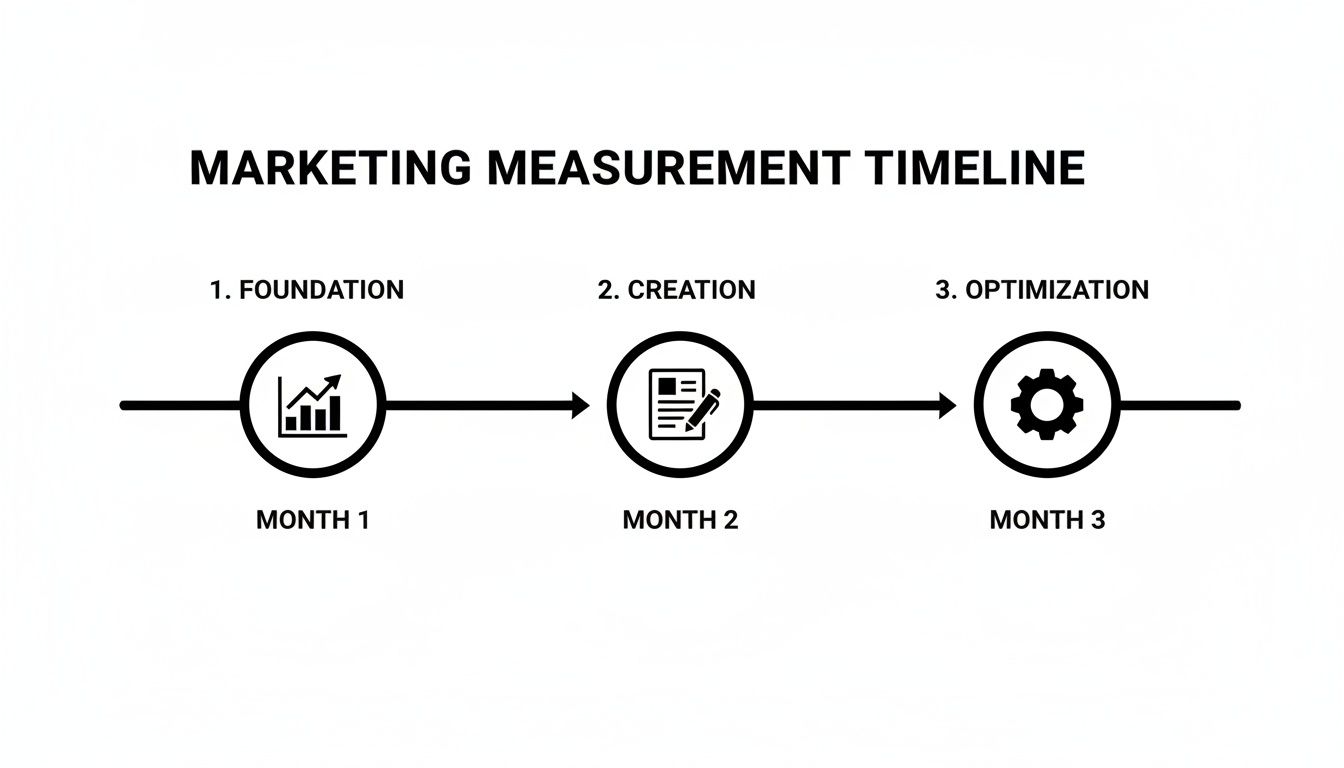
As you can see, a winning strategy moves logically from building a foundation to creating content and, finally, to optimizing based on performance.
Month 2: The Creation Phase
With your foundation set, Month 2 is all about creating and launching your first pieces of content. This is where you start telling your story and actually engaging with your audience. The goal is to start conversations and test the waters to see what sticks.
Don't aim for perfection here. Just aim for consistent action.
Your second month is about shifting from setup to execution. It’s time to publish content, schedule social posts, and launch a small ad campaign to gather immediate feedback.
Month 3: The Optimization Phase
In the final 30 days of your sprint, you shift from creating to refining. By now, you'll have a small but valuable pool of data coming in from your website, social media, and any ads you're running.
This month is all about digging into that early data, spotting the quick wins, and doubling down on what's working best. It’s time to trim the fat and amplify what's delivering results, setting you up for sustained growth long after these 90 days are up.
Frequently Asked Questions
Jumping into digital marketing can feel like you're trying to solve a puzzle with half the pieces missing. It’s totally normal to have questions when you’re also busy, you know, running a business. Let’s tackle some of the most common ones we hear so you can move forward with a bit more clarity.
How Much Should a Small Business Spend on Digital Marketing?
There’s no magic number here, but a solid benchmark to start with is 5% to 15% of your total revenue.
If you're a brand-new business trying to make a splash and carve out your space, you'll probably want to lean closer to that 15% mark. On the other hand, if you’re an established local favorite with great word-of-mouth, you might be perfectly fine investing around 5%.
The most critical shift in thinking is to see marketing as an investment, not a cost. You don't have to go all-in at once. Start small with a manageable budget for a single channel—maybe some local SEO work or a tiny Facebook ad campaign. Track your results like a hawk. When you find what works, you can confidently pour the profits back in to scale up.
SEO vs. PPC: Which Is Better for a New Business?
Think of it this way: SEO is like planting an apple orchard, while PPC is like buying apples from the grocery store.
The orchard (SEO) takes a lot of upfront work and time to grow. But once those trees mature, they provide you with free apples (organic traffic) for years to come with just a bit of maintenance. The grocery store trip (PPC) gets you apples immediately, but you have to pay for every single one. The second you stop paying, the apples stop coming.
For a new business, the smartest move is to do both.
- PPC for Quick Wins: Fire up a targeted Google Ads campaign to get traffic flowing today. It's the fastest way to test your offers and messaging.
- SEO for Long-Term Growth: At the same time, start laying the foundation for your orchard. Get your website optimized, start creating genuinely helpful content, and build your digital authority.
Over time, your SEO efforts will start bearing fruit, generating that coveted "free" traffic and making you less dependent on paid ads.
How Long Does It Take for SEO to Work?
Let's be upfront: SEO is a marathon, not a sprint. While you might see some small movements in a few weeks, it generally takes four to six months of consistent, quality work to see meaningful results. For those in really crowded markets, it can be closer to a year to crack the top spots for competitive keywords.
A bunch of factors play into this timeline, like your industry, your location, and how tough your competition is. The real key is consistency. Every blog post you publish and every quality backlink you earn is another brick in your digital foundation.
The SEO market is set to hit $122.11 billion by 2028 for a reason—it works. With billions of local searches happening every month, a patient, strategic approach to SEO is one of the most powerful ways for a small business to build a reliable stream of customers. You can dive deeper into the latest digital marketing trends on americanlendingcenter.com.
Ready to stop guessing and start growing? At Jackson Digital, we build data-driven marketing engines that deliver predictable leads and sales. Request a free performance audit today and get a clear roadmap for success. https://jackson-digital.com