
Think of a digital marketing strategy template as less of a document and more of a blueprint. It’s a practical, fillable guide for setting real goals, figuring out who you’re really talking to, picking the right channels, and actually measuring what moves the needle. It's what turns a bunch of scattered tactics into a cohesive machine built for growth.
Why Your Business Needs A Digital Marketing GPS
Trying to do digital marketing without a solid plan is like driving across the country without a map. Sure, you’re moving, but you'll burn through fuel on detours and probably end up miles from where you wanted to be. So many businesses fall into this trap—chasing the latest trend, tossing up random social media posts, or running ads with no clear objective. This approach feels busy, but it rarely produces consistent, predictable results.
A digital marketing strategy template is your business's GPS. It gives you the structure to stop reacting and start executing with a purpose. Instead of guessing, you’ll have a clear roadmap that connects your brand's unique story directly to what your ideal customers are searching for on Google.
This isn't about some abstract marketing theory. It's about building a hands-on plan that delivers real-world outcomes. By giving your efforts a structure, you create a system that consistently pulls in the right audience, tells a story that resonates, and walks them down the path to becoming a customer.
Connecting Strategy To Search Engine Visibility
A well-defined strategy is the bedrock of ranking on search engines. To get it right, every single effort—from the stories you tell in your content to the channels you focus on—needs to have a clear purpose. This template is built to help you do exactly that, zeroing in on three critical areas of search visibility:
- SEO (Search Engine Optimization): Getting your website and content dialed in so you show up in traditional search results for the right keywords.
- GEO (Geographic Optimization): Dominating local search, like Google Maps, to pull in customers right in your service area.
- AEO (Answer Engine Optimization): Structuring your content to directly answer user questions, which helps you snag featured snippets and show up in voice search.
I see this all the time: businesses treat SEO like it's completely separate from their main business plan. Real growth happens when your search strategy is a direct reflection of your business goals, customer insights, and brand story. Every piece of content should have a job to do.
This connection is what separates the businesses that thrive online from those that just exist. The global digital marketing market is absolutely exploding, projected to hit $1.3 trillion by 2033. That massive growth alone shows why a rock-solid strategy is non-negotiable if you want to grab your piece of the market.
Before you start building out your plan, it's a good idea to know where you stand today. One of our expert digital marketing audits can give you that baseline. To dig deeper into how all the pieces fit together, mastering a digital marketing strategy framework is a game-changer.
Ultimately, a strong plan helps you tell better stories that connect with your audience right when they need you. This downloadable template will give you the roadmap to get started immediately.
Core Components Of The Strategy Template
Here’s a quick look at the essential elements inside the downloadable template and the strategic purpose each one serves.
| Template Section | What It Helps You Achieve |
|---|---|
| Executive Summary | A high-level snapshot of your goals and how you plan to achieve them. Perfect for keeping stakeholders aligned. |
| Business & Marketing Goals | Defines clear, measurable objectives (SMART goals) to guide all your marketing activities. |
| Target Audience & Personas | Creates detailed profiles of your ideal customers so you can tailor your messaging, stories, and channels effectively. |
| Competitive Analysis | Identifies your competitors' strengths and weaknesses to find opportunities for your brand to stand out. |
| Channel Plan & Tactics | Outlines which marketing channels you’ll use (SEO, PPC, social, email) and the specific tactics for each one. |
| Content Strategy | Maps out the topics, formats, and distribution plan for the content you'll create to attract and engage your audience. |
| Budget & Resource Allocation | Assigns a budget to each marketing activity and allocates team resources for effective execution. |
| KPIs & Measurement | Selects the key performance indicators (KPIs) you'll track to measure success and make data-driven decisions. |
| Timeline & Action Plan | Sets a clear timeline with milestones and assigns responsibilities to ensure the strategy is implemented on schedule. |
Each section is designed to build on the last, giving you a complete and actionable plan to drive real growth for your business.
Laying the Groundwork: Goals and Audience
Before you even think about keywords or ads, we need to get two things straight: what you want to accomplish and who you're trying to reach. This is the bedrock of your entire digital marketing strategy. Filling out your template starts right here. Without this foundation, you’re just throwing money at the wall and hoping something sticks.
We’re moving beyond fuzzy goals like "get more traffic." Instead, we're going to pinpoint exactly what success looks like for you. Think of it as plugging a precise address into your GPS instead of just a city name.
It’s shocking how many companies are still driving blind. Nearly 47% of businesses don't have a documented digital marketing plan. That’s a huge miss. A written-down strategy is what separates focused, predictable growth from random acts of marketing. You can dig into more stats like this from Optimizely and Smart Insights on the state of marketing strategy.
Setting SMART Goals That Actually Drive Search Performance
The best goals are SMART goals—that’s Specific, Measurable, Achievable, Relevant, and Time-bound. This simple framework turns a vague wish into a concrete, accountable objective. It forces you to get real about what you can do and when.
Here’s how this looks in the real world for SEO, GEO, and AEO:
-
Vague Idea: "We want to rank higher on Google."
-
SMART Goal: "Achieve a top 3 ranking on Google for our 5 most important local service keywords (like 'emergency plumber Dallas') within the next six months."
-
Vague Idea: "We need more leads from the website."
-
SMART Goal: "Increase organic lead form submissions from our service pages by 15% by the end of Q3. We'll do this by creating three new long-form blog posts that answer our most common customer questions, aiming to capture featured snippets (AEO)."
See the difference? These are tangible targets you can plug right into your template. Now you have a real plan, not just a wish list.
Building Customer Personas That Guide Your SEO
Once your goals are set, it’s time to get crystal clear on who you're talking to. A customer persona is a sketch of your ideal client, but it has to go way deeper than basic demographics. For a search strategy to work, your personas must be built around search intent. What are they actually typing into that search bar, and what story is going on in their head that led them there?
The best SEO strategies are built on a foundation of empathy. When you stop thinking about 'keywords' and start thinking about the person behind the search—their worries, their urgent problems, their hopes—you create content that genuinely helps. Google rewards that helpfulness above all else.
To build a truly useful persona, you need to uncover the story behind their search. What problem is making them pull out their phone at 10 PM? What questions are they asking their friends? What words do they use to describe their situation?
Uncovering Pain Points and Search Intent
Let's say you're a local roofing contractor. A basic persona might be "Homeowner, age 35-55, lives in our service area." That’s not helpful. An SEO-driven persona gets into their head.
Persona Example: "Stressed-Out Steve"
- Role: Homeowner, father of two young kids.
- Demographics: 42 years old, lives in the suburbs, household income around $90k.
- Pain Points: He just found a nasty water stain on his living room ceiling after a big storm. He's freaking out about how much a new roof will cost, how disruptive it will be for his family, and the fear of getting ripped off by some fly-by-night contractor.
- Search Intent & Questions:
- Informational (Top of Funnel): "What does a roof leak look like?" "How to find a roof leak?" "DIY roof patch."
- Local/GEO (Middle of Funnel): "Best roofers near me." "Roof repair in [Your City]." "Reviews for local roofing companies."
- Transactional (Bottom of Funnel): "Emergency roof repair cost." "Get a free roofing estimate."
Boom. By mapping out Steve's journey, you've just created your content roadmap. Your digital marketing strategy template now has a clear list of blog posts, service pages, and FAQs you need to build to attract and help him at every single stage. This is the core of effective SEO, GEO, and AEO—connecting your solution directly to their problem.
Building Your SEO Content And Storytelling Engine
Alright, you’ve got your goals locked in and you know exactly who you're talking to. Now for the fun part: where data-driven SEO meets compelling storytelling. This is where we build a content plan that satisfies both Google's algorithms and the very real curiosity of your audience.
A winning content engine isn't about just churning out blog posts whenever you feel like it. It’s about methodically creating genuinely helpful, engaging material that answers specific questions people have at every step of their journey with you. Done right, this process turns your website into a powerful magnet for the right kind of traffic.
This diagram shows how your audience, goals, and KPIs are all woven together.
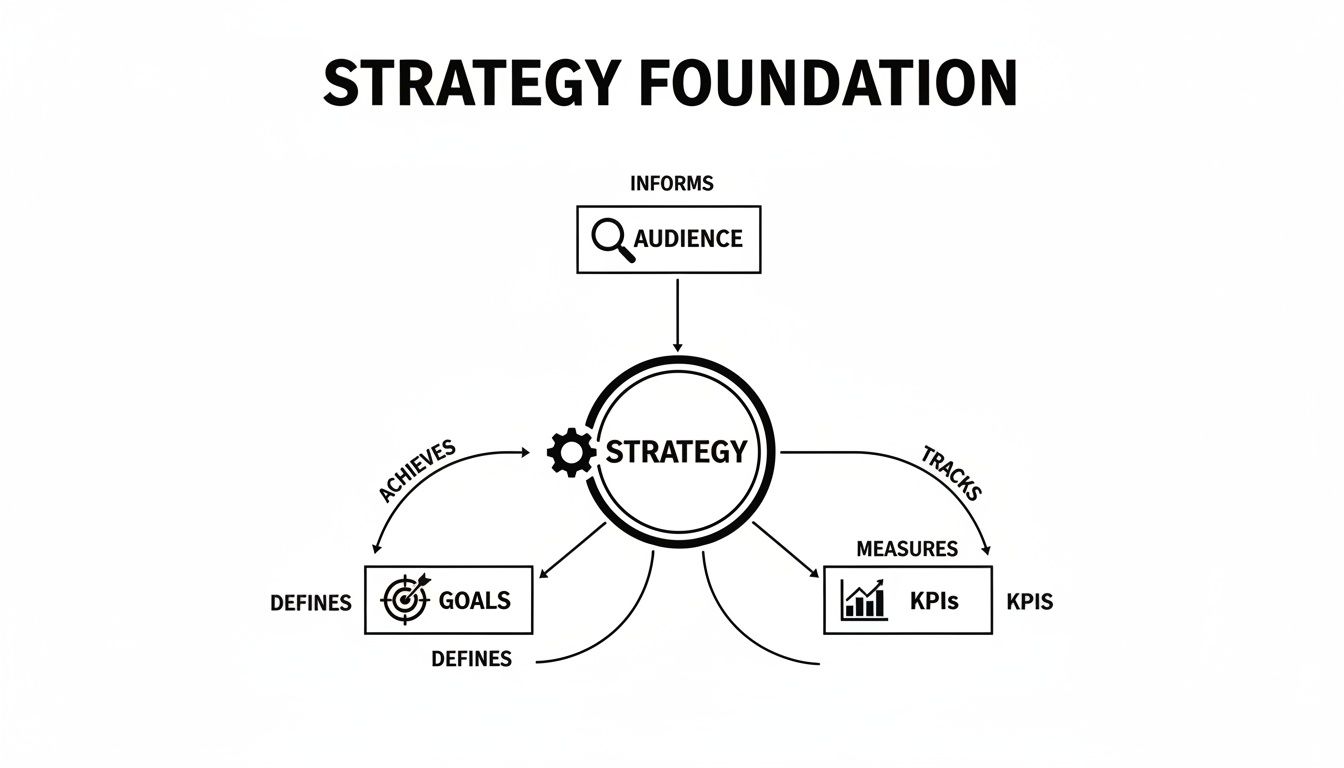
The main takeaway here is that none of these pieces work in a vacuum. Your audience's real-world problems should directly shape your goals, and your KPIs are just how you measure whether you're solving those problems.
Decoding User Intent With Keyword Research
Good keyword research is less about finding single words and more about understanding the intent behind a search. Every time someone types something into Google, they're looking for something specific, and their query usually falls into one of a few buckets. Knowing the difference is critical if you want to create content that actually connects and ranks.
- Informational Intent: The user wants to learn something. Think "how to fix a leaky faucet" or "what are the signs of a bad alternator?" They're in research mode, perfect for AEO-focused blog content.
- Local (GEO) Intent: The user needs a product or service in a specific area. This is where you get searches like "plumber near me" or "best coffee shop in downtown Austin." These are high-value keywords for local businesses.
- Transactional Intent: The user is ready to pull the trigger and make a purchase or take action. Keywords like "emergency plumbing cost" or "buy running shoes online" are clear signals they're close to deciding.
Your digital marketing strategy template needs a dedicated spot for mapping these different keyword types to content ideas. Answering those informational questions builds trust and authority. Optimizing for local and transactional keywords is what drives immediate leads and sales.
A huge mistake I see is businesses only targeting "buy now" keywords. The truth is, most of your audience isn't ready to buy the first time they find you. By creating helpful, story-driven content that answers their initial questions, you become the trusted guide they return to when they're finally ready to make a choice.
Mapping Content To The Customer Journey
Once you know the why behind their searches, you can start telling a cohesive story that guides a potential customer from just becoming aware of their problem all the way to making a decision. Every single piece of content should have a specific job to do, aligning perfectly with where that person is in their buying process.
Scenario: A Local HVAC Company
Let's walk through how this works for a local HVAC business trying to boost its local SEO (GEO) rankings.
-
Awareness Stage (Informational & AEO Content): A homeowner's AC is making a weird rattling noise. They google, "why is my air conditioner so loud?" Your business has a detailed blog post titled "7 Common AC Noises and What They Mean" that shows up. It tells the story of another homeowner's experience, it's easy to read, and it genuinely helps them diagnose the issue without a heavy sales pitch. This content is perfect for Answer Engine Optimization.
-
Consideration Stage (Local/GEO & Service-Focused Content): Now the homeowner knows they need a pro. Their search changes to "AC repair in [Your City]." This is where your highly optimized, location-specific service pages need to shine. This page should detail your repair services, feature customer testimonials (which are really just mini-stories of success), and have clear calls-to-action to book an appointment.
-
Decision Stage (Trust-Building Content): The customer has it narrowed down to two or three local companies, including yours. They're now looking for proof that you're the right call. This is where case studies, video testimonials, and a gallery of completed jobs do the heavy lifting. These assets tell powerful stories that show off your expertise and reliability, sealing the deal. Even if you're not a natural writer, you can find great tips for how to create great web content for your business that connects with customers.
Choosing Your Channels And Budgeting For Growth
You’ve mapped out a brilliant content plan designed to tell your brand’s story and answer the questions your customers are actually asking. That's a huge step. But even the best content is useless if no one ever sees it.
This is where we shift our focus from creation to distribution. It's time to pick the most effective channels to get your message in front of the right people and figure out how to budget for real, sustainable growth.
This isn't about being everywhere at once. It’s about making smart, strategic choices that directly support your business goals. A focused approach means your time and money go where they’ll generate the highest return, turning your content from a simple resource into a powerful lead-generation machine.
Selecting Your Core Marketing Channels
For most businesses we work with, especially those leaning into search visibility, a few core channels consistently deliver the best bang for the buck. Instead of spreading yourself thin across a dozen platforms, your strategy should prioritize the ones that directly support your goals for SEO, GEO, and AEO.
Let's look at the heavy hitters:
-
Organic SEO: This is your long-term foundation. By consistently creating valuable, optimized content, you build a durable asset that pulls in qualified traffic for months and even years. Think of it as the art of telling stories so well that search engines can't help but recommend you.
-
Google Business Profile (GEO Engine): If your business has a physical location or a service area, your GBP is non-negotiable. It's the engine of local search, controlling how you show up in Google Maps and the local pack. Honestly, optimizing your GBP is one of the highest-impact, lowest-cost GEO tactics you can do.
-
Paid Search (PPC): While SEO builds momentum over time, PPC buys you immediate visibility. It lets you target people with high purchase intent—think searches like "emergency plumber near me"—and puts your solution right in front of them the moment they need it.
-
Email Marketing: This is the only channel you truly own. You can use email to share your new blog posts, send out customer success stories, and gently guide leads through their decision-making process. It’s the best way to keep your brand top-of-mind.
The real magic happens when you stop seeing these as separate silos. Your goal is to create a seamless experience for your customer, where your story is consistent and helpful no matter where they find you.
Integrating Channels For Maximum Impact
Integration is how you amplify your efforts without just multiplying your workload. A single piece of pillar content—like a comprehensive guide or an in-depth article—can become the fuel for multiple channels at once. This creates a powerful feedback loop where each channel supports the others.
Real-World Scenario: A Tech Startup
Imagine a B2B tech startup just published a pillar blog post: "The Ultimate Guide to Automating Small Business Workflows."
- SEO & AEO: The guide is optimized to rank for key informational terms and structured with clear Q&As to target featured snippets, establishing the company as a credible expert in the field.
- Email: They send a summary of the guide to their email list, driving existing leads back to the website and re-engaging them with genuinely valuable content.
- PPC/Social Ads: A targeted ad campaign on LinkedIn promotes the guide to a specific audience of small business owners, using it as a lead magnet to capture new email sign-ups.
In this scenario, one piece of content serves three different channels, each with a specific job to do. The blog post builds long-term organic authority, the email nurtures the existing audience, and the ad drives immediate lead generation. It's a win-win-win.
Budgeting For Predictable Growth
Once you’ve picked your channels, you need a budget that actually supports your goals. Instead of pulling a random number out of thin air, it’s much more effective to work backward from what you want to achieve.
A huge piece of this puzzle is understanding your Customer Acquisition Cost (CAC)—basically, how much you spend on average to get one new customer. Knowing this number is critical for making informed decisions about where to invest your marketing dollars. We built a handy tool to help with this; you can check out our customer acquisition cost calculator.
Here are two common ways to think about budgeting:
- Percentage of Revenue: This is a straightforward method where you allocate a set percentage of your total revenue (or projected revenue) to marketing. For most established businesses, this falls somewhere between 7-12%.
- Objective-Based: Here, you define your specific goals (e.g., "generate 50 new leads per month") and then calculate what it will cost to hit those goals through your chosen channels. This approach is more precise and directly ties your spending to tangible outcomes.
No matter which model you choose, your digital marketing strategy template should treat the budget as a flexible plan, not a rigid set of rules. The key is to constantly track performance, measure your return on investment, and be ready to shift funds to the channels that are delivering the best results.
How To Measure Success And Adapt Your Strategy

Here’s the hard truth: a strategy without measurement is just a guess. You’ve put in the work to outline your goals and build a content plan, but that effort is wasted if you aren't tracking what's actually working. This is where your digital marketing strategy template stops being a plan and starts being a living, breathing roadmap that evolves with real-world data.
The goal isn't just to look at charts; it's to confidently analyze results, double down on what’s driving real business, and cut the dead weight. We need to move beyond vanity metrics like total website visits and focus on the Key Performance Indicators (KPIs) that truly signal growth.
Before you get started, make sure your tracking is set up correctly. This practical guide on how to use Google Tag Manager is a great resource for getting your tracking scripts implemented cleanly. Reliable data starts with a solid foundation.
Key Metrics For Tracking Search Performance
To truly understand performance, we need to track the right things. A spike in traffic is nice, but it tells you nothing if that traffic is from the wrong audience or bounces immediately. Instead, we'll focus on KPIs that directly reflect your visibility and effectiveness in SEO, GEO, and AEO. These are the numbers that show whether your storytelling is resonating with both search engines and your ideal customers.
Here's a breakdown of the essential KPIs for measuring your SEO, GEO, and AEO efforts and what each one reveals.
| KPI (Key Performance Indicator) | What It Measures | Why It's Critical For Your Business |
|---|---|---|
| Organic Keyword Rankings | Your position in search results for specific, targeted keywords. | This is your most direct measure of SEO progress. Climbing the ranks for terms your customers use is the first step to getting found. |
| Click-Through Rate (CTR) from Search | The percentage of people who see your result in search and actually click on it. | A high ranking is useless if no one clicks. A strong CTR proves your titles and meta descriptions tell a compelling enough story to beat the competition. |
| Organic Conversion Rate | The percentage of visitors from organic search who complete a desired action (e.g., buy, call, fill out a form). | This is the money metric. It ties your SEO efforts directly to business goals and proves your content is attracting qualified leads, not just traffic. |
| Local Pack & Map Visibility | Your business's appearance and ranking in the Google "map pack" for local searches. | For any local service business, this is non-negotiable. Ranking here is a huge driver of high-intent local GEO leads and phone calls. |
These core metrics should be plugged right into your template. Watch them like a hawk. They'll tell you the real story of what's happening.
Treating your strategy as a fluid document is the key to long-term success. The market changes, search algorithms update, and customer behavior evolves. A great strategy isn't set in stone; it's designed to be adapted based on what the data tells you.
Establishing A Simple Monthly Review Process
You don’t need a team of data scientists to make sense of your results. All it takes is a simple, consistent monthly review to stay on track. This is about building the habit of looking at your performance, asking the right questions, and making smart adjustments.
Use this checklist to guide your monthly review:
- Review Your Core KPIs: First things first, pull the numbers for the metrics in the table above. How do they stack up against last month? Are there any clear upward or downward trends?
- Analyze Top-Performing Content: Dig into your analytics. Which blog posts or service pages drove the most organic traffic and, more importantly, conversions? This is your roadmap for what story to tell next.
- Identify Underperforming Content: Find the pages that get traffic but don’t convert. These are your biggest opportunities for quick wins. Is the call-to-action weak? Does the content fail to answer the user's question? Time to optimize.
- Check Local Search Health (GEO): Jump into your Google Business Profile insights. How many calls, website clicks, and direction requests did you get? Are you getting new reviews? This is the pulse of your local presence.
Asking these questions every single month creates a powerful feedback loop. You learn, you refine your approach, and you steadily improve your return on investment. This process is what transforms your digital marketing strategy template from a static document into your most dynamic tool for growth.
Your Questions, Answered
Even with the best template in hand, questions always pop up. I get it. Let’s tackle some of the most common ones I hear from clients to make sure you can hit the ground running with confidence.
How Often Should I Update My Digital Marketing Strategy?
Think of your strategy as a living, breathing document—not something you carve in stone, frame, and hang on the wall. It’s your roadmap, and you need to check it constantly to make sure you're still heading in the right direction.
I recommend a deep dive into your high-level goals and channel mix once a quarter. That 90-day rhythm is the sweet spot. It gives you enough time to see what’s actually working (and what’s not) without overreacting to every little dip or spike in the data.
But that doesn't mean you ignore it for three months. Your core KPIs—things like your organic keyword rankings, conversion rates, and how many leads are coming from your Google Business Profile—need a look-over weekly, or at least bi-weekly. This is like glancing at your car's dashboard; it lets you make quick adjustments before you veer off course.
What's The Biggest Mistake To Avoid With A Marketing Template?
Easy. The absolute biggest mistake is treating it like a homework assignment you just need to fill out and turn in. If you just plug in some generic goals and then bury the file in a folder somewhere, you've completely missed the point.
A template is a tool to force strategic thinking, not replace it.
The businesses that crush it are the ones that use the template to spark real, sometimes tough, conversations.
- They actually debate who their ideal customer really is.
- They do the keyword research instead of just guessing.
- They put a name and a deadline next to every single action item.
A template without honest-to-goodness thought and accountability is just a piece of paper. The real magic is in the process of completing it—the research, the arguments, the commitments. It makes you tell the truth about where you are and where you want to go.
Without that gut-level engagement, your strategy is just a wish list. It won't have the teeth to survive contact with the real world.
Can I Use This Template With A Very Small Budget?
Absolutely. In fact, I'd argue a digital marketing strategy template is even more crucial when you're working with a shoestring budget. It forces you to be ruthless with your focus.
When every dollar counts, you can’t afford to throw money at tactics that don't deliver. The template becomes your framework for saying "no" to the shiny objects and "yes" to the handful of high-impact, low-cost activities that will actually move the needle.
- Google Business Profile (GEO): This is your golden ticket. Optimizing your GBP is 100% free and arguably the most powerful weapon a local business has.
- Content & SEO/AEO: Writing helpful blog posts that answer the questions your customers are asking costs you time, not cash. It's an investment that pays dividends for years.
- Email Marketing: Building an email list is like having a direct, free line of communication to people who already like you. You can't beat that.
This template will give you the clarity and confidence to zero in on what works, ensuring your small budget punches way above its weight.
How Does This Template Help With Local SEO?
I built this template with Local SEO (what we call GEO) baked right into its DNA. It’s not an add-on; it’s part of the core structure. It provides the framework to make sure your local signals are powerful and consistent everywhere, which is exactly what you need to show up in that coveted map pack.
Let me break down how it works in practice:
- The 'Audience' section: You won't just sketch out a generic customer. You'll build a persona for a local customer—thinking about their neighborhood, their community hangouts, and how they search for services right where you are.
- The 'Content' section: This is where you’ll plan out location-specific pages (like "Plumbing Repair in Anaheim") and blog content that solves local problems ("Best Drought-Resistant Plants for Orange County Yards").
- The 'Channels' section: You’ll formally prioritize your Google Business Profile, map out a plan for getting more local reviews, and identify key local directories for citations.
By following this structure, Local SEO becomes a natural, integrated part of your entire growth plan. It’s how you start telling a coherent local story that Google understands—and rewards with visibility.
Ready to stop guessing and start growing with a clear, data-driven plan? The expert team at Jackson Digital builds custom SEO and growth strategies that turn visibility into predictable revenue. Let's create your roadmap to success. Request a free performance audit today.