In the hyper-competitive world of online retail, visibility is currency. Simply launching an ecommerce store with excellent products is no longer a guarantee of success. To capture high-intent buyers and drive sustainable growth, your brand must appear prominently when and where customers are actively searching. This means mastering the art and science of search engine optimization specifically tailored for the unique challenges of ecommerce.
This guide moves beyond surface-level tips to provide a comprehensive, actionable blueprint of ecommerce SEO best practices. We are not just creating a checklist; we are building a strategic framework designed to transform your online store into a formidable presence in the search engine results pages (SERPs). You will learn how to connect your products with the right customers by decoding search intent, constructing a logical site architecture that search engines love, and implementing technical SEO that removes performance bottlenecks.
From leveraging product schema for eye-catching rich snippets to crafting category pages that act as powerful traffic magnets, each of the ten pillars we will cover is a critical component of a holistic strategy. We will explore how to build domain authority, align user experience with SEO goals, and integrate content marketing to tell your brand's story effectively. This is your playbook for not just ranking, but for building a powerful, data-driven engine that consistently drives traffic, conversions, and revenue. Let's begin.
1. Keyword Research & Search Intent Optimization for Product Pages
Strategic keyword research is the cornerstone of all successful ecommerce SEO best practices. It's not just about finding terms with high search volume; it's about identifying the precise language your customers use when they are ready to make a purchase. This foundational step involves analyzing search intent to ensure your product pages attract qualified traffic that is likely to convert.
The foundation of any successful ecommerce SEO strategy begins with understanding how to conduct keyword research effectively. This process allows you to align your product offerings directly with customer needs, ensuring you appear in search results at the exact moment a buyer is looking for a solution. For example, a potential customer searching for "buy organic dog food for puppies" has a clear transactional intent, making it a high-value keyword for a pet supply store's product page. In contrast, an informational query like "what is the best food for puppies" is better suited for a blog post.

Why It Works
Matching your product pages to high-intent keywords directly addresses a user's immediate need, dramatically increasing the likelihood of a sale. When a user finds a page that perfectly matches their query, it builds trust and reduces friction in the buying process. Home Depot excels at this by ranking for terms like "best indoor plants low light," capturing DIYers at the point of decision. This targeted approach ensures that the traffic driven to your site is not just browsing but actively looking to buy.
Actionable Tips for Implementation
- Prioritize Buyer Modifiers: Focus on keywords that include transactional terms like "buy," "discount," "deal," "sale," and "for sale." Tools like Ahrefs and SEMrush can help you filter for these high-conversion phrases.
- Analyze Search Intent: Before optimizing a page, perform a Google search for your target keyword. Analyze the top-ranking results: Are they product pages, category pages, or blog posts? This reveals what Google believes users want to see.
- Segment by Product Category: Organize your keywords into logical groups or silos that mirror your site's structure. This helps create a clear content architecture and strengthens topical authority for each product category.
- Monitor Competitor Strategies: Use rank tracking tools to see which keywords drive traffic to your competitors' product pages. This can uncover valuable opportunities you may have missed. If you're looking for more in-depth guidance, you can explore detailed keyword research strategies to build a comprehensive plan.
2. Technical SEO & Site Speed Optimization
Technical SEO is the non-content foundation that allows search engines to efficiently find, crawl, and index your ecommerce store. It directly addresses performance metrics like Google's Core Web Vitals, which are critical ranking factors. Optimizing your site's technical health and speed ensures a smooth user experience, which is essential for reducing bounce rates and boosting conversions, making it a non-negotiable part of any ecommerce SEO strategy.
A fast, technically sound website is no longer a luxury; it’s a core requirement for ranking and revenue. Google rewards sites that provide a superior user experience, and speed is a massive component of that. Slow-loading product pages frustrate potential customers, causing them to abandon their carts and damaging your brand's reputation. Major retailers like Best Buy and Target leverage structured data, a key technical SEO element, to create rich product snippets in search results that display price, stock status, and reviews, capturing clicks before a user even visits the page.

Why It Works
A technically optimized site communicates quality and reliability to both search engines and users. When Google can easily crawl your site without errors and determines that your pages load quickly, it views your site as more authoritative and user-friendly. This leads to better indexing and higher rankings. For example, many Shopify stores that focused on improving their Core Web Vitals saw a tangible 2-5% lift in conversions, demonstrating the direct financial impact of site performance.
Actionable Tips for Implementation
- Audit Core Web Vitals Regularly: Use Google PageSpeed Insights to test your key pages. Focus on improving Largest Contentful Paint (LCP) by optimizing images, Cumulative Layout Shift (CLS) by specifying dimensions for images and ads, and First Input Delay (FID) by minimizing JavaScript execution.
- Implement Product Schema Markup: Use JSON-LD to add structured data to all product pages. Include
Product,Offer(for price and availability), andAggregateRatingto become eligible for rich snippets in search results. - Leverage a Content Delivery Network (CDN): Use a service like Cloudflare or AWS CloudFront to cache your site's assets (images, CSS, JS) on servers globally. This drastically reduces latency for international customers.
- Optimize Product Imagery: Compress images using modern formats like WebP. Implement responsive images with the
srcsetattribute so that smaller images are served to mobile devices, improving load times. - Manage Your Crawl Budget: Use your
robots.txtfile to block search engines from crawling low-value pages like filtered search results or internal account pages. This ensures Google spends its resources on your most important product and category pages. To go deeper, you can explore the science behind technical SEO for a more comprehensive understanding.
3. On-Page Optimization: Title Tags, Meta Descriptions & Header Structure
Effective on-page optimization is the art of telling both search engines and potential customers exactly what your page is about. It involves crafting compelling, keyword-rich title tags, meta descriptions, and a logical header structure (H1, H2, etc.). For an ecommerce business, this is your digital storefront's first impression in the search results, making it a critical step in driving qualified clicks.
Mastering these on-page elements is one of the most fundamental ecommerce SEO best practices because it directly impacts your click-through rate (CTR) and search engine rankings. A well-optimized title tag and meta description act as a powerful advertisement in the SERPs, enticing users to choose your listing over a competitor's. For example, a generic product title like "Men's Wallet" is far less effective than a specific, descriptive title like Etsy sellers use: "Handmade Leather Wallet for Men, Minimalist RFID Blocking Wallet," which immediately communicates value and unique features.
Why It Works
A clear and logical on-page structure signals relevance to search engine crawlers, helping them understand and index your content accurately. More importantly, benefit-driven copy in your titles and descriptions addresses a user's pain points and search intent directly from the search results page. Best Buy excels at this with category page titles like "Best Gaming Laptops 2024 | RTX 4070 | High Refresh Rate," which captures users searching for specific features and performance, increasing the likelihood of attracting a highly motivated buyer.
Actionable Tips for Implementation
- Front-load Your Primary Keyword: Place your most important keyword within the first few words of your title tag (ideally 50-60 characters total). This gives it maximum weight in search algorithms and immediately confirms relevance to the user.
- Write Unique, Compelling Meta Descriptions: For every product and category page, write a unique meta description (around 150-160 characters) that acts as a mini-ad. Summarize the page's core value proposition and include a call-to-action like "Shop Now" or "Explore Our Collection."
- Implement a Logical Header Hierarchy: Use a single H1 tag for your main page title (e.g., the product or category name). Use H2s for major sections like "Product Description," "Specifications," and "Customer Reviews," and H3s for sub-points within those sections to create a scannable, user-friendly layout.
- Leverage Power Words to Boost CTR: Incorporate words that trigger an emotional response or suggest value, such as "Best," "Sale," "Exclusive," "Free Shipping," or the current year, "[2024]," to make your listing stand out and appear fresh.
4. Link Building & Authority Development for Ecommerce Domains
Link building is a critical ranking factor, yet ecommerce sites often struggle to attract high-quality backlinks naturally. Unlike content-heavy blogs, product and category pages aren't typically "link magnets." Therefore, a proactive and strategic approach to link acquisition is essential for building domain authority and signaling trust to search engines, forming a core part of any advanced ecommerce SEO best practices checklist.
Gaining authority in the eyes of Google requires earning links from reputable, relevant sources within your industry. For an ecommerce store, a single link from an authoritative product review site like Wirecutter can be more impactful than dozens of low-quality directory links. This process involves a mix of digital PR, relationship building, and creating link-worthy assets that go beyond just product listings. For example, Dollar Shave Club’s viral marketing videos in their early days generated a massive number of high-authority media links, cementing their brand authority almost overnight.
Why It Works
High-quality backlinks from trusted domains act as powerful votes of confidence for your store. When an industry authority or popular review blog links to your product, it tells search engines that your brand is credible and your products are worth recommending. This not only boosts your rankings for competitive commercial keywords but also drives highly qualified referral traffic. This external validation is a key differentiator that separates market leaders from the competition, directly impacting sales and brand visibility.
Actionable Tips for Implementation
- Analyze Competitor Backlinks: Use tools like Ahrefs or SEMrush to identify the top referring domains of your main competitors. Create a target list of 20-30 of the most relevant and high-authority sites to pursue.
- Create Linkable Assets: Develop content that naturally attracts links. This could be a comprehensive industry guide, a free tool (like a size calculator), original research, or an in-depth product comparison chart that serves as a resource for your niche.
- Target Broken Link Opportunities: Find broken external links on authoritative blogs or resource pages in your industry. Reach out to the site owner, inform them of the broken link, and suggest your relevant product or guide as a replacement.
- Engage in Digital PR: Build relationships with industry bloggers, journalists, and influencers well before you need them. When you launch a new product or have a compelling story, these connections can lead to valuable media coverage and backlinks.
- Submit to Relevant Directories: Focus on quality over quantity. Submit your store to niche-specific industry associations and well-respected product directories, such as those for outdoor gear retailers if you sell hiking equipment.
5. Product Schema Markup & Rich Snippets Implementation
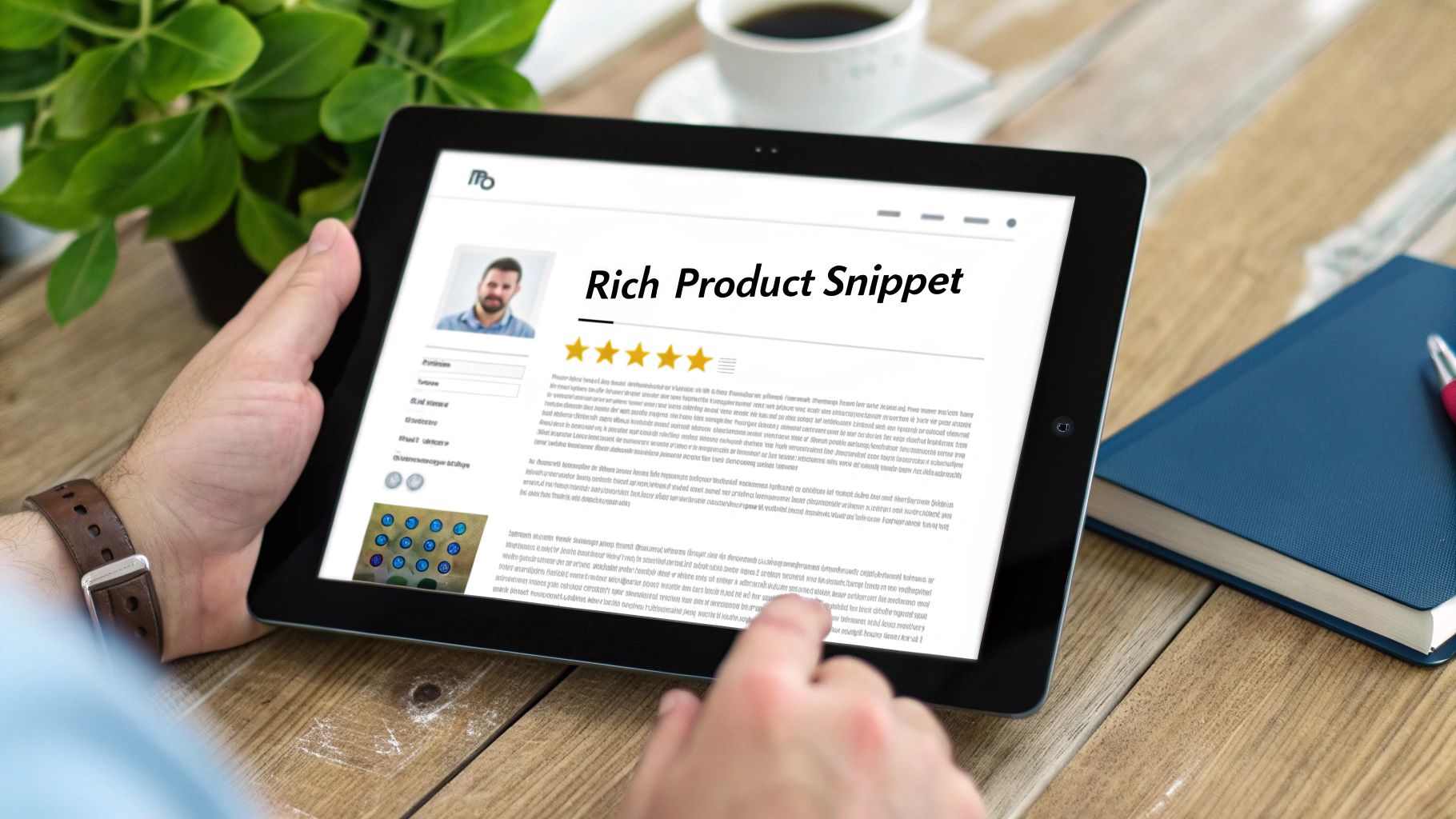
Product schema markup is a form of structured data that acts as a translator between your website and search engines. It provides explicit information about your products, such as price, availability, and review ratings, in a language Google can easily understand. This process is essential for enabling rich snippets in search results, which visually enhance your listings with star ratings and pricing, making them stand out to potential buyers.
Implementing schema is a critical ecommerce SEO best practice because it directly impacts how your products appear in the search engine results pages (SERPs). By giving search engines detailed, organized information, you help them feature your products more effectively, capturing user attention at the most crucial moment of their buying journey. This structured data is the engine behind the eye-catching listings you see from major retailers like Amazon and Target, which display ratings and stock status directly in search results.
Why It Works
Rich snippets significantly increase click-through rates (CTR) by making your listings more attractive and informative. When a user sees a product with a high star rating and a clear price, it builds immediate trust and provides key decision-making information before they even click. This pre-qualification of traffic means visitors arriving from rich snippets are often more informed and closer to making a purchase, improving conversion rates. It’s a powerful way to claim more SERP real estate and build credibility at a glance.
Actionable Tips for Implementation
- Use JSON-LD Format: Implement your schema using JSON-LD, as it's Google's preferred format. It's easier to deploy and manage compared to older formats like microdata or RDFa.
- Include Key Product Properties: Ensure your markup includes essential fields like
name,image,description, andoffer(withprice,priceCurrency, andavailability). These are foundational for qualifying for rich snippets. - Validate Your Markup: Before and after deployment, use tools like Google's Rich Results Test to validate your schema. This helps you catch errors that could prevent your rich snippets from showing.
- Leverage Aggregate Ratings: If you have genuine customer reviews, implement
aggregateRatingschema. Be honest; using fake reviews can lead to manual penalties from Google. - Monitor Performance: Check the "Enhancements" report in Google Search Console to monitor the performance of your rich results, track impressions, and identify any issues flagged by Google.
6. Category Page Optimization & Content Depth Strategy
Category pages are often the most powerful yet underutilized assets in an ecommerce SEO strategy. Instead of treating them as simple product grids, they should be transformed into comprehensive resource hubs that target broad, high-volume commercial keywords. This involves creating in-depth content that guides, educates, and ultimately converts shoppers who are exploring options but haven't decided on a specific product yet.
This approach shifts the category page from a mere navigational tool to a powerful ranking asset. By building out content that addresses the entire customer journey for that category, you create topical authority and answer user questions before they even ask them. For example, a shopper searching for "best DSLR cameras" isn't ready for a specific product page; they need a guide. DPReview dominates this space by providing detailed comparisons, buying guides, and expert recommendations directly on their category pages, capturing traffic at a crucial research phase.
Why It Works
Rich category pages satisfy user intent for broad commercial queries more effectively than a simple product listing. Google prioritizes content that provides comprehensive answers, and a well-developed category page acts as a one-stop-shop for a user's needs. This builds trust, reduces bounce rates, and establishes your brand as an expert. Retailer REI.com excels at this by integrating use-case guides like "Hiking for Beginners" into its hiking gear categories, which is one of the ecommerce SEO best practices that builds authority and guides users toward the right products.
Actionable Tips for Implementation
- Write Unique Category Descriptions: Create a minimum of 300 words of unique content for each category page. Use H2 and H3 subheadings to address user intent, such as "How to Choose the Right [Category Product]" or "Benefits of [Category Product]."
- Build a Strong Internal Linking Structure: Your main category page should link down to your top 10-15 products or subcategories. In turn, each product page should link back up to its parent category, creating a logical site hierarchy.
- Integrate Buying Guide Content: Add value beyond the product grid with comparison tables, use-case scenarios, and expert recommendations that address common questions and help shoppers make informed decisions.
- Target Secondary Keywords: Optimize your category content for valuable secondary keywords like "best running shoes for flat feet" or "laptops under $1000" to capture more specific, long-tail search traffic.
7. Internal Linking Strategy & Site Architecture Optimization
A strategic internal linking plan is one of the most powerful yet underutilized ecommerce SEO best practices. It functions as the roadmap for your website, guiding both search engine crawlers and users to your most important pages. This practice involves structuring your site logically and creating a web of internal links that distributes authority (or "link equity") and enhances product discovery.
Effective site architecture ensures that no product is more than a few clicks away from your homepage, making your entire inventory accessible. Amazon’s mastery of this is a prime example; its "Frequently bought together" and "Customers also viewed" sections are powerful internal linking engines that guide users, improve user experience, and signal relationships between products to Google. This deliberate structure reduces crawl depth and highlights top-performing products, turning your own site into a powerful ranking asset.
Why It Works
A well-planned site architecture and internal linking strategy helps Google understand the hierarchy and context of your content. When high-authority pages like your homepage link to key category or product pages, it passes authority and signals their importance, which can significantly boost their ranking potential. This creates a logical flow that keeps users on your site longer, reducing bounce rates and leading them down the conversion funnel from discovery to purchase.
Actionable Tips for Implementation
- Maintain a Flat Site Architecture: Ensure any product page can be reached within three clicks from the homepage. A common and effective structure is Homepage > Category > Subcategory > Product.
- Use Descriptive Anchor Text: Instead of generic phrases like "click here," use keyword-rich anchor text that describes the destination page, such as "men's waterproof hiking boots." This provides valuable context for both users and search engines.
- Implement Breadcrumb Navigation: Add breadcrumbs to all category and product pages. This improves user navigation and creates an additional layer of contextual internal links that reinforce your site structure.
- Add Contextual Links: Weave relevant internal links into your product descriptions, category page content, and blog posts. For example, a blog post about "How to Choose a Tent" should link directly to your best-selling tent product pages.
- Audit Your Internal Link Flow: Use tools like Semrush's Site Audit to visualize how link equity is distributed across your site. Identify "orphan pages" (pages with no internal links) and ensure your priority pages are receiving sufficient link authority.
8. Content Marketing & Long-Form Blog Integration for Product Awareness
Effective ecommerce SEO best practices extend beyond your product pages. Integrating a blog and a robust content marketing strategy allows you to capture customers at the top of the sales funnel, building trust and authority long before they are ready to purchase. This approach targets informational keywords, answering your audience's questions and positioning your brand as an industry expert.
A well-executed content strategy acts as a powerful lead magnet, attracting users searching for guides, comparisons, and solutions related to your products. For example, an outdoor gear retailer could create a comprehensive guide on "how to choose a hiking backpack." This content captures early-stage buyers, educates them, builds brand affinity, and creates natural opportunities to internally link to specific product pages, guiding them gently toward a purchase. This method builds a narrative around your products, telling a story that resonates more deeply than a simple product description.
Why It Works
Content marketing captures an audience that isn't yet searching for a specific product, broadening your reach significantly. By providing genuine value and expertise, you build a relationship with potential customers, making them more likely to buy from you when the time is right. REI's "Expert Advice" blog is a masterclass in this, offering thousands of articles on outdoor skills that naturally lead customers to their gear. This strategy establishes topical authority, which signals to Google that your entire domain is a credible source on a subject, boosting rankings across the board.
Actionable Tips for Implementation
- Create Content Clusters: Build your strategy around a central "pillar" topic (e.g., 'Beginner's Guide to Skincare') and create multiple "cluster" articles that delve into specific subtopics (e.g., 'best cleanser for oily skin,' 'how to apply serum'). This structure strengthens topical authority.
- Target Informational Keywords: Use keyword research tools to find questions your audience is asking, such as "how to use X," "best X for Y," or "X vs. Z comparison." These queries have high traffic potential and lower competition than commercial terms.
- Write Comprehensive Guides: Aim for long-form, in-depth articles (2,000+ words) that comprehensively cover a topic. These guides are more likely to earn backlinks, rank for long-tail keywords, and secure featured snippets.
- Strategic Internal Linking: Every blog post should be a bridge to your products. Contextually link from your informational content to relevant category and product pages to pass link equity and guide user journeys.
- Repurpose Your Content: Maximize your effort by turning a successful blog post into an infographic, a video tutorial, or a social media series. This extends your reach across different platforms and caters to various learning styles.
9. User Experience & Conversion Rate Optimization (CRO) Alignment
Aligning SEO with Conversion Rate Optimization (CRO) is a critical ecommerce SEO best practice that bridges the gap between attracting visitors and turning them into customers. Modern search engines like Google, powered by algorithms like RankBrain, prioritize pages that offer a superior user experience. This means metrics such as low bounce rates, high time-on-page, and strong click-through rates from search results directly influence your rankings.
The goal is to ensure that the pages you optimize for keywords are also optimized to convert. This synergy creates a powerful feedback loop: a great user experience boosts SEO signals, which drives more qualified traffic, which in turn has a higher chance of converting. To ensure your SEO efforts translate into sales, aligning with a robust strategy for conversion rate optimization Shopify is essential, guiding users from search to purchase. This holistic approach ensures your marketing spend delivers a stronger return.
Why It Works
When SEO and CRO work together, you create a seamless customer journey that search engines reward. A page optimized for both will not only rank higher but also generate more revenue from the traffic it receives. For example, Amazon constantly A/B tests its product pages, from CTA button placement to checkout flow, to reduce friction. This relentless focus on user experience not only improves their conversion rates but also reinforces their authority and top rankings in search results, proving that a user-centric approach is also an SEO-centric one.
Actionable Tips for Implementation
- Establish Baseline Metrics: Implement Google Analytics 4 to track key conversion goals. Segment your organic traffic to specifically measure the impact of CRO changes on visitors arriving from search engines.
- Prioritize High-Impact Pages: Start your CRO efforts on pages with high organic traffic but high bounce rates or low conversion rates. These are often your main category and top product pages, where small improvements can yield significant results.
- Test Your Call-to-Action (CTA): Experiment with the copy, color, size, and placement of your primary "Add to Cart" or "Buy Now" buttons. This is a classic CRO tactic that can often deliver a 5-15% lift in conversions with minimal effort.
- Streamline the Checkout Process: Reduce friction by minimizing required form fields, offering a guest checkout option, and prominently displaying security badges. Implementing one-click payment options can dramatically decrease cart abandonment.
- Analyze User Behavior: Use session recording and heatmap tools like Hotjar or Crazy Egg to visually understand how users interact with your pages. Identify where they get stuck, confused, or drop off, and use these insights to inform your A/B tests. Explore these conversion rate optimization best practices for more detailed strategies.
10. Mobile Optimization & Mobile-First Indexing Strategy
With Google's mobile-first indexing, the mobile version of your website is the primary one used for ranking and indexing. This shift means that for ecommerce businesses, a flawless mobile experience is no longer a bonus feature; it is a fundamental requirement for visibility, traffic, and revenue. Optimizing for mobile goes beyond a simple responsive design and encompasses speed, user experience, and a checkout process built for smaller screens.
Since the majority of product discovery and initial browsing now happens on smartphones, a robust mobile strategy is a non-negotiable part of modern ecommerce SEO best practices. Google rewards sites that provide a seamless mobile journey, from initial search to final purchase. For an online store, this means ensuring your site loads quickly on a 4G connection, navigation is intuitive for thumbs, and completing a purchase is effortless. A clunky mobile interface can cause a potential customer to abandon their cart and your site permanently.
Why It Works
A mobile-optimized site directly correlates with higher rankings, lower bounce rates, and increased conversions. When customers can easily find products, view images, and check out on their phones, they are far more likely to complete a purchase. Amazon's mobile website and app are prime examples; their one-click checkout and intuitive filtering system are designed for mobile-first users, which is a key reason they dominate mobile product searches. This focus on mobile usability builds customer loyalty and directly boosts your bottom line.
Actionable Tips for Implementation
- Audit with Google's Tools: Start by running your site through Google's Mobile-Friendly Test to identify immediate usability issues. This will give you a clear, prioritized list of technical fixes.
- Prioritize Mobile Page Speed: Aim for a Largest Contentful Paint (LCP) of under 2.5 seconds on a mobile connection. Optimize images, use lazy loading for non-critical assets, and minimize heavy scripts to achieve this benchmark.
- Simplify Navigation and UX: Design for "one-handed browsing." Use a hamburger menu for secondary navigation, keep primary menu items to 5-7 essentials, and ensure buttons and links have adequate spacing to avoid accidental taps.
- Streamline Mobile Checkout: Minimize the number of form fields required to complete a purchase. Implement autofill capabilities and offer one-click payment options like Apple Pay or Google Pay to drastically reduce cart abandonment rates.
- Test on Real Devices: Do not rely solely on browser emulation. Test your site's critical user journeys, like searching for a product, adding it to the cart, and checking out, on a variety of actual smartphones and tablets to find real-world friction points.
10-Point Ecommerce SEO Best Practices Comparison
| Strategy | 🔄 Implementation Complexity | 💡 Resource Requirements | ⭐📊 Expected Outcomes | Ideal Use Cases | ⚡ Key Advantages |
|---|---|---|---|---|---|
| Keyword Research & Search Intent Optimization for Product Pages | 🔄 Medium — analysis + testing | 💡 Tools (Ahrefs/SEMrush/GSC), SEO analyst | ⭐⭐⭐⭐ — higher qualified traffic & better conversion rates 📊 | Multi-SKU stores; high-competition categories | ⚡ Targets purchase intent; informs content & paid media |
| Technical SEO & Site Speed Optimization | 🔄 High — developer work & architecture changes | 💡 Dev time, CDNs, monitoring tools, image pipelines | ⭐⭐⭐⭐⭐ — faster pages, improved Core Web Vitals, lower bounce 📊 | High-traffic retailers; stores with large catalogs | ⚡ Direct ranking & UX impact; quick wins vs. content work |
| On-Page Optimization: Title Tags, Meta Descriptions & Header Structure | 🔄 Low — content edits and templates | 💡 Content team or SEO copywriter | ⭐⭐⭐⭐ — improved CTR and relevance; modest rank gains 📊 | Competitive categories where CTR matters | ⚡ Fast to implement; immediate search snippet gains |
| Link Building & Authority Development for Ecommerce Domains | 🔄 High — outreach & PR processes | 💡 Outreach team or agency, content assets, budget | ⭐⭐⭐⭐ — stronger domain authority and long-term rankings 📊 | Brands competing with established players | ⚡ High correlation with top rankings; referral traffic |
| Product Schema Markup & Rich Snippets Implementation | 🔄 Low–Medium — technical markup & maintenance | 💡 Dev or CMS/plugin, validation tools | ⭐⭐⭐⭐ — increased CTR via rich snippets; eligibility for product features 📊 | Any ecommerce with reviews/pricing | ⚡ Improves SERP real estate and trust signals |
| Category Page Optimization & Content Depth Strategy | 🔄 Medium–High — content creation + UX tuning | 💡 Content writers, designers, SEO strategist | ⭐⭐⭐⭐ — captures high-volume commercial keywords; increases AOV 📊 | Retailers with many categories; competitive niches | ⚡ Dual-purpose: SEO ranking and conversion tool |
| Internal Linking Strategy & Site Architecture Optimization | 🔄 Low–Medium — structural planning & site edits | 💡 SEO strategist, minor dev or CMS changes | ⭐⭐⭐⭐ — better crawlability, authority flow, improved rankings 📊 | Large catalogs (500+ products) | ⚡ Cost-free leverage to distribute PageRank and improve discovery |
| Content Marketing & Long-Form Blog Integration for Product Awareness | 🔄 Medium–High — editorial calendar & promotion | 💡 Writers, promotion budget, time for backlinks | ⭐⭐⭐⭐ — top-of-funnel traffic, authority, and link attraction 📊 | DTC brands; brand-building ecommerce | ⚡ Builds lasting authority and supports internal linking |
| User Experience & Conversion Rate Optimization (CRO) Alignment | 🔄 Medium–High — testing and iterative changes | 💡 Analytics, A/B testing tools, UX/CRO team | ⭐⭐⭐⭐⭐ — measurable revenue lifts and stronger UX signals 📊 | High-traffic stores with conversion focus | ⚡ Direct revenue impact; improves SEO signals via UX |
| Mobile Optimization & Mobile-First Indexing Strategy | 🔄 High — responsive design and mobile testing | 💡 Dev resources, device testing matrix, performance tools | ⭐⭐⭐⭐⭐ — essential for mobile rankings and conversions 📊 | All ecommerce (mobile-dominant traffic) | ⚡ Required for mobile-first indexing; reduces mobile abandonment |
From Checklist to Competitive Advantage: Activating Your SEO Strategy
Navigating the landscape of ecommerce SEO best practices can feel like assembling a complex puzzle. We've explored the critical pieces: from the foundational keyword research that deciphers customer intent to the technical precision of site speed optimization and schema markup. We've delved into creating compelling category pages, building authority through strategic link building, and weaving a narrative with content marketing that guides customers from awareness to purchase.
But the real magic happens when you stop seeing these as individual tasks on a checklist and start viewing them as interconnected components of a holistic growth engine. This is where your brand's story truly comes to life. Your technical SEO ensures the stage is set and easily found, your on-page optimization is the script that captivates both search engines and users, and your content marketing is the performance that builds a loyal audience.
The Shift from 'Doing SEO' to 'Being Discoverable'
The ultimate goal isn't just to rank; it's to be the definitive answer when a potential customer asks a question. This requires a fundamental shift in mindset. Instead of just optimizing a product page, think about the entire customer journey that leads someone there. What questions did they ask? What problems are they trying to solve?
This approach transforms your SEO efforts from a purely technical exercise into a powerful form of digital storytelling. Each optimized element, from a well-crafted title tag to a detailed blog post reviewing your product, becomes a touchpoint that builds trust and guides the user toward a solution- your product.
Your Actionable Playbook for Implementation
Feeling overwhelmed is natural, but momentum is built one step at a time. Here’s how to translate this comprehensive guide into immediate action:
- Start with an Audit: Begin with the low-hanging fruit. Use tools to run a technical SEO audit focusing on site speed, mobile-friendliness, and crawlability. Fixing these issues provides a stable foundation and can deliver quick performance boosts.
- Prioritize High-Impact Pages: Identify your top 5-10 product or category pages with the highest commercial potential but are stuck on page two of Google's search results. Apply the on-page and schema markup best practices we discussed to these pages first.
- Integrate SEO into Your Workflow: Make SEO a proactive part of your process, not a reactive fix. When adding a new product, conduct keyword research. When writing a new blog post, consider its internal linking potential. This integration makes maintaining ecommerce SEO best practices a sustainable habit.
- Measure, Learn, and Iterate: SEO is not a "set it and forget it" discipline. Regularly monitor your keyword rankings, organic traffic, and conversion rates through tools like Google Analytics and Search Console. Use this data to understand what's working, identify new opportunities, and refine your strategy.
Ultimately, mastering these ecommerce SEO best practices is about more than just appeasing an algorithm. It's about creating a seamless, intuitive, and valuable experience for your customers. It's about ensuring that when someone is searching for the exact solution you provide, your brand is the one they find, trust, and choose. By committing to this continuous process of optimization and storytelling, you don’t just build a website that ranks; you build a competitive advantage that lasts.
Implementing a comprehensive SEO strategy that blends technical precision with compelling brand storytelling can be a significant undertaking. If you're ready to transform your SEO from a checklist into a powerful, revenue-generating asset, the experts at Jackson Digital can build a custom strategy that aligns with your unique business goals. Visit us at Jackson Digital to learn how we turn enhanced visibility into measurable, sustainable growth for ecommerce brands.