Choosing a marketing agency isn't like hiring a vendor; it's about bringing on a growth partner. And the success of that partnership hinges on one thing: defining clear, measurable business goals before you even think about starting your search.
Getting this internal work done first ensures you're evaluating agencies based on your specific needs, not just their slick sales pitch.
Define Your Goals Before You Start the Search

Before you can find the right partner, you need to know exactly what you’re trying to build. Hiring an agency without a clear vision is like starting a road trip with no destination—you’ll burn through a lot of time and money, but you won't end up anywhere meaningful.
The most critical work happens inside your own walls, long before you send that first email or hop on a discovery call. This isn't about fuzzy ideas like "more traffic" or "better brand awareness." It's about translating those wishes into cold, hard numbers that directly impact your bottom line.
Moving from Vague Desires to Specific KPIs
A rock-solid agency partnership is built on clear Key Performance Indicators (KPIs). Instead of just telling an agency you want "more leads," you need to get granular. Define exactly what a qualified lead looks like, how many you need, and what you’re willing to pay for one.
Start by getting answers to these questions:
- What is our target Customer Acquisition Cost (CAC)? How much can you actually afford to spend to land a new customer and still be profitable?
- How many Marketing Qualified Leads (MQLs) do we need per month? Work backward from your revenue goals. If you know your sales team's closing rate, you can figure this out.
- What is our desired lead-to-close rate? Knowing this helps an agency focus on lead quality, not just pumping up the volume.
Let's make this real. A local roofing company might figure out their target CAC is $400. If their sales team closes 20% of qualified leads, and their monthly goal requires 10 new jobs, they know they need to generate at least 50 high-quality leads every single month. That level of detail completely changes the conversation with a potential agency.
"A service-based agency sells activities. A system-based agency sells outcomes and shows you how it works. You want an agency that understands the entire patient journey from first click to booked appointment."
This is a huge distinction. An outcome-focused agency will immediately connect their strategies to your CAC and lead targets. They won't just talk about rankings; they'll show you how those rankings will produce the specific business results you've already defined.
Aligning Your Budget with Reality
Your budget is more than just a number; it’s a direct reflection of your growth ambitions. A classic mistake is to pluck a budget out of thin air without understanding what it actually takes to hit your goals. This is especially true with paid media, which demands a serious and consistent investment to see results.
Consider this: 30.6% of total marketing budgets are expected to go toward paid channels in the coming year. That trend shows the growing investment needed just to compete. Knowing this helps you set realistic expectations from the start.
When you're thinking about budget, nail down your required Return on Ad Spend (ROAS). If you know you need a 4:1 ROAS to stay profitable, make that crystal clear to any agency you talk to. This allows them to build a strategy that respects your financial reality from day one.
Getting Your Internal Assets in Order
Finally, do your homework. An organized client is an attractive client, and showing up prepared signals that you're serious about growth. Run a quick internal review before you start reaching out.
This table breaks down what you should have ready to go. It's a simple checklist that will make your agency evaluation process much more productive.
Internal Audit Checklist Before Agency Search
| Audit Area | Key Question | Action Item |
|---|---|---|
| Analytics Access | Can an agency immediately see our historical data? | Grant view-only access to Google Analytics & Search Console. |
| Past Performance | What has worked (or failed) in the past? | Compile data/reports from previous marketing campaigns. |
| Audience Definition | Do we know exactly who we're trying to reach? | Gather customer personas and target audience profiles. |
| Competitive Landscape | Who are we up against, both online and offline? | Create a list of your top 3-5 direct competitors. |
Putting this information together before you start your search is a game-changer. For a deeper dive on how to conduct this kind of review, check out our guide on what is a marketing audit.
Having these assets ready means you can have strategic, data-driven conversations from the very first meeting. It allows an agency to get straight to the heart of your challenges, leading to a much more accurate proposal and a faster path to real results. This prep work puts you firmly in the driver's seat.
Finding and Shortlisting Potential Agency Partners

Alright, you’ve got your goals mapped out and a budget in mind. Now for the fun part: finding an agency that can actually pull it off. A quick Google search will throw a million names at you, all claiming to be the best. That’s a starting point, but it's far from the whole story. To find the real contenders, you need to dig a bit deeper.
Your first move should always be to tap your own network. A referral from a colleague or another business owner in your industry is worth its weight in gold. They've been in the trenches and can give you an honest take on their experience.
Beyond your immediate circle, B2B review platforms are your next best bet. They offer a more structured way to compare your options.
- Clutch and G2: These sites are great for seeing verified client reviews, checking out portfolios, and understanding an agency’s core services. You can quickly see who has a track record in your specific industry.
- Industry-Specific Forums: This is where the unfiltered opinions live. If you're a roofer, see who other contractors are buzzing about in construction forums. Dentists should be checking out what successful practices are using.
While you're at it, don't just limit your search to full-service agencies. It can be incredibly helpful to read up on finding the best marketing consultant for small business to get a different perspective on bringing in expert help.
The goal here isn't to build a massive list. You're aiming for a focused shortlist of 3-5 agencies that seem like a strong potential fit.
Assessing an Agency's Digital Footprint
Got your initial list? Time to put on your detective hat. An agency’s own marketing is their public-facing resume, and you should scrutinize it. How they market themselves tells you a lot about how they’ll market you.
Start with their case studies. Are they full of fluffy jargon like "increased engagement," or do they show real, quantifiable results? Look for hard numbers that tie directly back to business goals.
A powerful case study doesn't just show a pretty graph; it tells a story with numbers. For example: "Decreased cost-per-lead by 40% for an e-commerce brand by optimizing their Google Shopping feed and landing pages." This demonstrates a direct impact on profitability.
This kind of detail proves they get it—marketing activities need to produce a measurable return. It's the difference between an agency focused on vanity metrics and one that’s serious about driving revenue.
Vetting for Niche and Technical Expertise
Generalist agencies rarely deliver specialist results. The marketing playbook for a national SaaS company is worlds apart from what a local dental practice needs. This is where vetting for niche expertise is non-negotiable.
An agency that lives and breathes your industry will already know its unique challenges, customer quirks, and search patterns. For a local service business, that means they have to be masters of Geographic SEO (GEO)—everything from Google Business Profile optimization to local citation building and targeting the right location-based keywords.
Think about it: a marketing partner specializing in dental practices already knows that ranking for "emergency dentist near me" is a completely different ballgame than ranking for "cosmetic dentistry." They’ll speak your language. You won't have to waste time explaining the difference between a crown and a root canal.
This kind of industry fluency saves a ton of time and leads to campaigns that attract qualified leads, not just random clicks. You're looking for a partner who has already solved your exact problems for businesses just like yours.
Evaluating an Agency's Core Capabilities
Once you’ve got a shortlist, the real work begins. A great agency isn’t just a jack-of-all-trades; they have deep, provable expertise in the channels that actually move the needle for your business. It's time to look under the hood and see what they're really made of when it comes to search, paid ads, and brand storytelling.
This is the point where you move past the sales pitch and get a look at their playbook. You need to understand not just what they do, but how and why they do it. This is how you separate the agencies that talk a good game from the ones that deliver real results.
Beyond Rankings: SEO, GEO, and AEO
Any agency can promise to "get you on Google." A true SEO partner, however, will talk about a multi-faceted strategy covering technical health, local visibility, and the future of search. Their expertise has to go way beyond just stuffing keywords onto a page.
First, ask about their approach to technical SEO. Do they run comprehensive site audits? A solid answer will touch on things like crawl budget optimization, site speed, schema markup, and internal linking. These are the nuts and bolts that give your content a fighting chance.
Next, you absolutely have to dive into Geographic SEO (GEO). This is non-negotiable for any business with a physical footprint.
- Google Business Profile (GBP) Management: How do they get your GBP ranking in the local pack? They should be talking about consistent NAP (Name, Address, Phone Number), using Google Posts, managing reviews, and building out the Q&A section.
- Local Link Building: What’s their strategy for getting links from local businesses, news outlets, and community organizations to prove your geographic relevance to Google?
- Location-Specific Content: How do they create content that shows up for "near me" searches and actually speaks to the communities you serve?
Finally, touch on Answer Engine Optimization (AEO). With the explosion of voice search and AI-powered results, ranking isn't just about blue links anymore. Ask how they structure content to snag featured snippets and show up in voice search answers. It’s a great way to see if they’re thinking ahead or just stuck in the past.
Assessing Their Paid Media and Storytelling Prowess
Things have changed in the agency world. Recent data shows a massive shift towards paid advertising, with 89% of agency leaders now calling PPC their core service. That’s a huge jump from a few years ago when SEO was king. This makes it absolutely critical to put an agency's paid media skills under the microscope. For more on this trend, check out the 2025 marketing agency industry report.
When you're talking paid advertising, get straight to their strategic process.
A top-tier agency won't just talk about launching ads. They'll detail their process for audience segmentation, A/B testing ad creative, and optimizing landing pages for conversion. Their conversation should center on Return on Ad Spend (ROAS), not just clicks or impressions.
Ask them how they handle budget pacing and scaling campaigns. A smart agency will have a clear method for testing the waters with a small budget before advising you to go all in. They should also be able to explain how they use platforms beyond Google Ads, like social media advertising or programmatic display, to hit your audience at different points in their journey.
Most importantly, connect all this technical stuff to brand storytelling. How do they translate what makes your company special into compelling ad copy and authoritative content? A great partner gets that clicks don't mean a thing if the message falls flat. They should be able to show you exactly how they’ve captured a client's voice and built a narrative that actually converts. If you want a broader overview of how all these pieces fit together, you can learn more about what a digital marketing agency does.
This blend of technical skill and creative storytelling is what sets an effective, modern marketing partner apart. They understand that ranking on search engines and running efficient ad campaigns are just the tools; the real goal is to tell a story that brings in the right customers.
To help you dig deep during your interviews, here are some pointed questions to ask. They're designed to cut through the jargon and get to the heart of an agency's true capabilities.
Key Questions to Ask Potential Agencies
| Service Area | Question to Uncover True Expertise | What a Good Answer Looks Like |
|---|---|---|
| SEO | "Walk me through a technical SEO audit you performed. What were the top 3 issues you found, and how did fixing them impact the client's traffic?" | They should mention specifics like core web vitals, index bloat, or schema errors, and tie the fix directly to an increase in organic visibility or rankings. |
| Local SEO (GEO) | "A client with 10 locations is getting beat in the local map pack. What's your 90-day plan to turn that around?" | A detailed plan involving GBP optimization for each location, a citation cleanup strategy, review generation campaigns, and creating location-specific landing pages. |
| Paid Media (PPC) | "Our cost-per-acquisition is too high. How would you diagnose the problem and what levers would you pull first to improve ROAS?" | They’ll talk about analyzing search query reports, improving quality scores, testing ad copy and landing pages, and refining audience targeting—not just lowering bids. |
| Content & Storytelling | "Can you show me a piece of content you created that didn't just rank well, but also drove tangible business results like leads or sales?" | They'll provide a case study with data showing not just traffic, but conversion rates, lead quality, or revenue generated from that specific piece of content. |
| Analytics & Reporting | "How do you measure success beyond vanity metrics? What does a typical monthly performance report from you look like?" | They'll focus on business KPIs like pipeline generated, customer lifetime value (CLV), and cost per lead. Their reports should be clear, insightful, and tied to your goals. |
Using these questions as a guide will help you quickly identify the agencies that have the depth of experience you need. A great answer isn't just about knowing the textbook definition; it's about demonstrating they've been in the trenches and know how to solve real-world business problems.
The Vetting Process From Proposals to References
Alright, you’ve got your shortlist. Now the real work begins. This is where you move past the slick presentations and start digging into how these agencies actually think and operate.
The goal here is simple: separate the agencies that talk a good game from the ones that can deliver. You've already checked their core skills; now it's time to see how they'd apply that expertise to your business. This is the final, most critical filter.
From Generic Pitches to Strategic Proposals
The first real test is the proposal. A copy-and-paste, templated response is a huge red flag and an immediate disqualifier. You're looking for a customized plan that proves they’ve listened to your goals, understood your challenges, and put some serious thought into a solution.
A great proposal isn't just a menu of services with a price tag. It's a strategic roadmap.
To get a response like this, your Request for Proposal (RFP) needs to be sharp. Don't just ask for a quote. Ask them to outline a 90-day plan to hit your number one goal, whether that's dominating local search results or slashing your customer acquisition cost.
When the proposals land in your inbox, here's what to look for:
- Did they do their homework? Does the proposal specifically mention your goals, competitors, and target audience? Or does it feel so generic they could have sent it to anyone?
- Is the strategy logical? The plan should be a direct line to your objectives. If you said you need more local foot traffic, the proposal should be loaded with Geographic SEO (GEO) tactics, not fluffy promises about "building brand awareness."
- Is the pricing transparent? Costs should be broken down clearly. You need to see exactly what you’re paying for—whether it's hours, specific deliverables, or ad spend management. No hidden fees, no surprises.
This is where all your earlier vetting comes together. Their proposal should reflect a clear, integrated strategy across the core skills you’ve been evaluating.
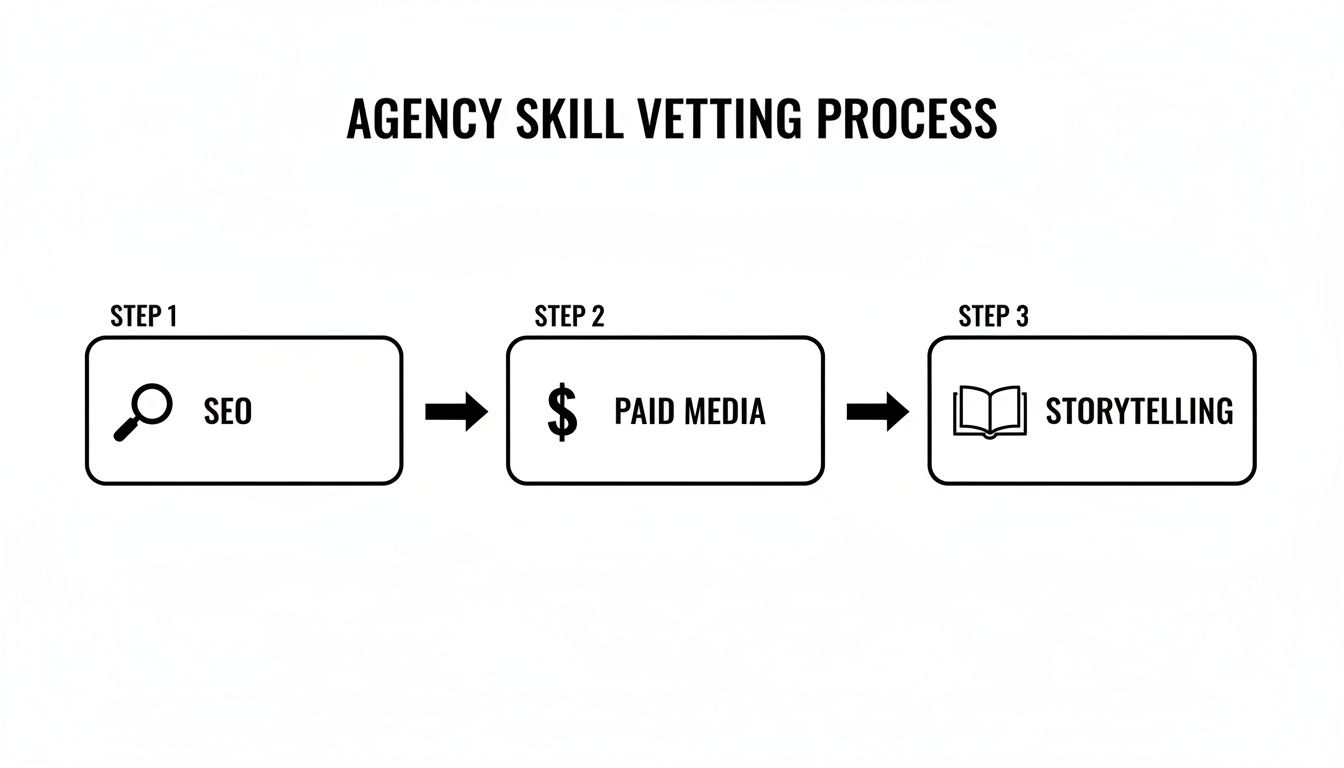
A strong proposal will show how their SEO, paid media, and storytelling expertise work together to solve your specific problems.
The Art of the Reference Check
The reference check is easily the most overlooked—and most valuable—step in this whole process. This is your one chance to get an unvarnished, behind-the-scenes look at what it's really like to work with this agency.
Don't squander this with softball questions.
A simple "Are you happy with them?" will get you a polite "yes." Instead, ask probing questions that reveal the truth about their communication, reporting, and problem-solving skills when things inevitably go wrong.
Your mission is to find out what happens after the contract is signed. An agency that looks perfect on paper might be a communication nightmare or fold under pressure when a campaign stalls.
Here are the three questions you absolutely must ask their clients:
- "Can you walk me through their communication and reporting? How often do you hear from them, and are the reports actually easy to understand?" This tells you everything about their proactivity and transparency.
- "Tell me about a time a campaign wasn't hitting its goals. How did the agency spot the problem, what did they do about it, and how did they communicate that to you?" This is the money question. It reveals their accountability and how they perform under pressure.
- "How have they contributed to your actual business goals, beyond just the marketing metrics?" This is how you separate a task-doer from a true strategic partner who cares about your bottom line.
The answers you get will paint a far more realistic picture than any proposal ever could. You’ll get a true sense of the agency’s character, resilience, and potential as a long-term partner. This is how you confirm you're not just hiring another vendor, but a team that will be in the trenches with you, driving real growth for your business.
Decoding Pricing Models and Measuring True ROI

Agency proposals can feel like a maze of different pricing models. Getting a handle on how they're structured is crucial for finding a partnership that actually fits your cash flow and your growth plans. This isn’t about hunting for the cheapest deal; it's about finding the best value and the clearest path to making money.
Most agencies you'll talk to use one of a few core models. Each one has its own rhythm and works best for different kinds of projects.
- Monthly Retainer: This is the most common setup. You pay a fixed fee every month for a specific scope of work. It’s perfect for ongoing efforts like SEO and content marketing where you're building momentum over the long haul.
- Project-Based Fee: This is a one-time, fixed price for a specific deliverable, like a website redesign or an in-depth technical SEO audit. It's a great fit for projects with a clear beginning and end.
- Performance-Based Agreement: With this model, the agency's pay is tied directly to the results they get—think a percentage of ad spend or a flat fee for every qualified lead. It's great for aligning incentives, but it often comes with a higher base fee to get started.
The right model for you really depends on what you need right now. A local business aiming for steady local SEO (GEO) growth would probably do well with a retainer. On the other hand, if you just need a one-off campaign launch, a project fee makes more sense.
Looking Beyond the Price Tag
Once you have a grasp on an agency’s pricing, the real work begins: figuring out how you’ll measure the value they bring. To get a real sense of success, you have to learn how to accurately measure marketing ROI. That means digging into the proposal to understand exactly what your money is getting you.
A solid proposal won't just throw a number at you; it will break down the deliverables. You need to push for specifics.
A proposal should be a clear statement of work, not a vague promise. Ask for the details: How many hours of strategic guidance are included? What exact reports will you deliver and when? How many pieces of content or new ad creatives can we expect each month?
Getting this level of detail clears up any gray areas and sets solid expectations from day one. It also makes sure you’re actually comparing apples to apples when looking at different agency proposals.
Establishing KPIs That Actually Matter
Here's probably the most important thing you can do before signing a contract: agree on the Key Performance Indicators (KPIs) that will define what "success" looks like. This is where you cut through the vanity metrics and focus on what really moves the needle for your business.
Impressions and clicks are nice to see, but they don’t pay the bills. The conversation with a potential agency needs to be about metrics that directly impact your bottom line.
- Cost Per Acquisition (CPA): This is the ultimate efficiency metric. How much does it cost you to land a new, paying customer? A good agency partner will be obsessed with driving this number down.
- Lead-to-Close Rate: This KPI is all about lead quality. A flood of new leads is worthless if none of them ever become customers. The agency’s work should have a direct, positive impact on this sales metric.
- Customer Lifetime Value (CLV): This looks at the bigger picture—the total revenue a customer brings in over their entire relationship with you. Great marketing doesn't just find one-time buyers; it attracts loyal fans who come back again and again.
Agreeing on these KPIs upfront ensures everyone is rowing in the same direction. For instance, if you set a target CPA of $350, the agency can then build their entire SEO and paid media strategy around hitting that specific number. If you're not sure where to start, using a customer acquisition cost calculator can give you a solid baseline for these critical discussions.
This kind of alignment is the bedrock of a successful partnership. It changes the relationship from a simple client-vendor transaction into a shared mission for growth, where every single action is measured by how much it contributes to your bottom line.
Common Questions Before You Sign on the Dotted Line
Even after all the proposals have been reviewed and the reference calls made, it's completely normal to have a few last-minute questions circling your head. Choosing a marketing agency is a big commitment, and you want to be sure.
Let's walk through the most common things business owners ask right before they pull the trigger. Getting these cleared up will give you the confidence you need to move forward with your new partner.
What’s a Standard Contract Length?
This comes up all the time, and the honest answer is: it really depends on what they're doing for you. For something that takes time to build momentum, like Search Engine Optimization (SEO), you'll need to be in it for the long haul.
Why? Because SEO isn't a magic switch you can flip. It’s about methodically building your site's authority and relevance, especially with things like local SEO or Answer Engine Optimization (AEO). That just doesn't happen overnight.
- For SEO: Look for a minimum contract of 6 to 12 months. If an agency offers you a shorter term, that's often a red flag. It's simply not enough time to implement a real strategy, see the data roll in, and deliver any meaningful movement in rankings or traffic.
- For Paid Media (PPC): These can be a bit more flexible. An initial 3 to 6-month term is pretty standard. This gives the agency enough runway to test different campaigns, dial in the conversions, and show you a solid Return on Ad Spend (ROAS).
- For One-Off Projects: Something like a website redesign or a deep technical audit will have a clear start and end date. These are project-based, not ongoing retainers.
The big takeaway here is about alignment. The contract length has to match the reality of the work being done. Be very skeptical of any agency that promises page-one rankings in 30 days—that’s just not how search engines work anymore.
What Happens If We Don’t See Results Right Away?
This is a perfectly reasonable thing to worry about. The truth is, not every marketing campaign is a blockbuster hit from day one. A great agency partner understands this and has a plan for communicating and adapting.
Your contract should spell out exactly how often you'll get reports and which KPIs matter most. In the early days, the focus will probably be on leading indicators, not the big lagging ones.
For instance, you might not see a flood of new leads from an SEO campaign in the first 60 days. But what you should see is clear progress on other fronts:
- Keyword Movement: Are your target search terms climbing up the rankings?
- Organic Traffic: Is the number of visitors finding you through search ticking upward?
- Technical Health: Have they knocked out the critical site issues they found in their audit?
A transparent agency won't wait for you to ask. If things are a bit slow out of the gate, they should be coming to you with an analysis of why and a smart plan to pivot. The conversation should never be about excuses; it should be about making data-driven adjustments together.
How Do You Make Sure the Onboarding Is Smooth?
A messy, chaotic start can poison a new partnership before it even begins. Any professional agency worth its salt will have a structured onboarding process designed to get them plugged into your business and working with your team seamlessly.
Those first 30 days are absolutely critical. A solid onboarding plan usually includes:
- A Kickoff Call: This isn't just a "hello." It's a deep-dive session with all the key players from both sides to get everyone aligned on goals, timelines, and how you'll all communicate.
- Asset & Access Requests: They’ll give you a clear checklist of what they need—access to your Google Analytics, ad accounts, website backend, you name it.
- Initial Audits: This is where they roll up their sleeves. They’ll dig into the technical, content, and competitive landscape to set a baseline and finalize their game plan.
- Setting a Rhythm: They'll establish a regular meeting schedule (like bi-weekly check-ins) and introduce you to your day-to-day point of contact so you always know who to call.
Don't hesitate to ask a potential agency to walk you through their onboarding playbook. A well-oiled process is a massive clue that you're dealing with an organized, professional team that respects your time and is eager to start driving real growth.
Ready to partner with an agency that focuses on systems, not just services? Jackson Digital builds data-driven growth engines for businesses through expert SEO, paid media, and brand storytelling. Get your free performance audit and see how we can help you achieve predictable, sustainable results. Learn more and get started at Jackson Digital.