
To really nail keyword research, you have to get inside your audience's head and figure out the real problems they're trying to solve. It's about more than just data; it's about telling the right story to the right person. It all starts with understanding the four types of search intent—informational, commercial, navigational, and transactional—so you can make sure your content actually answers their questions at every step of their journey.
Thinking Beyond Keywords to Understand Your Audience

Real keyword research isn't about hoarding a massive list of terms. It's about cracking the code of how your customers talk and think. So many people make the mistake of jumping right into a keyword tool, but the strategies that actually help businesses rank—whether you're targeting a local neighborhood (GEO) or a global audience—always start with the customer story.
This means you have to ditch the industry jargon for a minute. Think about the exact words a potential customer would use. A roofer's website might be packed with terms like "asphalt shingle installation," but their customers are frantically typing "leaky roof repair near me" into Google. That disconnect is where you lose business.
Decoding Customer Search Intent
Understanding search intent—the "why" behind every search—is the single most important first step. Get this right, and you've laid the foundation for a strategy that pulls in the right kind of traffic. If you need a quick primer on what keyword research entails, that's a great place to start.
Generally, intent breaks down into four main buckets:
- Informational Intent: The user is hunting for an answer. Think "how to fix a clogged drain" or "what are the symptoms of a bad car battery?" This is the core of Answer Engine Optimization (AEO).
- Navigational Intent: The user already knows where they want to go. Searches like "Jackson Digital login" or just "Facebook" fit here.
- Commercial Intent: The user is in research mode, weighing their options before they buy. This looks like "best CRM for small business" or "Ahrefs vs Semrush."
- Transactional Intent: The user has their credit card out and is ready to buy. These queries are direct and often include words like "buy," "price," or "for sale," such as "buy Nike Air Max size 10."
Building a Customer-Centric Foundation
Let's say you run a local plumbing company. A purely data-driven approach might tell you to target the keyword "plumbing" because it has a huge search volume. But that term is incredibly broad and brutally competitive.
By focusing on intent, you uncover far more valuable, story-driven opportunities. A search for "emergency plumber for burst pipe" tells a powerful story of urgency and distress. Creating content that directly addresses this specific, high-intent problem is how you build trust and win business.
This customer-first mindset turns a boring spreadsheet of keywords into a roadmap of your audience's needs. It helps you connect with people at every single stage, from their first question to their final click, turning generic searches into real customers. This is the foundation of practical SEO that actually helps your business grow.
Uncovering Keyword Opportunities You Might Be Missing

Alright, with the right customer-first mindset, it's time for the fun part: building out your initial list of keywords. The goal right now isn't perfection—it's about casting a wide net.
Think of yourself as a detective. We're gathering clues, looking for every possible way a customer might search for what you do. We'll sort through it all later, but for now, more is more.
Mine Your Competitors for Proven Keywords
One of the quickest ways to hit the ground running is to see what's already working for your competition. They've likely spent a good chunk of time and money figuring out which keywords bring in qualified traffic, so why not learn from their efforts?
First, pinpoint three to five direct competitors. I’m not talking about national franchises if you're a local plumber in Denver; I mean the other plumbing businesses also serving the Denver area. This is a core part of effective local (GEO) SEO.
Once you have that list, plug their domains into a tool like Ahrefs' Site Explorer or Semrush's Organic Research to see exactly what they're ranking for. Specifically, I like to look for:
- "Easy Win" Keywords: These are terms where your competitors are on page one, but their content is weak or not fully optimized. That’s your opening to create something better and snatch the spot.
- Keyword Gaps: Look for valuable keywords that two or more of your competitors rank for, but you don’t. It’s a clear signal that there's a conversation happening that you need to join.
- Question-Based Queries: Anything starting with "what," "how," or "why." These are golden opportunities for blog posts that build trust and establish you as an authority, a key part of AEO.
Listen to the Voice of Your Customer
Your customers are an absolute goldmine for keyword ideas. They use natural, everyday language to describe their problems—not the marketing jargon we sometimes fall back on. You just have to know where to listen.
Your best keywords are often hidden in plain sight, scattered across customer reviews, support tickets, and online forums. These are the unfiltered words people use when they aren't trying to impress a search engine.
Go to the online communities where your audience hangs out. If you sell project management software, for instance, you should be lurking in subreddits like r/projectmanagement. Look for recurring questions. Phrases like "how to manage a remote team" or "best alternative to Trello" are pure keyword gold.
Don't forget to dig through product reviews on sites like G2, Capterra, or even Amazon. If you sell running shoes, a competitor's negative review saying "not enough arch support for plantar fasciitis" just handed you a super-specific, high-intent keyword on a silver platter.
Expand Your List with Powerful Tools
Once you have a solid foundation from competitors and customer research, it's time to scale up. Using the right best keyword research tools is critical for adding data-backed volume and uncovering terms you’d never think of on your own.
A tool like Google Keyword Planner is a great starting point. Pop in a few "seed" keywords, and it will spit back hundreds of related ideas. For example, a local roofer could enter "roof repair" and get suggestions like:
- emergency roof leak repair
- cost to replace roof shingles
- local roofing contractors near me
- best roofing material for cold climates
These tools are also fantastic for uncovering long-tail keywords. These are longer, more specific phrases that, while having lower search volume, often convert like crazy because the user's intent is crystal clear. "Shoes" is a broad search. "buy women's size 8 waterproof hiking boots" is someone telling you a story about their specific need—they're ready to buy.
At this point, your keyword list should be getting pretty massive. Don't filter anything yet. Just capture every relevant phrase, question, and term you find. This raw data is the foundation we’ll use for the next, more strategic step: prioritization.
How to Prioritize Keywords for Maximum SEO Impact
You’ve done the detective work, cast a wide net, and now you’re staring at a massive spreadsheet. It’s filled with hundreds, maybe even thousands, of potential keywords. Honestly, this is the point where a lot of people get overwhelmed and just… stop. But a giant list of terms isn't a strategy; it's just data.
The real magic happens when you turn that raw data into a clear, actionable plan. This is where you separate the high-potential opportunities from the vanity metrics, making sure every piece of content you create has a direct line to your business goals. It's all about working smarter, not harder.
The Three Pillars of Keyword Prioritization
To turn your list into a strategic roadmap, you need to evaluate each keyword through a simple but powerful lens. Think of it as a three-point inspection for every single term on your list:
- Search Volume: How many people are actually searching for this term each month?
- Keyword Difficulty: Realistically, how hard will it be to crack the first page of Google for this?
- Business Relevance: If someone finds you using this keyword, how likely are they to actually become a customer? What story does this search tell?
Getting this balance right is everything. High volume might look appealing on paper, but it often comes with crushing competition and shockingly low relevance. Your goal is to find that sweet spot where these three pillars align perfectly for your business.
Why High Volume Is Not Always the Answer
Let me tell you a quick story about a local roofing company in Austin, Texas. They fire up a keyword tool and see the term "roofing" gets over 100,000 searches per month. It's incredibly tempting to chase that massive number, but it’s a classic strategic trap.
Think about who searches for that single word. It could be DIY enthusiasts, students writing reports, or people in other states entirely. The competition for "roofing" includes national brands, home improvement giants like Home Depot, and major publications. For a local Austin roofer, ranking is nearly impossible. Even if they did, most of that traffic would be completely useless.
Now, let’s look at a different keyword: "emergency roof repair Austin." Its search volume is only about 200 per month. But here's the thing: every single one of those searchers has an urgent, high-value problem that our roofer can solve right now. The intent is crystal clear, the competition is local, and the business relevance is off the charts.
This is the absolute core of effective keyword prioritization: choosing terms that attract potential customers, not just casual visitors. One qualified lead from a low-volume keyword is infinitely more valuable than a thousand clicks from an irrelevant, high-volume term.
The Power of Long-Tail and Geographic Keywords
The "emergency roof repair Austin" example perfectly illustrates the power of long-tail and geographic (GEO) keywords. While a few massively popular keywords dominate search traffic, the overwhelming majority of queries are highly specific and get very few searches on their own.
In fact, research shows that a staggering 92.42% of all keywords get ten or fewer monthly searches. Meanwhile, a tiny fraction—just 0.16% of the most popular keywords—accounts for over 60% of all searches. For a local service provider or a niche business, trying to compete for those top-tier national keywords is like shouting into a hurricane. Focusing on service-specific and location-based (GEO) long-tail keywords is how you get found by the right people at exactly the right time. You can learn more about these SEO statistics and their impact on strategy.
Creating a Simple Keyword Scoring System
To make this process objective and repeatable, you can build a simple scoring system right in your spreadsheet. This helps remove the guesswork and forces the true winners on your list to rise to the top.
Here’s a basic framework to get you started:
- Search Volume Score (1-5): Assign a score based on volume, relative to what's "high" or "low" for your specific niche. (e.g., 1 = 10-50 searches, 5 = 1000+ searches).
- Keyword Difficulty Score (1-5): This one's a bit different—you invert the difficulty metric from your SEO tool like Ahrefs or Semrush. A lower difficulty means an easier win, so it gets a higher score. (e.g., 1 = KD 60+, 5 = KD 0-10).
- Business Relevance Score (1-5): This is your most important, gut-check metric. How closely does this keyword align with a product or service you actually offer? A "5" would be a transactional term like "buy [product name]," while a "1" might be a loosely related informational query.
Now, let's put this into a simple table to see how it works in practice.
Keyword Prioritization Framework Example
This framework helps you assign a numerical value to each keyword, making it easy to sort and identify your top priorities.
| Keyword | Monthly Volume | Keyword Difficulty (1-100) | Business Relevance (1-5) | Priority Score |
|---|---|---|---|---|
| emergency roof repair austin | 200 | 12 | 5 | 14 |
| how much does a new roof cost | 1,200 | 45 | 3 | 9 |
| best roofing shingles | 5,000 | 68 | 2 | 6 |
| what is roof flashing | 800 | 25 | 1 | 6 |
| roofing | 100,000 | 85 | 1 | 3 |
By adding the three scores together, you get a "Priority Score." Sorting your list by this score instantly brings the most valuable, achievable keywords to the top. This simple act turns an overwhelming spreadsheet into a prioritized content calendar, showing you exactly where to focus your SEO and content creation efforts for maximum impact.
5. Map Keywords to Your Content and Customer Journey
You’ve done the hard work of finding and prioritizing your keywords. Now you have a spreadsheet full of potential, but data in a sheet doesn't get you rankings. It’s time to bridge that gap and assign each of those valuable terms to a specific page on your website.
This is called keyword mapping, and it’s where your strategy really comes to life. It's more than just an organizational step; you're essentially building a roadmap for your customers. You're deciding which story to tell at each stage of their journey. Get it right, and you’ll guide people seamlessly from their first curious search to becoming a paying customer.
Aligning Intent with Content: The Core of the Map
The golden rule of keyword mapping is matching the user's search intent to the right type of page. This seems obvious, but it's a mistake I see all the time. Sending someone who just wants information straight to a hard-sell service page is a surefire way to lose them.
Let’s stick with our local plumber in Seattle. A smart keyword map for them would cover every stage of a potential customer's journey:
- Informational Keywords: Someone searching "what causes low water pressure" isn't ready to hire anyone yet. They just want answers. This query is a perfect match for a helpful, in-depth blog post that establishes the plumber's expertise. No hard sell, just value.
- Commercial Keywords: Now, what about a search like "best tankless water heaters Seattle"? This person is further along. They're comparing options and getting ready to buy. This keyword should map to a detailed service or product comparison page that breaks down different models, benefits, and why this plumber is the best choice for the job.
- Transactional Keywords: Then you have high-intent queries like "hire a plumber for clogged drain." This person has a problem now and needs it fixed. This keyword goes directly to a service page optimized for conversion, with a prominent phone number, a clear call-to-action, and an easy-to-use booking form.
This is all about putting the right page in front of the right person at the right time.
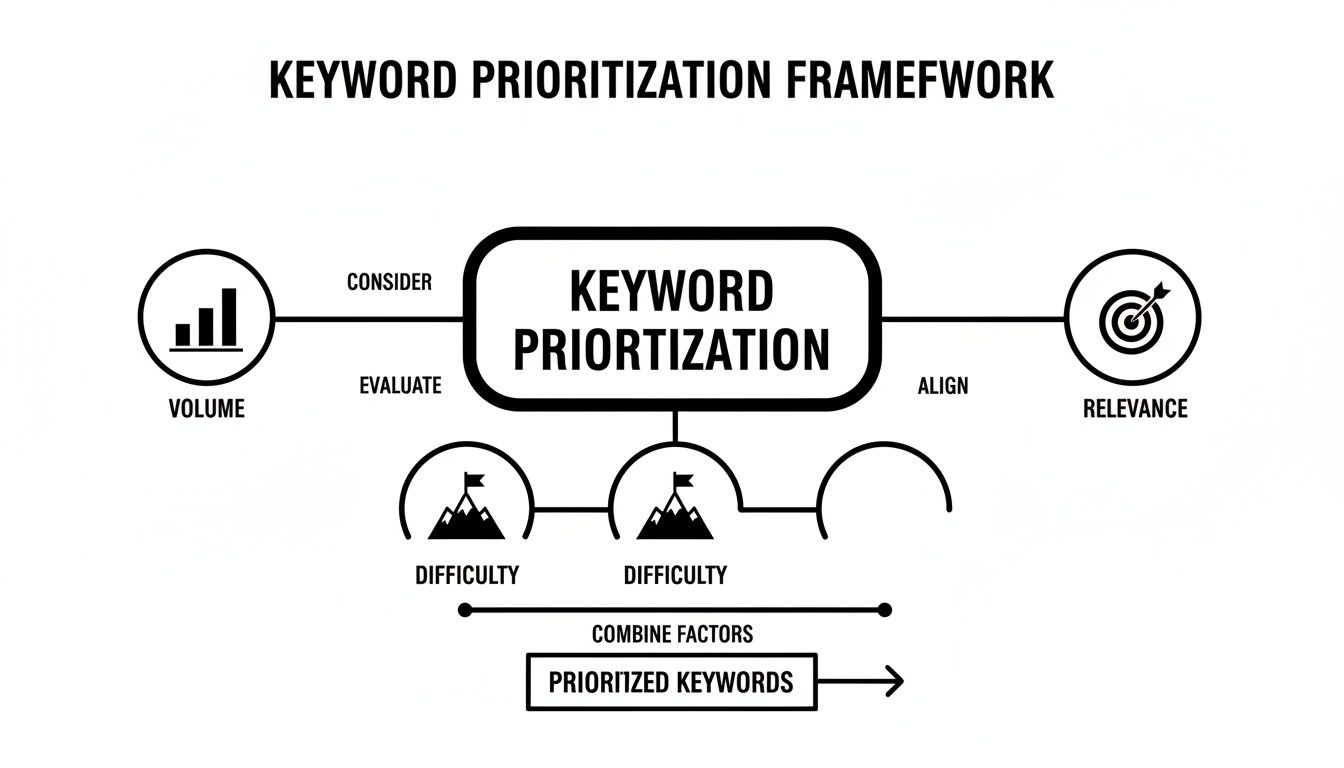
As the framework above shows, the best keywords aren't always the ones with the biggest search volume. You're looking for that sweet spot where volume, relevance, and your ability to actually rank all overlap.
Mapping Intent to Content Types
To make this crystal clear, here’s a simple table that breaks down how different types of search intent line up with specific kinds of content on your site.
Keyword Intent to Content Type Mapping
| Keyword Intent | Typical Search Query Example | Best Content Type | Page Goal |
|---|---|---|---|
| Informational | "how to unclog a sink" | Blog Post, Guide, FAQ | Educate, build trust, capture top-of-funnel traffic |
| Commercial | "best drain cleaner for hair" | Comparison Page, Review | Help user evaluate options, showcase product expertise |
| Transactional | "buy liquid plumber online" | Product Page, Service Page | Drive immediate conversion, sale, or lead |
| Navigational | "Roto-Rooter website" | Homepage | Direct user to the brand's primary web property |
This table should be your guidepost. Every keyword you target needs to be funneled into the correct content type to maximize its impact.
How to Build a Practical Keyword Map
Your keyword map doesn't need to be some complex, color-coded behemoth. A simple spreadsheet will do the trick. The key columns are: Target Keyword, Primary URL, and Content Type. This document becomes the blueprint for your entire content strategy.
It's also a good reminder of where people are spending their time. According to recent search data, a staggering 52.65% of all Google searches are informational. In contrast, only 14.51% are commercial and a tiny 0.69% are transactional. This is exactly why a strong blog and resource center are non-negotiable for long-term SEO success.
Your map should also make a clear distinction between creating new pages and optimizing pages you already have. You’ll often find an existing page is a decent match for a keyword—it just needs a little TLC to fully align with the searcher's intent.
A Tale of Two Businesses
Let's see this in action.
First, our Seattle plumber maps the keyword "DIY faucet repair tips" to a brand-new blog post. The goal isn't an immediate sale. It’s to be the helpful expert someone finds late at night when they're frantically trying to stop a drip. That builds brand recall, so when the DIY job inevitably goes wrong, they know exactly who to call.
Next, picture an e-commerce store selling high-end coffee gear. They see people asking questions like "what is the best grind size for French press" all over Reddit and forums. They map this question to a comprehensive guide on their blog. The article doesn't just answer the question—it also naturally features their premium burr grinders as the ideal tool for the job, maybe even with a slick video tutorial.
This strategic alignment is the heart of modern SEO. You're not trying to outsmart an algorithm; you're trying to help a person. Every single page on your site should have a clear purpose that serves a specific user need.
A solid map also prevents a common SEO pitfall: keyword cannibalization. This happens when multiple pages on your site accidentally compete for the same keyword, which confuses search engines and splits your authority. By giving each important keyword one definitive home, you create a clean, logical site structure that Google and your users will love.
Ultimately, this map turns all your research into a concrete plan. It’s the final step that ensures you know how to create great web content for your business, even if you’re not a writer and that every piece you publish has a clear, strategic purpose.
Measuring Success and Refining Your Keyword Strategy
Let’s get one thing straight: keyword research isn't a one-and-done task you can check off a list and forget about. Think of it more like tending a garden. It needs constant attention, pruning, and nurturing to actually bear fruit. Just launching content and crossing your fingers is a surefire way to waste a ton of time and effort.
The real magic happens in the follow-through. This last piece of the puzzle—turning your research into a cycle of measurement and refinement—is what separates strategies that fizzle out from those that build unstoppable momentum. It's about letting real-world data, not just your gut, guide your next move.
What Does "Success" Actually Look Like?
Before you can measure anything, you have to define what you're aiming for. It's easy to get excited about hitting page one, but a high ranking is just a stepping stone, not the destination. Real success is always tied to business results that help you rank and grow.
For most businesses, it all boils down to a handful of core metrics:
- Keyword Rankings: The most direct feedback on your efforts. Are you climbing the SERPs for the terms you care about?
- Organic Traffic: Are more of the right people finding you through search?
- Click-Through Rate (CTR): What percentage of people who see your page in the results actually click it? A low CTR could mean your title or meta description isn't compelling enough.
- Conversions: This is the bottom line. Are your keywords driving leads, sales, or sign-ups? This could be anything from a form fill to a phone call or an actual purchase.
Focusing on these KPIs helps you tell a clear story about what's working. A #1 ranking that doesn't bring in traffic or conversions is just a vanity metric.
Your Go-To Toolkit for Tracking Performance
You don’t need a huge, expensive software suite to keep tabs on your keyword strategy. In fact, the most indispensable tool is completely free, and it comes straight from Google.
Google Search Console (GSC) is your direct line to the search engine. If you're serious about SEO, using it is non-negotiable. It gives you invaluable, real-world data on how your site is performing. Inside GSC, the "Performance" report is your mission control.
Here’s a glimpse of what you'll find:
- The exact search queries people use to find you.
- Your average ranking position for every single one of those queries.
- The number of impressions (how many times you showed up in search results).
- Your click-through rate for each keyword.
Google Search Console is the source of truth for your SEO. It cuts through the noise and estimates from third-party tools and shows you exactly how real people are finding you on Google.
This data is pure gold. You’ll often find you’re ranking for keywords you never even planned to target. These “accidental” rankings are incredible opportunities to either create new, dedicated content or tweak an existing page to capture even more of that traffic.
Turning Data Into Action
Once you get in the habit of checking your performance data, you can start turning those numbers into smart, strategic decisions. This is where you connect the dots between SEO activity and actual revenue.
For example, you might see in GSC that a blog post about an informational topic is getting a ton of traffic but has a sky-high bounce rate. That tells you people are interested, but the page isn't doing its job of guiding them to the next step. Your move? Add stronger internal links or a more compelling call-to-action that points them toward a relevant service page.
This process shows why it’s so critical to connect your SEO data with your broader business analytics. When you look at both together, you get the full picture. If you want to dig deeper into tying performance to revenue, understanding the relationship between analytics and paid search can offer some powerful insights for a multi-channel approach.
Knowing When to Cut Bait and Adapt
Just as important as celebrating your wins is knowing when to cut your losses or pivot your strategy. This is sometimes called keyword pruning. Face it, not every keyword you target is going to be a home run, and that's perfectly fine.
Make a habit of reviewing your underperformers. If you’ve built a great piece of content around a keyword and it has failed to get any real traction after a few months, it might be time to move on. This doesn't mean deleting the content, but maybe re-evaluating the keyword's difficulty or your initial take on user intent. Perhaps the competition is just too fierce, or the searcher was looking for something completely different than what you offered.
This continuous loop of research, implementation, measurement, and refinement is what turns a static keyword list into a living, breathing asset for your business. It’s how you stay ahead of trends, adapt to market shifts, and ensure your SEO efforts consistently drive real, sustainable growth.
Common Questions About Keyword Research
Even with the best workflow, keyword research always throws a few curveballs. It's an area full of nuance, where the "right" answer usually starts with "it depends on your business."
Let's walk through some of the most common questions and hurdles people run into. I'll give you the straight, actionable answers you need to keep moving forward.
How Many Keywords Should I Target?
This is a classic, but there's no magic number. A local plumber in Dallas might only need to lock in 20-30 high-intent, geo-specific keywords (think "emergency plumber Dallas") to completely own their service area.
On the flip side, a national ecommerce brand could be juggling thousands of keywords across hundreds of product categories and informational blog posts.
The goal is never to collect the most keywords; it's to target the right ones. Start with a tight, focused list of high-priority terms that map directly to your most profitable services or products. You can always build out from there as your site gains authority.
How Long Does It Take to Rank for a Keyword?
Ah, the million-dollar question. The honest, if unsatisfying, answer is: it depends. How fast you can rank is a moving target, influenced by a few key variables.
- Keyword Difficulty: Trying to rank for a low-competition, long-tail keyword like "best waterproof hiking boots for wide feet" might get you to page one in a few months. But going after a monster term like "hiking boots"? That could take years of dedicated effort, if it’s even realistic for your site.
- Website Authority: A brand-new website with no backlink profile is starting from scratch. It's a much steeper climb than for an established site that has spent years building up trust and authority with Google.
- Content Quality: Hitting "publish" is just the start. To rank, your content has to be genuinely more helpful, more in-depth, or more authoritative than everything that's already on page one.
For most small and medium-sized businesses targeting realistic keywords, you can expect to see some positive movement in the rankings within 3-6 months. That initial traction is a fantastic sign that you're on the right track.
Should I Target Keywords with Zero Search Volume?
It sounds crazy, but sometimes, absolutely yes. SEO tools often report "zero" or very low search volume for terms that are brand new or incredibly specific. But that doesn't mean they aren't valuable.
Think about a query like "CRM integration for [new software name]." A keyword tool might show zero searches because the software just launched. But the handful of people who are searching for that have an immediate, specific problem they need to solve.
By ranking for that term, you position yourself as the only solution for a super-motivated, niche audience.
This is a key part of Answer Engine Optimization (AEO)—the practice of becoming the definitive answer for specific questions, regardless of what the volume metrics say. It’s also a core principle of the broader discipline of what is search engine optimization, which is all about connecting the right user with the most relevant information at the right time.
Ultimately, great keyword research is a mix of art and science. The data guides your strategy, but your real-world knowledge of your customers and their problems is what truly gives you an edge.
Ready to turn your keyword research into a powerful growth engine? The experts at Jackson Digital build custom SEO and content strategies that drive qualified traffic and predictable leads. Request your free performance audit today and discover your business's true ranking potential.