If you want to generate leads online, you have to start with a rock-solid foundation. Forget the fancy ad platforms and social media tactics for a minute. It all begins with three things: truly understanding your ideal customer's story, analyzing what your competitors are doing, and meticulously tracking your results.
This isn't just fluffy marketing talk; it's about building a predictable system for attracting the right people before you spend a single dollar on ads. It's about engineering your online presence to rank on search engines by being the most helpful and human answer.
Building Your Lead Generation Foundation
Too many businesses jump straight into running ads or posting on social media, hoping for the best. That’s like building a house without pouring the foundation first. This foundational stage is what separates campaigns that consistently pull in high-quality leads from the ones that just burn through cash.
Think of it as engineering a machine that attracts your perfect customer from the get-go. A local plumbing company and a B2B software firm both want leads, but their approach will be worlds apart. The plumber needs to capture urgent, local search intent right now. The software company has to educate and nurture prospects over a much longer sales cycle. Their foundations have to reflect those very different realities.
Who Are You Actually Selling To?
The first pillar is getting way beyond generic demographics. You need to build customer personas that feel like real people with real problems. Knowing your customer is a "35-year-old homeowner" is useless.
You need to know their story. What’s keeping them up at night? What frustrating experience just happened that your service could have solved?
A roofer's ideal customer isn't just "someone with a roof." It's "Mark, a father of two who just got hammered by a hailstorm and is now panicking about hidden leaks and dreading the confusing insurance claim process." See the difference? That level of detail changes everything:
- Your Content: You’d create a "Post-Storm Roof Inspection Checklist" instead of a generic "Our Services" page. You're telling a story of reassurance.
- Your Keywords (SEO): You'd target phrases like "hail damage roof repair near me" or "how to file a roof insurance claim." You're directly answering Mark's panicked search query.
- Your Messaging: Your ads would speak directly to "peace of mind" and "we handle the insurance hassles for you."
A well-defined customer persona is your north star. It ensures every ad you run, every blog post you write, and every keyword you target speaks directly to the person most likely to buy from you.
Uncovering Your Competitors' Weaknesses
Once you know who you’re talking to, you need to size up the competition. A smart competitive analysis isn’t about copying what everyone else does. It's about finding what they’re doing wrong and exploiting those gaps—especially in local search (GEO).
Are their websites painfully slow? Is their Google Business Profile a ghost town with no recent reviews or photos? Do their service pages feel thin and unhelpful? These aren't minor slip-ups; they are massive opportunities for you to win. Your goal is to offer a better, more helpful, and more trustworthy experience at every single touchpoint. If you want to dive deeper, this guide on how to generate business leads is a great place to start mapping out a full strategy.
This whole process can be broken down into a simple, repeatable system.

As you can see, a winning strategy always starts with the customer (Persona), moves to understanding the market (Analysis), and is held together by measuring what works (Tracking).
Tracking What Actually Matters
This brings us to the final, and maybe most crucial, piece of the foundation: setting up your analytics and conversion tracking. Without it, you’re flying blind.
It’s the only way to truly know what's working and what’s a waste of money. You have to be able to trace a new customer all the way back to the specific ad, social media post, or search term that brought them to you. Proper tracking turns your website from a passive digital brochure into an active, 24/7 salesperson that tells you exactly which marketing efforts are delivering a real return on your investment.
Winning the Search Game to Attract Eager Customers
If you want a consistent stream of online leads, you have to be where your customers are looking. And for over 90% of consumers, that journey kicks off on a search engine. Winning this game isn't just about ranking; it's about becoming the definitive, trusted answer for people who are actively searching for what you do.
This means we have to move beyond old-school SEO tactics. Real success today comes from mastering a powerful trio: Search Engine Optimization (SEO), Geographic Optimization (GEO), and Answer Engine Optimization (AEO). When you weave them together, your website transforms into a magnet for high-intent customers ready to pull the trigger.
Uncover the Questions Your Customers Are Actually Asking
The heart of modern SEO is figuring out user intent, which starts with knowing the exact questions people are typing into Google. Forget stuffing pages with generic keywords. The real gold is in becoming the best answer to specific problems. This is the essence of Answer Engine Optimization (AEO).
Put yourself in your customer's shoes. They aren't just searching for "plumber." They’re searching for "why is my water heater making a popping noise" or "cost to fix a leaky faucet in Dallas." Your job is to create content—whether it's a blog post or a service page—that tackles these questions head-on with clarity and authority.
It's no surprise that websites with a blog generate 67% more leads on average. Every single post is a new chance to answer a customer's question and rank for another valuable search term.
A great starting point? Just talk to your front-line team. They know the most common and pressing customer questions better than any keyword tool.
The Blueprint for Local Dominance: GEO
For service businesses like dentists, roofers, or electricians, showing up in the local map pack is everything. This is where Geographic Optimization (GEO) comes in, and its command center is your Google Business Profile (GBP).
Your GBP is often the very first impression a potential customer has of your business, so treat it like a second homepage. This isn't a "set it and forget it" task; it needs constant attention to signal to Google that you're an active, relevant, and trustworthy local player.
Mastering local search is all about proving your relevance to a specific area. A perfectly optimized Google Business Profile, consistent business info across the web, and a steady stream of positive reviews are the pillars of dominating the map pack.
An incomplete or stale profile is a major red flag for both customers and search engines. Here’s a quick checklist to get you started:
- Complete Every Section: Fill out every single field you can—services, products, accessibility options, hours, you name it.
- Upload High-Quality Photos Weekly: Show off your team, your work, and your location. Fresh photos signal activity.
- Actively Seek and Respond to Reviews: Aim for a steady flow of new reviews and respond to every single one, good or bad.
- Use Google Posts: Share updates, offers, and news weekly through Google Posts to keep your profile fresh and engaging.
Don't forget that consistent business information—your Name, Address, and Phone number (NAP)—across other directories like Yelp and Angi is also critical. These are called citations, and inconsistencies can confuse search engines and tank your local rankings.
A Real-World Success Story: How Storytelling Ranks Businesses
Let me tell you about a multi-location dental practice I worked with. They had beautiful offices but were basically invisible online, losing patients to competitors who popped up first for searches like "emergency dentist" and "Invisalign provider."
Their strategy was a mess. Each location had a generic page on the main website, but none of it told a story that connected with the communities they served. We completely flipped their approach to focus on hyper-local GEO and AEO.
Here's how we helped them rank by telling better stories:
- We built out dedicated location pages: Each page featured photos of the local staff, patient testimonials from that specific area, and content about local landmarks and community events. This told Google, "We are the dentist for this neighborhood."
- We optimized each location’s GBP: This meant uploading weekly photos of happy patients (with their permission, of course), responding to every single review within 24 hours, and using Google Posts to announce new patient specials. This created a living story of a vibrant, caring practice.
- We created hyper-local blog content: Instead of generic articles, we wrote posts like "Finding the Best Family Dentist in [Neighborhood Name]" and "What to Do After a Dental Emergency in [City]." We were answering real questions for real people in their specific area.
The result? Within six months, their appointment bookings from online searches tripled. Why? Because they stopped being a generic dental brand and started being the local dentist for each community. They told a story that connected with local search intent, and Google rewarded them for it. That's the power of combining SEO, GEO, and AEO to generate leads that actually convert.
Creating Content That Turns Visitors Into Leads
Getting people to your website is one thing. But the real trick to generating leads online is turning that attention into actual business opportunities. This is where your content comes in. It’s the bridge between traffic and revenue, but only if it's designed to make people act. Your goal is to transform your website from a passive brochure into an active lead-generation machine.
Your content needs to do more than just lay out the facts; it has to offer a solution so compelling that a visitor is happy to trade their contact information for it. That exchange is the heart and soul of online lead generation.
Crafting Irresistible Lead Magnets
A lead magnet is simply a high-value freebie you offer in exchange for an email address. The key word here is "high-value." A generic "subscribe to our newsletter" CTA just doesn't cut it anymore. There's too much noise out there.
Your lead magnet must solve a specific, urgent problem for your ideal customer. Don't think about what you want to sell them down the road. Focus on what they need right now. A great lead magnet makes them feel like they're getting an absolute steal.
Here are a few real-world examples to get the gears turning:
- For a local roofer: A downloadable "Post-Storm Roof Inspection Checklist" is incredibly practical for a homeowner who's just been through a rough storm and is worried about damage.
- For a B2B tech startup: An exclusive industry report like "The State of [Industry] Automation in 2024" instantly positions them as an authority and gives prospects critical business intelligence.
- For a financial advisor: A simple "Retirement Savings Calculator" tool is a fantastic way to help potential clients self-qualify while getting them to think about their needs.
These work because they’re specific, actionable, and tie directly back to the core service. They give the prospect an immediate win, which is the very first step in building trust.
The Anatomy of a High-Converting Landing Page
Once you've got a killer lead magnet, you need a dedicated landing page to show it off. And I don't mean your homepage. A landing page has one job, and one job only: to convince the visitor to download your offer.
Anything that distracts from that single goal has to go. That means no navigation menu, no links to other services, and no social media icons. Keep it simple.
A landing page is a focused conversation. It should have a clear headline that mirrors the ad or link the visitor clicked, bullet points highlighting the benefits of the offer, a visually appealing image of the lead magnet, and a simple form with a powerful call-to-action button.
Remember, every field you add to your form creates friction and can tank your conversion rate. For a top-of-funnel offer like this, a name and email address is usually all you need.
Using Storytelling to Build Trust and Drive Action
Facts tell, but stories sell. This is never truer than with case studies and testimonials. It's easy to turn a dry, data-heavy case study into a persuasive story that builds unshakable trust.
Instead of just listing results, frame it as a narrative:
- Introduce the Hero: Start with the client and the specific, relatable challenge they were facing. What was the pain point keeping them up at night?
- Introduce the Guide: This is you. Explain how you understood their unique problem and put a plan in place to help.
- Detail the Journey: Briefly walk through the process you took together, pointing out key milestones and how you tackled any obstacles.
- Reveal the Transformation: Share the impressive results, but always tie them back to the original problem. How did your work make their business or life better?
This structure turns a boring list of accomplishments into a journey that potential customers can see themselves in. It forges an emotional connection that raw data just can’t replicate. This storytelling approach is fundamental to creating content that not only ranks but also converts.
Ultimately, great content marketing is a core pillar of generating leads online. Statistics show that content marketing generates over 3 times as many leads as outbound methods, and it does so while costing 62% less per lead. For businesses that stick with it, the payoff can be huge.
Amplifying Your Message on the Right Channels
Creating killer, conversion-focused content is a massive win, but it's only half the battle. The world's greatest blog post or lead magnet doesn't do a thing if no one ever sees it. Now it's time to get that message out there by choosing the right channels—the places where your ideal customers are already hanging out.
This isn't about chasing every shiny new social media app or spreading yourself thin across a dozen platforms. The real goal here is to build a predictable, scalable system for generating leads. That means picking a few powerful channels, getting really good at them, and creating an integrated strategy where your efforts build on each other.
Organic vs. Paid Channels: Finding Your Mix
Your marketing efforts will pretty much always fall into two buckets: organic and paid. Neither is automatically better than the other; the real magic happens when they work in sync.
Organic channels are the ones you don't pay for directly, like SEO, social media posts, and email marketing. Think of these as a long-term investment. They build brand authority and trust over time and require more "sweat equity" up front, but they can deliver a steady stream of low-cost leads once you've got momentum.
Paid channels, like Google Ads and Facebook Ads, give you instant visibility. You're paying to put your message right in front of a hand-picked audience. This is your fast track to lead generation, perfect for testing new offers, promoting your best content, and grabbing high-intent customers the moment they start searching.
The smartest lead generation strategies don't choose between organic and paid—they blend them. Use paid ads to get immediate traffic and test what works, while your organic SEO and content efforts build a long-term, cost-effective asset that keeps growing.
Weaving Your Channels into a Cohesive Strategy
This is where your results really start to multiply. Your channels shouldn't operate in silos; they need to "talk" to each other to create a smooth, seamless experience for potential customers.
Let’s take a local HVAC company as an example. They write an amazing, SEO-optimized blog post titled "5 Signs Your AC Unit is About to Fail." Here's how they could weave their channels together:
- SEO (Organic): The post is optimized to rank for that search term, catching homeowners who are actively looking for information and are probably worried about their AC.
- Paid Ads (Targeted Promotion): They run a targeted Facebook ad pushing the blog post to homeowners in their specific service area. This gets the content in front of people who aren't searching yet but are likely to need their services soon.
- Email Marketing (Nurturing): Visitors who download the "AC Maintenance Checklist" offered in the post get added to an automated email sequence. This sequence sends more helpful tips and, eventually, a special offer for a pre-summer tune-up. It nurtures them from a curious reader into a paying customer.
This system works because each channel supports the others, creating multiple touchpoints that build familiarity and trust. You can dive deeper into measuring how well these campaigns are working by understanding the connection between analytics and paid search performance.
Choosing the Right Platform for Your Business
Not all channels are created equal, and where you put your energy depends entirely on your business and your customer. To get your message seen, it helps to understand the top marketing lead sources available today to get a broader view of your options.
Here's a quick comparison to help you figure out where to start.
Lead Generation Channel Comparison for SMBs
For small and local businesses, choosing the right channel can feel overwhelming. This table breaks down the most common options to help you decide where to invest your time and budget.
| Channel | Typical Cost Per Lead | Lead Quality | Best For |
|---|---|---|---|
| Google Ads | Medium to High | High (Search Intent) | Capturing immediate demand from users actively searching for a solution. Ideal for local service businesses. |
| SEO & Content | Low (Time Investment) | Very High | Building long-term authority, attracting organic traffic, and generating consistent, low-cost leads over time. |
| Facebook/IG Ads | Low to Medium | Varies (Awareness) | Reaching specific demographics and interests, promoting content, and building brand awareness. Great for visual products/services. |
| Email Marketing | Very Low | High (Warm Audience) | Nurturing existing leads, building customer relationships, and driving repeat business from a list you own. |
Ultimately, the key is to focus. Start by picking one organic channel (like SEO) and one paid channel (like Google Ads) to master. Once you have a predictable system running on those, you can start to branch out. This focused approach keeps you from getting overwhelmed and ensures you’re dedicating enough resources to actually win on the platforms that matter most.
How to Optimize and Scale Your Lead Generation
Getting a few leads to trickle in is a great start. But real growth? That comes from turning that trickle into a predictable, scalable flood.
This is where we move past just getting leads and start relentlessly optimizing the entire system. It’s the data-driven stage where we forge good results into a powerful growth engine. We'll get into the weeds of tracking, attribution, and Conversion Rate Optimization (CRO) to figure out not just what’s working, but why it's working—so you can double down on the wins and cut the dead weight.
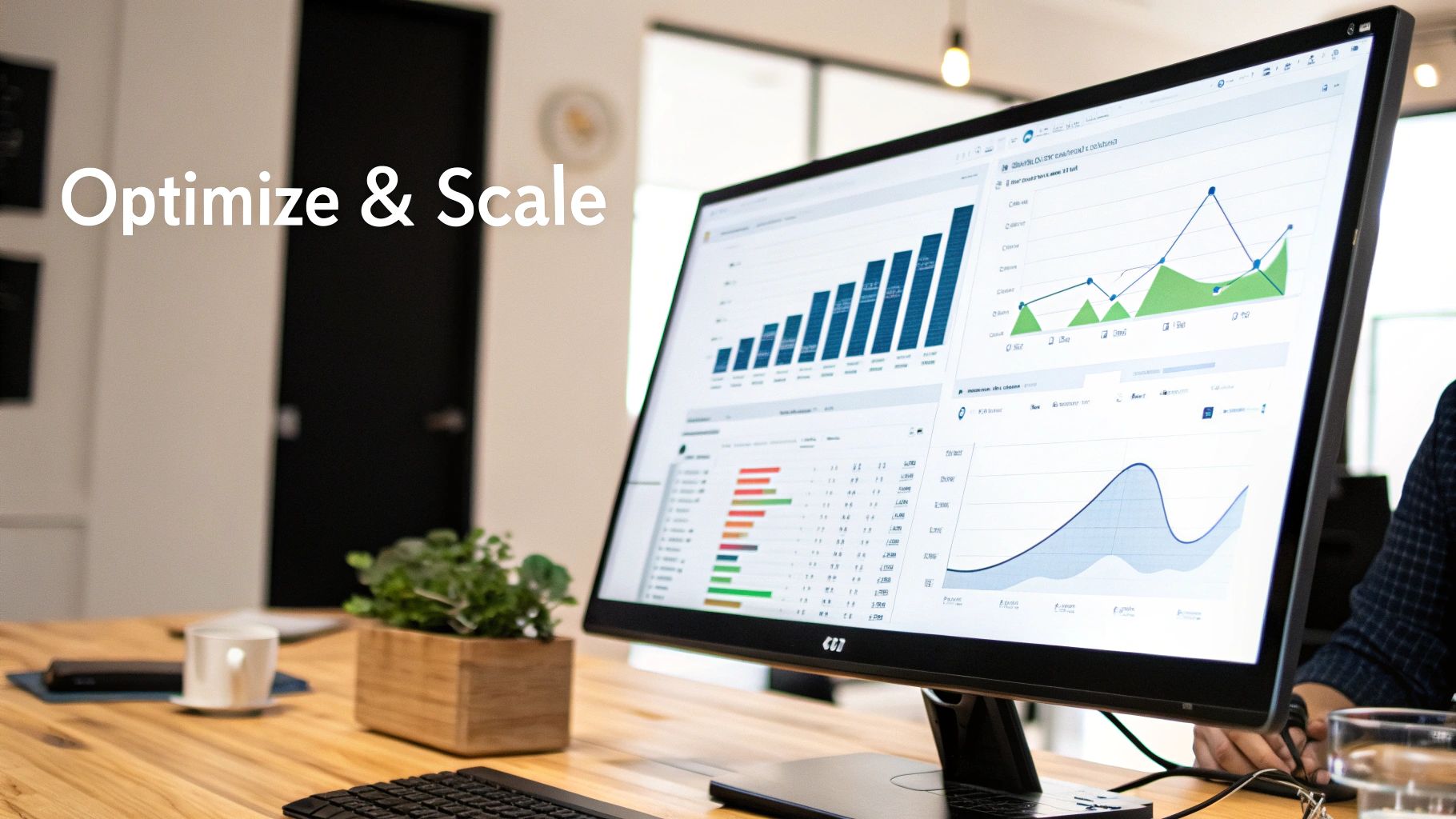
From Clicks to Profitable Customers
Your first job is to master attribution. It’s not enough to know a lead came from a Google Ad. You need to know which ad, targeting which keyword, led to a customer who actually became profitable. This is how you learn which channels deliver your best customers, not just the most clicks.
Tools like Google Analytics are your command center here. When you set up proper conversion goals and tracking, you can trace the entire customer journey from first click to final sale.
This lets you calculate your Customer Acquisition Cost (CAC) for each channel, which is a total game-changer. Once you know it costs you $50 to land a customer from SEO but $250 from Facebook Ads, your budget decisions become incredibly simple. You can play around with the numbers yourself using this helpful Customer Acquisition Cost calculator.
The Power of A/B Testing Your Way to More Leads
Once you have traffic flowing to your landing pages, it’s time to start squeezing more value out of it with A/B testing. It might sound technical, but the concept is dead simple: test two versions of a page (Version A and Version B) to see which one converts more visitors into leads.
You can test just about anything:
- Headlines: Does a benefit-driven headline beat a question-based one?
- Calls to Action (CTAs): Does "Get Your Free Quote" outperform "Request a Consultation"?
- Form Length: Will you get more submissions by removing just one non-essential field?
- Images: Does a picture of your team build more trust than a generic stock photo?
The golden rule is to test only one element at a time. If you change the headline and the CTA button color at the same time, you’ll never know which change was actually responsible for the lift in conversions.
I once worked with a local roofer whose landing page was converting at a dismal 2%. We changed nothing but the headline—from a generic "Our Roofing Services" to a specific, benefit-focused "Get Your Leaky Roof Fixed in 24 Hours, Guaranteed." That single change more than doubled their lead volume overnight.
That's the power of CRO. Small, data-backed tweaks can produce massive results without needing a single extra visitor.
Speed to Lead: Your Most Underrated Advantage
You've done all this work to generate and optimize your leads. Now comes the most critical—and most often fumbled—step: the follow-up. How fast you respond is one of the biggest factors in whether a lead becomes a paying customer.
Research has shown that contacting a new lead within five minutes increases your odds of converting them by a staggering amount. Wait just 30 minutes, and your chances plummet. In that short window, your prospect has already moved on, checked out three of your competitors, and might even be on the phone with one of them.
This is where a simple, automated system gives you a huge competitive edge.
- Instant Confirmation: The moment a lead submits a form, they should get an automated email or text. It confirms their submission and sets expectations ("We'll be in touch within the hour!").
- Internal Notification: Your sales team needs an instant notification with the lead’s details so they can act immediately.
- Nurture Sequence: If the lead isn't ready to buy right away, drop them into a short, automated email sequence that provides more value and keeps your business top-of-mind.
This kind of rapid response system tells a lead you're organized, professional, and eager for their business. In a competitive market, that first impression can make all the difference.
Your Top Lead Generation Questions, Answered
Jumping into the world of online lead generation can feel like opening a can of worms—solve one problem, and three more pop up. Let's tackle some of the most common questions we hear from business owners, breaking them down with clear, no-fluff answers.
How Long Does It Take to See Results From Online Lead Generation?
This really boils down to the path you choose. It’s a classic tortoise vs. hare situation, and honestly, you need both in your corner.
Paid channels like Google Ads are the sprinters. You can get the phone ringing in a matter of days, which is fantastic for immediate feedback and quick wins. On the flip side, organic strategies like SEO and content marketing are your marathon runners. It can easily take 3-6 months to build real momentum, but your reward is a steady, high-quality stream of leads that gets cheaper over time.
The smartest play? Use both. Launch paid ads for that initial jolt of business while your SEO and content—the real long-term asset—builds authority in the background to eventually take over.
What Is a Good Cost Per Lead for a Small Business?
There’s no magic number here. A "good" cost per lead (CPL) is completely relative to your business model.
Think about it this way: a local plumber would be thrilled to pay $75 for a qualified lead that turns into a $4,000 boiler installation. But if you’re selling $40 t-shirts, a $75 CPL would put you out of business fast. The key is to stop worrying about industry averages and start obsessing over your own numbers, specifically your customer lifetime value (LTV) and profit margins.
Your CPL isn't a vanity metric; it's a core business KPI. A "good" CPL is any number that lets you bring in new customers profitably. That's it. As long as your return on ad spend (ROAS) is healthy, you're on the right track.
Do I Need a Big Budget to Start Generating Leads Online?
Absolutely not. While a bigger budget can definitely speed things up, especially with paid ads, a lack of cash is no excuse for sitting on the sidelines. Some of the most effective lead generation tactics are built on sweat equity, not big spending.
This is where you roll up your sleeves and focus on the fundamentals:
- Own Your Local SEO: Meticulously optimizing your Google Business Profile costs nothing but your time and is the single most powerful lever for local search visibility.
- Create Genuinely Helpful Content: Answer your customers' biggest questions with detailed blog posts. This builds trust and attracts free, organic traffic for years to come.
These efforts create a powerful, lead-generating asset that you own outright, no monthly ad spend required.
What Is the Most Common Lead Generation Mistake Businesses Make?
The single biggest mistake we see is a paralyzing lack of focus and consistency. So many businesses fall into the "shiny object" trap. They try a little Facebook, throw a few bucks at Google Ads, and write a random blog post once a quarter. This "peanut butter" approach spreads your resources too thin and guarantees you'll never master anything.
A much better strategy is to pick one or two channels where you know your ideal customers hang out and go all-in. Become the undisputed expert at SEO in your city or build the most engaged Facebook group in your niche. Master that one channel, make it a reliable source of leads, and then think about adding another.
At Jackson Digital, we build custom growth strategies that turn visibility into predictable revenue. If you're ready to stop chasing leads and start building a system that consistently attracts your ideal customers, let's talk. Request a free performance audit today to uncover your biggest growth opportunities. Find out more at https://jackson-digital.com.