In my experience, every marketing dollar should tell a story—one that ends in measurable growth. When you anchor initiatives to specific targets, leverage SEO best practices, local GEO targeting, and AEO (Answer Engine Optimization) to surface your story in featured snippets and voice results, you turn guesswork into a reliable engine.
Setting The Foundation For Marketing ROI
First, decide what ROI means for your organization. Is it revenue growth, higher-quality leads or shaving costs? Pick one clear success metric and run with it.
Then, sketch out your current efforts in a simple visual chart. This reveals quick wins hiding in plain sight and shines a light on budget leaks.
- Define time-bound goals that push your team and create urgency.
- Audit SEO, paid media, social channels and offline touchpoints for performance gaps.
- Configure attribution (think Google Analytics) to map every impression and click back to a sale.
- Adjust spend according to cost-per-conversion and channel effectiveness.
- Inject personalization—AI-powered tools can boost engagement when used thoughtfully.
- Leverage local GEO signals by optimizing Google Business Profile, local citations, and geo-modified keywords to improve nearby search visibility.
- Optimize for AEO by creating structured content (FAQs, featured snippets) and schema markup so voice assistants and answer engines pick up your answers.
- Establish a rhythm of tests, learn fast and lock in the winners.
This bird’s-eye view doesn’t just rescue wasted spend; it reallocates it toward tactics that deliver results from day one.
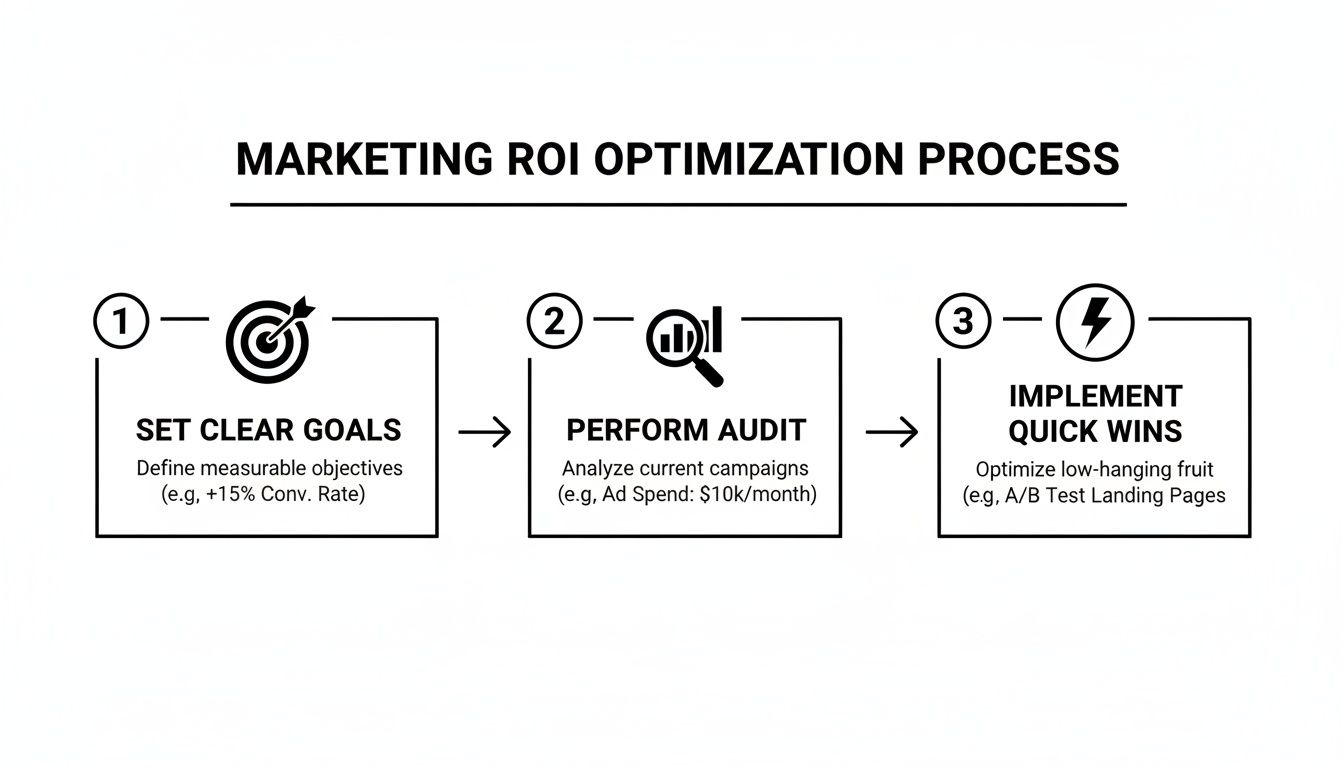
The graphic above maps out how to set goals, audit channels and pinpoint quick wins. Notice how early successes build momentum, while the audit clearly flags budget drains.
A local ecommerce shop I worked with spotted a low-converting social ad and shifted that budget into SEO-driven blog posts with location-based storytelling. Within six weeks, organic traffic jumped by 25%, and local orders rose 18%.
That realignment transformed a leaky funnel into a growth engine.
Key Benefits Of A Clear Roadmap
A visual framework nudges teams toward shared objectives and keeps everyone accountable.
- Clarity: The whole team knows which metrics to chase, including local pack impressions and featured snippet wins.
- Speed: You’ll spot quick wins in days, not months.
- Alignment: Efforts channel into the highest-impact initiatives across SEO, GEO and AEO.
These benefits lay the groundwork for scaling your ROI improvements across channels.
Why The Roadmap Matters
Without a plan, budgets bleed on half-finished tests and underperforming tactics. A methodical audit and razor-sharp targets stop waste in its tracks.
Whether you’re a small local business or an enterprise brand, this approach scales with your team’s bandwidth. Define your goals, grab those early wins and you’re poised to fine-tune every channel—online, local and conversational.
Ready to dive in? Let’s audit, optimize and start driving measurable returns today.
Defining Goals And Auditing Marketing Channels
Before you tweak budgets, it’s crucial to map out where your marketing engine stands today. Start by matching revenue objectives to each funnel stage and spotting which channels truly move the needle.
For instance, aiming for 20% growth in qualified leads over the next three months at the consideration stage immediately sharpens your team’s focus and prevents wasted spend.
- Awareness Stage: Track impressions, reach and local pack impressions at the top of the funnel.
- Consideration Stage: Watch click-through rates, engagement and featured snippet wins.
- Conversion Stage: Measure cost-per-acquisition (CPA) and conversion rate.
- Retention Stage: Keep an eye on repeat purchase rate and customer lifetime value (CLV).
When you tie those metrics directly to revenue targets, forecasting ROI for each channel—including GEO-targeted ads and AEO-driven content—becomes straightforward.
In one example, an ecommerce team discovered a paid social campaign running at a $8 CPA but only delivering 1.2% conversions. They shifted that budget into SEO-driven content and local landing pages, saw organic traffic climb by 25% in six weeks, and ranked in the map pack for key terms.
Setting Revenue Targets
I always start by calculating average order value or deal size. Multiply that by your revenue goal and you get a clear conversion target.
From there, reverse-engineer your funnel: assign KPIs like MQLs, SQLs or demo requests to each channel, so every tactic—whether it’s local geo ads, AEO content or paid search—has a measurable aim.
A Clear Target Aligns Budgets And Drives Accountability.
With specific goals in place, you’ll know exactly when a channel underdelivers—and when to pull spend or double down.
Conducting A Rapid Channel Audit
A speedy audit can reveal wasted budget in days instead of weeks. Focus on core metrics—cost, conversions, engagement across all channels, and pack and snippet performance.
- Gather spend and performance data for SEO, paid search, social, email, local ads and AEO content.
- Compare CTR, conversion rate, CPA, map pack click share and snippet capture rate side by side.
- Flag any channel performing 20% below your forecast.
- Highlight opportunities that exceed your efficiency target by 15% or more.
This quick scan makes it obvious where to trim back and where to ramp up.
Building Actionable Dashboards
Complex spreadsheets tend to bury insights. I prefer simple scorecards that highlight channels missing targets and shining spots.
| Channel | CPA | Conversion Rate | Map Pack / Snippet % |
|---|---|---|---|
| Paid Social | $8.00 | 1.2% | — |
| SEO Content | $5.50 | 3.6% | 12% |
| Local SEO | $4.20 | 4.8% | 18% |
Add a splash of color or an alert rule whenever CPA exceeds your benchmark or snippet rate drops below threshold. That way, you never miss a dip below your target ROI.
For deeper audit techniques, check out our guide on digital marketing audits.
To keep performance on track:
- Schedule weekly reviews to catch emerging trends.
- Automate data pulls and reclaim 2+ hours each week.
- Link dashboards directly to action plans for swift budget shifts.
Real World Example
A regional dental clinic noticed high open rates on emails but a 45% drop between clicks and confirmed appointments. That gap was quietly costing them revenue.
They tackled it by:
- Recasting clinic visits as direct revenue metrics.
- Tying KPIs like appointment rate and reminder clicks to each email.
- Redirecting spend from low-impact channels into local Google Ads with geo-specific ad copy.
In eight weeks, bookings jumped 18%, boosting clinic revenue by 12% and capturing a top-three map pack position for “dentist near me.”
Audits Reveal Where To Cut And Where To Double Down.
With goals and KPIs locked in, you gain a precise view of which channels deserve more—or less—spend. From here, you can fine-tune budgets in real time and watch your marketing ROI climb.
- Review funnel metrics weekly to catch shifts early.
- Use thresholds and alerts for automated monitoring.
- Adjust budgets on the fly based on fresh performance data.
Attribution And Measurement Setup
Clear attribution transforms uncertainty into actionable insights. When you connect every click, email open, in-store visit, local call and voice query to precise outcomes, you make budget decisions with confidence. Pulling together data from digital ads, GEO campaigns and AEO-driven content lets you see exactly where each marketing dollar lands.
At the heart of this setup are two complementary approaches: multi touch attribution and marketing mix modeling. The former breaks down credit across individual interactions; the latter measures channel impact on a broader scale. To separate real gains from background noise, controlled experiments—like geo tests or holdout groups—become indispensable.
Once your models and tests are in place, the next move is a dynamic dashboard. It should automatically flag anything out of the ordinary, so you catch underperformers in real time. With alerts in place, cost spikes don’t have a chance to drain your ROI before you react.
Multi Touch Attribution Explained
Multi touch attribution sheds light on every mini-moment in the buyer’s journey. Instead of giving all the credit to the final click, you spread it out based on how each touchpoint contributed, including visits from local packs and voice assistant prompts.
- Linear Attribution splits value equally across all interactions.
- Time Decay Models weight recent touches more heavily.
- Position Based Models highlight both the first and last engagements.
Include schema markup and track featured snippet impressions as separate touchpoints. Pick the approach that aligns with your business priorities. I’ve seen campaigns pivot toward channels that were previously overlooked, simply by shifting from last-click to a time decay model.
Learn more about analytics for paid search in our guide on analytics and paid media performance
Screenshot Of Attribution Dashboard
Below is a screenshot showing a multi channel attribution tool highlighting channel costs and returns.

This view brings spikes in Cost per Acquisition into sharp relief and immediately flags channels with declining ROI.
Marketing Mix Modeling Benefits
When privacy rules or technical limits block granular tracking, marketing mix modeling (MMM) steps in. By analyzing aggregated spend and outcomes, MMM gives you confidence at the macro level.
• A subscription service I worked with reclaimed 20% of wasted budget and saw a 35% jump in email and search ROI within three months.
• Survey data shows 63% of marketers say ROI is their top metric, yet 41% still struggle to measure across channels.
• Between 2020 and 2024, data query sizes swelled by 230% while query counts climbed 50%, thanks to better tooling.
Read the full research about improving data-driven measurement in this marketing data findings report
“Effective measurement can multiply ROI by redirecting budgets toward high-return activities.”
Setting Up A Measurement Framework
Start by cataloguing every data source—CRM dumps, ad platform exports, email stats, even call-center logs and voice assistant logs. Define the metrics that matter: Cost per Acquisition, Lifetime Value, Contribution Margin, Featured Snippet Share, and so on. Then, build automated pipelines to centralize everything in one place.
Key Configuration Tips:
- Identify critical channels and all customer touchpoints, including local and voice queries
- Map user journeys across each system
- Select your attribution model and assign weightings
- Craft dashboards with built-in alert rules
- Run small-scale geo or holdout tests to validate lift
When you merge first- and third-party data, you unlock a 360-degree view of performance. That way, you catch hidden touchpoints without sacrificing data control.
Your dashboard should include:
- Breakdown of channel costs
- Conversion volume trends
- Automated alerts for spikes in CPA
- Channel-level ROI projections
Together, these elements form a measurement engine that steers budgets toward growth opportunities.
Next Steps For Confident Decisions
With your dashboard humming along, you can shift budgets on the fly and maximize ROI. Set a weekly review to act on alerts and keep momentum going.
• Share insights in a collaborative report
• Align your team on channel impact before making changes
• Test new hypotheses driven by fresh data
By combining multi touch attribution with MMM and measuring GEO & AEO outcomes, you transform raw spend into strategic growth.
Cost Per Conversion Optimization With SEO And Paid Media
Lowering your cost per conversion shouldn’t force you to sacrifice volume or lead quality. Instead, think of it as a balancing act between SEO-driven articles, paid search, display ads, GEO-targeted campaigns, and conversion rate experiments.
A B2B software company did just that. By reprioritizing keywords, optimizing geo landing pages, and tweaking landing page elements, they saw their content ROI climb from 3:1 to 5:1 in six months. They audited high- and low-performing terms, then shifted budget toward pages with stronger intent and location relevance—proof that this blended approach works.
Balancing Bids And Budgets
When CPC spikes threaten ROI, build guardrails with dynamic bid rules. Cap spend whenever CPA drifts above your target, and flex budgets daily toward campaigns hitting at least 20% below benchmark.
- Schedule quick bid reviews every morning to spot cost drifts early
- Dedicate 30% of your paid spend to long-tail, low-competition keywords and local modifiers
- Reallocate impression share from overused ads to fresh test groups targeting specific geos
Plus, test ad scheduling to zero in on peak conversion hours in each time zone. Align bids with high-intent windows and you’ll squeeze more value from each click.
Accelerating Content Production
Speeding up content creation doesn’t mean settling for bland copy. By combining research tools with clear editorial guidelines, teams can slash drafting time by 40% without losing brand voice.
• Automate topic research to identify high-conversion and geo-relevant keywords
• Enforce review checkpoints to catch generic phrasing
• Use simple briefs that highlight user intent, desired CTAs, and local storytelling
Prioritizing SEO content pays off: benchmarks show B2B content marketing delivering between 3:1 and 5:1 returns, with SEO programs often outperforming when you scale wisely. Dive deeper into these stats at GenesysGrowth – Content Marketing ROI Stats.
Below is a screenshot showing a section of an SEO performance report highlighting organic conversion rates and cost per conversion metrics.
Here, you can see pages hitting a $4.75 cost per conversion and keywords driving a 7.2% conversion rate. That data steers your content calendar toward topics with proven ROI and geographic relevance.
Comparing Channel Performance
Before you shift budgets, take a close look at how each channel stacks up:
Comparison Of Conversion Channel ROI
| Channel | Average ROI | Cost Per Conversion | Key Metric |
|---|---|---|---|
| SEO Content | 4.2:1 | $6.50 | Organic Conversion % |
| Paid Search | 3.8:1 | $8.20 | Click-Through Rate |
| Display Ads | 2.5:1 | $10.00 | View-Through Rate |
| Local SEO | 5.0:1 | $4.20 | Map Pack Click % |
| CRO Tests | 5.0:1 | $5.00 | Landing Page CTR |
This table highlights where your dollars go furthest and where you might want to pull back. Channels above 4:1 ROI deserve the lion’s share of your budget.
After this audit, plan quarterly reviews with stakeholders and set up alerts for any spikes in CPA or drops in click rates. Document every test, tweak, and budget move in a shared report. Over time, you’ll build a living playbook—your proven roadmap to steady, sustainable ROI gains.
Enhance Conversions With AI Personalization
Aligning AI with real customer data can dramatically boost ROI. When people see messages that click with their preferences, engagement and conversions both rise.
Pair privacy-safe segmentation with generative AI, and you’ll often see double-digit uplifts across ads, emails, and recommendations, while also optimizing for voice queries and answer engine results.
For example, a retailer used first-party profiles to trigger email sequences and saw click-through rates jump by 18%. That result proves mass blasts just don’t cut it anymore.
Core Elements To Start With Include:
- Privacy-safe segmentation grouping customers by actual behaviors, geos and preferences
- Generative AI models that craft personalized copy, visuals and AEO-friendly answer snippets in seconds
- Dynamic decision rules adjusting offers based on engagement and lifecycle stage
Choosing The Right AI Tools
Selecting a tool boils down to features, cost, privacy controls and native support for structured data. Seek platforms with robust APIs and segmentation before adding generative messaging and creative layers optimized for voice and featured snippets.
Integrating AI Into Your Tech Stack
Merging AI into your CRM and CDP keeps every channel synchronized. Use webhooks or API connectors so segment changes flow automatically and trigger fresh content across email, ads, local pages and AEO snippets.
Kick off your integration with these steps:
- Map each touchpoint in your stack to define precise trigger conditions, including voice search triggers
- Test data sync latency and error rates to ensure message accuracy
- Document integration flows and rollback steps for smooth troubleshooting
Seamless integrations reduce delivery delays and prevent message fatigue.
Below is a dashboard screenshot showing real-time personalization metrics and campaign performance.

Here you can spot response spikes and see which segments engage most with dynamic offers and voice-enabled prompts.
Multiple 2024–2025 studies confirm AI-driven personalization increases conversion and revenue per customer, and 56% of marketing leaders are actively investing in personalization strategies to see measurable ROI. Read the full personalization ROI research on SproutSocial.
Building Humanlike Campaigns
Templates and decision criteria speed up setup, but each touchpoint still feels one-on-one. AI prompts let you adapt subject lines, product slots, ad copy and answer snippets in real time.
Key tactics include:
- Dynamic subject line tests that swap values based on past purchases and geo data
- Adaptive product recommendations surfacing items matching browsing history and location trends
- A/B tests for creative variants generated in under a minute
Personalized campaigns drive stronger outcomes by speaking directly to buyer needs and voice search queries.
Tips For Faster ROI
Shaving hours off content cycles and automating rules accelerates your path to revenue.
- Use prebuilt AI templates to cut production from days to hours
- Set automated triggers to reallocate budget based on real-time performance
- Review metrics daily to catch and capitalize on emerging trends, including local spikes
Tracking Personalization Performance
Measure impact by comparing personalized campaigns against control groups. Focus on conversion lift, average order value changes, revenue per user, and featured snippet click-throughs.
Tie those figures back to campaign costs and calculate true ROI uplift so you can scale winners confidently.
Optimize your measurement with:
- Scheduled reports comparing cohorts week over week
- Automated alerts for drops in engagement or cost spikes
- Regular reviews to refine segment definitions, geo targeting and AI prompts
Successful brands run dozens of micro-personalization tests monthly to capture both voice and local search opportunities.
Next Steps For Gains
Prototype an AI personalization test within one week to jumpstart ROI gains. Scale what works, archive low performers, and repeat the cycle.
Overlay these insights onto your funnel map to drive steady growth across SEO, GEO and AEO.
Audience Based Budgeting And Testing Roadmap

Budget planning kicks off by dedicating dollars to your highest-value audiences. It’s a simple shift, yet it transforms ROI across every channel.
In one case, a neighborhood service provider grouped customers by their lifetime worth and funneled resources to the most profitable segments, including geo-based cohorts.
Allocating Budgets By Audience Value
They split their list into five groups:
- New visitors
- Returning buyers
- High spenders
- Referral leads
- Dormant accounts
Then, based on projected lifetime value and acquisition cost, they carved out each segment’s share:
- 15% for new visitors—to ignite awareness and build the pipeline
- 25% for returning buyers—focused on retention and cross-sells
- 30% for high spenders—to maximize revenue from top-tier clients
- 20% for referral leads—to amplify word-of-mouth growth
- 10% for dormant accounts—to test reactivation tactics
By syncing spend with value and geography, they made ROI much more predictable.
Designing Tests And Templates
Experiments turn budget hypotheses into concrete insights. Rather than flying blind, you get real evidence.
A local plumbing outfit rolled out five landing page versions tailored to different service areas. In just four weeks, they saw a 30% drop in bounce rate and a 22% increase in leads.
| Variant | Bounce Rate Change | Lead Increase |
|---|---|---|
| A (Control) | 0% | 0% |
| B | -15% | +10% |
| C | -30% | +22% |
| D | -20% | +15% |
| E | -25% | +18% |
This side-by-side showdown makes it obvious where more budget belongs. Their process included:
- Crafting hypotheses from audience and geo behavior
- Building and QA’ing assets for consistency
- Launching tests with clear success metrics
- Diving into data as soon as results arrive
- Scaling winners for even bigger gains
Building A Six Month Testing Calendar
Without structure, tests can become chaos. A six-month roadmap keeps the team focused and prevents overload.
They mapped out:
- Months 1–2: Quick wins like sharpening value propositions and local page messaging
- Months 3–4: Pricing experiments and creative rotations based on geo segments
- Months 5–6: Channel mix optimization and scaling top performers across SEO, paid and AEO
This balanced pace fuels momentum without burning out resources.
Don’t forget to plug in tools like our Customer Acquisition Cost Calculator to project costs by audience and location before you set budgets.
After reallocating 20% more to its prime segments, the provider saw:
- 30% lower bounce rates
- 22% more leads
- 18% reduction in CPA
“Allocating spend by segment drove measurable gains and faster test iterations.”
Putting It All Together
When you combine audience-driven budgets, a structured calendar, and consistent testing—including GEO and AEO tactics—ROI growth stops feeling like guesswork.
This roadmap integrates into any broader marketing plan aimed at clear, measurable outcomes. By syncing spend, experiments, and timing, teams pivot quickly to what works.
Keep these habits in play:
- Review segment and geography performance each month and adjust budgets
- Log every test result to build a playbook of wins
- Prioritize tests backed by strong data and quick builds
- Rotate through messaging, design, geo-targeted offers and answer snippet tests to uncover fresh insights
Remember, your calendar isn’t set in stone. As audiences shift, seasons change, and new data rolls in, update your plan. Over six months, you’ll amass a toolkit of proven tactics that steadily lift marketing ROI through SEO, GEO and AEO.
This approach turns budgeting into a dependable engine for growth. Stay curious, keep experimenting, and invest where the numbers show the real impact.
Common Questions On Improving Marketing ROI
Marketing ROI often feels like a puzzle—overlapping channels, scattered data streams, and unclear outcomes. Here, we walk through real-world challenges and practical fixes for attribution, goal setting, SEO tactics, GEO targeting, AEO optimization, and AI-driven personalization.
You’ll find concise tips, actionable bullet points, and real examples to start tweaking your strategy immediately.
How To Attribute Cross Channel Impact
Attribution really comes down to rules that reflect your buyer’s journey. Swap a last-click mindset for something like time decay, and you’ll likely shift budgets toward channels that spark early interest—including local ads and answer engine content.
- Linear Model: Even credit to each touch
- Time Decay: Heaviest weight on recent interactions
- Position Based: First and last click dominate
“Accurate attribution unlocks hidden returns by connecting every touchpoint to revenue.”
This clarity makes it easy to decide whether to dial back underperformers or double down on your top drivers.
How To Set Realistic ROI Targets
A solid target starts with the formula: (Value – Cost) ÷ Cost. Before you dive into numbers, nail down what “value” means for you—revenue per lead, average order price, lifetime customer value, or even map pack traffic value.
Begin by listing out all expenses: ad spend, tools, time, local ad costs and content production. Then map those costs against projected campaign revenue and benchmark against your industry.
- Break down total outlay (media, tools, labor)
- Estimate revenue tied to each channel and geo segment
- Compare channel ROI to peers
- Validate with a small holdout test
One tech client reworked this approach and enjoyed a 35% ROI bump in just eight weeks. Grounding targets in real data prevents wild guesses and highlights quick wins.
How SEO Drives Cost Efficient Growth
Over time, SEO regularly outperforms paid tactics on cost per conversion. In fact, a 2025 survey revealed 73% of B2B marketers get better ROI from content marketing than from paid channels.
- Build topic clusters aligned with user intent
- Tweak title tags and meta descriptions for clarity
- Layer in internal links to spread authority
- Target long-tail and geo-modified keywords with at least 500 monthly searches
| Metric | SEO Content | Paid Search |
|---|---|---|
| Cost Per Conversion | $5.50 | $8.20 |
| Average ROI | 4.2:1 | 3.8:1 |
This side-by-side makes it clear why a steady SEO investment pays dividends down the road.
How AI Personalizes Campaigns Effectively
When you move from spray-and-pray messaging to AI-driven, 1:1 experiences, conversion rates climb. First-party data segmentation plus generative AI copytesting scales personalized outreach without a massive headcount.
- Trigger dynamic emails based on real-time behavior
- Spin up dozens of ad creative variations in minutes
- Automatically tweak offers when performance dips
AI-driven personalization lifts click rates 18% and slashes production time 40%.
Faster turns, more relevant content, and a clear path to escalating ROI.
How GEO & AEO Improve Marketing ROI
Local GEO targeting and Answer Engine Optimization bring your brand into maps, voice assistants, and featured snippets—often at a lower cost than paid ads.
- Optimize Google Business Profile for local keywords and images
- Use schema markup (FAQ, HowTo) to earn featured snippets
- Create short, direct answers for voice search queries
- Track map pack clicks, snippet impressions and voice query events
“GEO & AEO drive high-intent traffic and reduce CPC by up to 30%.”
By integrating these tactics, you capture searchers at every stage—from local map seekers to voice-driven question askers.
Ready to see similar results for your brand? Request a free audit and let our team at Jackson Digital uncover quick wins that move the needle.