Online reputation management for dentists is the whole process of watching, shaping, and managing how your dental practice looks online. It's about actively getting positive reviews, handling all feedback like a pro, and making sure your practice info is correct everywhere. This all feeds directly into patient trust and your local search rankings.
Your Digital Front Door: Why Reputation Matters More Than Ever
Let's be honest. The modern patient journey doesn't start with the Yellow Pages or a billboard anymore. It starts with a quick search on a smartphone, usually for something like "dentist near me" or "best cosmetic dentist in [City]."
What they find in those first few seconds is everything. Your star rating, your most recent reviews, and your Google Business Profile all combine to create that critical first impression. This is your new digital front door.
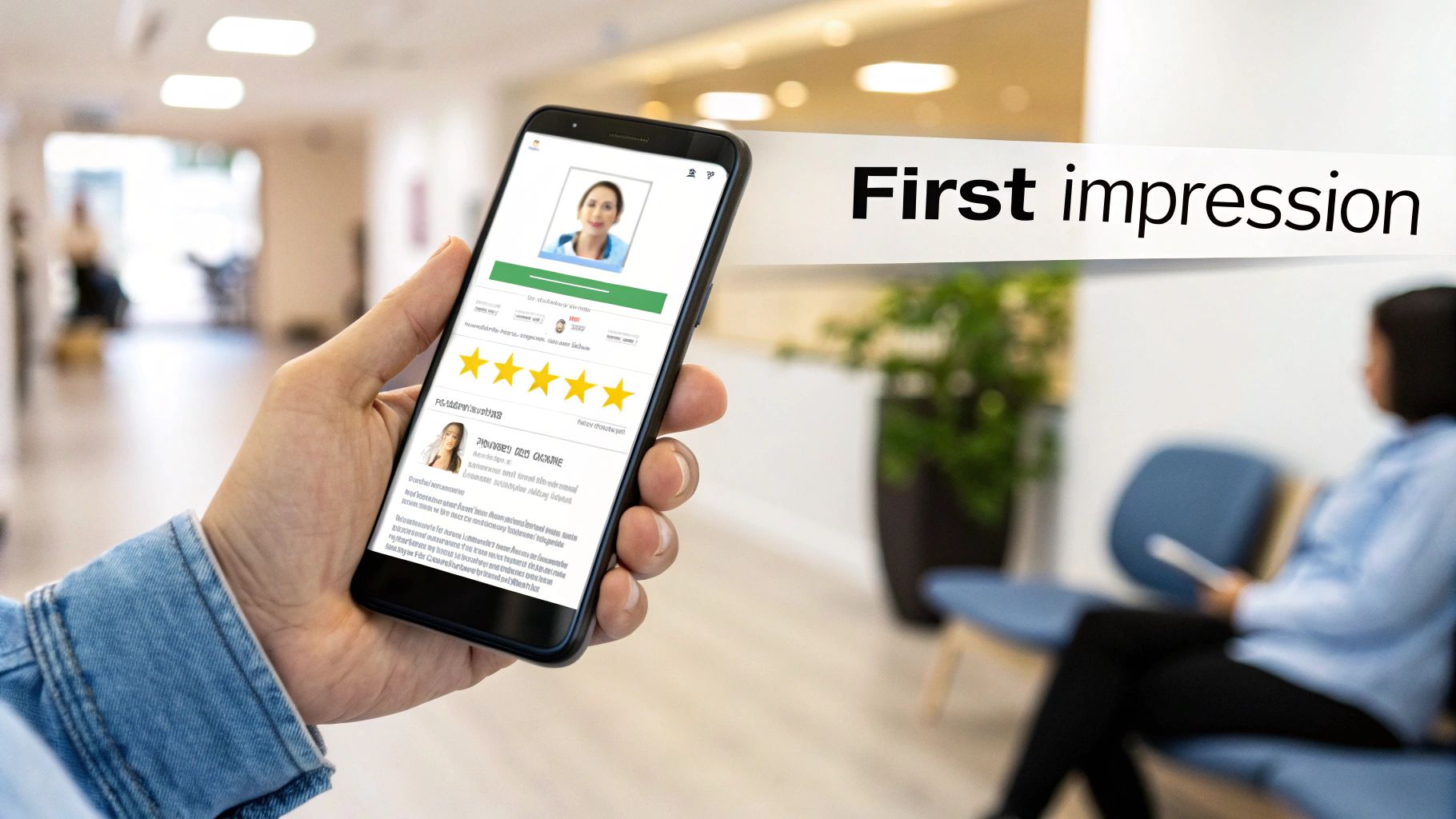
That digital handshake has completely replaced old-school word-of-mouth. Today, a steady stream of authentic, recent reviews from real patients carries more weight than just about anything else.
The New Word-of-Mouth
Think about this scenario for a minute. A potential patient, new to town, needs a family dentist. They search online and find two local practices.
Practice A has a beautiful, slick website but only a handful of reviews, and most of them are a year old. Practice B has a simpler site, but they've got over 150 recent Google reviews. Better yet, the dentist has personally replied to both the glowing reviews and the not-so-great ones.
Which practice gets the call? Nine times out of ten, it’s Practice B.
The numbers don't lie. A staggering 89% of patients now say that online reviews influence their choice of dentist more than traditional credentials. For your practice, this means your Google Business Profile is more than a simple listing; it's the place where 84% of patients trust what they read just as much as a personal referral from a friend.
Your online reputation isn't just a passive part of your marketing anymore. It's an active, powerful tool for bringing new patients through the door. It sends a direct signal to search engines like Google that your practice is trustworthy, relevant, and deserves a top spot in local search results.
In the end, every piece of online reputation management for dentists is connected. A smart strategy for getting reviews, engaging with patient feedback, and keeping your local listings sharp all work together. It builds the trust you need to turn someone searching online into a scheduled appointment. A strong reputation also makes it much easier to figure out how to improve patient experience in your practice, because happy patients are the ones most likely to share their positive stories online.
Your Reputation Needs a Solid Local SEO Foundation
A five-star reputation is fantastic, but it won't do you much good if potential patients can't find you online. This is where online reputation management and local SEO stop being two separate things and start working together. Think of them as a team, sending powerful signals to Google that your practice is the real deal—a trusted, authoritative choice right in your neighborhood.
The cornerstone of this foundation? Your Google Business Profile (GBP). For most people searching for a new dentist, this is the very first impression they'll have of your practice. It's your digital front door, and a fully optimized profile is one of the most powerful patient acquisition tools you have.
Go Beyond the Basics with Your Google Business Profile
Your GBP isn't just a static listing to set and forget. It's a living, breathing snapshot of your practice. Every single section is a chance to build trust with a potential patient and, just as importantly, climb higher in those all-important local map pack rankings.
You’ve got the basics down, but let's dig a little deeper.
- Categories: Don't just stop at "Dentist." Are you a "Cosmetic Dentist"? A "Pediatric Dentist"? Do you offer an "Emergency Dental Service"? Adding these secondary categories helps you show up for much more specific—and valuable—patient searches.
- Services: Get granular. List out every single procedure you offer, from routine cleanings to veneers, dental implants, and Invisalign. Use the exact terms and phrases your patients are typing into Google.
- Photos: Fresh, high-quality photos are a must. Show off your amazing team, the welcoming interior of your office, and your modern technology. Uploading new pictures regularly signals to Google that you're an active, thriving business.
And don't sleep on the GBP Q&A section. This is a golden opportunity to get ahead of common patient questions. You can proactively answer things about the insurance plans you accept, what a first visit is like, or your sedation options. It’s like a mini-FAQ that builds patient confidence before they even think about calling.
Why NAP Consistency Is Non-Negotiable
Your practice information doesn't just live on Google. It's scattered across dozens of online directories like Yelp, Healthgrades, and countless local business sites. One of the most critical signals for local SEO is the consistency of your Name, Address, and Phone number (NAP) across every single one of these platforms.
Even tiny inconsistencies—listing "St." on one directory and "Street" on another, or having an old phone number floating around—can create massive confusion for search engines. This eats away at the trust Google has in your data, which can directly tank your local search rankings.
A patient might not notice a small typo in your address, but a search engine’s algorithm sees it as a major red flag. Perfect NAP consistency isn't just a nice-to-have; it's an absolute must for building a local SEO foundation that actually supports your reputation.
The reality is, 93% of dental patients never click past the first page of Google results. That makes a rock-solid SEO presence absolutely essential, especially since almost every patient's journey starts with a search. We've seen multi-location dental groups boost their consultation bookings by as much as 240% just through active and strategic GBP management.
Tying It All Together to Dominate Your Local Market
When you get your reputation management and your technical SEO working in harmony, the magic happens. A steady stream of positive reviews tells Google that patients love and trust you. A complete, active GBP proves you're a legitimate, busy practice. And squeaky-clean NAP data confirms your physical place in the community.
For a comprehensive guide that weaves together local SEO, Google Maps, and AI-driven strategies to attract more patients, the ultimate SEO dental playbook is an excellent resource.
These pieces all work together to push you up the rankings and present a professional, trustworthy image from the very first click. To dive even deeper, check out our guide on the best local SEO strategies and start strengthening your digital footprint today.
Developing a System to Generate Authentic Patient Reviews
Your happiest patients can be your most powerful marketers, but they rarely think to leave a review on their own. Just hoping they’ll remember to post something online later is a recipe for a slow, inconsistent trickle of feedback. That trickle won’t accurately reflect the quality of your care or help you stand out.
The secret is to build a proactive system that makes leaving a review incredibly simple—a natural final step after a great visit. When you remove all the friction, you empower those satisfied patients to become your biggest advocates. This consistency drives both the volume and velocity of reviews, two huge factors in Google's local search algorithm.
This simple flow shows how a strong reputation is the bedrock of local SEO, directly impacting your practice's visibility.
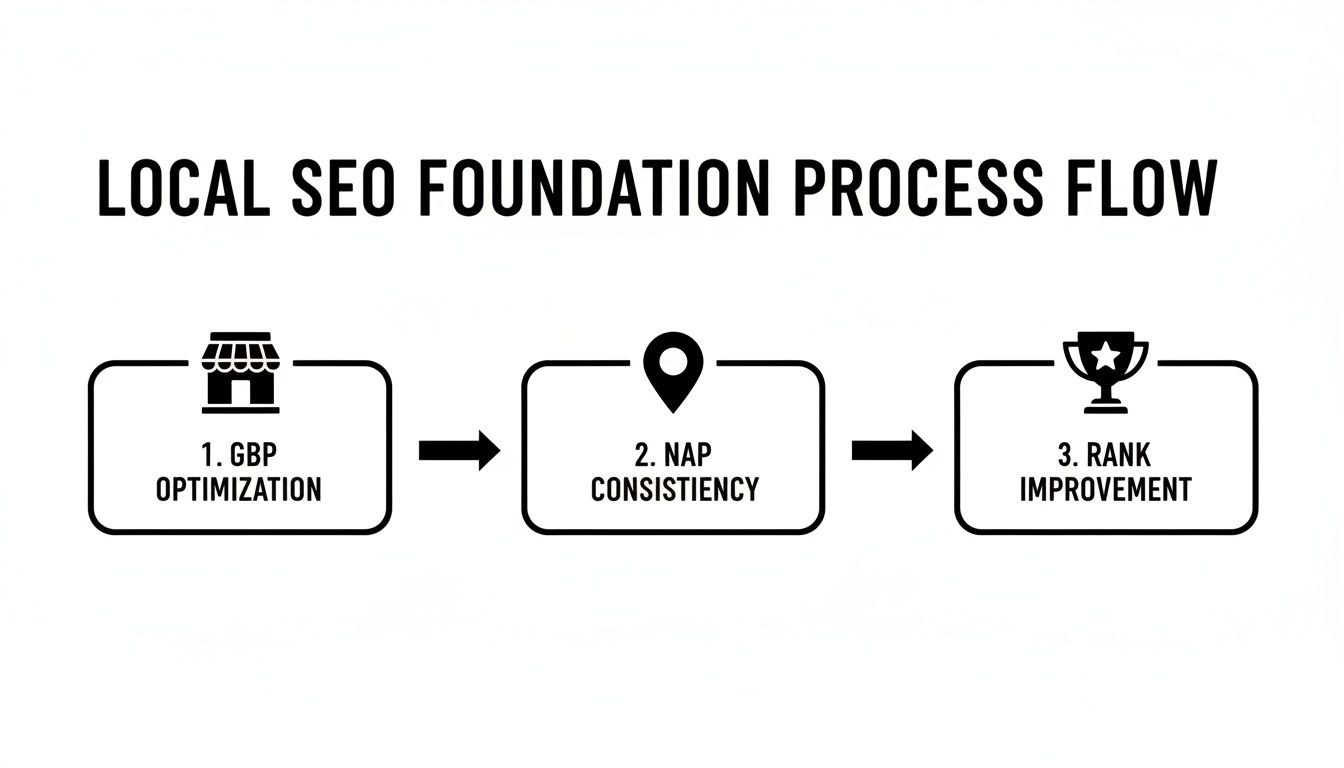
As you can see, everything starts with optimizing your Google Business Profile and locking down your NAP consistency. A steady stream of great reviews fuels this process, pushing you up the local rankings.
Making the Ask Feel Personal, Not Pushy
The single most effective way to get a review? Ask for it in person, right at the peak of patient satisfaction. This "moment of truth" usually happens at the front desk while the patient is checking out, feeling relieved and grateful for your team's great work.
Timing and tone are everything here. A generic, robotic "Leave us a review" falls flat. Instead, train your front desk staff or hygienists to make a specific, personal request. It’s that human touch that makes all the difference.
A warm, genuine request at the right moment is incredibly powerful. It reframes the ask not as a favor for the practice, but as a way for the patient to help other people find the same great care they just received.
For instance, after a patient mentions how gentle their cleaning was, the office manager could say: "I'm so glad to hear that! You know, comments like that on Google really help other people who might be nervous about dental visits find a caring team. If you have a moment later, we'd be so grateful if you shared that."
Choosing the Right Channel to Request Reviews
While in-person asks are fantastic, you need a reliable way to follow up. Deciding between text, email, or other methods depends on your patient demographics and your team's workflow. Each channel has its own strengths and weaknesses.
Here’s a quick breakdown to help you decide which channels are the best fit for your dental practice.
Effective Patient Review Request Channels
| Channel | Pros | Cons | Best For |
|---|---|---|---|
| SMS (Text Message) | – High open rates (98%) – Immediate delivery – Easy for patients (one click) |
– Requires explicit consent (TCPA) – Can feel intrusive if overused |
Practices seeking high response rates and have a mobile-savvy patient base. Ideal for automated post-visit follow-ups. |
| – More space for personalization – Less intrusive than SMS – Easy to track and automate |
– Lower open rates (20-30%) – Often gets lost in crowded inboxes – Can be flagged as spam |
Following up with older demographics or when you want to provide more context. Good for including in post-visit summaries. | |
| In-Person Ask | – Highest conversion rate – Extremely personal and genuine – Builds stronger patient relationships |
– Not scalable – Relies on staff remembering – Can feel awkward if not done right |
Every single happy patient at checkout. This should be the first line of attack, supported by automated follow-ups. |
| QR Codes | – Simple and contactless – Great for in-office signage |
– Requires patient to take action – Less personal than a direct ask |
Placing on appointment cards, front desk signs, or take-home flyers for patients who prefer a self-service option. |
Ultimately, a multi-channel approach is often the most effective. The personal, in-person ask plants the seed, and an automated text or email follow-up makes it incredibly easy for the patient to follow through.
Automating the Follow-Up Without Losing the Human Touch
In-person requests are gold, but they're not always consistent. To build a truly reliable system, you need an automated follow-up that catches every single happy patient. This is where simple SMS and email automation becomes your practice's best friend.
The key is to send the request within 1-2 hours of the appointment, while the positive experience is still fresh in their mind. We’ve found that text messages consistently outperform email for this, boasting much higher open and click-through rates.
Here are a few proven strategies for automating your outreach:
- Post-Visit SMS: Send a short, friendly text with a direct link to your Google review page. The goal is to make it so easy they can do it in 30 seconds.
- Email Signatures: A simple but effective tactic. Add a clickable link to your Google profile in the email signature of every team member.
- Reputation Management Software: For practices ready to get serious, platforms like Podium or Birdeye can automate the entire process. They often integrate with your practice management software to send review requests automatically after an appointment is marked complete.
To see how these tools fit into a broader strategy for attracting new patients, check out our comprehensive guide on digital marketing for medical practices.
Crafting the Perfect Review Request Templates
Your templates need to be polite, concise, and laser-focused on making the process easy. Long, complicated messages get ignored. Here are a couple of battle-tested examples you can adapt for your own practice.
SMS Template Example
"Hi [Patient Name], this is [Your Name] from [Practice Name]. We loved seeing you today! Would you mind taking 30 seconds to share your experience on Google? It really helps us out. [Direct Link to Google Review Page]"
Email Template Example
Subject: How was your visit at [Practice Name]?
Hi [Patient Name],
Thank you for trusting us with your dental care today. We truly hope you had a comfortable and positive experience.
If you have a free moment, we would be incredibly grateful if you could share your feedback on our Google profile. Your review helps others in our community find a dental team they can trust.
[Click Here to Leave a Review]
We look forward to seeing you at your next visit!
All the best,
The Team at [Practice Name]
By combining personal, in-office requests with a systematic, automated follow-up, you'll build a powerful engine that generates a steady stream of authentic reviews. This consistent patient feedback is the lifeblood of your online reputation, fueling better search rankings and building the social proof you need to attract the next new patient.
How to Respond to Every Type of Patient Feedback
Getting a steady stream of patient reviews is a huge win, but that's really only half the battle. How you respond—and if you respond at all—is where you truly start to shape your practice's public image.
When you reply to every single review, good or bad, you're sending a powerful signal to the original reviewer and every potential patient who reads it later. It says you're listening, you value feedback, and you're committed to great care. This is the bedrock of solid online reputation management for dentists.
The Art of Responding to Positive Reviews
It’s tempting to see a five-star review, fire off a quick "Thank you!", and move on. While that's better than radio silence, you're leaving a massive opportunity on the table. A thoughtful, specific response doesn't just thank the patient; it turns their positive experience into a mini-marketing story for everyone else.
The trick is to get personal without ever crossing into patient privacy territory. Ditch the generic, copy-paste replies and instead, echo the specific positive points they brought up.
A few tips for making those positive responses really count:
- Acknowledge the Details: Did a patient rave about your gentle hygienist or your friendly front desk team? Mention that! It proves you actually read and absorbed what they said.
- Reinforce Your Practice's Values: Use their compliments as a launchpad to talk about what you stand for. If they loved the modern tech, you can mention your commitment to cutting-edge, comfortable care.
- Keep It Human: Address the reviewer by the name they use on the platform and sign off with your name or the practice's. It’s a small touch that makes a big difference.
Positive Review Example:
A patient leaves a review saying, "Dr. Smith and his team are amazing! The front desk staff was so friendly, and my hygienist, Maria, was incredibly gentle. I've never felt so comfortable at the dentist."
A Great Response:
"Thank you so much for your kind words, [Patient Name]! We're thrilled to hear you had such a comfortable experience. Our team, especially Maria, works hard to be gentle and welcoming, so your feedback means the world to us. We look forward to seeing you again!"
A Framework for Handling Negative Reviews
Let's be honest, a negative review can feel like a punch to the gut. But hitting back with an emotional, defensive reply is the absolute worst thing you can do. A bad review is your chance to publicly show just how professional, empathetic, and committed you are to your patients. Your goal isn't to win an online argument; it's to take the issue offline and show prospective patients how you handle problems.
Stick to this simple de-escalation framework to turn a potential PR disaster into a masterclass in patient service.
- Respond Quickly and Professionally: Try to reply within 24 hours. A fast response shows you're on top of things and take concerns seriously.
- Acknowledge and Empathize: Kick things off by thanking them for the feedback and validating their feelings. A simple, "We're very sorry to hear your experience didn't meet your expectations," can work wonders.
- Take It Offline: This is the most important step. Never debate the details of a visit or discuss personal health information (PHI) in a public forum. Give them a direct point of contact—the office manager's name, a phone number, or an email—so you can resolve the issue privately.
Crucial Takeaway: Your public response to a negative review isn't for the person who wrote it. It’s for the hundreds of potential patients who will read it later. They are watching to see if you are reasonable, professional, and genuinely committed to patient care.
The impact of this goes way beyond just collecting reviews—it's about driving revenue. A small 5% increase in patient retention can boost a dental practice's profits by 25% or more. While a few bad reviews might scare some people off, maintaining a 90%+ response rate to all feedback builds an incredible amount of trust. If you'd like to dig deeper, you can discover more insights about the value of reputation management for dentists.
Real Examples of Good and Bad Responses
Seeing these principles in action makes it all click. Let’s break down two very different ways to handle the exact same negative review.
Negative Review Scenario:
"I had to wait 45 minutes past my appointment time and felt rushed during my cleaning. I also got a surprise bill for something I thought was covered. Not happy."
Bad Response (Defensive and Public):
"We were unusually busy that day, and our records show we informed you about the cost of that procedure beforehand. Our hygienist is very thorough and would never rush a patient."
This reply is a train wreck. It's full of excuses, it subtly blames the patient, and it discusses specifics publicly. It just sounds argumentative and will absolutely turn away new patients.
Good Response (Empathetic and Moves Offline):
"Thank you for sharing your feedback. We sincerely apologize that your experience did not meet your expectations regarding the wait time and billing. We take these concerns very seriously. Please contact our office manager, Sarah, at [Phone Number] so we can personally address this and work to make things right. We are committed to providing a five-star experience for every patient."
The second response is the clear winner. It's professional, it shows empathy, and it immediately shifts the conversation to a private, problem-solving channel. This tells everyone reading that even when things don't go perfectly, your practice is dedicated to finding a solution. This is how you build a reputation that can weather any storm.
Turning Your Reputation into a Powerful Marketing Story
All those five-star reviews you’ve collected are more than just a nice pat on the back. They're a goldmine of raw marketing material, just waiting to be shaped into a compelling story about your practice. Every single piece of feedback is a firsthand account of the patient experience you work so hard to create.
This is the point where your reputation strategy shifts from defense to offense. It becomes a proactive tool for growth. You can start strategically showcasing your best reviews right on your website, weaving powerful patient testimonials into your social media, and injecting undeniable trust signals into every ad you run.
Done right, this builds the social proof needed to convince a potential patient that you're the right choice, long before they ever pick up the phone to talk to your front desk.
Uncovering the Language of Your Patients
The real magic happens when you stop seeing reviews as just star ratings and start digging into them for recurring themes and specific language. This is the authentic voice of your patient base, and frankly, it's the best marketing copy you could ever hope for.
Go ahead and dive into your last 20-30 positive reviews. Look for patterns. Do you see multiple people mentioning your "painless procedures"? Are they constantly praising your team for being "great with anxious kids"? Maybe they're complimenting your "state-of-the-art technology."
These recurring phrases are your unique selling propositions, identified and validated by the people who matter most—your patients. This patient-generated language is the key to powerful Answer Engine Optimization (AEO).
AEO is all about lining up your website content and marketing messages with the exact questions and phrases real people use when they're searching for a dentist. When you start integrating these themes, you’re not just optimizing for Google; you’re speaking directly to the anxieties and desires of your ideal future patients.
Putting Patient Language into Action
Once you've pinpointed these key themes, it's time to put them to work across your entire digital footprint. This creates a consistent, trustworthy narrative that hammers home your practice's strengths at every single touchpoint.
Here’s how you can start using this patient-generated language to tell a much more compelling story:
- Homepage Headlines: Ditch the generic "Welcome to Our Dental Practice." Try a headline that echoes what patients are already saying, like "Gentle, Anxiety-Free Dentistry for the Whole Family."
- Service Pages: On your page about root canals, feature a real testimonial from a patient who called the procedure "surprisingly comfortable and pain-free." That single quote tackles a major patient fear head-on.
- Social Media Content: Stop posting generic stock photos of smiling families. Instead, share a simple graphic with a quote from a recent review, like: "The team at [Practice Name] made my kids feel so at ease!"
- Google & Facebook Ads: Pull phrases directly from your reviews and use them in your ad copy. An ad promising "A Dental Team That Truly Listens" will connect on a much deeper level than one that just lists your services.
This approach ensures your marketing is perfectly aligned with what new patients are desperately looking for. It builds powerful social proof and transforms your hard-earned reputation into a consistent engine for practice growth. In fact, properly using your online reputation is a fundamental part of learning how to generate leads online because it builds the trust required for someone to take the next step.
Turning Your Website into a Trust-Building Machine
Your website needs to be the central hub for your reputation story. While third-party sites like Google and Healthgrades are critical, you have 100% control over the narrative on your own turf.
Integrate review widgets that automatically pull in your latest five-star reviews from Google. This keeps your site constantly updated with fresh, relevant feedback without you having to lift a finger.
Place these testimonials strategically. Put them on your homepage, on your team bio pages, and right next to your "Schedule an Appointment" button. It provides that final nudge of confidence a visitor needs to take action. This isn't just about showing off; it's about making it dead simple for a potential patient to see that others just like them already trust you with their care.
Your Top Reputation Management Questions, Answered
Once you start digging into reputation management, some real-world questions always pop up. It's one thing to have a plan on paper, but another thing entirely to handle those tricky, nuanced situations that inevitably arise. Let's tackle some of the most common hurdles I see dental practices face.
Think of this as your practical field guide for when things get complicated.
What’s the Right Way to Handle a Fake or Malicious Negative Review?
It's infuriating. You pour your heart into patient care, and then a review pops up that's completely fabricated. The absolute number one rule? Don't engage emotionally in public. Your first move should always be to get the review taken down.
On Google, this means flagging it. Click the three dots next to the review, report it, and be specific about which policy it violates—spam, a conflict of interest, or maybe it contains offensive content. This isn't always a quick process, so while you wait, it's smart to post a calm, professional reply.
"We take all feedback from our patients very seriously. After a thorough check of our records, we can't find a patient registered under this name or with these specific details. We would welcome the chance to resolve this, so we encourage the poster to contact our office manager directly."
This response does two things beautifully. First, it shows any potential patient reading your reviews that you’re professional and attentive. Second, it plants a seed of doubt about the review's legitimacy without you getting into a messy public argument.
Should We Offer Gift Cards or Discounts for Patient Reviews?
This one comes up all the time, and the answer is a hard no. It’s tempting, I get it, but you should never offer incentives for reviews.
Platforms like Google and Yelp have iron-clad policies against this because it completely destroys the credibility of the feedback. Getting caught can lead to some serious headaches:
- The platform can—and will—remove the reviews.
- Your entire profile could get slapped with a penalty, making you less visible.
- Most importantly, it erodes the trust that potential patients have in your practice.
Instead of spending money on incentives, pour that energy into two things: creating an amazing patient experience and making it incredibly easy for them to leave a review. A genuinely happy patient who doesn't have to jump through hoops to share their story is the best "incentive" you could ever ask for.
How Much Time Should Our Practice Actually Dedicate to This Each Week?
Consistency is so much more important than intensity here. For a typical single-location dental practice, blocking out 1-2 hours per week is a perfectly realistic and effective starting point.
The trick is to break it down so it doesn't feel like a huge, looming task. A simple rhythm could look like this:
- Daily (10-15 minutes): A quick check of your main profiles (Google, Yelp) for new reviews. Jump on responses right away, whether they're glowing or critical.
- Weekly (30-60 minutes): Send out your review requests to patients from the past week. It's also a good time to do a quick spot-check of your key directory listings to make sure your hours and contact info are still accurate.
Of course, using a good reputation management software can automate a huge chunk of the review request and monitoring process, which can really cut down on the manual hours your team has to put in.
What Are the Most Important Metrics to Track?
You can't improve what you don't measure. To know if your efforts are actually moving the needle, you need to be watching the right key performance indicators (KPIs). Focusing on these five will give you a clear, no-fluff picture of your progress.
- Overall Star Rating: This is the big one. Keep a close eye on your average rating, especially on Google. The goal should be to maintain a strong 4.5 stars or higher.
- Review Velocity: Are you getting a steady trickle of new reviews each month, or is it just a random flood every six months? A consistent flow looks great to both new patients and search engines.
- Response Rate: How many of your reviews are you actually replying to? You should be aiming for over 90%. It shows you're engaged and listening to everyone.
- Local Search Ranking: Are you showing up in the Google Local Pack when someone searches for "dentist in [your city]" or "emergency dentist near me"? Track your position for these money-making keywords.
- Clicks from GBP: This is where you see the direct payoff. Use your Google Business Profile Insights to see how many people are clicking to call your office or visit your website right from your listing. That’s tangible ROI.
At Jackson Digital, we know that a strong online reputation isn't just about good reviews—it's about attracting the patients you want. Our team helps dental practices build powerful brand stories and turn online visibility into predictable growth. Discover how our tailored digital marketing strategies can elevate your practice.