For a small business, SEO basics come down to one thing: telling your story so effectively that local customers can't help but find you when they're searching online. It's not about complex technical wizardry. It's about giving Google a clear, compelling map that leads straight to your front door, built on a foundation of trust and expertise.
This means optimizing your digital presence to answer questions (Answer Engine Optimization or AEO), dominating your local map (Geographic Optimization or GEO), and building a solid reputation through reviews and consistent business information everywhere you're listed.
Your Guide To Local SEO And Unlocking Growth
Imagine you run a local plumbing business. A homeowner a few blocks away has a burst pipe and pulls out their phone, frantically searching for an "emergency plumber near me." Who shows up first? Is it you, the expert who lives down the street, or a faceless national chain with a massive marketing budget?
This exact moment is where Search Engine Optimization (SEO) makes all the difference. It acts as a bridge, connecting your business to the people who need you, right when they need you most. For a small business, this isn't just a marketing tactic—it's how you tell your story to the right audience and drive growth.
The best part? You don't need a huge budget to win. The secret is to focus on local SEO, a specific type of optimization designed to put your business on the map for geographically-related searches. It’s all about sending the right signals to Google that you are the best, most relevant solution for a customer's problem right here in town.
Why Local Search Is Your Biggest Opportunity
Think about how many people are looking for local services every single day. The numbers are staggering. A game-changing stat shows that 46% of all Google searches have local intent. Nearly half of the billions of daily searches are from people looking for businesses in their own neighborhood.
This isn't just some abstract number; it's a massive, tangible opportunity. For every person searching for a "plumber," there's another searching for a "plumber in [Your City]." Mastering the fundamentals of local SEO lets you tap directly into this high-intent audience. The benefits of SEO for small businesses are immense because you’re connecting with customers who are actively looking to buy what you sell.
The Three Pillars Of Local SEO
Success in local search really boils down to how well you manage three core areas. This diagram breaks down how on-page, off-page, and technical SEO all work together to tell Google you're a legitimate, trustworthy local business.
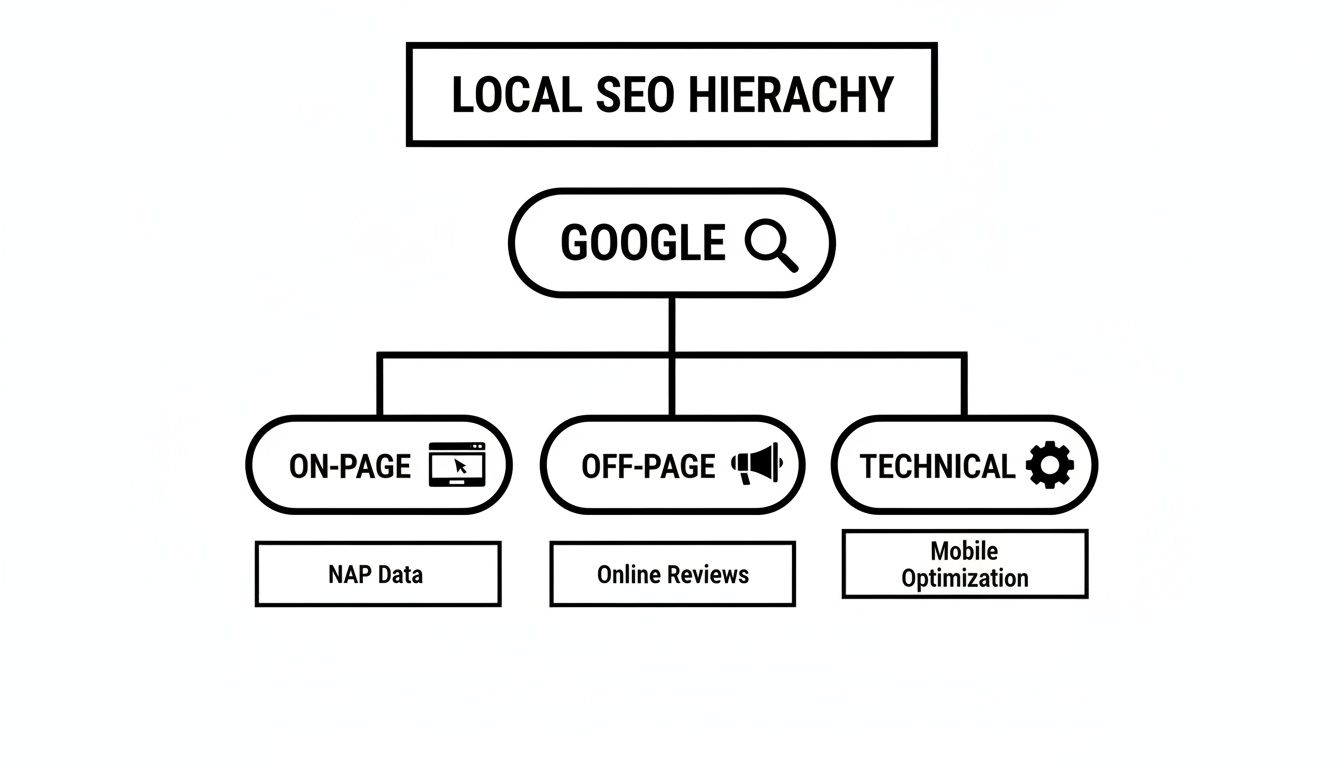
As you can see, a strong local presence requires a balanced approach. Your website content (on-page), your community reputation (off-page), and your site's behind-the-scenes functionality (technical) all need to send consistent, positive signals to search engines.
Ready to get started? Here are the most critical first steps for getting your local SEO foundation in place.
Your SEO Quick Start Checklist
To make this simple, we've boiled down the most important first steps into a quick checklist. Focusing on these three areas will give you the biggest bang for your buck right out of the gate.
| SEO Pillar | Key Action | Why It Matters |
|---|---|---|
| Google Business Profile (GEO) | Claim, verify, and completely fill out your GBP listing with photos, hours, and your business story. | This is your digital storefront. It's the #1 factor for ranking in your local area (Geographic Optimization). |
| Online Directories (Citations) | Ensure your business Name, Address, and Phone number (NAP) are 100% consistent across all major online directories like Yelp, Apple Maps, etc. | Inconsistent information confuses Google and erodes trust. Consistency proves you're a legitimate, stable business. |
| Customer Reviews & Content (AEO) | Actively ask for reviews and create helpful content that answers customer questions. | This is how you answer questions before they're even asked (Answer Engine Optimization), building trust and authority. |
Nailing these fundamentals sets the stage for everything else. Your goal is to make it incredibly easy for both Google and potential customers to find, trust, and choose your business over the competition.
For a deeper dive into all the components of a winning local strategy, check out this comprehensive Local SEO for Small Businesses: Your Ultimate Guide. It's a fantastic resource for mastering the details.
Mastering Your Google Business Profile for Local Dominance
If local SEO were a stage play, your Google Business Profile (GBP) would be the star of the show. This is the heart of your Geographic Optimization (GEO). Think of it less like a simple online listing and more like your most valuable digital storefront, open 24/7 on the world's biggest search engine.

Let me tell you a story about a small, family-owned roofing company. For years, they got by on word-of-mouth, but new competitors were popping up left and right. They felt totally invisible online.
That changed when they started treating their neglected Google Business Profile like their main marketing channel. They uploaded high-quality photos of finished roofs, told the story of their family's commitment to quality in the description, and used the Q&A feature to answer common questions about warranties and materials.
Within months, their phone started ringing. The calls were coming from people who found them right in the Google Maps "Local Pack"—that coveted box of top local results. This single shift dramatically boosted their qualified leads without them spending a penny on ads. This is one of the most powerful seo basics for small business you can put into action today.
Your Step-by-Step GBP Optimization Plan
Turning your profile into a customer magnet is a clear, repeatable process. The goal is to give Google so much rich, accurate, and engaging information that it has no choice but to show your business to local searchers.
Here’s the game plan for claiming, verifying, and fully optimizing your profile:
-
Claim and Verify Your Business: First things first, you need to either create a new profile or claim an existing one that Google may have auto-generated. This kicks off a verification process, usually by a postcard in the mail or a phone call, to prove you're the real owner at that physical address.
-
Complete Every Single Section: Don't skip a thing. This is where you tell your story. Add your website, accurate hours, service areas, and every attribute that applies (e.g., "family-owned," "free estimates").
-
Choose the Right Categories: Pick a primary category that perfectly describes your core business (like "Roofing Contractor"). Then, add as many relevant secondary categories as you can (e.g., "Gutter Cleaning Service," "Siding Contractor"). This is how you show up for a much wider range of local searches.
This detailed approach is absolutely vital for businesses that serve customers across different neighborhoods or cities. If that's you, getting a handle on local SEO for multiple locations is essential to make sure each branch or service area can rank effectively on its own.
https://jackson-digital.com/local-seo-for-multiple-locations/
Bringing Your Business Story to Life
A complete profile is just the foundation. To truly stand out, you need to use your GBP to tell your brand’s story and build trust before a customer ever even clicks through to your website.
A fully optimized Google Business Profile is more than just data; it's a dynamic, interactive preview of the customer experience you offer. It’s your chance to make a powerful first impression and stand out from the competition crowded onto the same map.
Start by writing a compelling business description. Don't just list what you do; explain what makes you different. Share your origin story, your commitment to quality, or your deep roots in the local community. Use keywords naturally, but make your priority telling a story that connects with your ideal customer.
Next, it's all about visual storytelling.
- Upload High-Quality Photos: Get at least 10 high-resolution photos up there to start. Include shots of your storefront (inside and out), your team on the job, your products, and—most importantly—happy customers.
- Post Regularly: Use Google Posts to share updates, promotions, new products, or recent blog articles. This sends a strong signal to Google that your business is active and engaged.
- Manage Q&As Proactively: Don't wait for customers to ask questions. Seed your own Q&A section by posting the common questions you get all the time and providing thorough, helpful answers. This is pure Answer Engine Optimization (AEO) and shows off your expertise head-on.
Creating Website Content That Ranks and Resonates
If your Google Business Profile is the digital front door, your website content is the expert salesperson waiting inside. This is Answer Engine Optimization (AEO) in action. It’s the art of telling both Google and your customers exactly what you're about, page by page, by answering their most pressing questions. This isn't about gaming the system; it's about creating a clear, compelling story that provides real solutions.

And you absolutely need to get this right, because the fight for attention online is brutal. A staggering 75% of users never click past the first page of Google results. Being on that first page is essential, but where you land matters even more. The number one spot can gobble up a 39.8% click-through rate, but that number crashes to just 7.4% by the time you get down to the fourth position.
Get Inside Your Customers' Heads
Before you type a single word, you have to figure out what your community is actually asking. This is where keyword research comes in. Think of it as listening in on the exact problems your potential customers are trying to solve.
Let’s say you run a local dental clinic. People aren't just searching for "dentist near me." They’re typing in specific, often urgent, questions like:
- "what to expect during your first root canal"
- "how much do dental implants cost in [Your Town]"
- "signs you need an emergency dentist"
Building helpful blog posts or service pages that directly answer these questions is the heart of a winning AEO strategy. It establishes you as the local authority and tells a story of expertise and trustworthiness before they even pick up the phone.
The Power of H1 Tags and Meta Descriptions
Okay, so you know what questions to answer. Now you need to package that content in a way Google can easily understand. The best way to think about your website is like a book.
Each page has one main "chapter title"—this is your H1 tag. It needs to be clear, to the point, and include the page's main topic or keyword. For our dentist's blog post, a perfect H1 would be: "What to Expect During Your First Root Canal."
This immediately tells both the reader and the search engine what the page is about. Every page should have one, and only one, H1 tag.
Next up is the meta description. This is that little snippet of text that shows up under your page title in the search results. It's your 155-character billboard—your one shot to tell a mini-story that convinces someone to click your link. A great meta description is persuasive, includes the target keyword, and gives people a compelling reason to click.
- Weak Meta Description: "This blog post is about root canals. We are a dental clinic that performs root canal procedures."
- Strong Meta Description: "Nervous about your first root canal? Our guide walks you through the entire process, from what to expect to aftercare. Feel confident with our expert team. Learn more!"
See the difference? One is a dry statement; the other speaks directly to the searcher's fear and offers a solution.
Putting It All Together: A Content Example
Let's stick with our dental clinic. They discovered "first root canal experience" is a hot topic in their area. They decide to create the ultimate guide to answer every possible question.
Here’s how they'd put these principles into action:
- H1 Tag: A Step-by-Step Guide to Your First Root Canal
- Meta Description: Feeling anxious about a root canal? Our guide explains every step, from preparation to recovery, so you know exactly what to expect. Schedule a pain-free consultation today!
- Content: The article itself is broken up with clear subheadings (H2s and H3s) like "How to Prepare," "During the Procedure," and "Aftercare Tips." It tells the story of the procedure, avoids jargon, uses helpful images, and methodically answers every question a nervous patient could have.
This one piece of content now becomes a 24/7 magnet for qualified local customers. It solves a real problem, builds their authority, and naturally guides people toward booking an appointment.
If writing isn't your strong suit, don't worry. We've got you covered with our guide on how to create great web content for your business, even if you’re not a writer. And for a more technical dive into ranking factors, check out this a comprehensive guide to improving search engine rankings.
Building Your Digital Reputation Beyond Your Website
If on-page SEO is everything you say about your business, off-page SEO is what everyone else says about you. It's the digital version of word-of-mouth, and it’s a huge signal to Google that your business is legitimate, trustworthy, and a real part of the local community. It's not just about links; it’s about the story your reputation tells online.
Think of it this way: a perfectly optimized website is like having a polished, welcoming storefront. But if nobody in town is talking about you, and your shop isn't listed in any local directories, people are going to have a hard time finding or trusting you. Off-page SEO is how you get the town talking.
This part of your strategy is all about building authority and trust signals away from your own website. For any small business, the two most important pillars are local citations and customer reviews, which are fundamental components of SEO basics for small business.
Solidifying Your Digital Footprint with Citations
So, what exactly is a local citation? Imagine your city still printed those massive, yellow business directories. A citation is simply your business’s entry in one of those books. Online, these directories are sites like Yelp, Angi, Apple Maps, and hundreds of other industry-specific platforms.
Each citation lists your business Name, Address, and Phone number (NAP). The single most important rule here is absolute consistency. Even a tiny variation, like using "St." on one site and "Street" on another, can confuse Google. That confusion chips away at the trust Google has in your location data, which can directly tank your local rankings.
Your goal is to create a perfectly consistent NAP footprint across the web. This consistency acts as a powerful verification signal, telling Google, "Yes, this business is exactly who and where they say they are."
Start by nailing down your information on the major data aggregators and popular platforms. Then, hunt down directories specific to your industry, like a local contractors' association or a niche directory for home services. Every single consistent citation you build reinforces your digital identity.
Turning Happy Customers into Your Best Storytellers
Your customers are your most powerful marketers. Full stop. Their reviews are today's word-of-mouth, providing social proof that sways both potential customers and search engines. Every review is a short story about the experience you provide.
Let’s be clear: you can’t just sit back and hope for good reviews. You need a simple, proactive process to encourage them. After a successful job or a happy purchase, make it a habit to send a follow-up message with a direct link to your Google Business Profile review page. The easier you make it for them, the more likely they are to share their experience.
Responding to every single review—good or bad—is just as crucial. A thoughtful response shows you value customer feedback and are actively engaged with your community. It shows you care, continuing the story even after the sale.
Earning Trust with Local Backlinks
Finally, let's touch on backlinks. A backlink is just a link from another website to yours. Think of each one as a vote of confidence. When a reputable local website links to you, they're essentially vouching for your business.
While massive link-building campaigns can feel overwhelming, small businesses can earn powerful local backlinks through simple community involvement. Here's a quick story: a new tech startup wanted to get its name out there. Instead of buying ads, they sponsored a local 5k charity run.
As a result, their logo and a link to their website appeared on the event's official page, in a local news blog covering the run, and on the charity’s "Sponsors" page. They didn't just get backlinks; they built goodwill and told a story of community support. This is a perfect example of how genuine engagement can build the kind of trust signals that Google loves to reward.
Here's a quick breakdown to help you prioritize your off-page efforts. Focus on the "Essential" column first before worrying too much about the "Nice-to-Haves."
Essential vs. Nice-to-Have Off-Page Signals
| Priority Level | Off-Page Tactic | Primary Goal |
|---|---|---|
| Essential | Consistent NAP Citations | Verify your business location and identity for Google. |
| Essential | Google Business Profile Reviews | Build trust, social proof, and improve local rankings. |
| Essential | Industry-Specific Directory Listings | Reinforce relevance and authority within your niche. |
| Nice-to-Have | Local Event Sponsorships | Earn high-quality local backlinks and build community goodwill. |
| Nice-to-Have | Guest Posts on Local Blogs | Demonstrate expertise and gain relevant backlinks. |
| Nice-to-Have | Local Press Mentions | Generate powerful authority signals and brand awareness. |
Ultimately, off-page SEO is about becoming a recognized and trusted name in your community, both online and off. By focusing on these core strategies, you're not just playing an SEO game—you're building a stronger, more reputable business.
How to Know If Your SEO Efforts Are Working
You can't improve what you don't measure. Diving into SEO without tracking your results is like telling a story without knowing if anyone is listening. Instead of getting lost in a sea of data, let's focus on the handful of metrics that truly matter for a small business.
The story is the same for so many small business owners: they pour time and money into their website but feel like they're shouting into the void. The good news is, free tools like Google Analytics and Google Search Console are built to answer that exact question. They tell you precisely how people are finding you and what they do once they arrive.
The KPIs That Actually Matter for Local Growth
Forget about vanity metrics like total website hits. For a local business, success isn't about attracting eyeballs from across the globe; it's about connecting with real customers in your service area. That means tracking the key performance indicators (KPIs) that lead directly to phone calls, appointments, and sales.
These are the numbers that tell the real story of your return on investment (ROI).
- Organic Traffic: This is simply the number of visitors who find your website through a non-paid search on Google. A steady, upward trend in organic traffic is the clearest sign that your story is reaching more people.
- Local Keyword Rankings: Are you showing up when someone searches for "plumber in Anaheim"? Tracking your rank for a handful of core, location-based keywords shows if you're capturing the people who are ready to buy.
- Conversions: This is the ultimate goal. A conversion is any valuable action a visitor takes, like filling out a contact form, clicking your phone number to call, or scheduling an appointment right on your site. This shows your story is compelling enough to inspire action.
Connecting SEO Directly to Revenue
Let’s get practical. Imagine a local e-commerce store that sells handmade furniture and also runs a blog with DIY project guides. By setting up Google Analytics, the owner can see exactly which blog posts are driving traffic that actually converts into local sales.
Here's a look at a Google Analytics dashboard, which can help you visualize your website's traffic sources and user engagement over time.

This kind of data is powerful. It allows the business owner to see which stories are resonating with their audience, letting them double down on what works and fix what doesn't.
Maybe they discover their post on "How to Refinish an Old Oak Table" brings in dozens of local visitors every month who then click over to browse their dining table products. That insight is gold. It tells them to create more content around furniture restoration, directly tying their SEO work to real-world revenue.
By tracking the right data, you stop guessing and start making informed decisions. You can prove the real-world value of your SEO work, turning your website from a simple online brochure into a predictable lead-generation machine.
Common Questions About Small Business SEO
Diving into local SEO always brings up a ton of questions. As a small business owner, you’re already wearing a dozen hats—adding "SEO expert" to the list can feel overwhelming. This section cuts through the noise with clear, direct answers to the questions we hear most often.
We’ve put these answers together to help you get past common roadblocks, tell your business's story more effectively, and feel confident in your SEO plan. Think of this as your personal cheat sheet for those nagging questions that pop up when you're trying to grow.
How Long Does Local SEO Take to Work?
This is easily the number one question we get, and for good reason. While some updates, like a well-tuned Google Business Profile, can start moving the needle in just a few weeks, building a real, sustainable presence in local search is a longer game.
In our experience, it usually takes a solid 3 to 6 months of consistent work to see significant, lasting results from an SEO strategy. SEO is a marathon, not a sprint. The key to winning is consistency—steadily telling your story, creating content, gathering reviews, and building citations over time.
Is a Blog Necessary for My Business?
Yes, absolutely. A blog is one of the most powerful tools for Answer Engine Optimization (AEO). It’s not about churning out generic articles; it’s about solving problems and telling stories for your specific community.
Every single blog post is a new hook in the water, a new chance to show up on Google and answer the exact questions your local customers are typing into the search bar. Imagine a local roofer writing a post titled "Choosing the Best Shingles for [Your Town]'s Wild Weather." Right away, they're telling a story that positions them as the go-to local expert.
How Can I Get More Positive Reviews?
The easiest, most effective way to get more reviews is also the simplest: just ask! The trick is to make it a natural part of your process. After you've finished a job, send a quick, friendly email or text with a direct link to your Google review page.
You have to make it incredibly easy for happy customers to share their stories. One crucial point: never, ever offer incentives for reviews. This is a big no-no that violates Google's policies and can completely torpedo your credibility. A story told through a genuine review is worth far more than any paid-for praise.
Is Social Media Important for Local SEO?
While what you do on social media isn't a direct ranking signal that Google uses, it plays a huge supporting role. For starters, your social media profiles almost always pop up in search results when someone Googles your brand name.
Beyond that, keeping your business information—your name, address, and phone number (NAP)—consistent across platforms like Facebook and Instagram helps reinforce your location and services in Google’s eyes. It's one more piece of the puzzle, another channel to tell your business's story, engage with your local community, and build the trust that is the bedrock of all good SEO.
Ready to stop guessing and start growing? The team at Jackson Digital builds custom SEO strategies that connect your business with local customers ready to buy. Request a free performance audit today and discover your path to predictable growth.