Think of SEO as less of a technical chore and more of a way to tell your story to the right people, right when they're looking for you. A solid SEO strategy for small business can transform your website from a simple digital brochure into your hardest-working salesperson—one that’s on the clock 24/7, pulling in customers who are ready to buy.
Why SEO is Your Best Storyteller and Salesperson
Let’s be honest, "Search Engine Optimization" sounds intimidating. But at its heart, it’s just the most effective way to connect with people the moment they need your help. It’s the difference between shouting into the void with expensive ads and being the trusted answer that pops up when a potential customer whispers a question into Google.
Imagine you're a local plumber. You could run paid ads and hope for the best. But with SEO, you can show up for specific, urgent searches like "emergency pipe repair near me." Instantly, you’re not just another business—you’re the hero of that homeowner's very bad day. That's a story that builds a reputation.
Building Trust Organically
There's a fundamental difference between paid ads and organic search results: trust. Ads often feel like an interruption. But when your website appears at the top of Google organically, it comes with an unspoken endorsement. People instinctively see high-ranking sites as more credible and authoritative, which is a massive leg up when you're a small business going toe-to-toe with bigger competitors.
You can't buy this kind of trust; you have to earn it. It’s built piece by piece, with every helpful blog post, every detailed service page, and every answered question—each one a small chapter in the story of your expertise.
The New Landscape of Search: GEO and AEO
The way people search is changing fast. They're not just typing in keywords anymore; they're asking full questions, expecting direct answers from their devices. This is where Answer Engine Optimization (AEO) and Generative Engine Optimization (GEO) come into play.
- AEO (Answer Engine Optimization) is all about providing short, direct answers that voice assistants like Siri and Alexa can easily use. For a bakery, this might mean having a page that clearly answers, "What are the ingredients in a sourdough starter?"
- GEO (Generative Engine Optimization) focuses on making your content so clear and authoritative that AI tools like ChatGPT will cite it as a source. This means creating comprehensive, well-structured content that establishes you as an expert.
By getting your content ready for these new ways of searching, you position your business as the primary source of information in your field. It’s about making your brand synonymous with expertise. This is the future of being found online.
It's no surprise that a staggering 74% of small businesses are planning to invest in SEO by 2026, making it a top priority. They've seen the writing on the wall: organic search drives real, sustainable value. The vast majority of clicks in search results go to organic listings, leaving paid ads in the dust. For local plumbers, dentists, or ecommerce shops, this means SEO is the engine that will keep the leads and sales coming in. You can dig deeper into these trends in these small business marketing stats to see what your competition is up to.
Laying Your Strategic SEO Foundation
Jumping into an SEO campaign without a clear map is a surefire way to waste time and money. Before you start chasing keywords or building links, you need to get the lay of the land. That means doing a quick, non-technical audit to figure out exactly where you’re starting from.
Think of it like planning a road trip. You wouldn't just get in the car and drive. You’d check your starting point on a map, figure out your destination, and plot the best route. Your SEO foundation is that initial check-in—an honest look at where your website stands today and what your competitors are up to.
Take Stock of Your Current Online Presence
First things first, you need to see your business the way Google sees it. This isn't some deep technical dive; it’s a high-level overview. What story is your digital footprint telling right now?
Start with a few basic questions:
- What are you known for? Go ahead and Google your business name. Does your website pop up first? Is all the info in your Google Business Profile accurate?
- How are customers finding you now? If you have basic analytics hooked up, check out which pages get the most traffic. This is a goldmine for understanding what services or products are already grabbing people’s attention.
- What does your website actually say? Imagine you're a first-time visitor. Is it instantly obvious what you do and where you do it? Your homepage needs to answer those questions in seconds.
This initial look helps you move past fuzzy goals. Instead of a vague target like "rank #1," you can set a real business objective, like "increase qualified leads from my service area by 20% in the next six months."
A winning SEO strategy is built on specific, measurable goals that tie directly back to your bottom line. It’s about shifting the focus from vanity metrics to real-world results—more phone calls, more form fills, and more sales.
Uncover Competitor Strengths and Weaknesses
Next, it’s time for a little friendly recon. You need to see what the competition is doing right—and, more importantly, where they’re dropping the ball. This isn't about copying their every move; it’s about learning from their playbook. Pick out two or three direct competitors who consistently show up at the top of local search results for your main services.
Look for patterns. Are their websites noticeably faster than yours? Do they have dedicated service pages for every single neighborhood they cover? Are they publishing helpful blog posts that answer common customer questions? Every observation is a clue. If a competitor is ranking well with a killer FAQ page, that’s a piece of "low-hanging fruit" you can replicate and improve on. For a solid, no-fluff plan, a comprehensive small business SEO guide like this one can provide the framework you need to get found.
Define Your Measurable Roadmap
Now that you have a clear picture of your starting point and the competitive landscape, you can build a practical roadmap. This is where you connect every SEO task to a specific business goal. You’re not just making a random to-do list; you’re creating a prioritized action plan.
For instance, your audit might reveal that your website is a nightmare on mobile. Since over half of all web traffic comes from mobile devices, fixing that becomes a top priority—it directly impacts whether a visitor sticks around or bounces. Or maybe you discover your competitors have hundreds of customer reviews while you're sitting on a handful. Your immediate action item? Create a dead-simple process to ask every happy customer for a review. Getting the fundamentals right is everything; you can learn more about how to do keyword research in our detailed guide.
This foundational work ensures every step you take is deliberate, measurable, and designed to push your business forward.
Dominating Local Search with Your Google Business Profile

For a small business, the customer journey almost always starts with a local search. Someone needs a plumber, a dentist, or a great cup of coffee right now, and they turn to the map on their phone. This makes your Google Business Profile (GBP) the single most powerful free tool in your entire marketing arsenal.
Think of your GBP not as a static listing, but as a dynamic, interactive storefront on Google. It's your digital handshake, your billboard, and your welcome mat all rolled into one. A well-managed profile doesn't just put you on the map; it tells a compelling story that turns nearby searchers into loyal customers.
The opportunity here is immense. Local SEO is essentially revenue SEO for small businesses, yet an astonishing 56% of local retailers haven't even claimed their free Google Business Profile. That's a huge miss when you consider that 46% of all Google searches are for local information, and 28% of those searches result in a purchase. Leaving your profile unmanaged is like leaving cash on the table.
Moving Beyond Basic Information
Simply claiming your profile and adding your address isn't enough to compete. The real magic happens when you treat your GBP as a living extension of your business. This is how you dominate the coveted "map pack"—that box of top local results that appears before the traditional organic listings.
Imagine a dental clinic struggling to book new patient appointments. Their basic GBP listing showed their address and hours, but so did every other dentist in town. They decided to tell a better story. They uploaded high-quality photos of their modern, welcoming office, their friendly staff, and the advanced technology they used.
Next, they filled out the "Services" section in detail, listing everything from routine cleanings to cosmetic dentistry. They began posting weekly updates with patient testimonials and oral hygiene tips. The result? Their profile started appearing for more specific searches like "best cosmetic dentist near me," and potential patients could see proof of their quality before even clicking to their website. Bookings from Google jumped significantly in just a few months.
Optimizing Every Feature for Maximum Impact
Your Google Business Profile is packed with features designed to help you connect with customers. Using them strategically is a core component of any effective SEO strategy for small business.
Here are the key areas to focus on:
- Services and Products: Don't just list what you do; describe it. Add prices, photos, and detailed descriptions for each service or product. This helps Google understand exactly what you offer and match you to more specific queries.
- Google Posts: Use this feature to share updates, promotions, events, or new blog content. Tell a micro-story: feature an employee, showcase a finished project, or highlight a happy customer. Posts keep your listing fresh and engaging.
- Questions & Answers: Proactively populate this section yourself. Think of the most common questions customers ask and post them, then answer them thoroughly. This builds a valuable FAQ right on your profile and prevents misinformation from being posted by others.
- Photos and Videos: Showcase your work, your team, and your business location. A steady stream of new, high-quality images signals to Google that your business is active and thriving. Tell your story visually.
To make sure you're hitting all the right notes, use this checklist to audit your own profile. It covers the essentials that can make a huge difference in your local rankings.
Google Business Profile Optimization Checklist
| Feature | Optimization Action | Why It Matters |
|---|---|---|
| Business Name | Ensure it matches your legal business name exactly. No extra keywords. | Consistency builds trust with Google and customers. Keyword stuffing can lead to suspension. |
| Categories | Select one primary category and 3-5 relevant secondary categories. | This is the #1 factor for ranking. It tells Google what your business is. |
| Address & Service Areas | Verify your physical address and define your specific service areas. | Crucial for appearing in map pack results for "near me" searches. |
| Hours of Operation | Keep hours accurate, including special hours for holidays. | Inaccurate hours are a major source of customer frustration and negative reviews. |
| Phone Number & Website | Use a consistent, local phone number and link to your website's homepage. | These are core contact points that drive leads and website traffic. |
| Photos & Videos | Upload high-quality photos weekly: interior, exterior, team, at-work shots. | Visuals increase engagement by over 42% and show your business is active and authentic. |
| Services/Products | Add every service and product with detailed descriptions and pricing. | Allows you to rank for specific, long-tail keywords (e.g., "emergency root canal"). |
| Google Posts | Publish at least one Post per week with an update, offer, or event. | Keeps your profile fresh, engages searchers, and provides timely information. |
| Q&A Section | Pre-populate with 5-10 frequently asked questions and answer them yourself. | Controls the narrative, provides helpful info, and reduces inbound calls for basic questions. |
| Reviews | Actively request reviews from happy customers and respond to every single one. | Social proof is a massive ranking factor and conversion driver. Google values engagement. |
Once you've worked through this list, your profile will be in much better shape to compete locally. But the work doesn't stop there.
Building a strong local presence also means building trust with Google across the web. This means ensuring your business name, address, and phone number (NAP) are consistent everywhere they appear online, from Yelp to industry-specific directories. This consistency, known as building local citations, reinforces to Google that your business information is accurate and reliable, further boosting your map pack potential. You can dive deeper into these techniques by exploring some of the best local SEO strategies that successful businesses use.
Creating Content That Attracts Real Customers

Content is the engine of any good SEO strategy. But it’s incredibly easy to get lost, churning out articles that nobody ever reads. Let's be clear: great content isn't about jamming keywords onto a page. It's about answering the real, nagging questions your customers are asking and telling a story that positions you as the expert they can trust.
To make content that actually works, you have to stop thinking like a business owner and start thinking like your ideal customer. What keeps them up at night? What problems are they desperately trying to solve? The answers to those questions are the bedrock of a content plan that brings in business, not just clicks.
Finding the Keywords That Matter
Keyword research is your window into your customer's mind. The goal isn’t just to find high-volume terms; it's to uncover the specific phrases that signal someone is ready to pull out their wallet. For a small business, this means prioritizing intent over sheer numbers.
Let me tell you about a local HVAC company we worked with. They initially burned through their budget trying to rank for the term "air conditioning." The competition was just brutal, dominated by national brands and manufacturers. After months of getting nowhere, they changed their whole approach. They started listening to their customer service calls and paying attention to the questions people asked.
This simple shift led them to target keywords like:
- "why is my AC unit leaking water"
- "cost to replace HVAC filter in Dallas"
- "best smart thermostat for Texas heat"
By creating genuinely helpful blog posts and service pages answering these specific, "long-tail" questions, they started attracting homeowners who had an immediate, painful problem. They weren't just getting traffic anymore; they were getting qualified leads. This is the pivot you need to make. With around 50% of search queries being four words or longer, the real opportunity is in these detailed, intent-driven searches.
The most effective content in an SEO strategy for small business doesn't just rank—it solves a problem. It provides a genuine answer, builds trust, and naturally guides the reader toward your solution, whether that’s a service call or a product purchase.
Building Your Content Calendar
Once you have a solid list of customer-focused keywords, the next step is to get organized with a simple content calendar. This doesn't need to be a complex, color-coded behemoth of a spreadsheet. Think of it as a simple blueprint for consistently publishing valuable information.
A good way to start is by splitting your content into two main buckets: Service Pages and Blog Posts.
Service Pages: These are your money pages. They should be laser-focused on a single service you offer (e.g., "Emergency Leak Repair," "Residential Roof Installation"). Each page needs to target commercial-intent keywords and clearly explain the value you provide, answering key questions about your process, costs, and benefits.
Blog Posts: This is where you establish your expertise. You answer the "how-to," "what-is," and "why" questions your customers have before they're ready to buy. This content builds trust and attracts people who are actively researching solutions. From these posts, you can then link back to your relevant service pages, creating a natural path for the reader.
If you aren't a natural writer, don't sweat it. Authenticity and helpfulness are what matter most. We've even put together a guide on how to create great web content for your business, even if you're not a writer.
Telling Your Brand Story Through Content
Every single piece of content you create is a chance to tell your story. Are you the family-owned plumbing company that’s been serving the community for three generations? Weave that into your "About Us" page and service descriptions. Are you a tech-forward dental clinic that invests in the latest pain-free technology? Show it off with a blog post and a video tour.
Your unique story is your biggest competitive advantage. It’s what separates you from the faceless corporations and builds a real connection with your audience. As you create content, always ask yourself: Does this sound like us? Does it reflect our values?
Ultimately, a strong content plan does way more than just improve your rankings. It turns your website into a valuable resource that people trust and return to. And in a world where organic traffic powers over 40% of revenue for businesses that get SEO right, building that trust is the smartest investment you can make. The data shows that 53% of all website traffic comes from organic search, so every helpful article you publish is another open door for a new customer.
Nailing Your On-Page and Technical SEO
Let's be clear: your amazing content and perfectly tuned Google Business Profile are only half the story. If Google's bots can't easily crawl, understand, and index your website, all that hard work might as well be invisible.
This is where on-page and technical SEO come in. Think of them as the foundational plumbing of your site. Good plumbing ensures everything flows smoothly for both search engines and your customers.
Your content is the main act, but your site's technical health is the stage it's performed on. A shaky stage with bad lighting and muffled audio will tank even the best performance. My goal isn't to turn you into a web developer, but to show you how to spot the critical issues and make simple fixes that deliver a huge impact.
The Art of On-Page SEO
On-page SEO is all about sending crystal-clear signals to search engines about what each page on your site actually is. These elements act like digital signposts, guiding Google's crawlers and helping you rank for the terms that matter. Getting them right is a non-negotiable part of any SEO strategy for small businesses.
Imagine a roofer in Austin who wants to rank for "metal roof installation Austin." Their main service page needs to reflect this with laser precision.
- Title Tag: This is the clickable headline people see in the search results. It needs to grab attention and include your primary keyword. For example:
Metal Roof Installation in Austin TX | Lifetime Warranty. - Meta Description: This is the short summary that appears under the title tag. While not a direct ranking factor, a great one convinces people to click. It’s basically a mini-ad for the page:
Expert metal roof installation in Austin. Get a free, no-obligation quote on a durable, energy-efficient roof for your home. - Headings (H1, H2, H3): These give your content structure. The H1 is your main page title, and you should only ever have one. H2s and H3s break up the content into logical, scannable sections that make it easy for people to read.
These aren't just technical boxes to tick; they are your first, best chance to tell a user (and Google) exactly what value they'll find on that page.
Crucial Technical Health Checks
Looking beyond individual pages, your website's overall technical health has a massive effect on user experience—and by extension, your rankings. A slow, confusing, or broken site frustrates visitors and sends all the wrong signals to Google.
Here are the absolute must-checks for any small business site.
Mobile-Friendliness is a Must
Google now uses "mobile-first" indexing. In simple terms, this means it primarily looks at the mobile version of your site for ranking signals. If your website is a pain to use on a phone—forcing users to pinch and zoom just to read text—you're actively sabotaging your own SEO.
A responsive design that automatically adapts to any screen size isn't just a "nice-to-have" anymore; it's essential.
Your website has to provide a flawless experience on a smartphone. More than half of all web traffic now comes from mobile devices, so a poor mobile experience is like locking the front door on half your potential customers.
Site Speed Matters More Than You Think
Be honest: how long will you wait for a page to load? Three seconds? Maybe five if you're feeling patient?
Study after study shows that page load time has a direct impact on bounce rates. A slow website doesn't just annoy users; Google sees it as a sign of a low-quality site. Use Google's PageSpeed Insights tool to get a free report card on your site's performance. It will even give you actionable tips to speed things up.
A Logical Site Structure
Finally, your website needs to be dead simple to navigate. A clear, logical structure helps users find what they need without thinking and, just as importantly, allows search engine crawlers to discover all your important pages.
A good rule of thumb is the "three-click rule"—a user should be able to find any piece of information on your site within three clicks from the homepage. This kind of clear hierarchy makes your site more useful for everyone involved.
How to Measure SEO Success and Budget Smartly
So, you're putting in the work. How do you actually know if your SEO efforts are paying off? Forget about just watching your overall traffic numbers go up—that's a vanity metric that won't tell you the whole story.
The only way to know if your strategy is really working is to measure your return on investment. You have to connect every single SEO action back to a real business result.
Focusing on the Right KPIs
It's easy to get lost in the weeds, obsessing over every little keyword ranking fluctuation. Don't. Instead, zero in on the key performance indicators (KPIs) that directly affect your revenue. These are the numbers that justify your time and money.
- Organic Traffic Growth: Is your site consistently getting more visitors from search engines month after month? A steady upward trend is a great sign that your visibility is growing.
- Keyword Rankings for "Money" Terms: Pay close attention to your rankings for keywords with high commercial intent. Think phrases like "emergency plumber near me" or "buy handmade leather wallet." These are the searches that actually lead to sales.
- Conversion Rate from Organic Traffic: What percentage of those organic visitors are doing what you want them to do? This could be filling out a contact form, making a purchase, or calling your business. This is arguably the most important metric of all.
- Leads and Sales Generated: Use tracking tools like Google Analytics to directly attribute leads and sales back to your organic search traffic. This is where you see the real ROI.
When you're trying to figure out which numbers to watch, it’s crucial to pick the right performance indicators from the start. Taking some time to learn what KPI metrics make a valuable report for small business can help you track progress effectively and justify every dollar spent.
This timeline gives you a good idea of how foundational SEO health checks can influence these very KPIs over time.
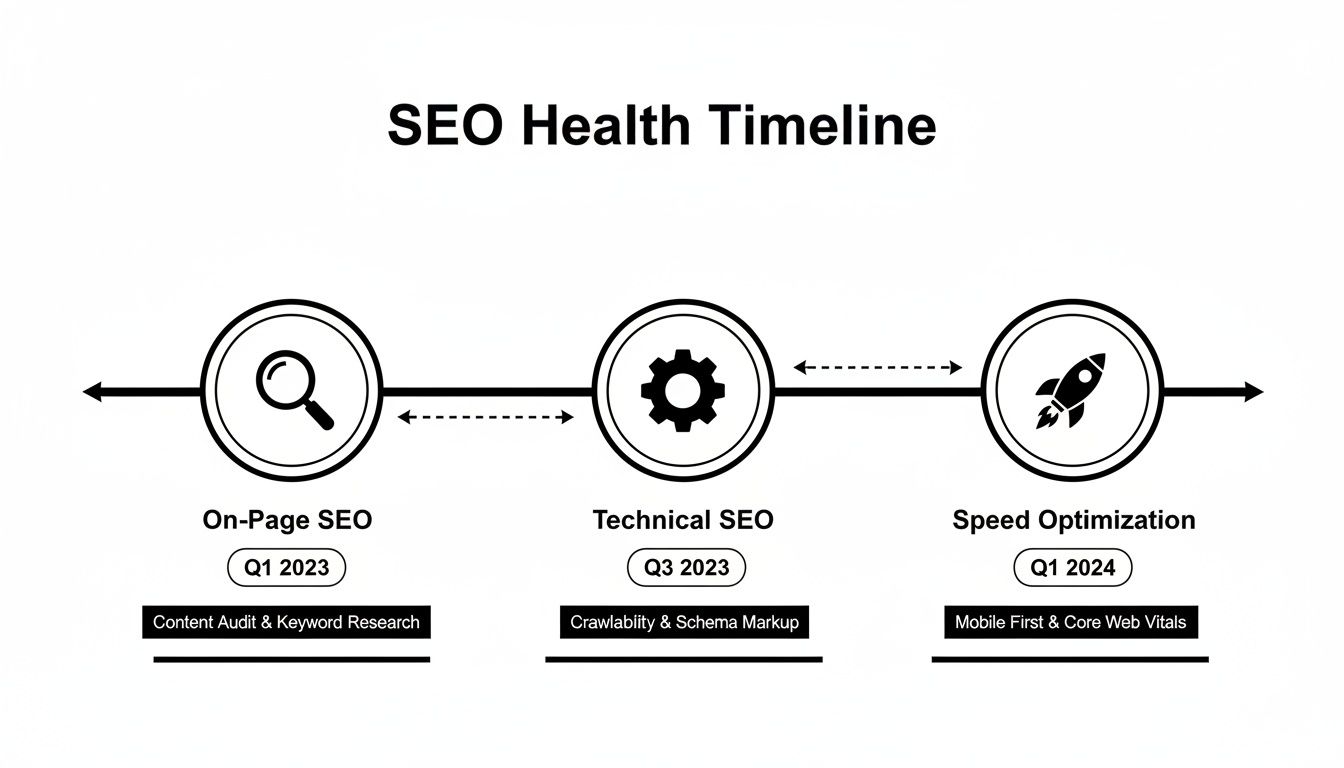
As you can see, consistent effort across on-page optimization, technical fixes, and site speed improvements leads to real, measurable gains that build on each other.
Allocating Your SEO Budget Wisely
The budget question always comes up. The truth is, you can get started on your own with free tools like Google Search Console, but investing some money will almost always speed things up.
For a small business working with an agency or a freelancer, a typical monthly investment can range from $500 to over $2,500. Where you fall in that range really depends on how competitive your local market or industry is.
Try to think of your SEO budget not as a cost, but as an investment. You're building a predictable system for generating new leads and sales. A solid strategy should pay for itself many times over in new business.
Common Questions Small Business Owners Ask About SEO
Getting into SEO for the first time usually brings up a lot of questions. We hear them all the time from business owners just trying to get a clear picture of what it takes. Here are some direct, no-fluff answers to the most common ones.
How Long Does SEO Take to Work for a Small Business?
This is the big one, and the honest answer is it takes patience. While you might see some quick wins in a few weeks—especially with a well-tuned Google Business Profile—a real, comprehensive SEO strategy usually needs four to six months to start building serious momentum.
Think of it like planting a tree, not flipping a switch.
The first few months are all about building a solid foundation: fixing technical glitches, figuring out the right keywords, and creating the core content your site needs. You'll probably see encouraging signs first, like your rankings creeping up for a few key terms, long before you see a big jump in phone calls or sales.
Can I Do SEO Myself or Should I Hire Someone?
You can absolutely get started with DIY SEO. In fact, this guide is designed to give you the confidence to do just that. Handling the basics of local SEO, like managing your Google Business Profile and asking customers for reviews, is a fantastic place for any business owner to start. It's low-hanging fruit.
But as your business grows, SEO gets more complicated. Bringing in an expert starts to make a lot of sense when you need a more advanced strategy, help with technical issues, or just a steady stream of content you don't have time to create. It frees you up to do what you do best—run your business.
What Is the Most Important Part of SEO for a Local Service Business?
If you run a local service business—a plumber, dentist, roofer, you name it—your number one priority is, without a doubt, local SEO. Your entire world should revolve around dominating the Google "map pack" for searches happening in your service area.
The heart of this strategy is your Google Business Profile (GBP). To win here, you need to be relentless about it.
- Fill out every single section of your GBP. Don't leave anything blank.
- Actively chase down new, positive customer reviews. This is a constant effort.
- Build out specific service pages on your website for each town or neighborhood you serve.
- Make sure your business name, address, and phone number are perfectly consistent everywhere online.
These are the things that make the phone ring with customers right down the street.
How Much Should a Small Business Budget for SEO?
SEO budgets are all over the map, but a realistic range for a small business working with a good freelancer or a small agency is typically somewhere between $500 to $2,500 per month. Where you land in that range really depends on how competitive your market is and how aggressive your growth goals are.
Be very wary of anyone promising the world for a couple hundred bucks a month. Good, effective SEO takes real expertise and a significant amount of time to execute properly.
Try to see your SEO budget as an investment in a predictable lead machine, not just another monthly bill. When it's done right, the return should blow the initial cost out of the water.
Ready to build an SEO strategy that drives predictable growth? The team at Jackson Digital creates custom plans that turn your website into a reliable source of qualified leads and sales. Request your free performance audit today.