Think of a digital marketing agency as a growth partner for your business. Their job is to take everything you offer—your products, your services, your story—and put it in front of the right people online. The ultimate goal? To help you rank on search engines, tell compelling stories, and turn clicks into customers.
Your Business Growth Partner Explained
If your business is a high-performance engine, a good digital marketing agency is the expert pit crew. They're not just there to change the tires; they're the architects of your entire digital strategy, mapping out a clear path to attract, engage, and ultimately convert your ideal audience into paying customers.
This isn't about guesswork. A solid agency transforms the chaotic noise of the internet into a predictable, measurable stream of leads and sales. They do this by focusing on core functions that directly influence how you show up in search results and win new business.
This flowchart breaks down how an agency systematically drives growth, moving from a foundational strategy all the way to monetization.
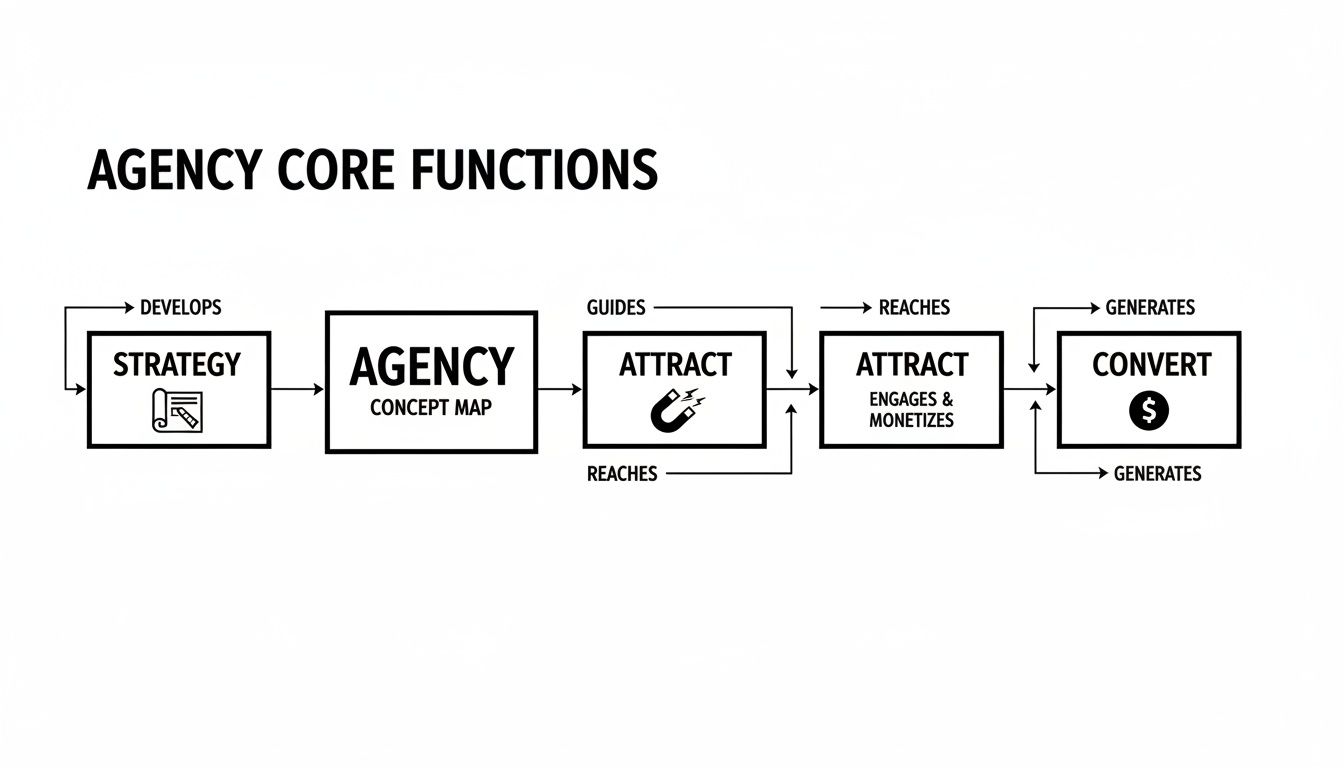
As you can see, success online is anything but random. It's a structured process that begins with a rock-solid strategy, which then fuels the tactics used to attract visitors and guide them toward making a purchase.
The Storytelling and Science of Growth
At its core, great digital marketing is a blend of two things: compelling storytelling and hard data. The story is what grabs people's attention and builds a connection.
For example, a local plumber isn't just selling pipe repairs; they’re selling the peace of mind that comes with a "worry-free weekend," where a burst pipe doesn't derail family plans. An agency helps you find and tell that story across all your digital channels.
But a great story is useless if no one hears it. That's where the science comes in. An agency dives into data, analyzing search trends to see the exact phrases your potential customers are typing into Google. This is how they help you rank. They create content that answers those questions, which signals to Google that your website is a trusted authority.
This one-two punch is what helps you rank higher on search engines. It improves your visibility for traditional searches (SEO), local searches (GEO), and even AI-powered answers (AEO).
A great agency doesn't just manage your ads or tweak your website. They build a sustainable growth machine that connects your business story to the customers who need to hear it most, transforming your online presence from a simple brochure into your most effective salesperson.
When you understand the moving parts, including an effective digital marketing team structure, it becomes clear how agencies deliver such specialized and comprehensive services. This integrated approach ensures every marketing dollar is an investment in measurable growth. In the next sections, we'll dig into the specific tactics they use to make it all happen.
Core Agency Services and Their Business Impact
To give you a clearer picture, here’s a quick rundown of the most common services you'll find at a digital marketing agency and the direct impact each one has on your business goals.
| Service | What It Is | Primary Business Goal |
|---|---|---|
| Search Engine Optimization (SEO) | Improving your website's visibility in organic search results. | Increase organic traffic and brand authority. |
| Paid Media (PPC) | Running targeted ad campaigns on platforms like Google and social media. | Generate immediate leads and sales. |
| Content Marketing | Creating valuable articles, videos, and guides to attract your audience. | Build trust, educate customers, and support SEO. |
| Web Analytics & Reporting | Tracking, measuring, and analyzing website data and campaign performance. | Make data-driven decisions and prove ROI. |
| Technical Website Audits | Analyzing your site's health for issues impacting performance and SEO. | Improve user experience and search engine crawlability. |
| Google Penalty Recovery | Diagnosing and fixing issues that have caused a drop in search rankings. | Restore lost traffic and revenue. |
| Local & E-commerce SEO | Optimizing for location-based searches and online product sales. | Drive foot traffic and increase online sales. |
Each of these services represents a different tool in the agency's toolkit, all working together to build a powerful and cohesive marketing engine for your business.
Building Your Foundation with SEO and Content
If you're looking for sustainable, long-term growth, this is where it all begins. Think of Search Engine Optimization (SEO) as the work that makes your business the most visible and trusted landmark in a bustling digital city. When your ideal customers search on Google, an agency's goal is to make you the first destination they find—not some hidden shop tucked away on a backstreet.

A digital marketing agency's job is to make that happen by mastering the three core pillars of SEO. Each one serves a distinct, yet interconnected purpose. Together, they build a powerful online presence that doesn’t just attract eyeballs, but actually converts them into customers.
The Three Pillars of SEO Agency Work
First up is technical SEO. This is like checking the structural integrity of your building before you open for business. An agency makes sure your website is built on a solid foundation, free of any cracks or issues that might confuse search engines. This covers things like optimizing your site speed, ensuring it works perfectly on mobile phones, and adding structured data so Google can easily understand what your pages are all about.
Next, we have on-page SEO. This is the art and science of crafting your individual web pages to perfectly match what your audience is searching for. An agency digs deep with keyword research to find the exact questions your customers are asking. Then, they carefully weave those terms into your page titles, headings, and content, turning each page into a crystal-clear and compelling answer.
Finally, there’s off-page SEO, which is all about building your reputation across the web. Going back to our city analogy, this is like earning rave word-of-mouth reviews. Agencies do this by earning high-quality backlinks from other reputable websites, which sends a strong signal to Google that your business is a trusted authority in its field.
Content: The Fuel for Your SEO Engine
Content is the lifeblood that flows through all three SEO pillars. It’s the valuable articles, helpful guides, and engaging stories that not only pull in search traffic but also build deep, lasting trust with your audience. An agency doesn’t just churn out blog posts; they develop a strategic content ecosystem.
This means creating content that tells your story while addressing customer pain points at every stage of their journey. From the moment they realize they have a problem to the final purchase decision, strategic content positions your business as the go-to expert. For example, a local contractor might create a blog post titled "5 Signs You Need a Kitchen Remodel" to catch homeowners right at the beginning of their research.
An agency’s job is to transform your website from a passive digital brochure into an active, lead-generating machine. By combining technical precision with compelling, story-driven content, they ensure you don't just get found—you get chosen.
This strategic approach is absolutely critical because search behavior is incredibly concentrated. While the top 500 search terms get about 8.4% of all search volume, a mind-boggling 97% of websites get almost no organic traffic from Google at all. This really highlights why an agency's expertise in targeted keyword research and optimization is so valuable. To learn more, discover insights about digital marketing statistics and their impact on strategy.
From Local Search to AI Answers
The core ideas of SEO now extend far beyond the traditional list of blue links. A good agency also focuses on two increasingly important areas: GEO and AEO.
-
Geographical Optimization (GEO): This is non-negotiable for local businesses. An agency will optimize your Google Business Profile, build local citations, and create content specific to your service area. The goal is simple: when someone in your town searches for "plumber near me," your business appears right at the top of the map pack, driving real foot traffic and phone calls.
-
Answer Engine Optimization (AEO): Search is becoming more conversational, especially with the rise of AI tools. AEO is all about getting your content featured as the direct answer to a question. An agency structures your content to be easily digested by these AI systems, using clear headings, concise answers, and structured data. The prize is becoming the cited source in an AI-generated response, positioning your brand as the definitive authority.
Let’s bring this to life with a story. Imagine a local roofing company struggling to get leads. An agency steps in and builds a geo-optimized landing page for "emergency roof repair in [City Name]." They also create a series of blog posts answering common questions like "How much does a new roof cost?" and "What to do after a hail storm?"
Through off-page SEO, they manage to get the company featured in local news articles about storm preparedness. Before long, the company is all over the local search results. When a homeowner's roof starts leaking during a storm, their panicked search leads them directly to the roofer’s helpful content. They see the positive local reviews, feel an immediate sense of trust, and make the call. The website has done its job, turning a search query into a paying customer.
Accelerating Results with Paid Advertising
While SEO is all about building your business into a permanent digital landmark, paid advertising is like putting up giant billboards on the busiest digital highways. It’s a powerful growth accelerator that drives immediate, targeted traffic straight to your virtual doorstep. A digital marketing agency knows how to harness this power to get your brand in front of customers at the exact moment they’re ready to buy.
This isn't about just "boosting a post" on social media. A great agency manages the entire lifecycle of a paid advertising campaign, transforming your budget into a predictable source of leads and sales.

They start with deep keyword and audience research to figure out precisely what your customers are searching for. From there, they craft compelling ad copy and visuals that stop users mid-scroll and make them want to click. It’s a delicate balance of art and science, all designed to capture attention instantly.
From Clicks to Customers: The Agency Process
Getting a click is easy. Turning that click into a paying customer—profitably—is the real goal. An agency manages your advertising budget with a data-first mindset, making sure every dollar is invested where it will generate the highest return. This is where their expertise truly shines.
They meticulously track performance, running A/B tests on everything from headlines and ad copy to button colors. This relentless optimization means your campaigns get smarter and more efficient over time, lowering your cost per lead and increasing your overall return on ad spend (ROAS).
The core function of an agency in paid advertising is to de-risk your investment. They use data and continuous testing to move beyond hopeful spending and into the realm of calculated, profitable customer acquisition.
This strategic approach is crucial. When managed correctly, a staggering 65% of all high-intent searches—meaning, from people who are ready to make a purchase—result in a click on a paid ad. An agency’s job is to make sure that click leads to your business, not a competitor's. To get a better handle on this, you can explore this overview of what paid search advertising is and how it fits into a broader marketing plan.
Choosing the Right Channel for Your Business
Not all advertising platforms are created equal, and a one-size-fits-all approach rarely works. A key role for a digital marketing agency is selecting the perfect channel where your ideal customers actually spend their time. The strategy for a B2B tech company is worlds apart from that of a local home services business.
Let’s look at a couple of stories to illustrate this.
-
Example 1: The B2B Software Company: Imagine a company selling project management software to large construction firms. An agency would likely focus their efforts on LinkedIn Ads. Why? Because it allows them to target users by job title ("Project Manager"), industry ("Construction"), and company size. The ad copy would speak directly to the challenges of managing complex builds, positioning the software as the solution. The goal isn't just clicks; it's getting demos booked with qualified decision-makers.
-
Example 2: The Local Landscaping Business: Now, consider a local landscaper who wants more clients in a specific affluent neighborhood. An agency would probably recommend Facebook and Instagram Ads. They can use geo-targeting to show ads only to homeowners in specific zip codes. The ads would be highly visual, showcasing beautiful garden transformations and featuring a "Get a Free Quote" call-to-action to generate immediate local leads.
In both scenarios, the agency isn’t just buying ads. They’re telling the right story, on the right platform, to the right people. This strategic selection process is what turns an advertising budget from a simple expense into a powerful engine for business growth.
Using Analytics to Make Smarter Decisions
Marketing without data is just guesswork. Real, successful campaigns aren't built on luck—they're powered by a deep understanding of customer behavior, and that understanding comes directly from analytics. This is the technical work that happens behind the scenes, turning raw numbers into smarter, more profitable decisions.
Think of analytics as the central control panel for your entire marketing engine. A digital marketing agency installs and monitors this panel, letting them track precisely what's working, what isn't, and why. This whole process strips away subjectivity and makes sure your marketing budget is being invested, not just spent.

This data-first approach is what separates the pros from the amateurs. They don’t just launch campaigns and cross their fingers; they measure, analyze, and adapt in a continuous cycle of improvement.
Mapping the Complete Customer Journey
One of the very first things an agency does is get tools like Google Analytics set up to map out the entire customer journey. This means tracking every single step a person takes, from the moment they first click on an ad or search result all the way to the final purchase and beyond.
This kind of detailed tracking uncovers some seriously critical insights. For instance, an agency might find out that customers who read a specific blog post are 50% more likely to buy something. Armed with that knowledge, they can push that blog post harder in ad campaigns and email newsletters, directly boosting revenue. A truly data-driven digital marketing agency uses these little discoveries to fine-tune every single part of a campaign.
An agency’s real value isn't just in running ads or writing content—it's in connecting those activities to measurable outcomes. They tell the story of your business growth with data, proving what works and cutting what doesn't.
This level of analysis is also crucial for ranking on search engines. By figuring out which pages keep users engaged, an agency can identify what content Google sees as most valuable, which then informs future SEO and AEO strategies.
Uncovering Hidden Problems with Technical Audits
Beyond just tracking performance, a core job for any good digital marketing agency is to act as a technical problem-solver. They run deep technical site audits—think of it like a thorough home inspection for your website's foundation, looking for hidden issues that could be quietly sabotaging your rankings.
These audits check for problems you might never notice but that search engines will absolutely penalize you for. The goal is simple: make sure your digital foundation is strong enough to support sustained growth. To do this, agencies use sophisticated tools, including AI-powered competitor analysis tools, to gain a strategic edge.
Common issues uncovered in a technical audit include:
- Slow Page Speed: If your site takes forever to load, people will bail, and Google will rank you lower. Studies show that just a one-second delay in page load time can slash conversions by 7%.
- Mobile Compatibility Flaws: More than half of all web traffic now comes from mobile devices. If your site is a mess on a smartphone, you're actively losing customers and search visibility.
- Broken Links and Crawl Errors: These nasty little issues can stop search engines from properly indexing your site, essentially making some of your most important pages invisible in search results.
By finding and fixing these foundational problems, an agency makes sure that all your other marketing efforts—from SEO content to paid ads—are built on solid ground. This proactive technical management is a crucial, often overlooked, part of what a digital marketing agency does to drive real, lasting results.
How Agencies Measure Success and Drive ROI
Let's get down to brass tacks. How do you actually know if hiring a digital marketing agency is paying off? The secret is to stop focusing on flashy "vanity metrics" and start looking at the numbers that directly fatten your wallet.
A great agency doesn’t just spend your marketing budget; they turn it into a predictable growth engine. They achieve this with total transparency, connecting every single task—from a simple blog post to a complex ad campaign—to a measurable business result. The conversation shifts from "How many people saw our ad?" to "How much revenue did that ad actually generate?"
Moving Beyond Vanity Metrics
It's easy to get caught up in the excitement of big numbers like website visits, social media likes, or ad impressions. Sure, they show activity, but they don't tell the whole story of your business's health. A truly effective agency will guide you toward the key performance indicators (KPIs) that really matter.
These are the numbers that paint a clear picture of your growth. They answer the million-dollar questions: Are we getting new customers profitably? Is our marketing spend actually making us money?
Here are the KPIs you should be obsessed with:
- Customer Acquisition Cost (CAC): This is the bottom-line cost to get a single new customer through the door, factoring in all your marketing and sales efforts. The name of the game is to drive this number down without sacrificing the quality of your leads.
- Return on Ad Spend (ROAS): For every dollar you pump into advertising, how many dollars come back out as revenue? A high ROAS means your paid campaigns are not just working, they're profitable.
- Qualified Leads Growth: Forget counting every single form submission. This tracks the increase in leads who actually fit your ideal customer profile and are likely to buy. It's all about quality, not just quantity.
The ultimate goal of working with an agency is to generate a positive return on investment (ROI). They should be able to draw a straight line from their work to the money it adds to your business, proving they cost less than the value they create.
Understanding Agency Pricing and Workflow
Agencies generally stick to a few common pricing models. The monthly retainer is the most popular for ongoing work like SEO or content marketing, essentially booking a dedicated slice of their team's expertise each month. For a one-and-done project, like a website overhaul, a project-based fee is the standard.
Whatever the model, a professional agency runs on a structured workflow to keep you in the loop and deliver results. Things usually kick off with a deep-dive strategy session to get everyone on the same page about your goals. From there, they get to work, providing regular performance reports—typically monthly—that track progress against your core KPIs.
Marketers are under immense pressure to prove their worth. Surveys reveal that while a whopping 83% of marketing leaders say demonstrating ROI is a top priority, only about 36% of marketers feel confident they can actually measure it accurately. This gap is exactly why agencies now sell more than just creative ideas; they provide the analytics, reporting, and testing frameworks needed to tie every activity back to the bottom line. As the digital economy shifts, budget strategy is also critical, with projections showing paid media will eat up about 30.6% of typical marketing budgets in 2025. You can read more about these digital marketing statistics to get a better handle on the trends.
Choosing the Right Digital Marketing Agency
Finding the right digital marketing agency is less like hiring a vendor and more like picking a key player for your leadership team. This partner is going to be responsible for your online growth, so you absolutely have to get this choice right. The best agencies don't just check off tasks; they tell stories with your data and build strategies that connect directly to your revenue goals.
An agency's real value shows up in the questions they ask you. A great partner will be intensely curious about your business model, your customer lifetime value, and your biggest roadblocks to growth. They should be able to look at your business and explain exactly how their SEO, GEO, and AEO strategies will help you rank higher and, more importantly, bring in qualified leads.
Key Questions to Ask Any Potential Agency
Before you even think about signing a contract, you need to dig deeper than their sales pitch. A solid evaluation process helps you find a true strategic partner and steer clear of those who make promises they can't keep. For a full checklist, take a look at our guide on how to choose a digital marketing agency to make sure you've covered all your bases.
Here are three critical areas to probe:
- Strategic Process: Ask them to walk you through their process for a new client in your industry. How do they handle keyword research? What's their game plan for building a content strategy that actually supports SEO and keeps customers engaged?
- Reporting Transparency: Ask for a sample performance report. Is it full of fluffy "vanity metrics" like clicks, or does it clearly tie their work to bottom-line results like customer acquisition cost (CAC) and return on investment (ROI)?
- Industry Experience: Look past their general portfolio. Ask for case studies or references from businesses similar to yours. A partner who already has experience in your vertical gets your audience’s search habits and challenges from day one.
Spotting a True Growth Partner
A real-deal digital marketing agency blends specialized services—like SEO, content, and paid ads—into one unified program built for measurable growth. This integrated approach is the mark of a mature, experienced partner. A recent survey from 2025 shows that while 89% of agency leaders list PPC as a core service, many are adding AI and beefing up their content offerings to create more powerful, cohesive strategies. To see more on what's happening in the industry, you can read the full 2025 Digital Agency Industry Report.
A great agency won't promise you the #1 spot on Google overnight. Instead, they’ll show you a realistic, data-backed plan for how to systematically climb the rankings for the keywords that drive profitable customer action.
At the end of the day, you want to find a partner who is obsessed with your success. They should feel like an extension of your own team, giving you the strategic guidance and transparent reporting you need to turn your marketing budget into a predictable engine for growth.
Frequently Asked Questions
Jumping into the world of digital marketing agencies can feel like learning a new language. You've got questions, and that's a good thing. Let's tackle some of the most common ones we hear from business owners, breaking them down into clear, straightforward answers.
How Long Until I See Real Results?
This is the big one, and the honest answer is: it depends on the channel.
With something like paid advertising (think Google Ads or social media ads), you can see traffic and leads hitting your site almost immediately after a campaign goes live. It’s a fantastic way to get quick feedback and start generating momentum right out of the gate.
SEO, on the other hand, is a long-term play. Think of it like planting a tree, not flipping a switch. You're building a foundational asset for your brand. You should expect to see positive movement within 3-6 months, but the real, game-changing results—the kind that compound over time—typically start to kick in after 6-12 months as your digital authority grows.
Specialized Versus Full-Service Agencies
Should you hire a sniper or a whole special ops team?
A specialized agency is the sniper. They are masters of one specific area, like focusing solely on technical SEO or running Facebook ads. This can be a great fit if you have a very targeted need and an in-house team to handle all the other moving parts.
A full-service agency is your complete team, offering everything from SEO and paid ads to content and analytics, all under one roof.
The real power of a full-service partner is having a unified strategy. Your SEO insights can sharpen your ad campaigns, and your content fuels both channels. Everything works in sync, creating a much more powerful and efficient growth engine for your business.
How Much Does a Digital Marketing Agency Cost?
It's better to think of agency fees as an investment in growth, not just another line-item expense. Pricing can run from a few thousand dollars a month for a local business to much more for a national brand, and it all comes down to the scope of work and your specific goals.
A good agency will always be upfront about its pricing. More importantly, they’ll frame the cost in terms of the return it’s designed to generate. The right partner isn't focused on the fee; they're focused on delivering a clear, measurable ROI that ensures the value you get back far outweighs what you put in.
Ready to see what a strategic growth partner can do for your business? At Jackson Digital, we build data-driven marketing engines that connect your brand's story to customers who are actually looking to buy.
Get your free performance audit today and let's uncover the hidden opportunities to drive predictable leads and sales.