Let's be honest, marketing without data is just guesswork. You're essentially throwing money at a wall and hoping something sticks. Marketing analytics is the antidote to that. It’s the process of digging into your campaign data, figuring out what's actually driving results, and then doing more of what works to rank higher and reach more customers.
It's about transforming a confusing mess of numbers into a clear, actionable story that shows you exactly how to grow your business on search engines and beyond.
Unlocking the Story Behind Your Data

Think of marketing analytics as the GPS for your business. Sure, you could try to navigate a new city without a map, but you'd waste a ton of time and money on wrong turns. Analytics gives you that turn-by-turn direction, telling you the most efficient route to your customers.
It’s not just a collection of charts and spreadsheets; it's a powerful tool that tells a clear story about how people find and interact with your brand. This story is what helps you make smarter, faster decisions that lead to real, measurable growth, especially when it comes to ranking your business on search engines.
The Shift to Data-Driven Decisions
The days of flying by the seat of your pants and relying on gut feelings are long gone. In today's market, every dollar spent needs to be justified with results. This isn't just a trend; it's a fundamental shift in how successful businesses operate.
That's why the global marketing analytics market is projected to hit $7.24 billion by 2026. This explosive growth shows just how critical data has become. Businesses that embrace it are the ones that will win.
This approach gives you the power to walk into any meeting and tell a compelling story backed by cold, hard facts. You can stop saying "I think this blog post is working for SEO" and start saying "I know this blog post generated 15 new organic leads last month, and here's the data to prove it."
What Does Marketing Analytics Actually Do?
At its core, marketing analytics breaks down your efforts into a few key functions that directly impact your bottom line. It brings clarity to how you connect with your audience and how you can get in front of more of them.
Here's a simple breakdown of what marketing analytics is responsible for:
| Function | What It Does for Your Business |
|---|---|
| Performance Measurement | Tracks key metrics like organic traffic, keyword rankings, and conversion rates to show you the direct results of your SEO, GEO, and AEO efforts. |
| Budget Optimization | Identifies which marketing channels are actually making you money, so you can stop wasting your budget on what isn't working and invest more in channels that drive rankings. |
| Customer Insights | Analyzes user behavior to reveal what content your audience loves, what questions they're asking search engines, and what their path to becoming a customer looks like. |
| Strategic Forecasting | Uses historical data to predict future trends, helping you anticipate market shifts and get ahead of the competition in search. |
Ultimately, this all comes together to help you build a smarter, more effective marketing strategy.
Marketing analytics turns your customer data into a strategic roadmap. It shows you the most efficient path to acquiring new customers and gives you the foresight to avoid costly marketing dead-ends.
When you embrace analytics, you stop reacting to what happened last month and start proactively shaping what will happen next. You get equipped not just to understand past performance but to fine-tune your campaigns for sustained success. This is the foundation of what data-driven marketing is all about, and it's absolutely critical today.
Using Analytics to Win at SEO, GEO, and AEO
Marketing analytics is your secret weapon for actually climbing the search results. It’s what turns mountains of raw data into genuine visibility, letting you move past guesswork and build a strategy that both search engines and customers can get behind. Instead of just hoping for rankings, you can create a reliable system for capturing your ideal audience the moment they start searching.

It’s all about connecting the dots. Effective SEO is impossible without a deep understanding of performance, which is why it's so important to learn how to track Google rankings for a clear picture of your digital footprint. Analytics gives you that clarity, showing you not just if you rank, but why you rank—and how to do it even better.
Master Your SEO with Data Stories
Classic Search Engine Optimization (SEO) is the art and science of landing on the first page of Google. Analytics is what tells you the story of how you get there. By looking at organic traffic patterns, you can see which blog posts or service pages are pulling in the most visitors. From there, you can dig deeper to see exactly which keywords they used to find you, and tell a story about what content truly resonates.
But this isn't just about traffic volume; it’s about understanding intent. Analytics helps you zero in on the high-value keywords your customers are actually using. You can move beyond generic terms and find the specific phrases that signal someone is ready to buy. You can also measure the user behavior metrics that Google loves to reward, like:
- Time on Page: Are people sticking around to read what you wrote, or are they hitting the back button immediately?
- Bounce Rate: Do users find what they need on the first page they land on, or do they "bounce" right back to the search results?
- Pages per Session: Are you successfully leading users from one page to another, keeping them engaged with your site?
When you improve these numbers, you’re not just tweaking things for an algorithm. You're building a better user experience that naturally leads to higher rankings and more qualified leads. The ability to monitor these factors is a key part of what you can learn from our guide on SEO reporting.
Dominate Local Search with GEO Insights
For any business with a physical location, GEO (Geographic Optimization) is non-negotiable. This is all about targeting customers right in your service area. Marketing analytics, especially from tools like Google Business Profile Insights, is your playbook for winning the local map pack and ranking in your community.
Analytics translates local search activity into real-world business intelligence. It tells the story of how your online visibility drives offline actions like phone calls, foot traffic, and direct customer conversations.
Instead of just wondering if your local listing is doing anything, you can measure precisely what’s driving results. Key data points you can keep an eye on include:
- Phone Calls: How many potential customers picked up the phone and called your business directly from your profile?
- Direction Requests: How many people tapped the "Directions" button to find your physical location?
- Website Clicks: How much traffic is your local listing sending over to your main website?
This data tells a powerful story about your local impact, giving you everything you need to optimize your profile and attract more customers right in your neighborhood.
Win Voice Search with AEO
Finally, Answer Engine Optimization (AEO) is the practice of positioning your content as the single best answer to a user’s question. With the explosion of voice search and digital assistants, people are asking full questions instead of typing short, fragmented keywords.
Analytics helps you pinpoint the exact questions your audience is asking. By digging into the search query reports in Google Search Console, you can uncover all sorts of long-tail questions related to what you sell. This data becomes your content roadmap, guiding you to create articles, FAQs, and guides that directly answer those queries, helping you rank for these conversational searches.
This approach is critical for proving your value. Today, the top metrics marketers focus on are lead quality (39%), lead-to-customer conversion rate (34%), and ROI (31%), showing a clear shift toward results that hit the bottom line. By using analytics to create answer-focused content, you set your brand up to capture those valuable featured snippets and voice search results, driving highly qualified traffic your way.
The Building Blocks of a Powerful Analytics System
To really get what marketing analytics is, it helps to think of it as a system you build, piece by piece. Imagine you're cooking a fantastic meal. You need quality ingredients, a clear recipe, a specific cooking method, and finally, a way to present the dish. A solid analytics system works the same way—it turns raw data into something that actually nourishes your business decisions.
Let's assemble this toolkit. This isn't about needing a data science degree; it's about understanding four core components that work together to tell you a story. When you get them right, you create a system that spits out clear, actionable insights for winning at SEO, GEO, and AEO.
Data Sources: The Raw Ingredients
Everything in marketing analytics starts with data. These are your raw ingredients, pulled from all the different places your customers interact with your brand. The more quality sources you have, the richer and more complete your final analysis will be. Without good data, any story you try to tell about search performance is just fiction.
Common data sources include:
- Website Analytics: Tools like Google Analytics 4 are your eyes and ears on your site. They tell you who's visiting, how they found you, and what they do once they arrive.
- Customer Relationship Management (CRM): Your CRM (think HubSpot or Salesforce) holds a goldmine of data on leads, customer conversations, and sales outcomes.
- Social Media Insights: The native analytics inside Facebook, Instagram, and LinkedIn reveal audience demographics, engagement rates, and how well your content is landing.
- Advertising Platforms: Data from Google Ads and Meta Ads shows your ad spend, reach, cost per click, and, most importantly, your conversion data.
To really build out robust data inputs, it's key to understand various collection methods. This can even include using proxies for web scraping data to gather competitive and market intelligence you can't get anywhere else.
Key Metrics: Your Recipe's Measurements
Once you have your ingredients, you need a recipe. Key metrics are the measurements that give your data meaning. Instead of staring at a giant pile of numbers, you use metrics to answer specific questions, like "How much does it cost us to land a new customer?" or "Is our SEO content actually driving engagement?"
These aren't just vanity numbers like page views or likes. They are direct indicators of your business's health.
Think of metrics as the vital signs for your marketing. They tell you if your strategy is healthy, needs a check-up, or requires immediate intervention. A rising conversion rate from organic search is a strong pulse; a high customer acquisition cost might be a fever.
Important metrics to track include:
- Conversion Rate: The percentage of visitors who take the action you want them to (e.g., filling out a form, buying a product).
- Customer Acquisition Cost (CAC): The total sales and marketing cost required to acquire a single new customer.
- Customer Lifetime Value (CLV): The total revenue you can expect from a single customer over the entire course of their relationship with you.
- Return on Investment (ROI): The profit you generate from your marketing campaigns compared to what you spent. Simple, but powerful.
Attribution Models: The Cooking Instructions
You have your ingredients and a recipe, but how do you know which ingredient truly made the dish a success? That's what attribution models do. They're the cooking instructions that assign credit to the different marketing touchpoints a customer interacts with on their journey to making a purchase.
Without proper attribution, you might give all the credit to the last ad a customer clicked. You'd be completely ignoring the blog post they found via Google search, the social media ad, and the email newsletter that warmed them up. Understanding attribution helps you tell an accurate story about which channels are really driving results and ranking your business.
Dashboards: The Beautifully Plated Dish
Finally, your analysis needs to be presented in a way that people can actually understand. Dashboards are the beautifully plated dish that presents your findings in a clear, compelling visual story. A great dashboard organizes your key metrics into charts and graphs, allowing you to spot trends at a glance.
This is where raw data becomes actionable intelligence. Instead of digging through messy spreadsheets, you can immediately see what's working and what's not, empowering you to make fast, informed decisions that drive real growth and improve your search rankings.
A Step-by-Step Guide to Implementing Marketing Analytics
Knowing the theory behind marketing analytics is one thing, but actually putting it to work for your business is a whole different ball game. This guide gives you a practical roadmap to build an analytics system that tells a clear story about your performance.
We’ll skip the dense academic stuff and focus on a straightforward process. The goal here is to help you make smarter decisions that actually move the needle for your SEO, GEO, and AEO efforts.
Step 1: Start with Your Business Objectives
Before you even think about touching a tool, you need to know what you're trying to achieve. Analytics without a clear goal is just a bunch of noise. The best way to start is by asking simple, direct questions that connect your marketing to your bottom line.
Your objective is to turn those vague ideas floating around into something you can actually measure. Getting this right from the jump ensures every piece of data you collect has a purpose. It helps you tell a story about whether you’re getting closer to your targets or just spinning your wheels.
Good starting questions look like this:
- For SEO: "Which blog topics are bringing in the most qualified leads from organic search?"
- For GEO: "How many phone calls are we actually generating from our Google Business Profile each month?"
- For AEO: "What are the top 5 questions customers ask right before they decide to contact us?"
Step 2: Set Up Your Core Tracking Tools
With your goals locked in, it’s time to install the tools that will gather your data. Think of this as setting up the cameras and mics before a big performance—without them, you have no way to review what happened.
The good news? You don't need a dozen expensive platforms to get started. For most businesses, a few powerful (and free) tools provide a rock-solid foundation.
- Google Analytics 4 (GA4): This is your command center for website traffic. It tells you who's visiting, how they found you (was it a Google search or a social media post?), and what they do once they're on your site.
- Google Search Console (GSC): This tool is non-negotiable for SEO. It shows you the exact search queries people use to find you, flags technical problems hurting your rankings, and tracks your overall visibility in search results.
- Your CRM's Analytics: Your Customer Relationship Management system tells you what happens after someone fills out a form. It’s the missing link that connects website clicks to actual sales, giving you the full story from first visit to closed deal.
Step 3: Connect and Clean Your Data
Once your tools are up and running, the next step is to make sure the data is reliable and connected. Data sources that don't talk to each other tell incomplete stories. For instance, if your website analytics are walled off from your ad platform, you’ll never truly know which ads are turning into customers.
This is also when you should set up filters to weed out internal traffic from your team and any spam bots. Clean, accurate data is the bedrock of trustworthy analysis. It's what allows you to tell a story about your search performance you can actually count on.
Your marketing analytics system is only as reliable as the data it's built on. Taking the time to ensure your information is clean and integrated prevents you from making critical business decisions based on a flawed narrative.
The diagram below shows a simplified view of how this all comes together, moving from raw data sources to insightful dashboards.
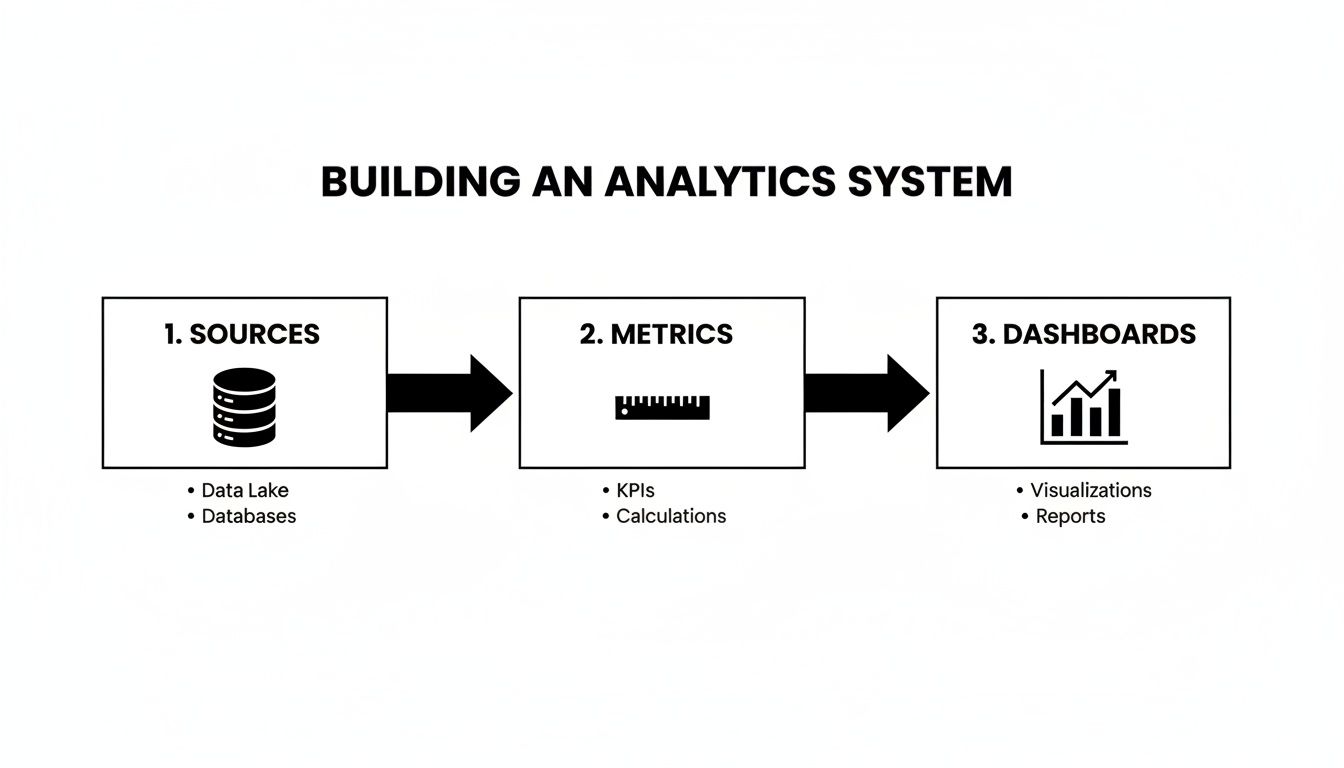
This visualizes how structured data collection (Sources) and clear measurements (Metrics) are the essential building blocks for creating a meaningful visual story (Dashboards).
Step 4: Analyze and Find the Story
With clean data flowing in, you can finally get to the most important part: the analysis. This is where you stop looking at numbers and start seeing a narrative. Hunt for trends, patterns, and oddities that answer the questions you defined back in step one.
For example, you might discover a specific blog post consistently brings in organic traffic for a high-value keyword (that's an SEO win). Or maybe you realize most of your phone call conversions come from people who found you through the local map pack (a key GEO insight). This is how you figure out what to do more of to rank higher.
And if you’re running campaigns, learning more about the role of analytics in paid search is invaluable for fine-tuning your ad spend.
Step 5: Report, Test, and Optimize
Finally, it's time to put your findings into action. Build a simple dashboard that visualizes the metrics tied directly to your business objectives. This dashboard becomes the central storyline you follow week in and week out.
Use these insights to form hypotheses and run tests. If your data story suggests that "how-to" guides are driving conversions and ranking well, then create another one and measure its performance.
This continuous loop—analyzing, reporting, testing, and optimizing—is what separates businesses that grow from those that stagnate. It's how you use marketing analytics to consistently improve your search rankings and drive predictable results.
Seeing Analytics in Action Across Different Industries
The core ideas behind marketing analytics are the same everywhere, but their real power is unlocked when you apply them to a specific business. The story data tells for a local plumber trying to rank on the map pack is completely different from the one it tells for a global software company aiming for answer engine optimization.
Let's look at how this plays out in the real world. These examples show how different businesses use analytics to answer their most critical questions and connect data directly to their search ranking goals.
Local Services: The Plumber's Playbook
For a local service business like a plumber, the entire game is winning the neighborhood. The most important story analytics can tell is how online searches turn into a ringing phone and a booked appointment. It's all about local SEO (GEO).
Their focus isn't on attracting massive website traffic, but on driving high-intent local actions. The core question they need to answer is: "Which of our local search efforts are actually making us money and getting us ranked on the map?"
Here's what they'd track:
- Google Business Profile (GBP) Calls: This is the big one. Tracking clicks on the "call" button from their map listing is a direct line to a hot lead.
- Direction Requests: How many potential customers are looking up directions? This is a strong signal of intent, especially for businesses with a physical location.
- Local Keyword Rankings: Are they showing up for searches like "emergency plumber near me"? They have to be visible the moment a pipe bursts.
By focusing on these KPIs, the plumber can tell a clear story: "Our optimized Google Business Profile generated 25 calls last month, which led to 10 new jobs and a 5x return on our local SEO investment."
Ecommerce: The Online Retailer's Roadmap
An ecommerce brand lives and dies by its ability to turn website visitors into paying customers—and keep them coming back for more. Their analytics story is all about smoothing out the customer journey, from the first click on a product they found via Google to the final checkout.
Their analytics need to answer: "Where are we losing potential customers, and how can we use SEO to get each one to spend more?"
For ecommerce, analytics is the magnifying glass that reveals every point of friction in the buying process. It turns anonymous clicks into behavioral patterns, showing you exactly where a simple tweak can prevent a lost sale.
To tell this story, they would dig into:
- Cart Abandonment Rate: Pinpointing the exact step where users are dropping off is crucial. If everyone leaves at the shipping stage, you know you have a problem.
- Customer Lifetime Value (CLV): This calculates the total revenue a single customer brings in over time. Knowing this number helps them figure out exactly how much they can afford to spend to acquire a new one.
- Conversion Rate by Traffic Source: Which channels—organic search, social media, paid ads—are actually bringing in customers who buy? This helps them double down on their most effective SEO strategies.
Their data-driven narrative becomes: "By analyzing our checkout funnel, we saw that 40% of users abandoned their carts after seeing shipping fees. We introduced a free shipping threshold, which cut cart abandonment by 15% and bumped up our average order value."
SaaS: The Software Company's Strategy
For a Software-as-a-Service (SaaS) company, the story is all about sustainable growth. It’s a constant balancing act between acquiring new users and keeping the ones you have. Analytics here is less about one-time sales and more about the long-term lifecycle, from a free trial sign-up to a loyal, paying subscriber, often driven by ranking for key problems (AEO).
They need to answer a critical question: "Are we attracting the right users through search, and is our product valuable enough to make them stick around?"
Key metrics for a SaaS business are:
- Free Trial Conversion Rate: What percentage of users upgrade from a free trial to a paid plan? This is a direct measure of how well the product sells itself.
- Customer Churn Rate: How many customers are canceling their subscriptions each month? A high churn rate is a flashing red light that something is wrong with the product or the customer experience.
- Monthly Recurring Revenue (MRR): The predictable revenue a company can expect every month. This is the ultimate measure of a healthy subscription business.
The story they can tell is: "Our analytics showed that users who complete our onboarding tutorial are 50% less likely to churn in their first three months. By promoting this series more heavily through our AEO content, we aim to reduce our overall churn rate by 5% this quarter."
Key Performance Indicators by Business Type
Every business has a north star metric that defines success. While a plumber might obsess over phone calls from their local listing, a SaaS founder is glued to their churn rate. This table breaks down the most important metrics different business models should be tracking to drive real, sustainable growth.
| Business Type | Primary KPI | Secondary KPI | What It Tells You |
|---|---|---|---|
| Local Service | Google Business Profile Calls & Form Fills | Local Keyword Rankings (GEO) | "Are our online efforts directly generating qualified leads and appointments right now?" |
| Ecommerce | Conversion Rate & Average Order Value (AOV) | Customer Lifetime Value (CLV) | "Are we effectively turning search traffic (SEO) into sales and maximizing the value of each transaction?" |
| SaaS | Monthly Recurring Revenue (MRR) & Churn Rate | Free Trial to Paid Conversion Rate (AEO) | "Are we building a predictable revenue stream with a product that's valuable enough for customers to keep paying?" |
| B2B / Lead Gen | Marketing Qualified Leads (MQLs) | Cost Per Lead (CPL) | "Is our marketing pipeline filling up with the right kind of prospects from search at a cost-effective rate?" |
Looking at these side-by-side, you can see how the definition of a "win" changes dramatically. The key is to ignore the vanity metrics that don't matter to your business and laser-focus on the numbers that directly reflect revenue and growth.
How AI Is Shaping the Future of Marketing Analytics
The world of marketing analytics is getting a massive upgrade, with artificial intelligence sitting squarely at the controls.
Think of it this way: traditional analytics is like a reliable GPS showing you the best route based on current traffic. AI, on the other hand, is the super-intelligent traffic advisor that also predicts future roadblocks and suggests a detour before you even hit the jam. This shift is making our data smarter, easier to understand, and powerfully predictive.

And this isn't some far-off concept—it's happening right now. The integration of AI is already one of the biggest shake-ups the field has ever seen. Right now, 63% of marketers are actively using generative AI in their day-to-day work, and the market for AI in marketing is on track to grow by 26.7% every year through 2034.
Businesses that are jumping on board are discovering deeper context in their data and delivering real results faster than their competitors. You can check out more of these marketing statistics and trends to see just where the industry is headed.
From Reactive to Predictive Insights
For a long time, analytics was all about telling a story of what already happened. You could see which SEO campaigns did well last quarter or which landing pages had the highest bounce rates. It was useful, but it was all rearview-mirror stuff.
AI flips that script entirely, moving us from reactive reporting to predictive analytics. It sifts through all your past data to forecast what's likely to happen next.
This means you can start doing things like:
- Forecast Conversions: AI can analyze lead behavior to predict which prospects are most likely to buy, letting your sales team focus their energy where it counts.
- Anticipate Customer Churn: By spotting subtle patterns in user activity, AI can flag at-risk customers before they decide to leave, giving you a crucial window to step in.
- Optimize Ad Spend Automatically: AI algorithms can tweak your ad budgets in real-time, funneling money to the channels and audiences that are actually delivering the best ROI.
AI transforms your data from a rearview mirror into a forward-looking radar. It doesn't just tell you the story of where you've been; it helps you write the next chapter by uncovering hidden opportunities for growth and better search rankings.
AI-Driven Personalization at Scale
Another game-changer is AI-driven personalization. AI tools can analyze thousands of data points for every single user—their browsing history, purchase patterns, and on-site behavior—to tailor their experience on the fly. We've moved way beyond just sticking a first name in an email subject line.
Instead, you can dynamically change website content, recommend the perfect next product, or serve up hyper-relevant ad creative to each individual. This level of customization used to be a pipe dream for most businesses, but AI makes it a genuinely accessible strategy. It’s all about building stronger customer relationships and, ultimately, boosting conversions.
With AI, your analytics system stops being a passive reporting tool and becomes an active partner in your growth.
Frequently Asked Questions About Marketing Analytics
Jumping into marketing analytics can feel like a massive undertaking, but it’s a lot more approachable than you might think. Let's clear up some of the most common questions business owners have so you can get started with confidence.
Think of this as demystifying the process. Our goal is to show you how these tools can directly fuel your SEO, local search, and overall online performance.
How Long Does It Take to See Results?
You'll see some data almost immediately. The moment you get something like Google Analytics installed, raw numbers like website visitors and page views start trickling in. This gives you an instant, basic pulse on your activity.
But the real magic isn't in the raw data; it's in the story that data tells over time. You need enough information to spot reliable trends and patterns, which usually takes about 1 to 3 months. This is the timeframe where you start uncovering the insights that actually lead to better search rankings and a stronger marketing ROI.
What Are the Most Important Tools for a Beginner?
You absolutely do not need a huge budget to get started. In fact, a handful of powerful, free tools can give you a rock-solid foundation for understanding exactly how customers find you through search.
- Google Analytics 4: This is non-negotiable. It's the best way to understand who is visiting your website and what they do once they get there.
- Google Search Console: Think of this as your direct line to Google. It shows you which keywords are actually driving traffic and how your site is performing in the search results.
- Your CRM's Analytics: This is what connects your marketing efforts to actual dollars. It tells the final, most important chapter of your customer's story by linking actions to sales.
Can I Do This Without Being a Data Scientist?
Absolutely. Modern marketing analytics is less about knowing complex statistical formulas and more about being genuinely curious about your business. Today's tools are designed to be user-friendly, turning raw numbers into clear charts and understandable stories.
The goal isn’t to become a statistician. It's to become a better storyteller who uses data to answer the most important business questions. Start by asking things like, "Which marketing channel brings in my best customers?" and let the tools help you uncover the narrative.
Ultimately, understanding marketing analytics is all about using data to make smarter decisions, rank higher in search, and grow your business with a clear path forward.
Ready to stop guessing and start growing with a data-driven strategy? The team at Jackson Digital builds analytics systems that tell a clear story about your SEO, paid media, and overall marketing performance. Request your free performance audit today.