Paid search advertising is a direct way to rank on search engines like Google or Bing by paying them to show your ads in their search results. Unlike organic SEO, which is a long-term strategy, this method gets your business seen fast. It’s not just about visibility; it’s about telling the right story to a customer at the exact moment they’re looking for a solution.
Your Instant Answer to Paid Search Advertising
Imagine a digital billboard on the world's busiest highway. Now, imagine it only lights up for people who are actively looking for your exact product or service. That's paid search in a nutshell.
It's a system built to vault your business to the top of the search results right when a potential customer is ready to buy. This direct line to interested buyers is what makes it such a powerful tool for businesses of all sizes, from the local coffee shop to a global e-commerce brand.
The real difference between paid search and organic Search Engine Optimization (SEO) boils down to speed and cost. SEO is the marathon of earning "free" placement over time with great content and technical tweaks. Paid search, on the other hand, is the sprint—you're buying that placement for instant results.
Paid search advertising connects your ads to searchers who are ready to buy. In fact, visitors who arrive from paid ads are 50% more likely to purchase than those who come from organic search.
Turning Search Intent into Business Growth
This model lets you be incredibly precise, turning someone's random search query into a real opportunity for your business. The applications are super practical and varied, allowing you to rank your business for specific customer needs:
- Local SEO & GEO Targeting: A local bakery can run ads targeting people searching "cupcakes near me" within a five-mile radius. Boom—instant foot traffic. This isn't just an ad; it's the story of a local business being the perfect, convenient solution for a neighbor's craving.
- E-commerce Growth: An online clothing brand can show its product ads to shoppers across the country searching for "women's summer dresses," snagging sales from people with high buying intent. The ad becomes a visual story, showcasing the lifestyle and look the customer desires.
- Answer Engine Optimization (AEO): A tech company can target specific questions like "best CRM software for small business," positioning its product as the perfect solution to a user's problem. By answering the question directly, the ad tells a story of expertise and helpfulness.
So, what is paid search advertising, really? It's a controllable, scalable, and immediate way to get your business seen on search engines. It turns user intent into measurable growth, whether you're trying to attract customers down the street or reach a global audience.
Here’s a quick breakdown of the core moving parts.
Paid Search Advertising at a Glance
This table sums up the key components of paid search and what they actually mean for your business strategy. Think of it as your cheat sheet for understanding how all the pieces fit together to drive results.
| Component | What It Means for Your Business |
|---|---|
| Search Engine | This is your advertising playground (e.g., Google, Bing). It’s where your potential customers are actively looking for solutions. |
| Keywords | These are the specific words or phrases your customers type into the search bar. Your job is to bid on the right ones to show up. |
| Ad Auction | An automated, real-time auction that decides which ads are shown and in what order. It's not just about the highest bid; quality matters, too. |
| Bid Strategy | This is how much you're willing to pay for a click. You can set manual bids or use automated strategies to optimize for goals like conversions or traffic. |
| Quality Score | A rating from Google (1-10) that judges the quality and relevance of your ads, keywords, and landing pages. A higher score means lower costs. |
| Ad Copy & Creative | This is the actual text and imagery of your ad. It needs to be compelling enough to make someone click. |
| Targeting | This allows you to show your ads to specific groups based on location, demographics, device, and even past behavior. |
| Performance Metrics | These are the numbers that tell you if your campaigns are working (e.g., Click-Through Rate, Conversion Rate, Cost-Per-Acquisition). |
Understanding these elements is the first step. When you see how they interact, you can start building a paid search strategy that doesn't just spend money—it makes money.
How the Paid Search Ad Auction Really Works
Ever wondered how Google picks the winner for that coveted top spot in the search results? It’s not a simple case of the highest bidder taking all the glory. It’s actually a lightning-fast, silent competition where how relevant and well-built your ad is matters just as much as the cash you’re willing to spend.
Think of it like a super-sophisticated auction. Every single time someone types a search query, the engine instantly pulls in all the advertisers bidding on that keyword and pits them against each other. But instead of just looking at who bid the most, it runs a quick calculation to determine something called Ad Rank.
Ad Rank is the secret sauce that decides your ad's position. It’s a simple formula: your maximum bid multiplied by your Quality Score. This means a smarter advertiser with a lower bid can absolutely outrank a bigger spender if their ad quality is top-notch.
The whole system is built to reward advertisers who give searchers a great experience, not just the ones with the deepest pockets. A high Quality Score becomes your secret weapon, helping you win better ad placements for less money.
Your Most Important Metric: Quality Score
So, what exactly is this all-important Quality Score? It’s a simple rating from 1 to 10 that search engines like Google assign to your ads, keywords, and landing pages. A high score is basically the search engine giving you a thumbs-up, telling you that your ad is relevant and genuinely useful to the person searching.
The score boils down to three main ingredients:
- Expected Click-Through Rate (CTR): Based on past performance, how likely is your ad to get clicked when it's shown? A compelling ad that perfectly matches what the user is looking for will naturally get more clicks.
- Ad Relevance: Does your ad actually make sense for the keyword someone searched? If someone is looking for "hiking boots," your ad for "running shoes" isn't a good fit, and your score will reflect that.
- Landing Page Experience: After someone clicks your ad, does the page they land on deliver on the promise? The page needs to be directly related to the ad, easy to navigate, and offer a smooth, helpful experience.
At its core, paid search is all about using smart targeting and quality ads to drive real business growth. This is the direct path from your advertising efforts to your bottom line.
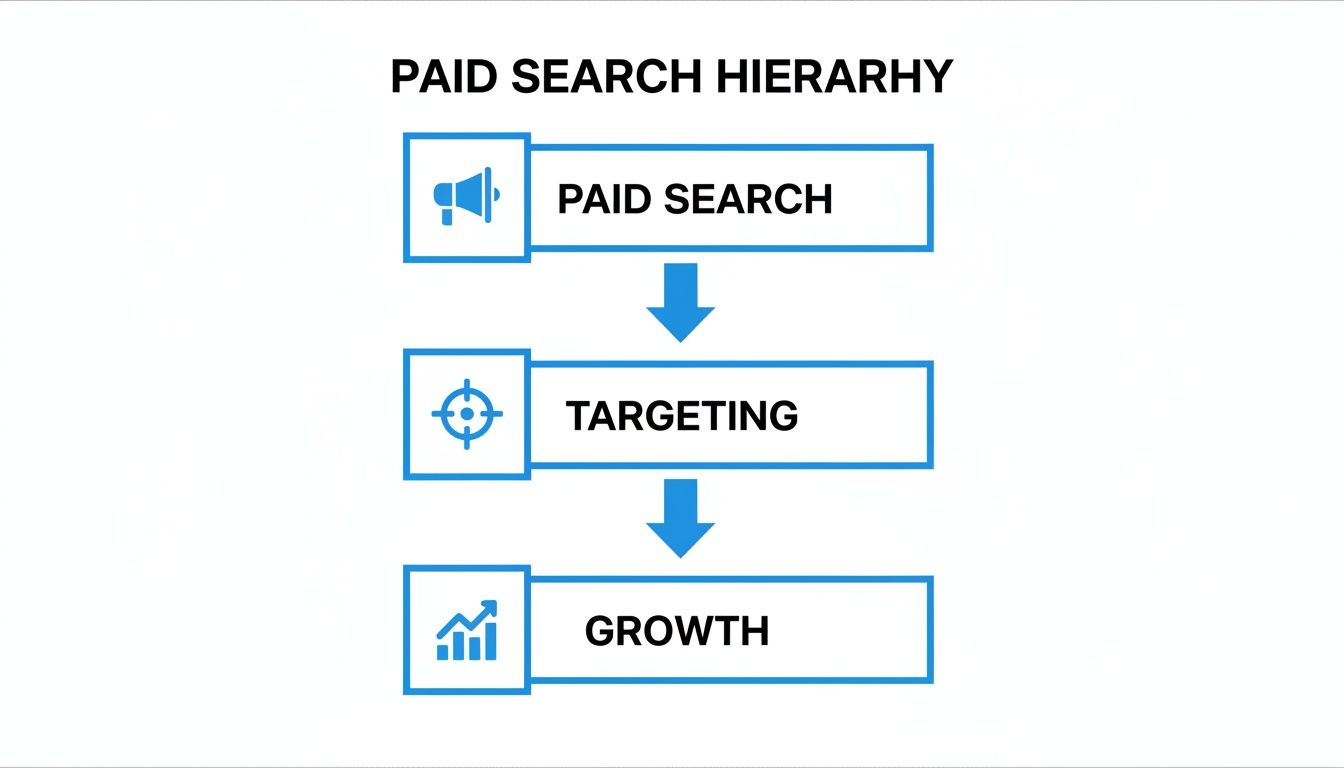
As you can see, effective targeting is the essential bridge connecting your paid search campaigns to measurable growth.
Controlling Your Audience with Keyword Match Types
To make sure your budget is spent reaching the right customers, you have to control who sees your ads. This is where keyword match types are indispensable. They let you tell the search engine exactly how closely a person's search needs to match your keyword.
There are three main types you'll work with:
- Broad Match: This casts the widest net, showing your ad for synonyms, related searches, and other variations. It's fantastic for discovering new search terms but can burn through your budget with irrelevant clicks if you don't manage it closely.
- Phrase Match: This gives you more control. Your ad appears for searches that include the meaning of your keyword. For example, your keyword "local plumbing services" could trigger an ad for someone searching "plumbing services in my local area."
- Exact Match: This is the most restrictive and targeted option. Your ad shows only when the search has the same meaning or intent as your keyword, ensuring you’re reaching a very specific, high-intent audience.
Getting these match types right is more critical than ever, especially with mobile search traffic continuing to explode. Globally, mobile devices are responsible for 52% of all PPC clicks and a whopping 70% of U.S. impressions. This trend is pushing mobile ad spending toward an estimated $228.12 billion by 2025. You can dig deeper into these top PPC statistics and their implications. By using precise match types, you can capture this incredibly valuable mobile traffic without wasting a dime on irrelevant searches.
Connecting with Customers Through Ad Formats and Targeting
Winning the ad auction is just the start of the race. The real win is connecting with the right person at the right time, and that’s where the creative side of paid search really comes alive. It's time to move beyond simple keyword bids and start telling a compelling story using a whole toolkit of different ad formats and precision targeting.
The format you choose has to line up with what you're trying to achieve. Let's say you run a local bakery. A standard text ad is fine, but a Local Service Ad (LSA) that puts your business hours, phone number, and a "Google Guaranteed" badge right in front of someone searching "birthday cakes near me"? That’s an instant trust-builder.
If you’re running an e-commerce store, visually engaging Shopping ads are a must-have. These ads put your product’s picture, price, and store name directly in the search results, grabbing the eye of shoppers who are ready to pull out their wallets. Think of these different ad types as specialized tools—each one built to tell a specific part of your brand's story and solve a particular customer problem.

Pinpointing Your Ideal Audience with Layered Targeting
Just getting your ad seen isn't enough; you need it in front of the people most likely to actually become customers. You do this by layering on targeting options that let you define your audience with incredible accuracy. Of course, at the heart of paid search, mastering effective keyword targeting strategies is the foundation for reaching the right people when they're actively looking.
But today's paid search platforms let you go so much deeper. Picture it like applying a series of filters to your campaign, making sure your ad dollars are only spent on your most valuable prospects.
- Geographic Targeting (GEO): This is non-negotiable for any business with a physical footprint. You can target users by country, state, city, or even drill down to a specific zip code or radius around your shop to drive local foot traffic and dominate local search results.
- Demographic Targeting: Want to get more specific? You can narrow your audience based on age, gender, parental status, and household income. A luxury jewelry store, for instance, could target users in higher income brackets to find its ideal clientele.
- Device Targeting: Think about how your customers search. Are they on a desktop during work hours or scrolling on their phone at night? You can adjust your bids to prioritize the devices that bring you the most business.
By layering these targeting options, you create a highly specific profile of your ideal customer. This not only improves your ad's relevance but also dramatically increases your Return on Ad Spend (ROAS) by eliminating wasteful clicks from irrelevant audiences.
A Quick Story on Precision Targeting
Let's follow the journey of a small business—a boutique hotel in a popular tourist town. When they started, their ads targeted broad keywords like "hotel rooms," which brought in clicks from all over the country. The problem? A lot of those clicks came from people just browsing, not actually planning a trip anytime soon.
So, they got smarter and started telling a more focused story. First, they used GEO targeting to focus their ads on people within a 300-mile driving radius, since they knew that's where most of their visitors came from. Next, they added demographic targeting, focusing on the age groups and income levels that matched their typical guest. Finally, they used remarketing to show special offers to people who had already visited their website but hadn't booked a room, continuing the conversation.
This multi-layered approach totally transformed their campaign. They went from casting a wide, inefficient net to throwing a precise spear, connecting with travelers who were genuinely interested. This is a crucial part of any solid digital marketing strategy for startups. Their conversion rates shot up, and their ad spend became far more efficient. That’s the real power of paid search—when you match the right message with the perfect audience.
Understanding the Costs of Paid Search Advertising
Alright, let's get to the question every business owner wants answered: what’s this actually going to cost me? Unlike a simple price tag on a shelf, paid search advertising is dynamic. Think of it more like an auction where you decide what a new customer is worth to your business and then you bid accordingly.
The best part is, you're always in the driver's seat. You set the daily and monthly budgets, so you'll never spend a penny more than you’re comfortable with. This flexibility is precisely what makes it such a potent tool for businesses of all shapes and sizes, from the local plumber to a nationwide ecommerce store.
How You Pay: Unpacking the Pricing Models
Most paid search campaigns run on a Cost-Per-Click (CPC) model. It's as straightforward as it sounds: you only pay when someone is interested enough in your ad to click on it. If 1,000 people see your ad but only 50 click, you're only paying for those 50 clicks. Simple.
Then there’s the Cost-Per-Acquisition (CPA) model, which is a game-changer for businesses laser-focused on the bottom line. This model zeroes in on the cost to get a specific action, like a completed sale or a filled-out contact form. It answers the most important question: "How much did I have to spend to land that new customer?" Getting a handle on this is critical, and a good customer acquisition cost calculator can help you map everything out.
To help you decide which model aligns best with your goals, here’s a quick breakdown:
Paid Search Pricing Models Compared
| Pricing Model | How It Works | Best For |
|---|---|---|
| CPC | You pay the search engine each time a user clicks on your ad, regardless of what they do after they click. | Driving traffic, building brand awareness, and campaigns where the goal is broad reach. |
| CPA | You pay only when a specific, predefined action (like a sale or lead) is completed after an ad click. | E-commerce, lead generation, and any campaign where a direct conversion is the primary goal. |
Ultimately, choosing between CPC and CPA depends on what you're trying to achieve. One focuses on getting eyeballs on your site, while the other is all about turning those eyeballs into tangible business results.
In essence, you aren’t just buying ad space; you are investing in potential customers. A well-managed campaign ensures that every dollar you spend is tied directly to a measurable action that helps grow your business.
What Actually Influences Your Ad Spend?
Your final cost isn't just one number; it's a blend of different factors that all play a role in the ad auction. The average American business makes $2 for every $1 they spend on Google Ads, and mastering these variables is how you get that kind of return.
Think of it as a constant balancing act. A few key elements will shape what you end up paying for each click and conversion:
- Industry Competition: It's pure supply and demand. Bidding on keywords in crowded fields like finance or law is going to cost more because you have more businesses fighting for the same eyeballs.
- Keyword Selection: Not all keywords are created equal. High-intent, ready-to-buy terms like "emergency plumber near me" are far more valuable (and expensive) than research-based phrases like "how to fix a leaky faucet."
- Quality Score: This is your secret weapon. As we touched on earlier, a high Quality Score is Google's way of telling you your ad is relevant and helpful. Your reward? Better ad positions for a lower cost-per-click. It's a win-win.
By concentrating on creating top-notch, genuinely helpful ads and landing pages, you can actively drive your advertising costs down. It’s a strategic approach that makes sure your budget is working smart, not just hard.
Measuring Success with Metrics That Actually Matter

Running a paid search campaign without tracking the right numbers is like driving a car blindfolded. You might be moving, but you have no idea where you're going. It's easy to get buried in a mountain of data, but most of it is just noise. The trick is to tune into the Key Performance Indicators (KPIs) that tell you the real story of what’s working—and what’s not.
Imagine you're a small business owner who just launched your first ads. You see a ton of clicks flooding in, which feels great at first. But are those clicks actually turning into paying customers? This is the moment you have to move past vanity metrics and connect your ad performance directly to your bottom line. It’s all about learning to read the story your campaign data is trying to tell you.
Core Metrics for Campaign Health
To get the full picture, you only need to start with a handful of foundational metrics. These KPIs work together to show you exactly how people are interacting with your ads and what they do next.
-
Click-Through Rate (CTR): This is your ad's first impression score. A high CTR means your ad copy is hitting the mark and convincing people to click. It tells you that your message is resonating.
-
Conversion Rate: This is the big one. It’s the percentage of clicks that turn into something valuable—a sale, a lead form submission, or a phone call. It reveals how well your landing page is closing the deal.
-
Cost Per Acquisition (CPA): This is your reality check. It tells you exactly how much you had to spend on ads to get one new customer or lead. This is the number that keeps your budget in check.
Monitoring these numbers is a solid start. If you want to build a more powerful reporting dashboard, we have a complete guide on the essential analytics for paid search.
A high CTR paired with a low conversion rate is a classic red flag. It usually means your ad is writing a check that your landing page can't cash. The promise is there, but the follow-through isn't, causing people to bounce.
Tying It All Back to Profit
At the end of the day, the only reason to run paid ads is to make money. That's where Return on Ad Spend (ROAS) comes into play. This metric cuts straight to the chase: for every dollar you put into your ads, how many dollars are you getting back in revenue?
A 3:1 ROAS, for example, means you're generating $3 in revenue for every $1 you spend.
But to truly understand profitability, you need to go one step further. It's crucial to get comfortable with understanding the differences between ROAS and ROI. While ROAS is fantastic for measuring the raw effectiveness of your ad campaigns, ROI (Return on Investment) accounts for all your costs, including things like agency fees and the cost of goods sold. This gives you a much clearer picture of your actual profit and empowers you to make smarter decisions that grow your business.
Common Paid search Mistakes and How to Avoid Them
It's thrilling to get your first paid search campaign off the ground, but it's also surprisingly easy to fall into a few common traps that will empty your ad budget in a heartbeat.
Picture a local bakery bidding on a broad keyword like "bakery." They might get a flood of clicks, but most of them could be from people halfway across the country just looking for recipes—not their fresh sourdough. This is a classic rookie mistake, and it’s a fast way to burn through cash on completely irrelevant traffic.
The quickest path to a profitable campaign is learning from these mistakes before you make them. A smart paid search strategy isn't just about what you do; it’s about what you consciously decide not to do.
Neglecting Negative Keywords
One of the most expensive blunders you can make is ignoring negative keywords. These are simply the terms you tell Google or Bing not to show your ads for.
For instance, a business selling brand-new furniture would want to add terms like "free," "used," and "repair" to their negative keyword list. This one simple move stops your ads from showing up for people who have zero intention of buying your products, saving your budget for the clicks that actually count.
Think of a well-maintained negative keyword list as a bouncer for your ad budget. It only lets in searchers with real buying intent, which directly pumps up your campaign's efficiency and return on ad spend (ROAS).
Sending Traffic to a Generic Homepage
Another critical error is pointing all your ad traffic straight to your website's homepage. It seems logical, but it's a huge conversion killer.
When someone clicks an ad for "women's running shoes," they have a crystal-clear expectation: they want to see a page full of women's running shoes. Dropping them on a generic homepage forces them to hunt for the product themselves. This disconnect is jarring, and most people will just hit the "back" button.
Instead, you need to create dedicated landing pages that perfectly align with the promise you made in your ad. A few best practices to live by:
- Mirrored Messaging: The headline on your landing page should be a near-perfect match for your ad's headline.
- Singular Focus: The page should have one clear goal and a single, unmissable call-to-action button.
- Minimal Distractions: Get rid of any extra navigation menus or links that could pull the user away from the conversion goal.
By steering clear of these common pitfalls, you can build smarter, more effective campaigns right from the start. You'll protect your investment and get on the fast track to hitting your business goals.
Your Top Paid Search Questions, Answered
Even with the best game plan, you’re bound to have questions when you jump into something new. Let's tackle some of the most common ones we hear from business owners. The goal here is to clear up any lingering doubts so you can move forward with confidence.
How Quickly Will I See Results?
This is where paid search really shines, especially compared to the slow burn of SEO. Unlike organic strategies that can take months to gain traction, paid search ads can deliver results almost instantly.
Once your campaign is approved and you flip the switch, your ads can start showing up in search results within minutes. That means immediate traffic. But, and this is a big "but," immediate traffic isn't the same as immediate profit. Getting to a point where you have a consistently strong return on your investment takes a bit of time. You'll likely need a few weeks, maybe even a couple of months, to gather enough performance data to really dial in your targeting, bids, and ad copy.
Can I Start With a Small Budget?
Absolutely. In fact, it’s one of the biggest perks of paid search. You don't need a massive war chest to get in the game. Platforms like Google Ads were built to be scalable, making them a great fit for businesses of all sizes.
You have total control over your spending. You can set strict daily budget caps to make sure you never spend a penny more than you're comfortable with. A really common and smart approach is to start small. Run a test campaign, see what resonates with your audience, and once you find a winning formula, you can confidently scale up your investment. It’s all about being strategic to make every single dollar work for you.
Is Paid Search Better Than SEO?
That's the million-dollar question, but it frames the whole thing wrong. Paid search and SEO aren't rivals fighting for the same title; they're more like partners on the same team, each with a unique role to play in a winning digital strategy.
Think of it this way: Paid search is like renting a billboard on a busy highway for instant visibility. SEO is like buying the land and building your own permanent storefront. One gets you customers right now, the other builds a lasting asset.
The most successful businesses don’t choose one or the other—they use both. Paid search gets you immediate traffic and priceless data on which keywords convert. SEO uses that insight to build long-term, organic authority and trust that you don't have to pay for with every click. When they work together, you can dominate the entire search results page, catching customers no matter where they are in their buying journey.
Ready to turn searchers into customers? The team at Jackson Digital builds custom paid search strategies that drive the right kind of traffic and slash customer acquisition costs. Get your free performance audit today and see what's possible.