SEO management is the ongoing, strategic game plan for getting your website seen by the right people on search engines. This isn't a "set it and forget it" task. Think of it as the constant effort needed to build and maintain a powerful digital presence that actually drives business and tells your unique story.
Defining SEO Management Beyond Just Rankings
Imagine you've just opened a new brick-and-mortar shop. You could have the best products in town, but if your store is tucked away on a dead-end street with no sign, you're not going to get any customers. Nobody will ever find you.
That's where SEO management steps in. It's the art and science of moving your shop to the busiest street in the city, putting up a massive, eye-catching sign, and making sure the inside is so well-organized that customers can find exactly what they need in seconds.
Simply put, SEO management is a coordinated strategy that pulls together a bunch of different activities to get you ranking higher on Google. It’s the difference between crossing your fingers and hoping for traffic, and building a reliable superhighway that leads customers straight to your digital front door.
To really get what we're talking about, let's break down the essential components of any solid SEO management strategy.
The Core Activities of SEO Management
Think of SEO management as having several key pillars. Each one is critical, and they all work together to support your website's performance. When one is weak, the whole structure can suffer.
Here’s a quick rundown of what those pillars are and why they're so important:
| Pillar | What It Is | Why It Matters |
|---|---|---|
| Technical SEO | This is all the behind-the-scenes stuff. Think site speed, mobile-friendliness, and having a site structure that Google’s robots can easily crawl and understand. | If your site is slow, broken, or confusing to search engines, nothing else you do will matter. This is the foundation everything is built on. |
| On-Page SEO | This is about optimizing the content and HTML source code of individual pages. It's about using the right keywords, writing great headlines, and making sure every page has a clear purpose. | This tells Google exactly what each of your pages is about. It’s how you signal relevance for the searches you want to show up for. |
| Content Strategy | This involves creating and distributing valuable, relevant, and consistent content to attract and retain a clearly defined audience. Think blog posts, guides, and videos that tell your story. | Great content is what earns you rankings, builds trust with your audience, and gives other sites a reason to link back to you. It's the fuel for your SEO engine. |
| Link Building (Off-Page SEO) | This is the process of getting other reputable websites to link to yours. Think of these links as votes of confidence or digital referrals. | Links are a primary signal Google uses to determine your site's authority and trustworthiness. More high-quality links = more authority. |
| Local & E-commerce SEO | These are specialized tactics. For local businesses, it’s about optimizing your Google Business Profile. For e-commerce, it’s about optimizing product pages and site structure. | If you're a local plumber or an online store, these specific strategies are non-negotiable for attracting customers who are ready to buy. |
Each of these pillars requires continuous attention. Technical audits, content creation, and link building aren't one-and-done projects; they are ongoing processes that adapt as search engines and your competition evolve.
The ultimate goal of SEO management is not just to rank for keywords, but to connect your business with people who are actively looking for the solutions you provide. It transforms your website from a passive brochure into an active, lead-generating engine for your business.
At the end of the day, understanding what is SEO management means seeing it as a core business function, not just a technical checklist. It's the persistent work of making sure that when someone searches for what you do, your business is the best and most visible answer. This is how you build a sustainable stream of traffic, leads, and sales that grows over time.
The Four Pillars of a Powerful SEO Strategy
Effective SEO management isn't about chasing a single ranking factor; it's about building a strong, interconnected strategy that lasts. Think of it like constructing a house. You can't just focus on the fancy kitchen or the great view—you need a solid foundation, a sturdy frame, well-designed rooms, and a good reputation in the neighborhood.
Your website's online presence is built the same way, resting on four distinct but related pillars. When these pillars work together, they create a resilient structure that can withstand Google's algorithm updates and leave competitors in the dust. Let's break down what each of these pillars involves.
Technical SEO: The Invisible Foundation
Before you can wow visitors or even get on Google's good side, your website needs to be fundamentally sound. Technical SEO is all the behind-the-scenes work that optimizes your site’s infrastructure so search engine crawlers can efficiently find, understand, and index your pages. When it's done right, your users won't notice a thing, but it's absolutely critical for getting seen.
Imagine your website is a brand-new library. If the doors are locked, the lights are out, and there's no catalog system, the librarians (search engines) can't organize your books (your content), and patrons (users) will never find what they're looking for.
Technical SEO is what unlocks the doors and turns on the lights. It ensures your website is:
- Crawlable: Search engine bots can easily navigate your site's structure without hitting dead ends or broken links.
- Fast: Your pages load quickly, which is a confirmed ranking factor. A mere one-second delay in mobile load times can slash conversion rates by up to 20%.
- Secure: Using HTTPS to protect user data is a baseline requirement for trust and a small but important ranking signal.
- Mobile-Friendly: Your site delivers a great experience on all devices, which is non-negotiable since most searches now happen on mobile.
Without a solid technical base, even the most brilliant content will struggle to rank. For a deeper dive into how this all works, you can explore the science behind Technical SEO and see how it sets the stage for success.
The following diagram illustrates how these core pieces of SEO management fit together.
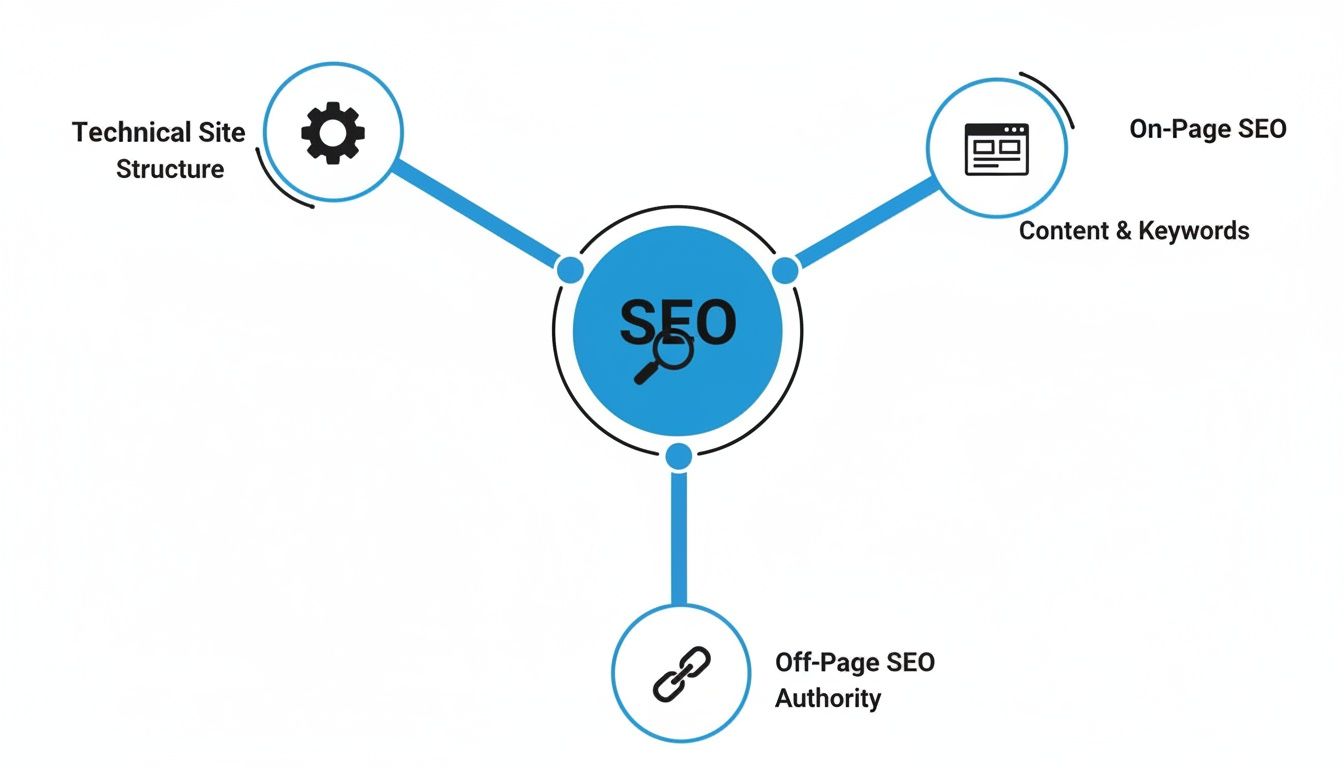
This visual shows how a central strategy branches into Technical, On-Page, and Off-Page optimization—each one a vital part of the whole.
On-Page SEO: Optimizing What Users See
Once your site's foundation is solid, the next step is On-Page SEO. This pillar involves optimizing the individual pages of your website to be as clear, relevant, and user-friendly as possible. It’s all about making sure both search engines and human visitors instantly get what your content is about and why it matters.
If technical SEO is the library's structure, on-page SEO is how you label the aisles, categorize the books, and write compelling descriptions for each one. This includes elements like:
- Keyword Optimization: Weaving relevant keywords naturally into your titles, headings, and body copy.
- Title Tags and Meta Descriptions: Crafting the headlines and summaries that show up in search results and make people want to click.
- Content Quality: Creating in-depth, well-structured, and easy-to-read content that actually answers the searcher's question.
- Internal Linking: Connecting related pages on your site to guide users and search engines deeper into your content.
This is where you turn a technically sound site into a genuinely helpful resource.
Content Strategy: The Engine of Authority
Content is the fuel for your entire SEO engine. A strong Content Strategy is the pillar that focuses on planning, creating, and distributing valuable information that attracts and engages your target audience. This is more than just churning out blog posts; it's about becoming the go-to authority in your field by telling your story.
Think of a local plumber. If he consistently posts videos showing homeowners how to fix a leaky faucet, he becomes more than just a guy to call for repairs—he becomes a trusted advisor. That’s what great content does. It builds trust, earns attention, and naturally attracts links and shares.
A successful content strategy isn't about tricking algorithms. It's about genuinely helping people by answering their questions, solving their problems, and telling compelling stories.
This pillar is what helps you show up in local searches when you create content about projects in your area and helps you dominate "answer engine optimization" when your articles directly address the questions people are typing into Google.
Off-Page SEO: Building Your Reputation
Finally, Off-Page SEO refers to all the things you do away from your website to boost its authority and reputation. The biggest piece of this puzzle is link building—the process of earning links from other reputable websites.
In the real world, if a well-respected expert recommends your business, people are more likely to trust you. Online, a link from an authoritative site is the same kind of powerful vote of confidence. Google sees these backlinks as signals that your content is credible, trustworthy, and valuable.
Off-page SEO isn't just about links, though. It also includes:
- Brand Mentions: Even unlinked mentions of your brand across the web can contribute to your authority.
- Online Reviews: A steady stream of positive reviews on platforms like Google Business Profile builds trust with both customers and search engines.
- Social Media Marketing: While social shares aren't a direct ranking factor, they drive visibility, which can lead to more links and mentions down the line.
Together, these four pillars form the backbone of SEO management. It’s a continuous, strategic effort to build a valuable, visible, and trusted online presence.
Winning the Neighborhood with Local and Ecommerce SEO
So far, we’ve covered the universal pillars of SEO. But for many businesses, the real money is made when you zero in on a specific type of customer. If you have a physical storefront or a defined service area, your battle is local. If you're selling products online, your digital shelf is everything.
These aren't just optional add-ons to a broader SEO strategy. They are specialized disciplines that turn highly targeted searches into actual sales.
Think about a local bakery, let's call it "The Rolling Pin." For months, they baked the best sourdough in town, but foot traffic was flat. Their online presence was practically invisible. By shifting focus to Local SEO, they completely turned things around.
They started by claiming and meticulously optimizing their Google Business Profile, uploading daily photos of fresh pastries—telling the visual story of their craft—and actively encouraging happy customers to leave reviews. This simple move was like putting a giant, flashing neon sign in the digital world.
Suddenly, when someone searched "best croissant near me," The Rolling Pin popped up at the top of the local map results, complete with a 4.9-star rating and easy-to-follow directions. The result? Foot traffic shot up by 40% in just three months.

Dominating the Local Map Pack
The story of The Rolling Pin isn't a fluke; it's a repeatable formula for any local business. Local SEO (or GEO-targeting) is the art and science of making your business the most visible and trusted choice for customers in your immediate area. It's less about your website in isolation and more about the signals that prove your local relevance.
Success in local search really boils down to a few key activities:
- Google Business Profile (GBP) Optimization: Think of this as your digital storefront. A complete GBP profile—with accurate hours, services, photos, and a steady stream of positive reviews—is the single most powerful local ranking factor.
- Local Keyword Targeting: Weaving location-specific terms like "plumber in Austin" or "dentist near downtown" into your website's content, title tags, and headings tells Google exactly where you operate.
- Managing Online Reviews: Responding to both good and bad reviews shows you're engaged and builds trust with potential customers. Plus, a high review velocity (the rate you get new reviews) gives your visibility a nice boost.
- NAP Consistency: Making sure your Name, Address, and Phone number are identical across all online directories (like Yelp, Angie's List, etc.) is a fundamental trust signal for search engines.
For businesses with more than one location, this process gets a bit more complex but is even more critical. If you're juggling multiple storefronts, you can get the full rundown in our guide to local SEO for multiple locations.
Effective Local SEO management ensures that when a potential customer pulls out their phone to find a solution nearby, your business is the first and best answer they see.
Turning Clicks into Customers with Ecommerce SEO
While Local SEO targets a specific geographical area, Ecommerce SEO targets a global product catalog. For an online retailer, the challenge isn't getting someone through a physical door; it's guiding them to the right product page among millions of competitors. A solid SEO management plan here is all about structure, detail, and user experience.
Imagine an online store with thousands of products. Without a clear system, it's like a warehouse with no aisles or labels—a total mess for both search engines and shoppers. Ecommerce SEO is what brings order to that chaos.
This involves fine-tuning several key areas:
- Product Pages: Writing unique, persuasive descriptions that tell the story of the product, using high-quality images, and targeting very specific product-related keywords.
- Category Pages: Building well-organized hub pages that group products logically, making it easy for users to browse your offerings.
- Technical Structure: Implementing a clean URL structure and using "breadcrumb" navigation so users and crawlers always know where they are on your site.
- Schema Markup: Adding structured data that gives Google specific details like price, stock availability, and review ratings. This is what powers those eye-catching "rich results" directly in the search listings.
Whether your customers are just around the corner or clear across the country, specializing your SEO management for local or ecommerce intent is how you connect with people who are ready to buy.
From Audit to Action: The SEO Management Workflow
Good SEO management isn't a shot in the dark or a series of random tweaks. It's a disciplined, repeatable process. Think of it less like wandering through the woods hoping to find the trail, and more like using a map and compass to get exactly where you need to go. This workflow is what turns fuzzy goals into concrete actions and real, measurable results.
This structured approach is the key difference between professional SEO and just guessing. It gives us a framework to diagnose what’s wrong, set clear targets, get the work done, and actually prove it's making a difference. Let's walk through what that journey looks like, from the first health check to the ongoing cycle of improvement.
The Diagnostic Phase: Your SEO Audit
Every solid SEO campaign kicks off with a deep, honest look under the hood. The SEO audit is that starting point—a complete diagnostic of your website's health. It’s basically a check-up for your online presence, showing us what’s working, what's broken, and where the biggest opportunities are hiding.
A proper audit digs into everything from the technical nuts and bolts of your site to how well your content is performing. It uncovers the kind of critical issues that hold you back, like painfully slow page speeds, broken links, or simple on-page optimizations that were missed. This isn't just about finding flaws; it’s about creating a prioritized to-do list.
Without this first step, you're flying blind. You could waste months pumping out new content when the real problem is a technical glitch stopping Google from even indexing your site properly. To get a better sense of how this initial review shapes the entire strategy, you can find out more about the power of digital marketing audits.
Strategy And Goal Setting: Defining Success
Once the audit shows us the lay of the land, the next step is to decide on the destination. Strategy and goal setting is where we translate the audit's findings into an actionable game plan. This is where we answer the most important question: what does "success" actually look like for your business?
Is the main goal to get more qualified leads calling your service business? Or is it to drive more online sales for your e-commerce store? Maybe you just want to become the go-to authority in your industry.
The goals you set determine the strategy we use. For instance:
- Goal: More Leads. The strategy would likely focus on Local SEO (GEO) and creating content that targets keywords people use when they're ready to hire someone.
- Goal: More Sales. We’d shift our focus to optimizing product pages, making the site easier to navigate, and locking in technical e-commerce SEO tactics.
- Goal: Brand Visibility. The plan would lean heavily on creating educational, top-of-funnel content and earning backlinks from high-authority websites. This is a core part of Answer Engine Optimization (AEO).
Clear goals are what turn SEO from a vague marketing expense into a measurable investment in your business. They set the benchmarks for everything that follows, making sure every ounce of effort is tied to a tangible result.
Execution And Reporting: The Ongoing Cycle
With a solid strategy in place, it’s time for execution. This is the day-in, day-out work where we actively manage and improve on the four pillars of SEO: technical, on-page, content, and off-page. This is the grind of writing blog posts, optimizing title tags, building links, and squashing technical bugs as they pop up.
But just doing the work isn't enough. Execution without measurement is just staying busy. That’s why reporting and analysis is the most critical part of the entire workflow. Using tools like Google Analytics and Google Search Console, we track the metrics that actually move the needle—not just vanity numbers like keyword rankings.
We focus on metrics that matter, like:
- Organic Conversions: How many actual leads or sales did our SEO efforts generate?
- Organic Traffic Growth: Are more of the right kinds of customers finding the site?
- Click-Through Rate (CTR): Are your listings in the search results compelling enough to make people click?
This cycle of analysis feeds right back into the strategy, allowing us to constantly refine our approach. The insights we pull from reports help us make smarter decisions—doubling down on what’s working and pivoting away from what isn’t. This iterative loop is the engine that drives long-term SEO success.
This commitment to a structured process is why the global SEO services market, valued at $82.3 billion in 2023, is still growing. Businesses know that with Google handling over 8.5 billion searches daily, you need a managed approach to capture a piece of that action and see a real return. You can find more insights on how AI is shaping SEO statistics at SEOmator.com.
Choosing Your Path: In-House Team vs. Hiring an SEO Agency
Sooner or later, every business owner who's serious about growth hits a fork in the road. Do you build an SEO team from the ground up, or do you bring in a specialized agency? This isn't just a line item on a budget; it's a strategic call that will shape your team's focus, your marketing spend, and how quickly you can climb the search rankings.
To really get what’s at stake, let's look at two common scenarios.
First, picture a fast-moving tech startup. They need to be incredibly nimble, constantly testing new angles and pivoting on a dime. For them, a small in-house team makes perfect sense. It gives them maximum control and deep product knowledge, letting them tell their brand story authentically and make changes on the fly.
Now, think about a local roofing company. The owner is a master of his craft, but he's not an expert in keyword research or link building. By hiring an agency, he gets an entire team of specialists—a technical SEO guru, a content writer, a link-building pro—for less than the cost of a single senior-level employee. He gets top-tier expertise without the headache of salaries, benefits, and pricey software subscriptions.
Weighing the Financial Commitment
Money is often the deciding factor, and it’s a lot more complicated than just comparing a salary to a monthly retainer. An in-house team comes with a ton of costs beyond payroll. You're on the hook for benefits, ongoing training, and the sky-high price of essential SEO tools, which can easily run into thousands of dollars a year.
An agency, on the other hand, rolls all those costs into their fee. They’ve already invested in the enterprise-level tools and have a roster of people with diverse, specialized skills ready to go. This lets you tap into a deep well of expertise from day one. It's a critical decision, especially when you consider that 62% of consumers will simply ignore a business if they can't find it online. Understanding the true cost is the first step. You can find more stats on how businesses are investing in SEO at AIOSEO.com.
SEO Management Models: A Head-to-Head Comparison
So, which way should you go? The truth is, there’s no single "best" answer. The right choice depends entirely on your company’s situation—your budget, your internal resources, your industry, and your long-term goals.
To help you see which path makes the most sense for you, we've broken down the key differences between the three main models: hiring an agency, building an in-house team, or working with a freelancer.
SEO Management Models: A Head-to-Head Comparison
| Factor | SEO Agency | In-House Team | Freelancer |
|---|---|---|---|
| Cost Structure | Predictable monthly retainer covering team, tools, and overhead. Often lower upfront investment. | Full-time salaries, benefits, recruitment costs, and ongoing training. Requires separate, expensive software subscriptions. | Typically project-based or hourly rates. Can be cost-effective for specific, limited tasks. |
| Expertise & Skills | Immediate access to a diverse team of specialists (technical, content, link building, etc.). | Expertise is limited to the individuals you hire. It's rare to find one person who excels at everything. | Skillset is usually specialized in one or two areas of SEO, like content or technical audits. |
| Scalability | Easy to scale efforts up or down by adjusting your retainer. The agency handles resource allocation. | Scaling requires a lengthy, expensive hiring process. Downsizing can be difficult and disruptive. | Limited scalability. Dependent on one person's availability and capacity. |
| Focus & Integration | Brings an external, objective perspective and broad industry experience from working with multiple clients. | Deeply integrated with company culture and product teams. 100% dedicated to your business. | Operates externally. Integration level varies but is generally less than an in-house team member. |
| Tools & Technology | Provides access to a full suite of premium, enterprise-level SEO tools as part of the service. | The business must purchase and manage its own licenses for tools like Ahrefs, Semrush, or Moz Pro. | May have their own tool subscriptions, but often not the same enterprise-level suite as an agency. |
Ultimately, it all comes down to a trade-off. An in-house team offers unmatched integration and focus, but it comes at a higher cost and takes longer to get up and running. A freelancer is great for targeted projects but lacks the bandwidth of a full team. For many small and medium-sized businesses, an agency hits the sweet spot, providing immediate, scalable expertise and access to premium tools in a flexible, cost-effective package.
Your Action Plan: A Simple SEO Audit Checklist
Knowledge is a great start, but action is what gets you results. Good SEO management kicks off with a clear-eyed look at where you stand right now. This checklist is built for business owners and marketers—not developers—to run a quick health check on your website and spot some immediate wins.
Think of it like the first step in a treasure hunt. Every item you check off is another clue that can lead to more traffic and better rankings.
Foundational Technical Checks
Before you start worrying about keywords or content, you need to make sure your digital storefront is even open for business and easy for both people and search engines to navigate. These checks make sure your foundation is solid.
-
Is Your Website Mobile-Friendly?
With over 60% of all searches now happening on mobile, this one is non-negotiable. If your site is a pain to use on a phone, you're bleeding customers. Plain and simple.- How to Check: Pop your website's URL into Google's free Mobile-Friendly Test.
- Why It Matters: Google now primarily uses the mobile version of your site to decide how to rank it. A clumsy mobile experience is a massive red flag.
-
How Fast Does Your Site Load?
Every. Second. Counts. A slow website frustrates visitors and can directly kneecap your rankings.- How to Check: Test your site with Google's PageSpeed Insights. It’ll spit out a score and give you specific, actionable recommendations.
- Why It Matters: Slow sites have higher bounce rates—that’s people hitting the "back" button before they even see what you offer.
On-Page and Content Clarity
Alright, now let's look at how well you're communicating with search engines. This is all about making sure your content has the right labels so Google knows exactly what each page is about.
An SEO audit isn't about finding every single flaw. It’s about identifying the 20% of issues that are causing 80% of your problems and creating a focused plan to fix them first.
- Do Your Title Tags Make Sense? Your title tag is the clickable blue headline that shows up in Google search results. It's your first impression—make it count.
- How to Check: Go to Google and search
site:yourdomain.com. Scan the headlines for your most important pages. Are they clear? Compelling? Do they actually mention your main service or keyword? - Why It Matters: A confusing or generic title won't get the click, even if you rank on the first page.
- How to Check: Go to Google and search
Local Presence and GEO Signals
For any business with a physical location or a service area, your local online footprint is everything. This is how you win those crucial "near me" searches that bring real customers through your door.
- Is Your Google Business Profile Complete?
Your Google Business Profile (GBP) is your most powerful local SEO weapon. An incomplete or outdated profile is like hanging a "closed" sign on your digital front door.- How to Check: Search for your business name on Google. Is your profile claimed? Are the hours, address, and phone number correct? Do you have recent, high-quality photos and a steady stream of positive reviews?
- Why It Matters: A fully optimized GBP is often the very first thing a local customer sees. It builds instant trust and directly influences their decision to call or visit.
Got Questions About SEO Management?
Jumping into the world of SEO can feel like learning a new language, and it's natural to have questions. Getting clear, straightforward answers is the first step toward turning that confusion into a real strategy that gets your business found. Let's tackle a few of the most common questions business owners have.
How Long Does It Take to See SEO Results?
This is the big one, and the honest answer is: it takes time. While you might see a small bump from quick technical fixes, meaningful, lasting growth from SEO management typically takes 4 to 12 months. SEO is a long game, not a lottery ticket. It’s all about building real authority and trust with search engines.
Think of it like planting a tree. You don't get a giant oak overnight. But with consistent watering and care, you'll see steady, strong growth. You can often spot early positive signs within the first three months—things like more keyword impressions or better rankings for very specific, long-tail terms. The exact timeline really depends on how competitive your industry is, your website's history, and how aggressively you pursue your strategy.
What Is the Difference Between SEO and SEM?
This is a super common point of confusion, but the distinction is actually pretty simple once you break it down.
- SEO (Search Engine Optimization) is all about earning unpaid, organic traffic. You do this by making your website the absolute best, most helpful answer for what people are searching for. This can also be called AEO, or Answer Engine Optimization.
- SEM (Search Engine Marketing) is the bigger umbrella. It includes SEO and paid advertising methods, like Pay-Per-Click (PPC) campaigns on Google.
So, SEO is a vital piece of a complete SEM strategy. SEO builds that foundational, long-term authority, while PPC can drive traffic to your site right now.
The real magic happens when they work together. Your organic SEO efforts can inform your paid campaigns by revealing which keywords convert best, helping you get more mileage out of every single marketing dollar.
Can I Do SEO Management Myself?
Yes, you absolutely can! For many small businesses, especially local service providers, taking the DIY route is a powerful first step. Many of the foundational SEO tasks we've talked about are perfectly manageable in-house.
You can start by getting your Google Business Profile completely dialed in, creating genuinely helpful content that answers your customers' real questions, and just making sure your website is clean and mobile-friendly. As your business grows or if you're in a cutthroat market, you might find you need an expert to break through to the next level. But mastering the fundamentals yourself gives you a massive advantage no matter what.
Ready to see what a dedicated strategy can do for your business? The team at Jackson Digital creates custom SEO and growth marketing plans that connect your brand with the customers who need you most. Request a free performance audit to uncover your biggest opportunities. Find out more at https://jackson-digital.com.