Let’s be honest, the term "affordable digital marketing" gets thrown around a lot. But what does it actually mean for a small business? It’s not about finding the rock-bottom cheapest price. It’s about getting the absolute best return for every dollar you spend by ranking on search engines and telling a story that connects with your ideal customers.
Real affordability means your marketing dollars are bringing in tangible growth—more qualified leads, higher local rankings, and actual sales—without you needing a Fortune 500 budget. It's about finding a partner whose strategies steadily lower your cost to acquire a new customer.
What Affordable Digital Marketing Really Means

We need to clear the air on something important: "affordable" and "cheap" are not the same thing. Not even close.
Cheap services often dangle flashy promises for a low monthly fee, but what you usually get are automated reports filled with useless "vanity metrics." True affordability, on the other hand, is about value and sustainable growth. It’s an investment in a team that understands your business and focuses on strategies that build real, long-lasting digital assets while telling your brand's unique story.
The Story of the Contractor and the "Cheap" Agency
I've seen this happen more times than I can count. A local general contractor, eager to grow his business, hired an agency that guaranteed "first-page rankings" for just a few hundred bucks a month. They threw up a generic website and sent him monthly reports showing his site had thousands of "impressions."
The problem? His phone never rang. The traffic was from completely irrelevant keywords, and the website's story didn't connect with the kind of high-value clients he actually wanted. After six months and a few thousand dollars down the drain, he had nothing to show for it. That contractor didn't need cheap; he needed effective.
This is a classic cautionary tale. The lowest price often carries the highest cost in lost time, missed opportunities, and pure frustration.
True affordability isn't about minimizing your monthly marketing spend. It’s about maximizing the return you get from every dollar invested, turning your marketing from an expense into a predictable growth engine.
To help you spot the difference, here’s a quick breakdown of what to look for versus what to run from.
Affordable vs Cheap Digital Marketing Services
| Characteristic | Truly Affordable Service (High ROI) | Cheap Service (Low ROI) |
|---|---|---|
| Focus | Long-term growth, asset building, ROI | Short-term metrics, rankings, impressions |
| Strategy | Customized based on business goals & data | One-size-fits-all, templated approach |
| Reporting | Shows impact on leads, sales, and revenue | Vanity metrics (traffic, clicks, likes) |
| Communication | Proactive, strategic, transparent | Reactive, automated, often confusing |
| Outcomes | Lower customer acquisition cost over time | Wasted budget, stagnant growth |
Ultimately, a truly affordable service delivers results that pay for the investment many times over, while a cheap one is just a recurring expense with no real payoff.
Building Assets, Not Just Running Campaigns
This is the core difference. Effective, affordable digital marketing creates digital assets that grow in value. This is where foundational strategies like SEO, Local SEO (GEO), and Answer Engine Optimization (AEO) help you rank and tell your story.
- Search Engine Optimization (SEO): Think of SEO as building the best, most helpful digital storefront in your industry. It involves making your website technically sound so search engines can easily crawl it, and creating content that proves your expertise. Every optimized page becomes a permanent asset, working 24/7 to attract customers actively searching for your solutions.
- Local SEO (GEO): For any local business, this is how you win your neighborhood. GEO focuses on ranking in the Google Map Pack for critical "near me" searches. This involves optimizing your Google Business Profile with great photos and service details, getting consistent business listings across the web, and earning reviews that tell the story of your excellent service.
- Answer Engine Optimization (AEO): This is where storytelling meets search. AEO means structuring your website's content to directly answer your customers' most pressing questions. By creating helpful guides, FAQs, and how-to articles, you not only rank for specific queries but also build trust and position your brand as the go-to expert. You become the solution, not just a result on a page.
The global digital marketing market is projected to hit $786.2 billion by 2026, and a huge part of that is small businesses demanding real results. With 69% of marketers already investing in SEO—a channel where click-through rates jump by 2.8% for every single position gained on Google—it's obvious that smart, strategic optimization delivers the best bang for your buck. You can find more details in this great roundup of digital marketing statistics.
The end goal is simple: lower your customer acquisition cost over time, making sure each new lead costs you less than the last one.
Setting a Realistic Digital Marketing Budget
Defining a marketing budget can feel like throwing a dart in the dark. How much is too much? And how little is just not enough? The right way to do this isn't about guessing; it's about starting with your business goals and working backward. This way, you can confidently invest in affordable digital marketing services that actually deliver a return.
Let's ground this in a real-world scenario. Picture a local dental clinic in a competitive suburb. Their main goal is to bring in 15 new high-value implant patients every month. If each of those patients has a lifetime value (LTV) of around $5,000, that's a $75,000 monthly revenue target.
Suddenly, the question changes. It's no longer, "What does marketing cost?" Instead, it becomes, "What investment do I need to make to hit a $75,000 revenue goal?" This simple shift in perspective makes all the difference.
A solid rule of thumb is to set aside 7-12% of your total revenue for marketing. If you're really pushing for growth, you'll want to aim for the higher end of that range to get the traction you need. For our dental clinic, that works out to a monthly budget of $5,250 – $9,000. See? That's not just an expense—it's a calculated investment tied directly to a business outcome.
Understanding Common Pricing Models
Once you start talking to agencies or freelancers, you'll run into a few different ways they charge for their work. Knowing the difference is key to finding a fit for your budget and your goals.
- Monthly Retainers: This is the go-to model for ongoing work like SEO, Local SEO, and content marketing. You pay a set fee each month for a specific scope of work. It’s predictable, which is great for budgeting, and it's built for long-term, consistent effort.
- Project-Based Fees: Perfect for one-off jobs like a website redesign or a deep-dive SEO audit. You pay a single flat fee for a project with a clear beginning and end. No surprises.
- Hourly Rates: Some consultants and smaller agencies charge by the hour. This is great for strategy sessions, training, or small, one-off tasks. It offers a lot of flexibility but can be tough to budget for if the scope isn't tightly controlled.
For instance, a construction supplier with multiple locations would get the most value from a monthly retainer covering Local SEO and PPC. It ensures they're consistently visible in all their service areas. A solo CPA, on the other hand, might just need a project-based fee to get their website updated before even thinking about a monthly commitment.
The most effective budget isn't just a number—it's a strategic plan. It should be built from your revenue goals backward, ensuring every dollar you spend is aimed at a measurable business outcome.
Real-World Pricing Benchmarks
To give you a clearer picture of what to expect, let's look at some typical costs. Of course, prices can swing wildly based on your location, how fierce your competition is, and the exact scope of work. But this should give you a solid starting point.
Here’s a table that breaks down some realistic monthly cost ranges to help you budget effectively.
Estimated Monthly Pricing for Common Digital Marketing Services
| Service | Typical Monthly Cost Range (SMB) | What It Usually Includes |
|---|---|---|
| Local SEO | $750 – $2,500+ | Google Business Profile optimization, citation building, local link building, review management. |
| Comprehensive SEO | $1,500 – $5,000+ | Technical SEO, on-page optimization, content strategy, link acquisition, and detailed reporting. |
| PPC Management | 15-20% of ad spend ($500 min.) | Campaign setup, keyword bidding, ad copywriting, landing page optimization, and performance tracking. |
| Content Creation | $500 – $4,000+ | Blog posts, case studies, service pages, and website copy, often based on word count or a set number of articles. |
Think of these numbers as a sanity check. They empower you to spot a deal that's too good to be true. If an agency quotes you $300 for "guaranteed SEO results," you should see that as a massive red flag—it's just not enough to cover the time and resources needed for legitimate, effective work.
For small businesses trying to make every dollar count, looking into the best SEO software for small business can be a smart move to supplement agency work and keep costs down.
From Cost to Conversation
When you're armed with this kind of information, you can walk into conversations with potential agencies on a totally different footing. Instead of getting lost in the line-item costs, you can steer the discussion toward the big picture: results.
With a clear LTV and a goal-driven budget, you're not just buying services; you're looking for a partner. This approach also helps you build a marketing plan that can grow with you. Maybe you start with a foundational Local SEO package. As the leads start coming in, you can reinvest some of that new revenue into a more ambitious content strategy.
If you need help formalizing this process, our comprehensive digital marketing strategy template provides a clear, step-by-step roadmap.
The end goal is to shift from a cost-focused mindset to a growth-focused one. Your marketing budget shouldn't feel like a necessary evil—it should be one of the most powerful tools you have for building a predictable, profitable business.
How to Find and Vet the Right Marketing Partner
Finding the right team for affordable digital marketing services goes way beyond a quick Google search. Honestly, the best partners I've ever worked with came from trusted sources, not a cold search. The key is to tap into your existing network for real-world recommendations before you even think about looking online.
Start by asking other business owners you trust—especially those whose marketing you admire—who they use. A direct referral from a happy client is the most reliable signal you can get. Period.
Where to Look for High-Quality Partners
You don't want to put all your eggs in one basket. Cast a wider net to get a better pool of candidates to choose from.
- Industry Associations: Your trade or professional organization is a goldmine. Members are usually brutally honest about agencies that specialize in your specific niche, whether it's construction, healthcare, or e-commerce.
- Software Partner Directories: Do you live and breathe a certain software like HubSpot, Shopify, or a specific CRM? Check their certified partner directories. These agencies are already vetted for their technical skills, which saves you a huge headache.
- Local Business Groups: Your local Chamber of Commerce or other networking groups are fantastic. This is where you get the real scoop on an agency's communication style and their understanding of the local market.
Once you have a shortlist of three to five potential partners, the real work begins. Your goal is to get past the sales pitch and really dig into their process, their expertise, and how they think about telling a brand's story. This is the step that separates a great hire from a costly mistake.
For a deeper dive into this decision, it’s worth exploring the pros and cons of in-house vs. agency marketing. It can give you a lot of clarity on what's right for your business right now.
The Ultimate Vetting Checklist
When you get on those initial calls, you need to be in the driver's seat. Come prepared with sharp questions that cut through the fluff and get right to what matters. A genuinely good agency will welcome this.
Budgeting will be a big part of these early conversations. Here’s a simple framework for how that process should look.
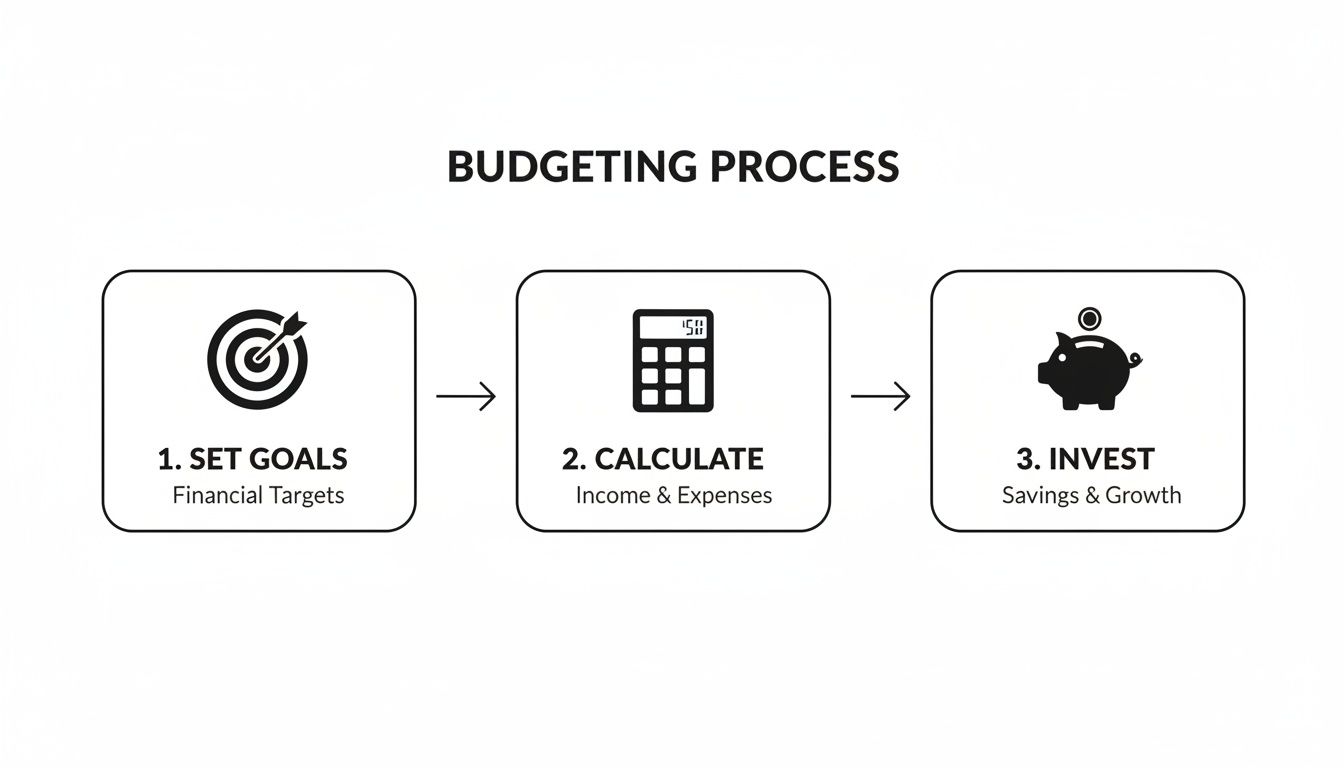
It’s all about starting with clear goals, figuring out what it’ll take to hit them, and then investing accordingly.
Use these questions to steer your conversations:
Experience and Expertise
- Can you show me case studies from clients in my industry or with similar goals? (You're looking for real data, not just pretty screenshots).
- Who, specifically, will be working on my account? What’s their background?
- How do you keep up with all the algorithm changes and marketing trends?
Strategy and Storytelling
- What’s your process for getting to know my brand, my customers, and what makes us unique?
- How do you turn our business goals into a concrete marketing strategy for SEO, GEO, and AEO?
- What’s your approach to content? How do you make sure it connects with our audience and ranks well?
Technology and Reporting
- What tools do you use for analytics, reporting, and project management?
- Can I see a sample of a monthly report?
- How do you measure ROI? How will you connect your work to our actual sales and leads?
This level of detail is non-negotiable. With search driving 93% of website traffic and 97% of consumers checking a business out online before engaging, the partner you pick is your first impression. Our guide on how to choose a digital marketing agency has even more tips for making this critical choice.
Analyzing Case Studies and Testimonials
A slick portfolio is one thing; real results are another. When an agency shows you a case study, don't just nod along. Dig in. Ask them to walk you through the "before" and "after."
What was the specific problem? What was their exact strategy? What roadblocks did they hit, and how did they get around them?
A great case study isn't just a highlight reel. It’s a story of a problem, a strategy, a process, and a measurable outcome. If they can’t tell you that story in detail, the results might not be entirely their own.
The same rule applies to testimonials. Vague praise like, "They were great to work with!" is nice, but it tells you nothing. You want specifics. Look for testimonials that say, "They helped us increase qualified leads by 40% in six months" or "Our local map rankings for our main service went from page three to the top three."
By the end of this process, you should have a clear favorite. You’ll feel confident that you’ve found a partner who not only offers affordable digital marketing services but truly gets your vision and has a credible plan to bring it to life.
Spotting Red Flags and Avoiding Bad Actors
Navigating the world of affordable digital marketing services can feel like you're walking through a minefield. Seriously. For every legitimate partner who wants to see you grow, there are dozens of bad actors ready to take your money and deliver nothing but headaches.
Learning to spot the warning signs is your most important defense. Think of this as your guide to self-preservation. These red flags aren't just theoretical; they come from cautionary tales I've witnessed firsthand, where good business owners get roped into worthless contracts. Knowing these pitfalls will give you the confidence to trust your gut and walk away from a bad deal.
The All-Too-Common Guarantee of #1 Rankings
This is the oldest trick in the book, and it’s still shockingly effective. If an agency guarantees you a "#1 ranking on Google," you should end the conversation right there. No one can guarantee a specific ranking, not even the people who work at Google. It's simply not possible.
Search engine algorithms are complex, constantly changing beasts influenced by hundreds of factors. A legitimate SEO pro focuses on a proven process—technical tune-ups, quality content, and building authority—to improve your visibility over time. They talk about strategy and best practices, not impossible promises.
A reputable agency will promise to execute a sound strategy. A questionable one will promise a specific outcome they can't possibly control.
Imagine a local service business being pitched a "secret sauce" SEO package that promises to put them at the top of the search results in 30 days. The right response isn't excitement; it's deep skepticism. Ask them how they plan to do it. If their answers are vague or mention "proprietary methods," that’s a massive red flag.
Vague Reporting and a Focus on Vanity Metrics
Here's another huge warning sign: a lack of transparent, meaningful reporting. If your monthly report is just a colorful PDF filled with fluffy numbers like "impressions," "reach," or "clicks" without any connection to your actual business goals, you've got a problem.
These are vanity metrics. They look impressive on the surface but tell you nothing about whether the marketing is actually moving the needle. A good partner ties their efforts directly to what matters most to you:
- Qualified Leads: How many real potential customers contacted you?
- Conversion Rates: What percentage of website visitors took the action you wanted them to?
- Customer Acquisition Cost (CAC): How much did you spend to get each new customer?
- Rankings for High-Intent Keywords: Are you showing up for searches that lead to sales, like "emergency plumber near me"?
If an agency can’t—or won’t—provide a report that connects their work to your bottom line, it's often because there’s nothing positive to report.
Proprietary Traps and Holding Your Assets Hostage
This red flag is subtle but incredibly dangerous. Some agencies will build your website on their own proprietary platform or insist on setting up your Google Analytics and Google Business Profile under their own company email. At first, it might seem convenient, but it's a trap.
The moment you decide to leave, you might discover that you don't actually own your own website or your analytics data. They hold all the keys, and you’ll be forced to start over from scratch, losing all your hard-earned SEO authority in the process.
You must always have full ownership and administrative access to your core digital assets. No exceptions.
- Your Website Domain and Hosting: These should always be registered in your name.
- Your Website Content Management System (CMS): You need full admin rights, period.
- Your Google Analytics and Google Search Console: This data belongs to your business, not your agency.
- Your Google Business Profile: This is one of your most critical local (GEO) assets. Don't let anyone else be the primary owner.
Insist on this from day one. An agency that pushes back on this isn't a partner; they're trying to lock you in.
The One-Size-Fits-All Strategy
Finally, be wary of any agency that presents a generic, cookie-cutter strategy without first taking the time to understand your business, your customers, and your unique goals. Effective digital marketing is not a simple checklist of services.
A great partner starts by asking a ton of questions. They’ll want to know about your sales process, who your best customers are, and what your biggest challenges are. Their proposal should feel like it was written specifically for you, outlining a clear plan for using SEO, GEO, and AEO to solve your specific problems and tell your unique story.
If their pitch could be given to any other business in any other industry, they don’t understand yours. And if they don't understand your business, they can't help you grow it.
Measuring Success and Ensuring Positive ROI

Pouring money into affordable digital marketing services is easy. Knowing if that money is actually coming back to you, with friends, is the hard part. If you're not measuring, you're just guessing.
The key to getting a solid return on investment (ROI) is to stop chasing flashy numbers that don't actually move the needle. "Impressions" and "clicks" might look nice on a report, but they don't pay your bills. For a small business, success is all about tangible results that hit the bottom line. It's time to ditch the vanity metrics and focus on the Key Performance Indicators (KPIs) that signal real growth.
Focusing on Metrics That Matter
A good agency partner won't just send you reports full of jargon; they'll help you track the numbers that tell the real story of how your marketing is turning into revenue.
These are the core KPIs you should obsess over:
- Qualified Leads: This isn't about every form submission or phone call. It’s about contacts from people who are genuinely in the market for what you offer. Think quality, not just quantity.
- Conversion Rate: What percentage of people visiting your website actually take the action you want them to, like requesting a quote or picking up the phone? This number tells you how well your site is doing its job.
- Customer Acquisition Cost (CAC): This is the big one. How much, on average, are you spending to get one new paying customer? The entire goal is to drive this number down over time.
- Organic Traffic to Key Service Pages: It's great to see more website visitors, but it's even better when they're landing on the pages for your most profitable services. That's targeted traffic.
Tracking these KPIs is non-negotiable. They give you a clear, unfiltered view of what's working, allowing you and your agency to make smart decisions based on data, not just a gut feeling. Our handy customer acquisition cost calculator can help you get a firm grasp on this critical number.
The ultimate measure of an 'affordable' marketing service is a consistently low and improving Customer Acquisition Cost. If each new customer is costing you less to acquire this month than last month, your strategy is working.
A Reporting Template for a Local Service Business
Let's get practical. Say you're a local plumber and you’ve hired an agency to boost your local SEO. A good report won’t just show you that your ranking for "plumber near me" went up. It will connect that ranking to actual business results.
Here’s what a meaningful report for your plumbing business should look like:
| Metric | Last Month | This Month | Change | Goal | Notes |
|---|---|---|---|---|---|
| Organic Rank for "Plumber Near Me" | Position 8 | Position 4 | +4 | Top 3 | Moving in the right direction. |
| Website Clicks from Google Maps | 45 | 72 | +60% | 100 | Increased visibility is driving clicks. |
| Tracked Phone Calls from Website | 12 | 21 | +75% | 25 | Call tracking confirms SEO is working. |
| Quote Request Form Fills | 8 | 15 | +88% | 20 | Landing page changes are effective. |
| Total Qualified Leads | 20 | 36 | +80% | 45 | Nearing our monthly lead goal. |
| Customer Acquisition Cost (CAC) | $150 | $111 | -26% | < $100 | ROI is improving significantly. |
See the difference? This report tells a story. It draws a straight line from the SEO work (better rankings) to a tangible outcome (more calls and a lower CAC). This is the kind of transparency you should expect.
The Power of Regular Strategy Sessions
This kind of reporting leads to the final, crucial piece of the puzzle: regular, meaningful conversations with your agency. A monthly report is just a snapshot. The real value is in the strategy sessions where you dig into what that data actually means for your business.
These meetings are your chance to:
- Review Performance: Go over the KPIs. What worked? What bombed? Why?
- Align with Business Goals: Are you heading into your busy season? Launching a new service? Your marketing strategy needs to be in lockstep with what's happening on the ground.
- Plan for the Future: Brainstorm what's next. A new content push? A local link-building campaign? Optimizing for voice search? This is where you stay ahead of the curve.
This mindset applies across all channels. While this guide focuses on core lead generation, other channels like social media and email marketing are powerful, affordable avenues for growth—but only if you track the right numbers. With 76% of social users saying content influences their purchases, you have to measure beyond likes and shares. And email marketing, a top ROI channel for 30% of marketers, gives you a direct line to 4 billion daily users, making it a highly measurable tool for nurturing leads.
A transparent agency partner ties all these activities back to real business growth, ensuring every dollar you spend is working as hard as you do.
Got Questions About Affordable Digital Marketing?
Look, diving into digital marketing brings up a ton of questions, especially when you're trying to make every dollar count. Let's tackle some of the most common ones I hear from business owners. The goal here is to get you direct, no-fluff answers focused on what really matters: getting value and finding a genuine partner for your business.
How Long Does It Take to See SEO Results?
This is the big one, and the only honest answer is: it depends. SEO isn't a light switch you flip on for instant results; it's a long game that builds real, lasting value.
For a brand new website just getting started, you're probably looking at 4 to 6 months before you start to see the needle move on rankings and traffic. If you've got a more established site with some history, you could see positive shifts in as little as 90 days.
Think of it like building a reputation in your neighborhood. You can't just open your doors and expect a line of trusting customers on day one. You have to show up consistently, provide real value, and prove you're an authority. SEO is the digital version of that—steadily building your site's authority with search engines through great content (AEO), solid technical fundamentals, and earning trust. The results are gradual, but they snowball into a powerful, sustainable source of leads that you own.
What Should I Prioritize with a Small Budget?
If the budget is tight, you have to be ruthless with your focus. Don't fall into the trap of trying to do a little bit of everything. Instead, get really, really good at the essentials that move the needle for local businesses.
- Local SEO (GEO): This is your #1, non-negotiable priority. That means getting your Google Business Profile completely dialed in with compelling descriptions, frequent updates, and great photos that tell your story. Build consistent local citations and actively encourage happy customers to leave detailed reviews. It's the fastest path to showing up in those "near me" searches and getting your phone to ring.
- A High-Performing Website: Your website is home base for everything else. It has to be fast, work flawlessly on a phone, and make it crystal clear what you do and why someone should choose you.
- Hyper-Focused Content (AEO): Stop thinking about generic blog posts. Start creating content that directly answers the most urgent questions your customers are typing into Google. A detailed guide on "How to Choose a Reputable Roofer in [Your City]" that tells the story of your process will always beat a generic article about roofing materials.
When your resources are limited, don't spread them thin. Your goal should be to completely dominate your local search results first. It's hands-down the most cost-effective way to generate high-intent leads and build a foundation to expand on later.
Can I Just Do SEO Myself?
Absolutely. You can and should handle certain parts of your SEO, especially on the local (GEO) front. Things like managing your Google Business Profile, personally asking customers for reviews, and writing content that shares your expertise are perfect for you to own. Nobody can tell your business's story better than you can.
But the technical side of SEO gets complicated fast. We're talking about site speed optimization, schema markup, and deep-dive keyword strategy. That's where specialized knowledge really pays off.
For a lot of business owners, a hybrid approach is the sweet spot. You handle the day-to-day local presence and storytelling, and you partner with an agency for the heavy lifting on technical SEO and strategic content planning. This way, you ensure your efforts are technically sound and you're not leaving critical ranking opportunities on the table.
Ready to invest in a marketing partner that's obsessed with real results? The team at Jackson Digital builds custom growth strategies that connect SEO, brand storytelling, and data analytics to lower your customer acquisition costs and drive predictable sales. Request a free performance audit today.