
A solid foundation in digital marketing is as crucial to your business as the one you pour for a building. Relying solely on word-of-mouth referrals is no longer enough to sustain growth in a competitive market. To thrive, construction companies need a strategic mix of modern tactics that not only capture the attention of high-intent customers on search engines but also tell a compelling story of your quality, craftsmanship, and reliability. This guide moves beyond generic advice to provide a blueprint of actionable construction marketing strategies designed for real-world results.
We will detail a prioritized roundup of tactics focused on what truly drives leads and secures projects: boosting your local visibility through Search Engine Optimization (SEO), dominating your geographic service area (GEO), and leveraging Answer Engine Optimization (AEO) to establish your company as the go-to authority. Forget abstract theories; we are breaking down each strategy into practical, step-by-step implementation plans.
You will learn how to:
- Rank your business higher in local search results and on maps.
- Showcase your best projects to attract your ideal clients.
- Build a predictable pipeline of high-value leads.
- Manage your online reputation to build trust before the first call.
From optimizing your website for local search to launching targeted ad campaigns and creating content that converts, this comprehensive listicle provides the tools you need to build a powerful marketing machine. Let’s lay the groundwork for your digital dominance and construct a more profitable future for your business.
1. Local SEO Optimization for Construction Services
Local Search Engine Optimization (SEO) is a fundamental construction marketing strategy that focuses on making your business visible in geographically-related (GEO) searches. When a potential client in your service area searches "roof repair near me" or "general contractor in [City Name]," local SEO is what ensures your company appears prominently in Google's Local Pack (the map results) and organic listings. This approach is critical because construction is inherently local; your customers are searching for reliable professionals within their immediate community.
This strategy involves optimizing your digital presence to signal your location, services, and credibility to search engines. A well-executed local SEO campaign tells the story of your business as the go-to expert in a specific region, building trust before a prospect even clicks on your website. For example, a regional roofing company can use local SEO to rank in the top three map results across multiple cities, while a local plumbing franchise can dominate search results with a high star rating, consistently driving calls and inquiries.
How to Implement This Strategy
To effectively leverage local SEO and improve your geographic (GEO) ranking, focus on these core components:
- Google Business Profile (GBP): This is your digital storefront and the core of local SEO. Fully optimize your GBP with accurate business information, service categories, high-quality photos of your work, and posts that tell the story of your recent projects. This helps Google rank your business for local searches.
- Service Area Pages: Develop dedicated pages on your website for each city or neighborhood you serve. These pages should feature localized content, such as case studies of local projects and references to local landmarks, to signal your geographic relevance to search engines.
- Review Management: Systematically generate new customer reviews by sending automated requests after a job is completed. Aim for 5-10 new reviews monthly and respond to all feedback within 48 hours. Reviews are a major ranking factor for local search and tell a story of customer satisfaction.
- Local Citations: Ensure your business name, address, and phone number (NAP) are consistent across all online directories, especially industry-specific ones like Houzz and HomeAdvisor. Consistency helps search engines trust your location data.
By mastering these elements, you can significantly improve your local search ranking. To dive deeper into the technical aspects, you can learn more about SEO for service-based businesses and how to apply it directly to your company.
2. Google Local Services Ads (LSA) for Lead Generation
Google Local Services Ads (LSA) are a powerful, pay-per-lead advertising platform that positions your business at the very top of Google's search results, often above traditional ads and organic listings. When a local customer searches for services like "emergency plumber" or "roofing contractor in [City]," LSAs appear with a prominent "Google Guaranteed" or "Google Screened" badge, along with your star rating and a direct call button. This high-visibility placement builds immediate trust and captures high-intent customers at the exact moment they need your services.
This strategy is one of the most direct construction marketing strategies for generating qualified leads and dominating your geographic (GEO) service area. Unlike pay-per-click models, you only pay when a customer directly contacts you through the ad, ensuring your budget is spent on genuine inquiries. For example, an HVAC company can use LSAs to capture seasonal repair calls, while a general contractor can secure pre-qualified appointments, telling a story of immediate availability and trust backed by Google.
How to Implement This Strategy
To effectively launch and manage a Local Services Ads campaign, focus on these key actions:
- Complete the Verification Process: Undergo Google's background and license checks to earn the "Google Guaranteed" or "Screened" badge. This step is critical for building trust and even appearing in LSA results, which is key to ranking at the very top of the search page.
- Optimize Your Profile and Budget: Select your specific service categories (e.g., "Roof installation," "Leak repair") and define precise service areas to control lead volume and quality. This tells Google exactly which geographic searches you want to appear for.
- Maintain High Responsiveness and Reviews: Your LSA ranking is heavily influenced by your response rate and review score. Aim to answer every incoming call and respond to all messages within an hour. Consistently generate positive reviews on your connected Google Business Profile, as these are displayed directly on your ad.
- Actively Manage and Dispute Leads: Regularly review incoming leads through the LSA dashboard or app. You can dispute and receive credit for irrelevant or spam leads. This ensures your marketing spend remains highly efficient and focused on ranking for the right queries.
By focusing on these components, your business can leverage LSAs to create a consistent and predictable flow of high-quality customer inquiries. To get started with the verification process, visit the official Google Local Services Ads page and begin building your profile.
3. Content Marketing & Project Showcase Strategy
Content marketing is one of the most effective construction marketing strategies for demonstrating expertise and building trust. This approach involves creating and sharing valuable, visual, and educational content centered around your completed projects. This is where you master Answer Engine Optimization (AEO) by creating content that directly answers your customers' biggest questions. By showcasing your work through detailed case studies and video walkthroughs, you not only prove your capabilities but also tell a compelling story about the quality and craftsmanship your company delivers, attracting organic traffic and ranking you as an authority.
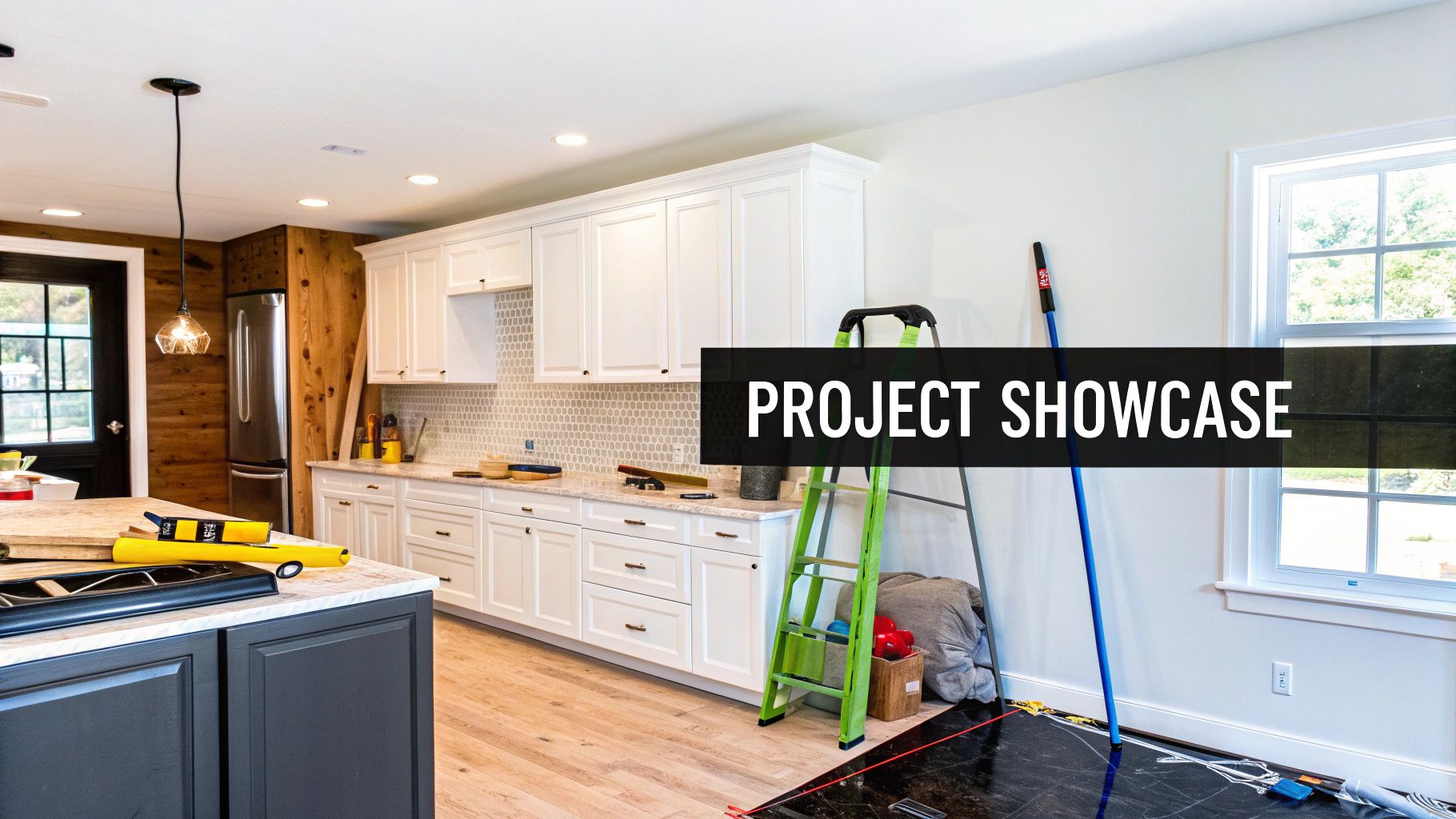
This strategy allows you to connect with clients at every stage of their buying journey. For instance, a kitchen remodeling contractor can create a video tour of a stunning design transformation to inspire homeowners, while a commercial construction firm can publish detailed project timelines that appeal to detail-oriented B2B clients. The goal is to create assets that not only rank in search engines for specific keywords but also build your brand's authority as a leader in the field.
How to Implement This Strategy
To effectively showcase your work and build authority, focus on these content-driven tactics:
- Create Detailed Project Case Studies: Develop dedicated pages on your website for standout projects. Tell the story: describe the client's problem, your solution, and the final outcome. Include high-resolution photos and details like materials used. This content provides valuable keywords for SEO.
- Leverage Video Content: Film professional walkthroughs of finished projects or time-lapses of the construction process. Video is a powerful storytelling tool that keeps users on your site longer, a positive signal to search engines.
- Systematically Collect Testimonials: At the end of each project, request a testimonial that you can feature alongside the project showcase. For construction businesses, generating renovation project reviews for profit is a powerful way to turn successful work into a future sales engine.
- Develop Content Clusters (AEO): Build your site's authority by creating clusters of content that answer common customer questions around your core services. For a roofing company, a main "roof replacement" page could be supported by blog posts answering "How much does a new roof cost?" and "Signs you need a new roof." This positions you as the expert answer engine.
By consistently creating high-quality content, you can attract qualified leads and establish your company as a trusted industry expert. You can learn more about how to create great web content for your business even without a dedicated writing team.
4. Paid Search (Google Ads & Bing) for Immediate Visibility
Paid search advertising is one of the most direct construction marketing strategies for generating immediate, high-intent leads. Unlike organic SEO which takes time to build authority, platforms like Google Ads allow you to place your company at the very top of search results the moment a potential customer is looking for your services. This approach involves bidding on specific keywords, giving you precise control over who sees your ads, when, and—most importantly for GEO targeting—where.
This strategy is powerful because it captures clients at their point of highest need. For example, a homeowner searching "emergency plumber near me" during a leak is not browsing; they are buying. By running a targeted paid search campaign, your plumbing business can be the first solution they see. Similarly, a roofing contractor can run ads during storm season for "hail damage roof repair," capturing an influx of urgent, qualified leads and telling a story of rapid, reliable service right at the top of the search engine results page.
How to Implement This Strategy
To launch an effective paid search campaign that ranks you instantly, concentrate on these essential actions:
- Target High-Intent Keywords: Start with a focused list of 5-10 keyword phrases that signal clear commercial intent, like "furnace replacement cost" or "general contractor in [City]." This ensures you appear for the searches that lead to jobs, not just research.
- Write Compelling Ad Copy: Your ads must stand out. Tell a mini-story of value by highlighting unique selling points like "24/7 Emergency Service," "Free Estimates," or "A+ BBB Rating." Use call and location extensions to make it easy for users to contact you directly from the search results.
- Optimize Landing Pages: Send ad traffic to dedicated landing pages that match the ad's promise. A user clicking an ad for "kitchen remodeling" should land on a page showcasing your kitchen projects and a clear call-to-action, directly answering their search query.
- Track Everything: Implement conversion tracking for every lead source: phone calls, form submissions, and online chat requests. This data is critical for understanding which keywords and geographic areas are driving real business, allowing you to optimize your campaigns for better search engine performance.
By mastering paid search, you can create a predictable and scalable lead generation engine. To get a comprehensive overview, you can learn more about what paid search advertising is and how to apply its principles.
5. Review Generation & Reputation Management
Review generation and reputation management is one of the most powerful construction marketing strategies for building trust and directly impacting your search engine ranking. This strategy involves proactively collecting customer feedback on key platforms like Google and Houzz. In an industry where trust is paramount, a high volume of positive reviews tells a compelling story of reliability and quality, which Google's algorithm rewards with better visibility in local (GEO) search results.

This approach goes beyond simply getting a good rating; it's about shaping the narrative around your business. For instance, a local roofing company with over 100 Google reviews and a 4.8-star average will almost always rank higher and get more clicks than a competitor with only 10 reviews. Similarly, a plumbing service that responds thoughtfully to every piece of feedback within 24 hours demonstrates exceptional customer service, building community trust and encouraging more clients to share their own positive stories.
How to Implement This Strategy
To build and maintain a five-star reputation that boosts your SEO, integrate these tactics into your process:
- Systematize the Ask: Don't leave reviews to chance. Ask for a review at the moment of peak customer satisfaction, such as during the final project walkthrough. Train your team to make this a standard part of closing out a job.
- Make It Effortless: Provide clients with a direct link or QR code to your preferred review platform (e.g., your Google Business Profile). The fewer steps a customer has to take, the more likely they are to leave the feedback that fuels your search ranking.
- Engage with All Feedback: Respond to every review, both positive and negative, within 48 hours. Thank positive reviewers personally. For negative reviews, respond professionally and offer a solution offline. This engagement is a positive signal to search engines.
- Leverage Positive Reviews: Showcase your best testimonials on your website, in social media posts, and even in your ad campaigns. This social proof is a powerful storytelling tool for converting prospects who are on the fence.
By making reputation management a core part of your operations, you create a feedback loop that not only attracts new clients but also provides valuable signals for improving your SEO. You can learn more about the direct impact of reviews on local search rankings from studies by industry authorities like BrightLocal.
6. Email Marketing & Customer Retention Campaigns
Email marketing is a powerful construction marketing strategy that allows you to directly communicate with leads and past clients, nurturing relationships and driving repeat business. Instead of constantly chasing new customers, this approach focuses on building long-term value from your existing network. For a construction business, where trust is paramount, staying top-of-mind by telling stories of your recent work and offering helpful advice is key to securing future projects and referrals.
This strategy involves more than just sending occasional newsletters; it's about delivering targeted messages that add value at the right time. For example, a roofing company can send automated pre-storm inspection reminders to homeowners in its database, while a home remodeling firm can follow up a year after a project with warranty information and an offer for a new consultation. These touchpoints reinforce your brand's reliability and expertise, turning one-time customers into lifelong clients and advocates.
How to Implement This Strategy
To build an effective email marketing and retention program, focus on these key actions:
- Build & Segment Your List: Start collecting email addresses from day one through website contact forms, quote requests, and post-project follow-ups. Segment this list by service type (e.g., "Roofing Clients," "Siding Leads") to send highly relevant content that tells the right story to the right audience.
- Create Automated Nurture Sequences: Develop a series of automated emails for new leads that introduces your company, showcases past projects, and answers common questions. This "warms up" prospects by telling your story before a sales representative even makes a call.
- Launch Retention Campaigns: Schedule timely, value-driven campaigns for past customers. Send seasonal maintenance reminders (e.g., HVAC tune-ups before winter), announce new services, or offer exclusive discounts to your loyal client base.
- Optimize for Engagement: A/B test your subject lines to see what drives higher open rates. Ensure every email has a single, clear call-to-action (CTA) like "Book a Free Inspection." Include high-quality photos of your work and client testimonials to build social proof and engagement.
7. Video Marketing & YouTube Optimization
Video marketing is a powerful construction marketing strategy that uses visual content to showcase your work, build trust, and dominate search results. Since YouTube is the world's second-largest search engine, optimizing your video content for it allows you to appear in both YouTube and Google search results, capturing a massive audience. For construction companies, video is uniquely effective because it visually tells the story of your projects, transforming abstract plans into tangible, impressive results that build credibility and improve your overall SEO.
This strategy involves creating and promoting video content that educates, entertains, or demonstrates your expertise. It humanizes your brand, allowing potential clients to see your craftsmanship before ever picking up the phone. For instance, a general contractor can create a time-lapse video of a large commercial build to showcase efficiency, while a kitchen remodeler can produce a detailed project walkthrough, highlighting the quality of their finishes. These assets rank in search engines and significantly increase user time on your website, a key SEO metric.
How to Implement This Strategy
To build an effective video marketing presence that ranks on search engines, concentrate on these key actions:
- Create Pillar Content: Develop long-form videos centered around your core services, such as "The Complete Guide to a Kitchen Remodel." These in-depth videos can be broken down into smaller clips for social media and directly answer customer questions, boosting your AEO.
- Optimize for Search (Video SEO): Treat every YouTube upload like a webpage. Write keyword-rich titles and detailed descriptions that include your primary keywords, service locations, and links back to your website. This helps your videos rank in Google for relevant searches.
- Design Compelling Thumbnails: Your thumbnail is your video's first impression. Create custom, high-contrast images with bold text overlays that clearly communicate the video's topic and entice users to click, improving your video's ranking performance.
- Promote and Distribute: Share your new videos across all your marketing channels, including your email newsletter and relevant service pages on your website. Embedding videos on your site can significantly boost on-page SEO by increasing user dwell time.
8. Strategic Partnerships & Referral Networks
Strategic partnerships and referral networks are powerful construction marketing strategies centered on building relationships with complementary, non-competing businesses. When an architect, real estate agent, or interior designer recommends your services, the lead comes with a high level of built-in trust. This approach creates a predictable pipeline of high-quality leads, reducing reliance on traditional advertising and telling a story of credibility through the endorsement of other trusted professionals.
This strategy leverages the professional credibility of your partners to endorse your work. It transforms your network into a proactive sales force that understands your ideal customer and can pre-qualify opportunities. For example, a trusted real estate agent referring a home buyer for a kitchen renovation, or an architect specifying your company for a new commercial build, generates leads that are significantly warmer and more likely to convert than those from other marketing channels.
How to Implement This Strategy
To build a robust referral network, focus on creating mutually beneficial relationships:
- Identify Complementary Partners: Make a list of 5-10 ideal partner types in your service area, such as real estate agents, property managers, architects, and interior designers. Focus on professionals whose clients are your ideal clients.
- Establish Clear Agreements: Create a simple referral agreement outlining expectations, any referral fees, and the process for handoffs. This ensures transparency and professionalism, making partners more comfortable sending business your way.
- Equip Your Partners: Provide partners with co-branded marketing materials or a dedicated landing page. Make it easy for them to share your story and showcase your work. Regularly update them on project successes and new capabilities.
- Track and Nurture: Use your CRM to track the source of every referral. This data will reveal your most valuable partners. Nurture these key relationships with regular check-ins and expressions of gratitude to ensure a long-lasting, fruitful partnership.
9. Paid Social Media Advertising (Facebook, Instagram, LinkedIn)
Paid social media advertising is a powerful construction marketing strategy that allows you to bypass organic reach limitations and place your brand directly in front of a highly targeted audience. Unlike search ads that capture existing demand, social ads excel at creating new demand by showcasing your work to specific demographics and interests. This is where you can tell visual stories about your projects to build brand awareness and nurture potential leads long before they are ready to search on Google.
This strategy is effective because it leverages the visual nature of construction work. A kitchen remodeling contractor can use a carousel ad on Instagram to show stunning before-and-after transformations, while a commercial builder can use LinkedIn ads to target property developers with case studies of large-scale projects. While not a direct SEO tool, social ads can indirectly boost search visibility by driving traffic to your website and increasing brand name searches, which are positive signals to Google.

How to Implement This Strategy
To launch a successful paid social campaign, focus on precise targeting and compelling creative:
- Start with Retargeting: Begin by targeting users who have already visited your website. This warm audience is already familiar with your brand. Show them ads that tell a deeper story—like client testimonials or videos of your team in action—to encourage them to come back and convert.
- Utilize High-Quality Visuals: Your project photos and videos are your greatest assets. Use clear, high-resolution before-and-after images, video walkthroughs of completed jobs, and time-lapses of the construction process to tell a powerful visual story that stops the scroll.
- Leverage Lookalike Audiences: Once you have a solid customer list, upload it to your ad platform to create a "lookalike" audience. The platform will find new users with similar characteristics to your best customers, expanding your reach to a highly relevant group.
- Optimize for Conversions: Use lead form ads directly within Facebook or Instagram to make it easy for users to request a quote without leaving the app. Ensure you have conversion tracking set up to measure the true ROI of your campaigns, including form submissions and phone calls.
10. Technical SEO & Website Performance Optimization
Technical SEO is the discipline of optimizing your website's infrastructure so search engines can effectively crawl, index, and understand its content. While content tells search engines what your site is about, technical SEO ensures there are no roadblocks. For a construction company, a fast, secure, and mobile-friendly website is the non-negotiable foundation upon which all other SEO, GEO, and AEO strategies are built. It's how you ensure your amazing project stories can actually be found and seen by search engines and users.
This strategy addresses the "how" of your website's performance, not just the "what." A technically sound site delivers a superior user experience, which Google rewards with higher rankings. For instance, a general contractor whose project gallery loads instantly on a mobile device will retain more visitors than a competitor with a slow, clunky site. This improved performance directly translates to a lower bounce rate and longer session durations—both key signals that tell search engines your site is a quality result.
How to Implement This Strategy
To build a technically sound website that supports your search engine ranking goals, focus on these critical actions:
- Prioritize Core Web Vitals: Use Google PageSpeed Insights to measure your site's performance. Focus on improving Largest Contentful Paint (LCP) to under 2.5 seconds by optimizing images and deferring non-critical scripts. A faster site experience is a direct ranking factor.
- Ensure Mobile Responsiveness: Your website must provide a seamless experience on all devices. Test your site's mobile usability in Google Search Console and ensure all buttons and forms are easy to use. Google ranks the mobile version of your site first.
- Implement Schema Markup: Add structured data (schema) to your website's code to help search engines understand your services, service area, and customer reviews. This can result in enhanced search listings (rich snippets) that include star ratings, making you stand out and improving click-through rates.
- Conduct Regular Technical Audits: Use tools like Screaming Frog or the Semrush Site Audit tool to crawl your website monthly. Identify and fix critical issues like broken links (404 errors) and duplicate content to maintain a healthy, crawlable site structure that search engines love.
10-Point Construction Marketing Strategy Comparison
| Strategy | Implementation Complexity 🔄 | Resource Requirements ⚡ | Expected Outcomes 📊 | Key Advantages ⭐ | Ideal Use Cases & Tip 💡 |
|---|---|---|---|---|---|
| Local SEO Optimization for Construction Services | 🔄 Medium — ongoing listings & on‑page work | ⚡ Moderate — time for GBP, citations, content | 📊 Strong local visibility; phone leads in 3–6 months | ⭐⭐⭐ High-intent local traffic; review-driven credibility | 💡 Best for service-area firms; create GBP per location and monitor reviews |
| Google Local Services Ads (LSA) for Lead Generation | 🔄 Low–Medium — verification + management | ⚡ High (pay-per-lead budget $500–3k+/mo) | 📊 Immediate qualified leads; conversions high while active | ⭐⭐⭐ Very high conversion; pay only for leads | 💡 Ideal for emergency/seasonal trades; complete verification and maintain >4.2★ |
| Content Marketing & Project Showcase Strategy | 🔄 Medium–High — consistent production & SEO | ⚡ High — photography, video, writing, time | 📊 Long-term organic authority and inbound leads (3–12+ months) | ⭐⭐⭐ Differentiates brand; shortens sales cycle with proof | 💡 Use project pages and 1,500+ word pieces; repurpose across formats |
| Paid Search (Google Ads & Bing) for Immediate Visibility | 🔄 Medium — campaign setup and ongoing optimization | ⚡ Variable — recommended $1k–5k+/mo + management | 📊 Immediate top-position visibility; measurable ROI while funded | ⭐⭐⭐ Fast scale and precise targeting | 💡 Start with 5–10 high-intent keywords and track phone conversions |
| Review Generation & Reputation Management | 🔄 Low–Medium — systematic workflows and responses | ⚡ Low–Moderate — CRM/tool + staff follow-up | 📊 Improved local rankings, CTR and conversion over months | ⭐⭐⭐ Strong social proof; increases trust and clicks | 💡 Ask at project completion; use direct links/QR codes to simplify reviews |
| Email Marketing & Customer Retention Campaigns | 🔄 Low–Medium — segmentation and automation setup | ⚡ Low — platform fees ($30–300/mo) + content time | 📊 High ROI and repeat business; predictable seasonal revenue | ⭐⭐⭐ Excellent ROI and customer lifetime value | 💡 Segment lists and automate maintenance reminders 30 days before season peaks |
| Video Marketing & YouTube Optimization | 🔄 Medium–High — production, editing, SEO | ⚡ High — equipment/production time and editing | 📊 Higher engagement, backlinks and search presence long-term | ⭐⭐⭐ Visual trust-builder; improves dwell time and shares | 💡 Produce pillar project walkthroughs; optimize titles, thumbnails and captions |
| Strategic Partnerships & Referral Networks | 🔄 High — relationship building and maintenance | ⚡ Low–Moderate — time, possible incentives/commissions | 📊 Recurring high-quality referrals; timeline varies by network | ⭐⭐⭐ Low CAC; trusted lead sources | 💡 Target 5–10 complementary partners; formalize referral terms and track sources |
| Paid Social Media Advertising (Facebook, Instagram, LinkedIn) | 🔄 Medium — creative production + targeting setup | ⚡ Moderate — $500–2k+/mo + creative costs | 📊 Awareness, retargeting leads; lower intent than search | ⭐⭐ Strong visual reach; efficient retargeting | 💡 Start with retargeting website visitors; refresh creative every 2–3 weeks |
| Technical SEO & Website Performance Optimization | 🔄 High — audits, developer fixes, ongoing monitoring | ⚡ Moderate–High — developer time and audit tools | 📊 Better crawlability, speed, and improved rankings foundation | ⭐⭐⭐ Essential technical foundation for all channels | 💡 Prioritize Core Web Vitals (LCP <2.5s, FID <100ms, CLS <0.1) and run quarterly audits |
Executing Your Marketing Framework for Lasting Growth
The blueprint for a successful construction business in the digital age is no longer just about the quality of your work; it's about the quality of your story and how effectively you share it to rank on search engines. Throughout this guide, we've explored a comprehensive toolkit of construction marketing strategies, moving from foundational tactics like Local SEO and Reputation Management to more advanced growth levers such as paid media and strategic partnerships. The true power, however, doesn't lie in adopting any single strategy. It comes from integrating them into a cohesive framework that improves your search visibility and tells your story 24/7.
Think of it this way: your technically optimized website is the solid foundation that allows search engines to rank you. Your compelling project showcases are the frame and structure, providing the content that answers user questions (AEO). Your paid advertising and Local Services Ads are the high-visibility cranes that attract immediate attention in your geographic area (GEO), and your sterling reviews and strong referral network are the curb appeal that closes the deal. Each component supports the others, creating a marketing engine far greater than the sum of its parts.
From Blueprint to Reality: Your Actionable Next Steps
The sheer number of options can feel overwhelming, but progress is about focused, consistent action, not trying to do everything at once. Your immediate goal is to move from passive learning to active implementation.
Here is a simple, three-step plan to get started:
-
Conduct a Foundational Audit: Before building anything new, inspect your existing foundation. Where do you stand right now? Perform a quick audit of your Google Business Profile (Is it fully optimized for local search?), your website's mobile performance (Does it load in under 3 seconds?), and your current online reviews (Do they tell a story of success?). This initial assessment will reveal your most urgent priorities for search engine ranking.
-
Master Your Core (The "Big Two"): For most contractors, the fastest path to impact is by mastering Local SEO and Review Management. These two strategies create a virtuous cycle. Dominating local search results gets you in front of high-intent customers, and a stellar online reputation convinces them to choose you. Dedicate the next 90 days to relentlessly pursuing these two goals before layering on anything else.
-
Layer and Integrate Strategically: Once your foundational elements are generating consistent results, begin layering in the next strategy. If Local SEO is bringing in traffic, supercharge it with targeted Google Ads for immediate lead flow. If you have a portfolio of stunning projects, turn them into compelling video tours for YouTube to capture more search real estate and tell your story visually. The key is to build upon your successes.
Beyond Leads: Building a Lasting Brand Narrative
Ultimately, the most effective construction marketing strategies do more than just generate leads; they build a brand that people trust, remember, and find easily on Google. Every project case study you publish, every client testimonial you share, and every behind-the-scenes video you post contributes to a larger narrative about your company’s expertise, reliability, and commitment to quality. This is how you transition from being just another contractor in the search results to becoming the go-to authority in your market.
This principle of strategic brand building is universal across specialized trades. For instance, the detailed methodologies on how to market an architecture firm offer valuable lessons on creating a premium brand identity and communicating complex value propositions, insights that construction leaders can readily adapt to elevate their own market positioning. By telling your story effectively across multiple channels, you build an asset that pays dividends for years to come.
Your marketing shouldn't be an afterthought; it should be as meticulously planned and executed as the projects you build. Start small, stay consistent, and build your marketing framework one strategic block at a time. The result will be a predictable, scalable pipeline of high-quality leads and a brand that stands the test of time.
Ready to design a custom marketing blueprint that drives measurable growth for your construction business? The team at Jackson Digital specializes in implementing data-driven construction marketing strategies that deliver real-world results. Get your free performance audit today and discover your biggest opportunities to build a dominant online presence.