A basic customer lifetime value calculation gives you a solid estimate of the total revenue you can expect from the average customer over the entire time they do business with you. It’s a simple but powerful shift in thinking—moving away from one-off sales and toward building a sustainable business by telling the story of your most valuable customers.
Why CLV Is Your Most Powerful Marketing Metric
Before we jump into the formulas, it’s worth taking a moment to understand why CLV is so much more than just another number on a spreadsheet. Think of it as the North Star for your entire marketing strategy. It completely reframes your perspective from chasing expensive, single transactions to building real loyalty with customers who bring in predictable revenue for years to come.
Once you know what a customer is actually worth to your business, every marketing decision gets sharper and more effective. This one metric can reshape your entire approach, from how you handle local SEO to the stories you tell in your content marketing.
Pinpointing Your Most Valuable Customers
At its heart, CLV helps you figure out who your best customers really are. Is it the client who makes a huge, infrequent purchase, or the one who buys smaller items week after week? For a local dental practice, is it the family coming in for cleanings twice a year, or the patient who gets a one-time, high-ticket cosmetic procedure? A good CLV calculation clears this up instantly, giving you the main character for your brand's story.
With this insight, you can:
- Segment your audience better: Stop blasting generic messages and start creating targeted campaigns for your high-value customer groups.
- Sharpen your acquisition efforts: Put your ad spend where it counts by attracting prospects who look just like your most profitable customers.
- Refine what you offer: Double down on the products or services that your best customers can't get enough of.
Making Smarter Budgeting Decisions
Understanding CLV is also the key to making smart financial moves and getting the most out of every dollar you spend. It directly tells you how much you can actually afford to spend to acquire a new customer—a figure we call Customer Acquisition Cost (CAC).
A healthy business model typically maintains a CLV:CAC ratio of at least 3:1. This means for every dollar you spend to bring in a new customer, you should expect to get at least three dollars back over their lifetime.
This simple ratio is your guardrail. It keeps you from burning cash on low-value leads and gives you the confidence to invest aggressively in the channels that deliver a real, measurable return. For a deeper look at getting more from your marketing spend, you can explore ways to improve marketing ROI with data-backed strategies.
Ultimately, focusing on CLV is about playing the long game. It’s a strategic pivot that ensures your growth isn’t just fast, but profitable and built to last. For more on why this metric is so critical, check out these strategies to increase customer lifetime value.
Getting Started With The Foundational CLV Calculation
Diving into customer lifetime value doesn't require a Ph.D. in data science. Not even close. The most common and accessible method—what we often call the historical or foundational model—is something any business owner can get a handle on pretty quickly. Think of it as the perfect first step for a quick health check on your customer relationships and marketing ROI.
This approach isn't about fancy predictive algorithms. It’s all about looking at the real, hard data you already have sitting in your CRM or accounting software. You're simply using past customer behavior to paint a clear picture of what an average customer is worth to you over time.
The Three Core Parts of Historical CLV
The historical customer lifetime value formula is actually quite simple. It just multiplies three key metrics, and each one tells a part of the story about your customer's journey with your business.
Let's break them down:
- Average Purchase Value (APV): This is the average amount of money a customer spends in a single transaction. It answers the simple question, "When someone buys from me, how much do they typically spend?"
- Purchase Frequency (PF): This metric tracks how often the average customer buys from you within a set period, usually a year. It tells you, "How many times does a happy customer come back for more?"
- Average Customer Lifespan (ACL): This is the average length of time a customer continues to buy from you before they churn or go dark. It answers the big one: "How long do my customers actually stick around?"
When you multiply these three numbers, you get a straightforward, revenue-based CLV.
CLV = Average Purchase Value × Purchase Frequency × Average Customer Lifespan
This basic equation has been a game-changer for businesses since it started gaining traction in the early 2000s. For a local service business like a dental practice, the numbers add up fast. A patient with a $200 average visit who comes in 4 times a year for 10 years has an $8,000 CLV. Suddenly, investing in local SEO (GEO) to attract and keep those loyal patients—which can slash acquisition costs by up to 25%—makes a whole lot of sense.
Putting The Formula To Work: A Real-World Example
Formulas are one thing, but seeing them in action with real numbers is where the lightbulb really goes on. Let's walk through this with a type of local business we work with all the time at Jackson Digital—a plumbing company.
Imagine "Reliable Rooter," a local plumbing outfit, wants to figure out its CLV to make smarter calls on its local SEO and Google Ads budget. First, they need to track down the data for their three key metrics.
Finding Your Numbers
Here’s how a business like Reliable Rooter would find its numbers:
- Average Purchase Value (APV): They check their books and see total revenue last year was $300,000. Then, they look at their invoicing software (like QuickBooks) and see they completed 1,000 jobs. Easy enough.
- Purchase Frequency (PF): Next, they dig into their customer list and find they served 400 unique customers during that same year.
- Average Customer Lifespan (ACL): This one can be a little trickier to nail down. They review their customer records and find that, on average, a customer stays with them for about 5 years before they move or switch to a competitor.
With that data in hand, we can now plug everything into our foundational CLV formula. The table below lays it all out, step-by-step.
Historical CLV Calculation for a Service Business
This table breaks down the historical CLV formula with a clear, real-world example for a local service business, showing how each component is calculated.
| Metric | Formula | Example Data (Local Plumber) | Calculation | Result |
|---|---|---|---|---|
| Average Purchase Value (APV) | Total Revenue / Total Purchases | $300,000 Revenue / 1,000 Jobs | $300,000 / 1,000 | $300 |
| Purchase Frequency (PF) | Total Purchases / Unique Customers | 1,000 Jobs / 400 Customers | 1,000 / 400 | 2.5 |
| Average Customer Lifespan (ACL) | Sum of Lifespans / Unique Customers | N/A | Based on historical data | 5 Years |
| Customer Lifetime Value (CLV) | APV × PF × ACL | $300 APV, 2.5 PF, 5 Years ACL | $300 × 2.5 × 5 | $3,750 |
This process gives Reliable Rooter a concrete number to work with, turning vague assumptions into actionable data.
This infographic shows how CLV insights directly fuel a smarter marketing cycle.
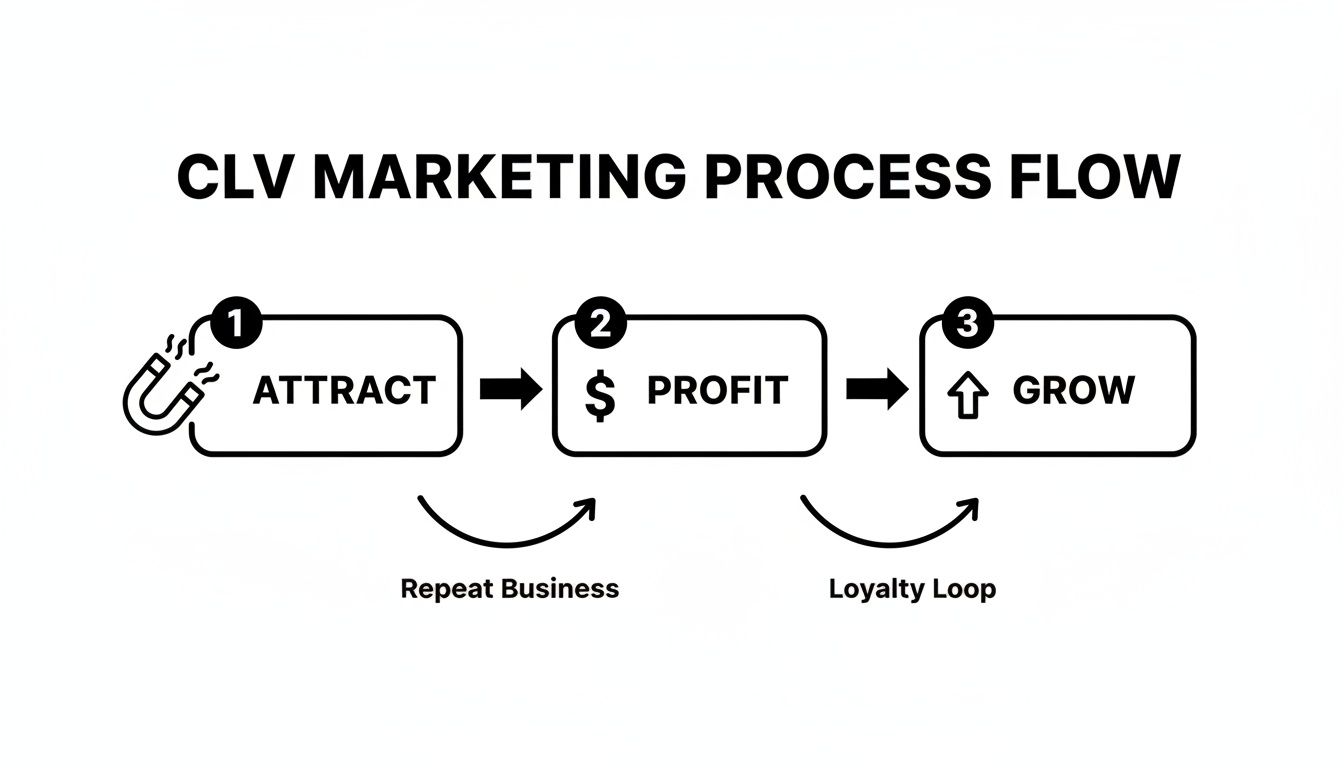
The flow from attracting customers to growing their value highlights that marketing isn't just about getting that first sale; it's about nurturing long-term profitability.
Calculating Reliable Rooter’s CLV
With all the components ready, the final calculation is just simple multiplication.
CLV = $300 (APV) × 2.5 (PF) × 5 (ACL)
CLV = $3,750
This number is huge. Reliable Rooter now knows that the average customer they bring in is worth roughly $3,750 in revenue over the life of that relationship. This single figure provides immediate clarity and serves as a baseline to measure business health and marketing effectiveness. For a deeper dive into all the ways you can calculate this crucial metric, check out a comprehensive guide to calculating customer lifetime value.
Knowing this, the owner can now confidently answer questions that were previously guesswork:
- How much can I actually afford to spend on Google Ads to get a new plumbing lead?
- Is my investment in local SEO paying off by attracting high-value, long-term clients?
- Should I launch a loyalty program to try and bump my customer lifespan from 5 to 7 years?
This foundational method is your first real step toward making data-driven decisions. Sure, it doesn't account for things like profit margins or inflation, but it provides an invaluable snapshot of your ability to create and keep profitable customer relationships. It transforms a gut feeling about your business into a hard number you can track, analyze, and work to improve.
Predictive CLV Models for Subscription Businesses

While the historical model gives you a solid baseline, its backward-looking nature has some real limitations. For any business built on recurring revenue—think SaaS platforms, subscription boxes, or membership sites—you can't afford to wait years for a customer's entire history to play out. You need to predict future value to make smart decisions today.
This is where predictive models steal the show. Instead of just adding up past purchases, these methods forecast future revenue streams. That forward-looking perspective is everything when you're trying to scale a subscription business, where monthly recurring revenue (MRR) and customer retention are the absolute cornerstones of growth.
The Go-To Formula for Subscription CLV
For subscription companies, the customer lifetime value calculation is often boiled down to a powerful little formula that perfectly balances revenue and loyalty. It all hinges on two core metrics: Average Revenue Per User (ARPU) and Customer Churn Rate.
Here’s what it looks like:
Predictive CLV = Average Revenue Per User (ARPU) ÷ Customer Churn Rate
Let's quickly break those terms down:
- Average Revenue Per User (ARPU): This is the average revenue you bring in from each active customer during a set period, usually a month. Just divide your total MRR by your number of active customers.
- Customer Churn Rate: This is the percentage of your subscribers who cancel or don't renew their subscription during that same period. A lower churn rate means customers are sticking around longer, which is the magic ingredient for a high CLV.
This model is so effective because it beautifully captures the dynamics of a recurring revenue business. The churn rate acts as an inverse proxy for customer lifespan, giving you a quick and surprisingly accurate forecast.
Putting the Predictive Model into Practice
Let's imagine a SaaS company, "LeadGen Pro," that sells a marketing automation tool. They need to figure out their CLV to decide how much they can spend on Google Ads to acquire a new subscriber and still turn a profit.
Here are their key numbers from last month:
- Monthly Recurring Revenue (MRR): $50,000
- Total Active Subscribers: 500
- Subscribers Who Canceled: 20
First things first, they need to calculate their ARPU and monthly churn rate.
- Calculate ARPU:
$50,000 (MRR) / 500 (Subscribers) = $100 ARPU - Calculate Monthly Churn Rate:
20 (Canceled Subscribers) / 500 (Total Subscribers) = 4% Monthly Churn Rate
Now, LeadGen Pro can plug these figures right into the predictive CLV formula.
Predictive CLV = $100 (ARPU) ÷ 0.04 (Churn Rate)
Predictive CLV = $2,500
This $2,500 figure is pure gold. It tells the LeadGen Pro team that, on average, every new subscriber they bring in is projected to generate $2,500 in revenue over their entire relationship with the company. This kind of insight is the foundation of any sustainable, data-driven growth marketing strategy.
The Importance of Setting Time Horizons
A single CLV number is a great start, but savvy businesses add another layer of context: the time horizon. Calculating a lifetime value over an infinite period can be a bit misleading, especially when you're talking to investors or setting near-term growth targets. It's often much more practical to calculate CLV over specific windows, like 12, 24, or 36 months.
Setting a time horizon does two key things:
- It aligns your CLV with practical business cycles and financial planning.
- It gives you a more realistic target for marketing ROI, especially in fast-moving industries.
The ARPU ÷ Churn Rate model, which really took off with the rise of SaaS after 2015, gives you a powerful forecast. For example, with a 5% monthly churn, a customer's expected lifespan is 20 months (1 / 0.05). If that customer's ARPU is $100, the CLV comes out to $2,000. Some research has even shown that brands tracking LTV over a 24-month window saw 35% gains in marketing efficiency—a testament to the power of this focused approach.
This forecasting ability is what makes a predictive customer lifetime value calculation so vital for the tech startups and subscription businesses we work with at Jackson Digital. It turns marketing from a simple cost center into a predictable, revenue-generating engine.
Using CLV to Drive Your Marketing and SEO Strategy
Figuring out your customer lifetime value is a huge win, but the real magic happens when that number leaves the spreadsheet and gets put to work. A CLV figure on its own is just a piece of data. When you actually apply it to your strategy, that's when you start driving real, profitable growth.
This is where we connect the dots between knowing your numbers and using them to make smarter marketing moves. Your CLV can act as a compass for your entire marketing engine, guiding everything from the keywords you target to the cash you drop on paid ads. It helps you quit chasing vanity metrics like raw traffic and start attracting the right customers—the ones who stick around and grow your bottom line for years.
Crafting a CLV-Informed SEO and Content Strategy
After you've segmented your CLV, you should have a razor-sharp picture of your ideal customer. You know exactly what they buy, how often they engage, and what makes them so valuable in the first place. This insight is pure gold for your SEO and content marketing.
Instead of casting a wide, generic net, you can now build a strategy laser-focused on reeling in more of these high-value people.
- Sharpen Your Keyword Research: It's time to move beyond broad, high-volume keywords. Dig deep into the long-tail, high-intent phrases your best customers are typing into Google. If a plumber’s data shows that "emergency water heater repair" clients have a 3x higher lifetime value than "leaky faucet repair" clients, their whole content and local SEO game should shift to match.
- Create Persona-Driven Content: Start writing blog posts, guides, and landing pages that speak directly to the pain points of your best customers. Tell their story. This focused content doesn't just pull in better-qualified traffic; it resonates on a deeper level, building trust from the very first click.
- Map Content to the High-Value Journey: Think about the path your best customers take, from their first inkling of a problem to the moment they decide to buy. Create content that supports them at every single stage, answering their questions and positioning your brand as the only logical solution.
Your SEO strategy shouldn’t be about getting any traffic. It should be about attracting traffic that looks exactly like your most profitable customers. CLV gives you the blueprint.
This change in mindset transforms your website from a simple online brochure into a powerful magnet for your ideal clients.
Optimizing Your Paid Media with the CLV:CAC Ratio
Maybe the most immediate and powerful way to use CLV is in managing your paid ad budget. For years, marketers have wrestled with a simple question: "How much should I spend to get a new customer?" Without CLV, it’s all a guessing game. With CLV, it becomes a calculated decision.
This is where the relationship between CLV and Customer Acquisition Cost (CAC) becomes critical. CAC is the total you spend on sales and marketing to land one new customer. The CLV:CAC ratio tells you exactly what kind of return you're getting on that investment.
Finding Your Ideal Spend
A healthy business is typically aiming for a CLV:CAC ratio of 3:1 or better. This means for every $1 you spend to acquire a customer, you get $3 back in lifetime value. Simple as that.
- A ratio below 3:1 (like 1:1): You’re spending way too much to get customers. Your business model probably isn't profitable, and it's definitely not sustainable.
- A ratio of 3:1: This is the sweet spot. You have a solid, healthy business model that’s generating a strong return on your marketing dollars.
- A ratio above 3:1 (like 5:1): You're crushing it. In fact, you might even be underspending on marketing. This is a clear signal that you can afford to get more aggressive and accelerate your growth.
Knowing your CLV empowers you to set intelligent bids on platforms like Google Ads and Meta. If you know a customer is worth $2,500 to your business over their lifetime, you can confidently spend up to $800 to acquire them while still keeping that healthy 3:1 ratio. This takes the guesswork out of it.
For a precise handle on your spending, using a customer acquisition cost calculator can give you immediate clarity.
Ultimately, integrating CLV into your marketing is about making your data tell a more useful story. It lets you move with confidence, invest your resources with precision, and build a business that isn’t just growing—it’s growing profitably.
Common CLV Calculation Mistakes to Avoid

Getting your customer lifetime value calculation right can completely reframe your marketing—turning it from a line item expense into a powerful profit engine. But when it's wrong? You end up chasing the wrong customers with an overblown budget, and that's a recipe for costly mistakes. Nailing this metric is about more than just plugging numbers into a formula; it's about making sure your data tells the real story of your business's health.
I've seen these same missteps trip up countless businesses. Let's walk through the most common pitfalls so you can steer clear and ensure your CLV is a reliable compass for growth, not a source of misdirection.
Using Revenue Instead of Gross Margin
This one is, by far, the most common—and most dangerous—mistake out there. Calculating CLV with top-line revenue makes your customers look way more profitable than they really are. It completely ignores the cost of goods sold (COGS), which can be massive for e-commerce brands or any service business with high material costs.
Think about a roofer who calculates a CLV of $15,000 based on total project revenue. Sounds great, right? But if their gross margin is only 40% after paying for shingles, supplies, and labor, the actual profit-based CLV is just $6,000. If they then base an $8,000 customer acquisition budget on that inflated revenue figure, they're losing money on every new client without even realizing it.
The fix here is simple but critical: always, always use your gross margin. Your true customer lifetime value calculation needs to reflect the actual profit a customer brings in, not just what they pay you.
Profit-Based CLV = Revenue-Based CLV × Gross Margin %
This quick adjustment brings your numbers back down to earth and anchors your marketing spend in reality.
Calculating a Single Blended CLV
Another frequent error is boiling everything down to one single CLV for your entire customer base. This "blended" average might seem helpful, but it hides the most valuable insights. The reality is that not all customers are created equal; some are exponentially more valuable than others.
A local dental practice, for instance, has high-value cosmetic dentistry patients alongside lower-value patients who just come in for twice-yearly cleanings. If you lump them all together into one CLV figure, you'll almost certainly overspend acquiring routine cleaning clients and underspend on attracting the high-profit cosmetic cases.
The solution is to segment your customers before you calculate CLV. Group them by meaningful categories to see where the real value is coming from.
- By Acquisition Channel: Do customers from organic search have a higher CLV than those from your paid social media campaigns?
- By First Product Purchased: Are customers who start with your premium service more loyal than those who bought a discounted entry-level product?
- By Demographics or Geolocation: Do clients in certain neighborhoods or age brackets spend more with you over time? This insight is crucial for effective GEO (geographic) targeting.
Segmenting turns a fuzzy, averaged-out number into a sharp, actionable map of your most profitable customer personas. This allows you to tailor your marketing—from local SEO to paid ads—with surgical precision.
Ignoring Early Churn Signals
So many businesses only pay attention to churn when a customer officially cancels their subscription or simply stops buying. By that point, it’s usually too late to win them back. You're missing all the early warning signs, like a drop in purchase frequency, lower engagement with your app, or a sudden spike in support tickets.
These subtle signals are gold for predictive CLV models. If a SaaS user's login frequency drops by 50%, their probability of churning has just shot through the roof, and their projected lifetime value has tanked. If you ignore this, your CLV forecast remains inaccurately high, leading to poor decisions.
The fix is to build engagement metrics into a customer health score. Keep a close eye on user activity, support interactions, and product adoption rates. When these metrics dip below a certain threshold, it should trigger an immediate alert for your customer success team to step in and preserve that customer's future value.
Questions That Come Up When Calculating CLV
Even when you've got the formulas down, some practical questions always seem to pop up once you start trying to apply customer lifetime value in the real world. This is where the theory meets reality. Think of this section as a quick reference guide to clear up those nagging doubts.
Let's dig into some of the most common questions we hear from business owners.
What Is a Good CLV to CAC Ratio?
This is the golden question for anyone managing a marketing budget. While there's no single magic number that fits everyone, a healthy benchmark for most businesses is a CLV to CAC (Customer Acquisition Cost) ratio of 3:1.
What does that mean in simple terms? For every dollar you spend to bring in a new customer, you should be making back three dollars in profit over their entire relationship with you.
- Below 3:1: This is a red flag. Your acquisition channels might be too expensive, or your customer retention is weak, putting profitability at risk. It's time to diagnose the problem.
- Above 3:1: You've got a strong, efficient marketing engine humming along. This is a green light to invest more aggressively in your growth channels.
How Often Should I Recalculate CLV?
Your customer lifetime value calculation isn't a "set it and forget it" metric. Far from it. Customer behavior changes, you tweak your pricing, and the market itself is always shifting.
To keep your strategy grounded in what's actually happening, you need to recalculate CLV on a consistent schedule. A good cadence for most businesses is quarterly or semi-annually. This is frequent enough to spot meaningful trends without getting totally bogged down in analysis paralysis.
The exception? If you've just rolled out a major new product or launched a big retention campaign, you'll want to run the numbers sooner to see what impact it's having.
Is CLV the Same as LTV?
Yep. For all practical purposes, CLV (Customer Lifetime Value) and LTV (Lifetime Value) are two acronyms for the same thing. You'll see them used interchangeably across marketing and finance articles, but don't get hung up on it.
Both terms refer to the total net profit a business expects to pull in from a single customer over the entire time they do business with you. They represent the exact same core concept: the long-term worth of a customer.
Does CLV Apply to Every Type of Business?
Absolutely. The specific inputs might change, but the core principle of CLV is universal for any business that relies on repeat customers.
- E-commerce stores use it to figure out how much they can really afford to spend on Google Ads and to segment their email marketing lists.
- SaaS companies live and die by this metric, using it to manage churn and justify their often-high customer acquisition costs.
- Even local service businesses like plumbers or dentists can use it. It helps them understand the true value of earning a loyal, repeat client who calls them first for every issue, which is key for local SEO success.
Ultimately, CLV is about shifting your mindset from purely transactional to relational. It helps you make smarter, more profitable decisions about where to invest your time and money for sustainable growth.
Understanding and applying your customer lifetime value calculation is the key to building a predictable, profitable growth engine. At Jackson Digital, we help businesses turn these insights into powerful SEO and paid media strategies that attract high-value customers. If you're ready to make data-driven decisions that scale your brand, let's talk. Request your free performance audit today.