Data-driven growth marketing is all about using analytics, customer data, and a bit of experimentation to make smart decisions that actually grow your business. It's a huge step up from traditional marketing, which often focused more on just getting your brand name out there.
Think of it this way: every campaign, every piece of content, every ad becomes a mini-experiment. The goal is to constantly get better at every single point in the customer journey, from the first time someone hears about you all the way to them becoming a loyal fan. The whole idea is to stop guessing and start using a more scientific approach to rank higher, tell better stories, and connect with customers.
What Is Data-Driven Growth Marketing, Really?
Imagine you’re trying to sail across the ocean. You could just point your ship in what feels like the right direction and hope for the best. Or, you could use satellite maps, real-time weather data, and a GPS. That's the difference between old-school marketing and a data-driven growth marketing approach.
This isn't about drowning in spreadsheets full of numbers. It’s about using those numbers to tell a story—a story about your customers and where your business needs to head next. For search engines, this means telling a story they can understand and reward with higher rankings. For customers, it means telling a story that resonates and solves their problems.
This systematic process turns all that raw data into a clear roadmap that guides you through every stage of your customer's experience. Instead of launching a campaign and crossing your fingers, you're making decisions based on what your audience actually does, not just what you think they might do.
From Guesswork to a Growth Engine
The end game here is to build a reliable, predictable engine for bringing in leads and sales. This mindset isn't just for big tech companies; it works for everyone, whether you're a local plumber trying to show up in your city's search results (GEO) or a global e-commerce brand wanting to get customers to stick around longer.
It’s about moving away from broad assumptions and toward specific actions backed by real evidence. For instance, instead of just "running some ads," a data-driven marketer would be:
- Analyzing which ad copy brings in the most qualified leads, not just the most clicks.
- Pinpointing the exact pages on your website where potential customers are bailing.
- Figuring out which marketing channels deliver customers who spend more and stay loyal over time.
At its heart, data-driven growth marketing is about one thing: continuous improvement. It’s an admission that you don't have all the answers right away, but it gives you a solid framework for finding them through structured tests and analysis. Every "failed" experiment is just as valuable as a win because it tells you what not to do next.
This strategic shift is changing the entire marketing game. In the fast-moving world of digital marketing, data-driven strategies have pushed the global digital ad market to an incredible $667 billion, with projections hitting $786 billion by 2026. This reflects a steady 10% annual jump in ad spending as businesses move their budgets online, highlighting how agencies like Jackson Digital use analytics and SEO to scale brands efficiently. You can dig into more digital marketing statistics to see just how big this shift really is.
To truly tap into this potential and make quick, informed decisions, getting a handle on topics like Mastering Real-Time Data Analytics is crucial. It's that ability to read and react to live information that separates the market leaders from everyone else.
Building Your Data-Driven Growth Framework
Making the leap from theory to practice with data-driven growth requires a solid blueprint. Think of it like building an engine for your business—you can’t just toss a bunch of parts together and hope it roars to life. You need a structured framework that turns raw information into repeatable, predictable growth. This whole approach rests on three core pillars: Measurement, Experimentation, and Attribution.
Getting these pillars right is what separates the pros from the amateurs. It’s about moving beyond guesswork and gut feelings and creating a systematic process where every marketing dollar is accountable, every campaign teaches you something valuable, and every decision is backed by real evidence. This takes the anxiety out of the unknown and replaces it with the confidence that comes from a clear plan.
The First Pillar: Measurement
Before you can grow, you have to know where you stand. The Measurement pillar is your foundation, and it all starts with setting up a solid analytics platform. For most businesses, this means getting Google Analytics 4 (GA4) configured correctly to track what actually matters to your bottom line—not just vanity metrics like page views or social media likes.
Effective measurement zeroes in on user actions that directly connect to revenue. This could be anything from a form submission for a local service business to a completed purchase for an e-commerce store.
- Define Your Goals: What’s the single most important action a visitor can take on your site? Pinpoint this and make it your primary conversion goal.
- Track the Journey: Set up event tracking to watch the key steps in the customer journey, like adding an item to a cart or visiting a pricing page.
- Segment Your Audience: Figure out which traffic sources (e.g., organic search, paid ads, social media) are bringing in your most valuable customers.
A solid measurement plan isn't just about collecting data; it's about collecting the right data that tells a clear story about how people are actually behaving.
The Second Pillar: Experimentation
Once your measurement system is humming along, it’s time for Experimentation. This is where the scientific method crashes into marketing. Instead of launching a new campaign and crossing your fingers, you form a hypothesis, test it, and learn from the results—whether you win or lose.
This process, often called A/B testing or split testing, involves showing two different versions of a webpage, ad, or email to different segments of your audience to see which one performs better. A true growth marketer is always running these small experiments to find those incremental gains that add up over time.
A core principle of data-driven growth marketing is that every "failed" test is actually a success. It provides a valuable lesson on what your audience doesn't respond to, saving you time and money while pointing you in a better direction for your next hypothesis.
This simple visual shows the powerful flow from collecting data to making informed decisions that fuel real business growth.
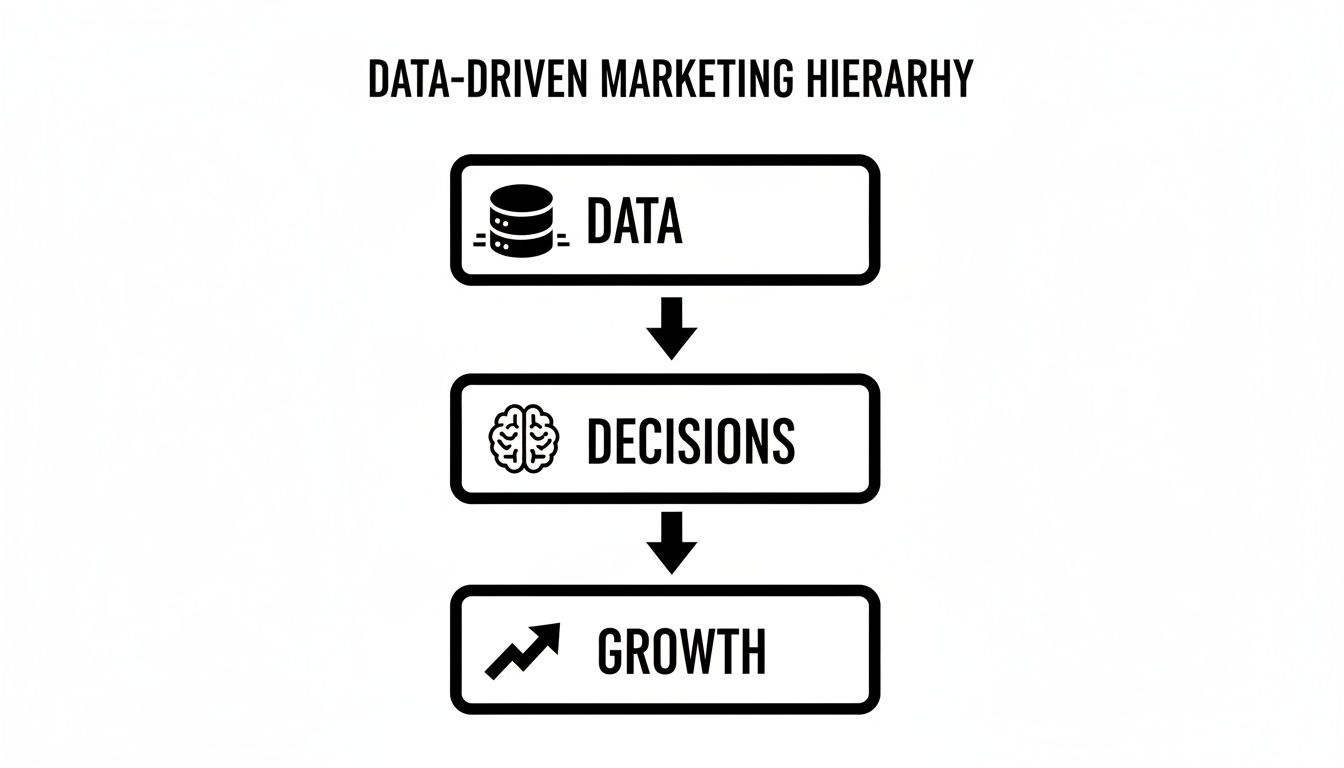
This hierarchy makes it clear: reliable data is the non-negotiable first step. It directly leads to smarter strategic choices which, in turn, create sustainable growth.
The Third Pillar: Attribution
Finally, we land on Attribution, which might be the most challenging—but also the most crucial—pillar of them all. Attribution is the science of figuring out which marketing channels and touchpoints get the credit for a conversion. Did that new customer find you through a Google search, click a Facebook ad, or open an email?
Knowing the answer is critical for spending your budget wisely. Without clear attribution, you risk pouring money into channels that feel busy but don't actually drive sales. For instance, you absolutely need to understand how analytics for paid search campaigns directly contribute to your overall revenue goals. To effectively build your data-driven growth framework, identifying and leveraging the right top B2B data providers is essential for acquiring accurate and comprehensive customer information.
By combining Measurement, Experimentation, and Attribution, you create a powerful feedback loop. You measure what’s happening, run experiments to improve it, and attribute the results to the right channels. This is the engine that drives sustainable, data-backed success.
Using Data To Win at SEO, GEO, and AEO
In the world of search, data is the ultimate storyteller. It’s the difference between guessing what keywords your customers might use and knowing the exact questions, pain points, and desires that keep them up at night. A real data-driven growth marketing approach to SEO isn't just about snagging the top rank for a keyword. It’s about owning the entire conversation and becoming the go-to answer for your audience, no matter where they are in their journey.
Think of yourself as a detective. Every search query is a clue your customers leave behind. By piecing together all that search data, you can map out their entire story—from the moment a problem pops up to the second they’re ready to pull out their credit card. This lets you craft content that feels less like a sales pitch and more like a genuinely helpful conversation, building the kind of trust that turns visitors into customers and sends strong ranking signals to Google.
Decoding Customer Intent with Search Data
First things first: stop thinking about keywords as just words. Start seeing them for what they really are—questions. Your Google Search Console account is an absolute goldmine for this kind of insight. It doesn't just show you what you rank for; it shows you the exact phrases people are typing into Google to find you.
This is where you find out what's really on their minds. For example, a local plumber might be happy they rank for "plumbing services," but their Search Console data reveals people are actually searching for "how to fix a leaky faucet without a plumber." That’s a massive opportunity. Creating a helpful, step-by-step guide answering that exact query positions them as a trusted expert long before that person ever needs to hire someone.
This is the core of mapping keywords to the customer journey:
- Awareness Stage: Someone searching "why is my sink dripping?" isn't ready to buy, but they desperately need an answer.
- Consideration Stage: The search for "best faucet repair kits" shows they're weighing their options.
- Decision Stage: A query like "plumber near me for faucet replacement" screams purchase intent. This is where GEO targeting becomes critical.
By creating specific content for each stage, you become their trusted guide through the whole process.
Finding Untapped Opportunities in Competitor Data
Your competitors are another incredible source of data, just waiting to be analyzed. When you dig into their backlink profiles with tools like Ahrefs or Semrush, you're not just looking for places to get links. You're discovering who already trusts them. If a major industry blog has linked to three of your competitors but not you, that’s a clear signal. That blog is interested in your niche, and you have a warm lead for outreach.
The same goes for their top-performing content. Analyzing what’s already working for them shows you which topics strike a chord with your shared audience. If their article on "how to winterize your pipes" gets a flood of traffic and links every single year, that's a proven concept. Your job isn't to copy it, but to use that data to create something even better—a more comprehensive, more helpful resource that tells the story more completely.
A data-driven approach to SEO means you never have to start from a blank page. The market has already told you what works through competitor performance and user search queries. Your job is to listen to that data and execute better than anyone else.
This analytical process is key to stretching every marketing dollar further. For a deeper dive, our guide on how to improve marketing ROI offers strategies that fit perfectly with this data-first mindset.
Winning with GEO and Answer Engine Optimization (AEO)
The way people search is changing. More and more, they’re asking full questions to voice assistants or looking for quick, direct answers from Google’s featured snippets. This is where Answer Engine Optimization (AEO) comes into play. AEO is all about structuring your content to directly answer your audience's questions, making it incredibly easy for search engines to grab your page as the single best answer.
For local businesses, combining AEO with GEO is a superpower. The data you've already collected is your playbook. Take all those questions you unearthed in Search Console and build localized content around them.
- Localize the Question: Instead of just "how to replace a water heater," create a page titled "How to Replace a Water Heater in [Your City]."
- Provide a Direct Answer: Start with a clear, concise answer in the first paragraph.
- Use Local Signals: Mention local landmarks, neighborhoods, and regulations. This tells Google you're a local authority.
- Implement Schema: Use local business and FAQ schema markup to give search engines extra context.
This strategy transforms your website into the definitive local authority. When someone asks their smart speaker, "how long does it take to replace a water heater in Chicago?" and Google reads back the answer directly from your blog, you've just won a high-intent customer at their exact moment of need. That’s the power of using data to not just rank, but to answer locally.
Personalizing the Customer Journey With Data
Data isn't just for dusty spreadsheets and quarterly reports. Think of it as the raw material for building genuine customer relationships, but at scale. The real magic of data-driven growth marketing kicks in when you use the information you already have—like website behavior, past purchases, and even search queries—to craft experiences that make your customers feel seen and understood.
This is where you turn cold, hard data into a real connection. It’s the difference between a generic, one-size-fits-all email blast that gets ignored and a targeted message that speaks directly to what a customer actually needs. With modern tools like Customer Relationship Management (CRM) platforms and marketing automation software, this level of personalization is well within reach for any business, turning your data into an engine for loyalty and growth.
Turning Behavior Into a Conversation
Every single click, scroll, and page view tells a story. Your customers are leaving a trail of digital breadcrumbs, showing you exactly what they're interested in, what problems they're trying to solve, and how close they are to making a decision. A data-driven approach is all about listening to these signals and responding with something genuinely helpful.
For instance, imagine an e-commerce store notices a user keeps coming back to look at hiking boots. Instead of just letting that behavior fade away, the store can trigger an automated email showing off new arrivals in that category or a useful guide on "How to Choose the Right Hiking Boots."
This isn't just for online stores, either. The same idea works perfectly for local service businesses. If someone spends five minutes reading your blog post about "emergency roof repair," that's a massive signal. A smart follow-up could be a targeted social media ad offering a free roof inspection. It's not intrusive; it's just good service, delivered right when they need it most.
Mapping Data to Search and Geo-Targeting
Personalization is an absolute powerhouse for SEO, especially when you bring local search (GEO) and question-based search (AEO) into the mix. When you truly understand your user data, you can create hyper-relevant content that both search engines and customers find invaluable.
- Geo-Targeted Content: A plumber in a big city might analyze search data and see that queries for "burst pipe repair" spike in certain neighborhoods after a cold snap. With that insight, they can spin up location-specific landing pages and run geo-fenced ads targeting those exact areas, offering a direct solution to a very localized problem. This data-driven story tells both customers and Google, "We understand this neighborhood's specific problems."
- AEO and Behavioral Signals: Let's say your site analytics show a ton of users are searching for "how much does a new AC unit cost." That's your cue to create the most detailed, helpful cost guide you can. By structuring this content with clear headings and a direct answer right at the top, you make it a prime candidate for Google's featured snippets and voice search results. You're literally answering the exact question on your audience's mind.
The goal is to use data not just to sell, but to serve. When you consistently provide answers and solutions tailored to individual needs, you build the trust that leads to long-term customer loyalty and higher rankings.
The Power of Proactive Personalization
This data-first mindset is changing the game. Personalization isn't some "nice-to-have" feature anymore; it's a core driver of success. The numbers don't lie: research shows that consumers are 2.5 times more likely to purchase from brands that deliver tailored content. On top of that, personalization leaders are 40% more likely to surpass their revenue goals. This is why a strategy that blends analytics, good storytelling, and conversion improvements delivers such powerful results.
By using a CRM, you can easily segment your audience based on past purchases or how often they engage with your brand. This opens the door to highly specific campaigns—maybe a special offer for loyal customers who haven't bought anything in a while, or an educational email series for new leads who have only downloaded one guide. It’s about shifting from reactive marketing to proactive relationship-building, all guided by the stories your data is telling you.
Choosing Your Growth Tech Stack on a Budget

The world of marketing technology, or "MarTech," can feel like a labyrinth of expensive tools and confusing jargon. Here's the good news: building a powerful tech stack for data-driven growth marketing doesn't mean you have to empty your wallet. It's all about being strategic and picking lean, effective tools that give you real, actionable insights.
Think of your tech stack like a well-organized toolbox. You don't need every tool ever made—you just need the right ones for the job. For growth marketing, that means having reliable instruments for analytics, search optimization, customer relationships, and experimentation. Your goal is to turn raw data into smart decisions, and you can absolutely start doing that with some powerful, budget-friendly options.
Getting your MarTech right is the backbone of sustainable growth. The market itself hit $406.56 billion and is projected to skyrocket to $822 billion by 2033, which shows just how essential these tools are for any business serious about chasing leads through analytics and testing.
Core Tools for Analytics and SEO
Your journey starts with a simple but critical question: who is your audience and how do they find you? These first two tool categories are non-negotiable for gathering the foundational data you need to answer that.
- Analytics (Free): Google Analytics 4 (GA4) is the essential starting point. It's a surprisingly robust platform that shows you who is visiting your website, how they got there, and what they do once they arrive. When it's configured properly, GA4 can track everything from button clicks to form submissions, giving you a clear window into your customer journey.
- SEO (Paid with Free Tiers): Tools like Ahrefs and SEMrush are the gold standard for a reason. While their full suites come with a price tag, they both offer incredibly valuable free features. You can use them to research what keywords your competitors are ranking for, check your site's domain authority, and uncover technical SEO problems that could be quietly tanking your rankings.
These tools provide the core data you need for any solid SEO strategy, helping you get inside the head of your customers by understanding their search intent and behavior.
Managing Customers and Experiments
Once you start getting traffic, the game shifts to building relationships and optimizing their experience. A simple CRM and an experimentation tool are key to turning those first-time visitors into loyal customers.
The most effective tech stacks aren't the most expensive; they're the ones that are used consistently to ask questions, test hypotheses, and uncover insights. Your tools are only as good as the strategy behind them.
A Customer Relationship Management (CRM) tool is where you organize and keep track of every interaction with your leads and customers.
- CRM (Free): HubSpot's Free CRM is an absolute powerhouse for small businesses. It lets you manage contacts, track deals, and see a full timeline of every interaction a lead has had with your company. This data is priceless for personalizing your communication and figuring out what actually drives conversions. It can even help you pinpoint your average customer acquisition cost. Check out our customer acquisition cost calculator to put this data to work.
Finally, an experimentation tool helps you test changes and improve your website's performance based on what real people are doing. Hotjar offers a fantastic free plan that gives you access to heatmaps and session recordings. This lets you literally see where users click, scroll, and get stuck on your site. That kind of direct feedback is invaluable for improving user experience and, ultimately, your conversion rates.
Got Questions? We've Got Answers.
Jumping into data-driven growth marketing can bring up a few questions. It’s a different way of thinking, after all. Below, we’ve tackled some of the most common ones we hear from business owners who are ready to make the switch.
How Can a Small Business Start on a Tight Budget?
You don’t need a massive budget or a suite of expensive tools to get started. Honestly, the most powerful platforms are probably the ones you already have access to, like Google Analytics 4 and Google Search Console. The trick is to get them set up correctly, because once you do, they become a goldmine of information on user behavior and search performance.
Instead of getting overwhelmed trying to track fifty different things, zero in on just one or two metrics that truly move the needle for your business. This could be the conversion rate on your main contact form or how much organic traffic your top service pages are getting.
From there, use that focused data to make one small, informed change each month. Maybe you rewrite a page title to better match what people are searching for, or you tweak a call-to-action button to make it clearer. The goal isn’t a massive overhaul overnight; it’s about building the simple, consistent habit of letting evidence—not guesswork—guide your decisions.
What's the Difference Between Growth and Traditional Marketing?
Traditional digital marketing often lives at the top of the funnel. Think big-picture activities like driving traffic, getting your name out there, and building general brand awareness. Success is usually measured in broad strokes like reach and impressions.
Data-driven growth marketing, on the other hand, is a full-funnel obsession with experimentation and measurement. It’s not just about getting visitors in the door. It’s about systematically testing hypotheses to improve every single stage of the customer journey: activation, retention, revenue, and even referrals.
Think of it as applying the scientific method to your marketing. Every action is an experiment designed to produce a measurable result and a valuable lesson for the next experiment.
How Long Does It Take to See Results?
While you can definitely score some quick wins within a few weeks—a simple A/B test on a high-traffic landing page can do wonders—the real power of data-driven growth marketing is cumulative. Building a solid data foundation and running consistent, thoughtful experiments is a long game. It's about sustainable success, not a one-off campaign.
The objective isn't a single, temporary spike in traffic. It's about creating a predictable, sustainable engine for growth that becomes more efficient and effective over time.
Realistically, you can expect to see meaningful improvements in key business metrics like lead quality and customer acquisition cost within three to six months. That timeframe gives you enough runway to collect solid data, run several rounds of experiments, and start seeing reliable, positive trends take shape.
Ready to stop guessing and start growing with a strategy built on real data? The team at Jackson Digital specializes in turning analytics into actionable leads for businesses just like yours. Request a free performance audit today and discover your biggest opportunities.