Digital marketing for your local business isn't just a "nice to have" anymore. It's the primary way customers find you, decide if they trust you, and ultimately choose to walk through your door.
It’s about using targeted online strategies—like local SEO and social media—to connect with people in your community who are actively searching for what you offer. This isn't about creating a digital brochure; it's about building a powerful engine for community engagement, storytelling, and sales.
Why Digital Marketing Is Essential for Local Success
The days of relying solely on a Yellow Pages ad or word-of-mouth are over. Today, your potential customers live on their phones.
When a pipe bursts, they aren't digging through a phone book. They're grabbing their phone and searching "emergency plumber near me." When they get a craving for coffee, they're looking up "best bakery in [Your Town]." It happens in an instant.
This shift means your business's visibility now depends on search engine algorithms and online stories (reviews), not just your physical address. The good news? Effective digital marketing for local businesses isn't about having a massive budget. It’s about being smart, focused, and telling a compelling story exactly where your customers are listening.
The Modern Customer Journey
Think about how you find businesses. Before you ever step through a door, you've already formed an opinion based on their digital footprint. Their website, their Google listing, their reviews—that's your first impression, and it must build trust immediately.
This modern path to purchase follows a simple, powerful flow.
It breaks down into three core stages, taking a potential customer from discovering you exist all the way to making a purchase.
The takeaway here is that just being visible isn't enough. You have to give people a reason to trust you and then make it incredibly easy for them to take the next step.
The goal is to become the obvious choice in your local area. You do that by being easy to find, highly trusted, and simple to contact—the three pillars of a winning local digital strategy.
Core Goals for Local Dominance
To make that happen, everything you do online should be focused on a few key goals that turn online searches into real-world business.
- Become the Top Local Choice: This is all about showing up at the top of local search results and on maps when someone nearby needs what you sell. It means mastering the art of local SEO and optimizing your Google Business Profile.
- Build Community Trust Instantly: Think of your online reviews, social media presence, and professional website as your digital handshake. They tell your story, build your credibility, and showcase your expertise long before a potential customer even thinks about contacting you.
- Create a Direct Line to Your Audience: Digital channels give you a way to talk directly to your community. Through social media, email, and local ads, you can build loyalty that goes way beyond a single transaction.
How to Master Local SEO and Win Neighborhood Searches
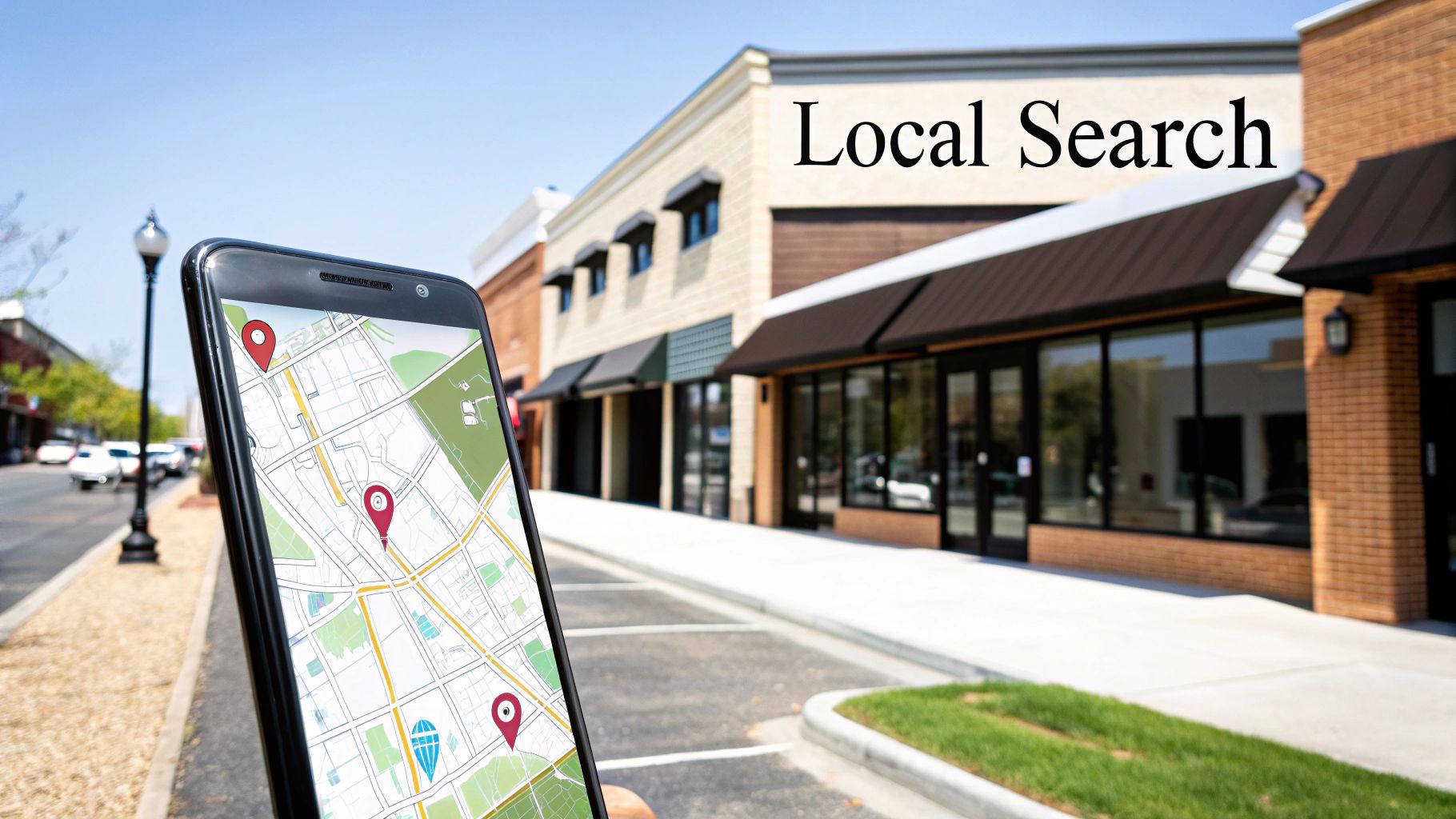
Let's get into the practical steps for showing up right when a local customer needs you. Nailing local SEO isn't about technical magic; it's about telling a consistent, hyperlocal story that both Google and your potential customers can understand and trust. It’s what separates the businesses that are invisible online from the ones that are the first name people see.
Think about it from a customer's perspective. A pipe just burst in a home in Austin’s Crestview neighborhood. The homeowner isn't just searching for a plumber; they're frantically typing "emergency plumber in 78757" into their phone. They need someone close, fast, and reputable. Your entire goal is to be that result. That's the core of local SEO—connecting your real-world service area with the exact phrases your neighbors are using.
The power of this connection is huge. A staggering 46% of all Google searches have local intent. Nearly half the people using Google are looking for something nearby, turning online searches into actual foot traffic or phone calls. If you want to go deeper on this, our comprehensive guide to SEO localization is a great next step.
Speak Your Customer's Language
First things first, you have to get inside your customer's head. What words are they actually using? A roofer in Dallas doesn't just "fix roofs." They offer "hail damage roof repair in Preston Hollow" or "commercial roofing services in the Design District." This is how you start building your geographic footprint online.
Go beyond just your city name. Brainstorm keywords that include:
- Neighborhoods: "Hyde Park coffee shop"
- Zip Codes: "HVAC repair 90210"
- Nearby Landmarks: "restaurant near the art museum"
- "Near Me" Modifiers: "tire rotation near me"
These hyper-specific phrases have way less competition and attract customers who are ready to pull the trigger. They send a clear signal to Google that you aren't just located in a city—you're a core part of its specific communities.
A classic mistake is trying to rank for a broad city name alone. True local dominance is won by owning the searches in the specific neighborhoods and districts you serve every single day.
Build a Website That Screams Local
Your website is your digital storefront, and it absolutely has to reflect your local roots. A generic, one-size-fits-all site just won't cut it. To build real local authority, you need to create dedicated pages for each of your primary services and—this is key—for each physical location or major service area.
For instance, a dentist with offices in two different suburbs should have a separate, unique page for each one. Each of those pages needs to feature:
- The specific address and an embedded map for that location.
- Unique content describing the services offered there, woven with local flavor and keywords.
- Testimonials from customers in that specific town or neighborhood.
This structure tells search engines you have a real, tangible presence in multiple communities, making you a much more relevant result for people searching there.
Master Your Digital Identity with NAP Consistency
One of the most critical (and most often botched) elements of local SEO is NAP consistency. This is your business Name, Address, and Phone number. These three little pieces of information must be absolutely identical everywhere they show up online.
Think of it as your business's digital fingerprint. If your Google Business Profile says "Mike's Auto, Inc." but Yelp just has "Mike's Auto," search engines see a mismatch. That tiny inconsistency creates doubt and can knock you down in the rankings.
Do a quick audit of your listings across the big players—Google, Yelp, Bing—and any industry-specific sites. Make sure your NAP is an exact match, right down to the comma and whether you use "St." or "Street." Consistency builds trust with search engines, reinforcing that you're a legitimate, established local business.
Earn Backlinks from Your Community
Finally, start thinking about how to get other local websites to talk about you. In the SEO world, we call these backlinks, and they act like votes of confidence. A link from some random national blog is fine, but a link from the local chamber of commerce, a neighborhood blogger, or a charity you sponsored? That's pure gold for local rankings.
Here are a few practical ways to earn those valuable local links:
- Sponsor a local youth sports team and ask for a link from their website.
- Host a community event or workshop and get coverage from local news outlets.
- Partner with a complementary local business (like a wedding planner linking to a local florist) and cross-promote each other.
These actions don't just generate powerful SEO signals; they weave your business into the fabric of the community. It's a win-win that tells both Google and your future customers that you are the trusted local choice. With 97 billion local searches conducted online every month, building that trust is no longer optional.
Optimizing Your Google Business Profile
If your website is your digital storefront, then your Google Business Profile (GBP) is the big, bright sign out front with an "Open" sign flashing. For many potential customers, it's the first—and sometimes only—thing they'll see of your business online.
A well-oiled GBP is hands-down the most powerful free tool you have for local marketing. It turns a simple pin on Google Maps into a powerhouse that convinces searchers to become customers by answering their questions before they even ask them.
Think about it. Before someone even decides to click through to your website, they can see your hours, check your reviews, look at photos of your work, and find answers to their questions. It's your chance to make a killer first impression right there in the search results.
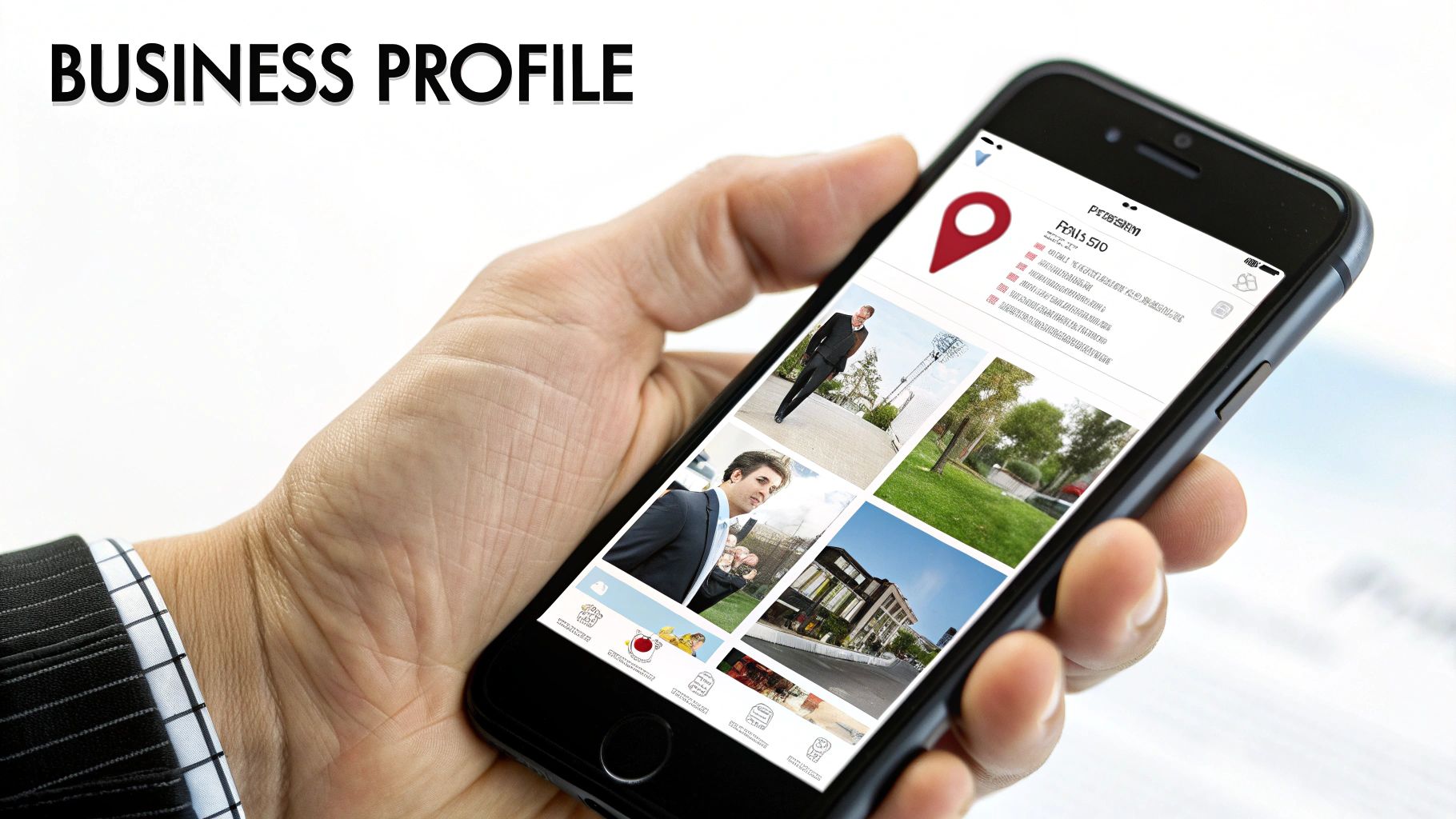
This is your central hub for connecting with customers, posting updates, and seeing exactly how people are finding you.
Go Beyond the Basics
Just claiming and verifying your profile is table stakes. The real wins come when you stop treating your GBP like a static directory listing and start using it as an active storytelling channel.
That means filling out every single section. Seriously.
So many businesses just plug in their name, address, and phone number and call it a day. That's a massive missed opportunity. To stand out, you've got to dig in.
- Select Multiple Categories: Don't just list your business as a "Plumber." Get specific. Add secondary categories like "Water Heater Installation," "Drain Cleaning Service," and "Emergency Plumber" to show up in more searches.
- Define Your Service Area: Clearly map out the specific neighborhoods, towns, and zip codes you cover. This tells Google exactly where to show your profile to the most relevant local searchers.
- Add Your Services and Products: Take the time to meticulously list every service you offer. Add descriptions and even pricing. This content is all searchable and helps you rank for those super-specific, long-tail keywords.
Your Google Business Profile isn't a "set it and forget it" tool. The businesses that dominate local search are the ones who actively manage and update their profiles weekly, if not daily.
Tell a Visual Story with Photos and Videos
People want to see who they're about to do business with. A profile packed with high-quality, real-world photos and videos will always crush one with just a generic logo.
Picture a local bakery. One GBP listing has a bland stock photo of bread. The other is constantly updated with vibrant photos of fresh pastries, short videos of the baker at work, and pictures of happy customers. Which one are you going to visit?
Get into the habit of uploading new media regularly. It signals to Google that you're an active business, and it gives customers a genuine feel for what you do. For service businesses like roofers or landscapers, before-and-after photos are pure gold.
Engage Actively with Posts and Q&A
Two of the most underutilized—and powerful—features on GBP are Posts and the Questions & Answers section. This is your direct line to your audience, right within your listing.
Google Posts are like mini-ads that show up directly on your profile. They’re perfect for:
- Promoting special offers or seasonal deals.
- Announcing new services or products.
- Highlighting recent projects with a great photo and a link to your portfolio.
- Sharing company news or talking about upcoming events.
Posts expire after seven days, so they're designed for fresh, timely updates. Posting consistently is a huge signal to Google that your business is active and engaged.
The Q&A feature lets anyone ask a question about your business—and anyone can answer. It's critical that you are the first one to jump in with a response. Even better, use this feature proactively by building out your own FAQ section.
Have a friend or family member ask common questions ("Do you offer free estimates?" or "Are you open on weekends?"). Then, you can log in and provide the official, keyword-rich answer. This builds immediate trust and saves you from answering the same questions over and over again.
For businesses juggling multiple locations, keeping each GBP listing optimized can get complicated. We dive deep into this topic in our guide on local SEO for multiple locations, which offers strategies to keep every profile consistent and effective. By making your GBP a cornerstone of your local marketing, you create a direct path for customers to find you, trust you, and choose you.
Building Trust with Online Reviews
Forget what you think you know about traditional word-of-mouth. Online reviews are the new frontier. They're the digital breadcrumbs customers follow when they’re weighing you against the competition down the street, and they are absolutely essential for building the trust that fuels your entire local marketing engine.
Think of them as real-time stories from your community about their experiences with you. A solid collection of positive, authentic reviews is one of the most powerful assets you can have. It provides the social proof potential customers crave, making them feel confident in their decision to choose you. When someone sees their neighbors had a great experience, it instantly lowers their guard.
This isn't just a "nice-to-have" either; it has a direct impact on your visibility. Google sees a steady stream of positive reviews as a powerful signal that you run a reputable, high-quality business, which can give your local search rankings a serious boost.
Encouraging Happy Customers to Share Their Story
Here’s a little secret: most happy customers are perfectly willing to leave a review. They just need a little nudge. The trick is to make it incredibly simple for them, right in that golden moment after you've delivered fantastic service or an amazing product.
Don't be shy about asking. You've earned it! The best time to pop the question is when a customer is actively expressing their satisfaction, whether that's in person, over the phone, or in a follow-up email.
Here are a few simple but effective ways I've seen work time and time again:
- A quick email or text: After a job is done, send a friendly message. "Hi [Customer Name], we're so glad we could help with your [service] today. Would you mind sharing your experience on Google? It really helps a local business like ours." Make sure you include a direct link to your Google review page.
- QR codes on invoices: For businesses with a physical location, like cafes or auto shops, this is a game-changer. Add a QR code to your printed invoices or receipts that takes customers straight to your review profile.
- A "Leave a Review" button on your site: Don't make people hunt for it. Place a clear, easy-to-find button on your homepage or contact page.
The name of the game is removing friction. The fewer clicks it takes for a customer to leave a review, the more likely they are to actually do it.
The Art of Responding to Every Single Review
Your work isn't finished once the review is posted. Far from it. Responding to reviews—both the glowing and the grumpy—is where you truly build your reputation. It shows you're engaged, that you actually listen to feedback, and that you're committed to great customer service.
Responding shows potential customers that there's a real, caring person behind the business. It’s a public display of your customer service philosophy in action.
Handling Positive Reviews
When someone leaves a great review, treat it like the gift it is. Acknowledge it promptly and personally.
- Thank them by name: "Thanks so much, Sarah!"
- Mention what they loved: "We're thrilled you love your new kitchen faucet."
- Reinforce what you do best: "Providing fast and reliable service is what we aim for every time."
This simple gesture reinforces their positive feelings and shows future customers what you're all about.
Turning Negative Reviews into Opportunities
A negative review can feel like a punch to the gut. I get it. But it's also a golden opportunity to show your character. How you respond says more about your business than the negative review itself. Whatever you do, never ignore them.
Follow this simple framework for a professional, effective response:
- Acknowledge and Apologize: Start by validating their frustration and apologizing that their experience wasn't up to snuff. "Hi John, we're very sorry to hear you were disappointed with your experience."
- Take it Offline: Offer to resolve the issue directly and privately. "We want to make this right. Please give our manager, David, a call at [Phone Number] so we can get to the bottom of what happened."
- Don't Get Defensive: Resist the urge to argue or make excuses in a public forum. Your goal is to show everyone watching that you're proactive and take responsibility.
A thoughtful, calm response can often turn a detractor into a loyal fan. More importantly, it demonstrates to everyone else that you take customer satisfaction seriously. This active reputation management is a non-negotiable part of successful local marketing.
Using Paid Ads for Immediate Local Impact
While local SEO and a stellar Google Business Profile are long-term plays, sometimes you just need the phone to ring right now. This is where paid advertising comes in. Think of it not as a replacement for your organic efforts, but as a powerful accelerator that can deliver immediate, measurable results.
Forget the myth that ads are only for big companies with massive budgets. The real beauty of digital ads for local businesses is how ridiculously precise you can be, spending just a little to reach exactly the right people in your own backyard.
It’s like putting a flyer directly into the hands of someone who just thought, "I wish I could find a great yoga studio near me." It’s that targeted.
Hyperlocal Targeting The Smart Way
Let's say you run a local yoga studio. Your ideal customer isn't someone across the country; they're probably within a short drive of your front door. With platforms like Facebook and Instagram, you can create ads that are only shown to people within, say, a three-mile radius of your studio.
But you can get even more granular than that. You can layer on interests, targeting users who’ve shown they’re into "wellness," "meditation," or follow popular yoga brands. Now your ad for a "New Client Special" isn't just shouting into the void—it's speaking directly to your most likely customers, right in their social media feeds.
This kind of targeted approach is becoming more crucial every day. With the global digital marketing market forecasted to hit $472.5 billion in 2025 and social ad spend set to climb over $276.72 billion, the tools are there for small shops to compete. You can use data with precision, turning online clicks into downtown customers.
Choosing Ad Formats That Drive Action
The goal of a local ad isn't just to get likes; it's to generate calls, form fills, or actual foot traffic. Luckily, ad platforms are built with these exact goals in mind.
When you're setting up a campaign, look for objectives designed for local impact:
- "Get More Calls": This slaps a "Call Now" button right on your ad, making it dead simple for someone on their phone to get in touch.
- "Get More Website Purchases": This is perfect for driving traffic to a specific landing page, like your class schedule or a special offer signup.
- "Get More Visits to Your Physical Location": This option can even provide directions, bridging the gap between seeing your ad online and walking through your door.
The key is to remove as much friction as possible. If you want phone calls, don't make people click to your website first. Use an ad format that lets them call you with a single tap.
Writing Ad Copy That Speaks to Your Neighbors
Your ad copy should feel less like a corporate announcement and more like a friendly tip from a local expert. Use language that actually resonates with your community.
Instead of a generic headline like "Yoga Classes Available," try something that hits on a local pain point or desire:
- "Unwind After Work, West Asheville. Your First Yoga Class is On Us."
- "Tired of Downtown Traffic? Find Your Zen at Oak Hill Yoga."
- "Join Your Neighbors for Morning Flow. New Classes Start This Week!"
This approach feels personal and relevant, making your ad stand out. Pair it with a real photo of your studio or a happy client—not a cheesy stock image—and you’ll start building trust instantly. Of course, knowing if your ads are working is critical, and our guide on analytics for paid search can help you measure what truly matters.
With a small daily budget—even just $10 or $20—you can start generating immediate leads and figuring out what messages connect with your local audience. It’s a fast, effective way to complement your SEO and build some serious momentum.
Got Questions? We've Got Answers
When you're running a local business, diving into digital marketing can feel like opening a can of worms. A lot of questions pop up. Let's tackle some of the most common ones we hear from business owners who are ready to move from theory to real-world results in their own backyard.
How Much Should a Local Business Budget for Digital Marketing?
This is the million-dollar question, isn't it? The truth is, there's no single magic number.
A solid starting point for many small businesses is to earmark 5% to 10% of total revenue for marketing. So, if your business pulls in $500,000 a year, you're looking at a marketing budget between $25,000 and $50,000 annually.
But percentages are just a guide. Your specific situation is what really matters. Think about these factors:
- Your Growth Goals: Are you aiming for steady, predictable growth, or are you in a dog-eat-dog market where you need to get aggressive? Faster growth always requires a bigger investment.
- Your Industry: A plumber or roofer in a major city is going to need a much larger war chest than a niche boutique in a small town. Competition dictates the cost.
- Your Starting Point: Are you a brand-new business with zero online footprint? You'll need to invest more upfront just to build a solid foundation.
The key is to stop thinking of marketing as just an expense. It's an investment in a machine that generates leads. The goal isn't to spend as little as possible; it's to spend wisely to get the highest possible return.
How Long Until I See Results from Local SEO?
Let's be clear: Local SEO is a marathon, not a sprint. While you can fire up paid ads and get the phone ringing tomorrow, building real, lasting organic visibility takes time and consistency. It’s like planting a garden—you don't get ripe tomatoes the day after you put seeds in the ground.
Generally, you can expect to see some initial movement and small wins within 3 to 6 months. This might look like ranking for some less competitive, "long-tail" keywords or noticing a slow but steady increase in calls coming from your Google Business Profile.
To achieve those coveted page-one rankings for your most valuable keywords, you're usually looking at a 6 to 12-month journey of consistent effort. This means ongoing content creation, link building, and actively managing your reviews. It’s a commitment, but the results are absolutely worth the wait. You're building a sustainable asset that will pay you back for years.
What’s More Important: SEO or Paid Ads?
This is a classic question, but it’s the wrong one to ask. It’s not an "either/or" battle; it's about a powerful partnership. They work best together.
Local SEO is your long-term foundation. It builds trust, credibility, and an organic presence that doesn't just vanish the second you turn off your ad spend. Think of it as the bedrock of a healthy, sustainable marketing strategy for any local business.
Paid Ads are your accelerator. They give you instant visibility. You can test new offers, laser-target specific neighborhoods or demographics, and get the phone ringing right now while your SEO efforts are still gaining traction.
Here’s a real-world example: A new dental practice could use hyperlocal Google Ads to immediately attract new patients with a teeth-whitening special. At the very same time, they’d be working on their local SEO to rank for terms like "best dentist in [their neighborhood]" for the long haul. One strategy delivers immediate cash flow, while the other builds lasting, compounding value.
Ready to stop guessing and start growing? The team at Jackson Digital builds custom growth plans that turn your online presence into a predictable source of leads and sales. Request a free performance audit today to discover your biggest opportunities.