A solid digital marketing strategy is the bedrock of any successful startup. It’s not just about running a few ads or posting on social media; it’s about crafting a cohesive story that connects every single marketing action, from SEO to paid ads. This initial groundwork is what makes sure every dollar and every hour you pour into marketing is actually pushing you toward real, measurable business goals.
Building Your Startup Marketing Foundation
Before you even think about launching a campaign, you need to build the launchpad. So many founders get this backward. They jump straight into tactics like Google Ads or blasting out social media posts, then wonder why nothing feels connected or effective.
This foundational work isn't just fluffy theory. It’s the gritty, practical stuff that separates the startups that gain real traction from those that just end up shouting into the void. It’s all about locking in your core message so that everything you do, from your first blog post to your biggest ad spend, tells the same powerful, consistent story.
Define Your Ideal Customer Beyond Demographics
Look, knowing your audience is Marketing 101, but for a startup, surface-level demographics like age and location just don't cut it. The gold is in the psychographics—the why behind their choices. What are their biggest headaches? What do they dream about at night? What’s the real motivation that would drive them to look for a solution like yours?
Instead of a flat profile like "our ICP is a 30-year-old project manager," dig deeper:
- Pain Points: "Our ICP is 'Stressed-Out Sarah,' a project manager who's completely swamped by scattered communication. She’s constantly worried a project is about to derail, and she secretly fears all this chaos makes her look incompetent to her boss."
- Motivations: "She's driven by a deep need for control and recognition. She wants a tool that makes her look hyper-organized and proactive, one that helps her lead her team confidently and maybe even snag that next promotion."
Getting this specific changes everything. It dictates the copy you write, the channels you choose, and how you position your entire product. It’s the difference between generic fluff and messaging that makes a prospect think, "Wow, they really get me." For B2B startups, this often starts with nailing your target audience on LinkedIn as a foundational step, since that's where these professionals live and breathe.
Set Goals Tied Directly to Business Outcomes
"Getting more traffic" is a wish, not a goal. Your marketing objectives have to be bolted directly onto tangible business results. The SMART framework (Specific, Measurable, Achievable, Relevant, Time-bound) isn't just corporate jargon; for a founder, it's a lifesaver.
It’s incredibly easy to get distracted by vanity metrics like social media likes or impressions. Don't fall for it. Focus on the KPIs that actually move the needle: Customer Acquisition Cost (CAC), Lifetime Value (LTV), and conversion rates. A simple rule to live by: your LTV needs to be way higher than your CAC if you want to build a sustainable business.
Here's what strong, business-focused goals actually look like:
- Acquire our first 1,000 active users within six months, keeping our CAC under $50.
- Hit $10,000 in Monthly Recurring Revenue (MRR) by the end of Q3 using a mix of SEO and targeted paid search.
- Generate 200 qualified leads through our website in the next 90 days.
If you need a hand structuring this, grabbing a solid digital marketing strategy template can help you lay out these critical benchmarks properly.
This simple flow chart really nails it—understanding your customer, setting clear goals, and checking out the competition are the absolute pillars of your strategy.
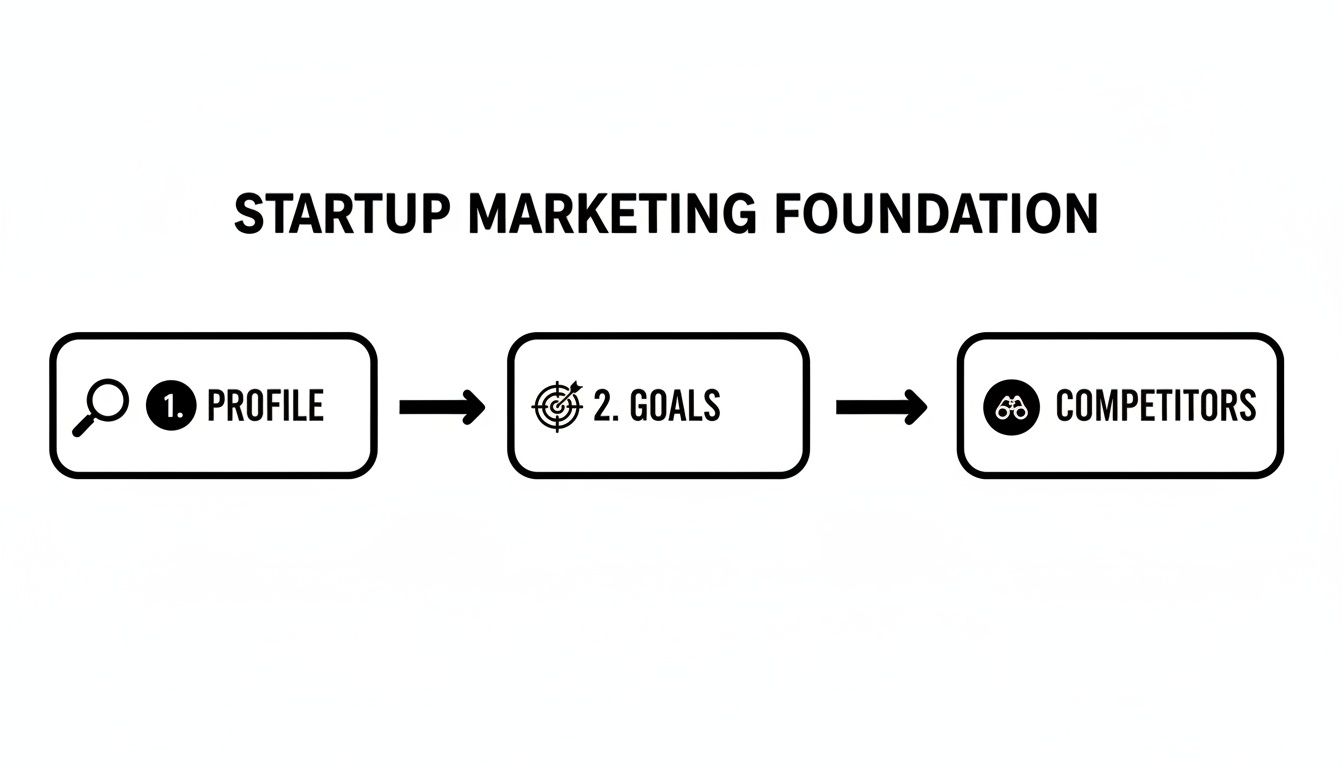
These three pieces—your customer profile, your goals, and your competitor landscape—are completely interconnected. Get them right, and you're building on solid ground.
Uncover Gaps with Lean Competitor Analysis
You don’t need to commission a 100-page dossier on every competitor. A lean analysis is all about quickly spotting the gaps in their story and their market position. Just pick 2-3 of your closest competitors and ask yourself these questions:
- What’s their angle? Are they positioning themselves as the "premium" choice, the "super easy" one, or the "bleeding-edge innovator"?
- Who are they ignoring? Is there a niche audience whose problems they aren't really solving?
- Where is their messaging weak? Do their customer reviews highlight common complaints that you are perfectly positioned to fix?
The point here isn't to copy them. It's to find the open space in the market where your unique brand voice can cut through the noise. You’re hunting for their blind spots so you can turn them into your biggest strengths.
Winning the Long Game with Search Engine Storytelling

Paid ads are like a faucet—turn them on for a quick flood of traffic. But organic search? That's the well you dig. It takes effort to build, but it provides consistent value for years to come. For any startup, Search Engine Optimization (SEO) isn’t just another line item in the marketing budget; it's a long-term asset that actually appreciates over time.
The real goal here is to become the definitive answer your ideal customer is desperately searching for, right at the moment they need it most.
But let's be clear: great SEO has nothing to do with stuffing keywords onto a page. It’s about storytelling. It’s about getting inside the head of the person typing into that search bar and crafting a narrative that solves their problem, eases their fears, and builds genuine trust. When you nail this, your website transforms from a static digital brochure into a powerful, lead-generating machine.
Uncovering Customer Stories with Keyword Research
Before you can tell a compelling story, you have to know what your audience wants to hear. This is where keyword research comes in, but we're not just hunting for high-volume, generic terms. We’re digging for the narrative behind the query.
Let's say you're a startup selling project management software. A keyword like "project management tool" is obvious, broad, and brutally competitive. Instead, think about the real-world stories and problems your customers are actually living through:
- "how to stop scope creep in agile projects"
- "best way to manage remote team tasks"
- "project budget tracking template for small business"
These are long-tail keywords. Sure, they have lower search volume, but the intent is screamingly obvious. Someone searching for these isn't just window shopping; they have a specific, urgent problem they need to solve now. Your content can be the hero of their story.
Your sweet spot is the intersection of what your customers are searching for and the specific problem your business solves. Tools like AnswerThePublic or even Google's "People Also Ask" section are absolute goldmines for uncovering these narrative-driven, high-intent keywords that bigger competitors often ignore.
Crafting a Compelling First Impression On-Page
Once you've found your keywords, it’s time to weave them into your on-page content. This is your chance to make a killer first impression right there in the search results. Think of your title tag and meta description as your movie trailer—they have to be compelling enough to earn the click.
Put it this way: the keyword gets you on the stage (the search results page), but your story is what gets the audience to actually buy a ticket (click on your link).
- Weak Title: "Project Management Software | BrandName"
- Strong Title: "Stop Wasting Time on Project Chaos | Our Tool Simplifies Everything"
See the difference? The second title tells a story. It hits a real pain point and immediately offers a solution. It includes the core topic but frames it as a benefit, a narrative of transformation. This small tweak can have a massive impact on your click-through rate, which is a huge signal to Google that your result is relevant.
Dominating Your Neighborhood with GEO
For startups with a physical footprint—a local brewery, a dental clinic, a neighborhood consultancy—Geographic Engine Optimization (GEO) isn't optional. It's everything. This is how you win the "near me" searches that happen millions of times a day. Your most powerful weapon here is your Google Business Profile (GBP).
Your GBP is your digital storefront. For many local customers, it's the very first interaction they'll have with your brand. Optimizing it is one of the highest-impact things you can do, period.
- Tell Your Local Story: Don't just list services; use the business description to tell the story of why you're in this neighborhood. Are you a family-run shop? A tech startup trying to improve the local community? Infuse it with personality.
- Chase Reviews: Actively ask your happy customers to leave a review. And make sure you respond to all of them, good and bad. It shows you're paying attention and are part of the local conversation.
- Use Local Lingo: Weave location-specific terms into your GBP description and website. Think "best cold brew in downtown Austin," not just "best cold brew."
- Post Updates: Use Google Posts to share events, special offers, or blog updates. It's free, hyper-local advertising that keeps your profile fresh and engaging.
A well-oiled GBP can land you in the coveted "Local Pack"—that map with three business listings at the very top of local searches. For a local startup, that's prime real estate.
Becoming the Answer with AEO
Answer Engine Optimization (AEO) is where SEO is heading. It’s all about structuring your content to directly answer the specific questions your audience is asking search engines and voice assistants like Alexa. When you get this right, you can snag a featured snippet, that glorious answer box at the very top of the search results page.
This is storytelling in its purest form. You are literally providing the answer.
Instead of a generic blog post titled "Our Software Features," craft a narrative around customer questions. Structure your content with clear headings (H2s, H3s) that pose the exact questions people are searching for.
- H2: "How Do I Stop Losing Track of Project Tasks?"
- Paragraph/List: Immediately follow up with a clear, concise answer. "The most effective way is to use a centralized task management system that… 1. Creates a single source of truth… 2. Automates reminders…"
This simple structure makes it incredibly easy for search engines to grab your content and feature it as the definitive answer, positioning your startup as an instant authority. You're not just ranking; you're becoming the trusted source.
Fueling Rapid Growth with Paid Acquisition

While SEO and content are your long-term wealth builders, sometimes a startup just needs to make it rain. Right now. Paid acquisition is the fastest way to get your message in front of the right people, test what resonates, and start generating the traction you need to survive.
Think of it as pouring gasoline on a spark to see if it catches fire.
This isn't about burning through cash with vanity campaigns. A smart digital marketing strategy for startups uses paid channels with surgical precision. The goal is rapid, controlled experimentation to find out what works so you can scale confidently. You're buying data and speed, not just clicks.
Capturing Intent vs. Building Affinity
First things first, you need to understand the fundamental difference between paid search and paid social. They serve two completely different—yet complementary—purposes. Getting this right is the key to spending your precious budget wisely.
Paid search, mostly through Google Ads, is all about capturing existing demand. You’re targeting people who are actively searching for a solution to a problem they already have. The intent is sky-high, making it an incredibly powerful channel for driving immediate conversions and leads.
Paid social, on platforms like Meta (Facebook and Instagram) or LinkedIn, is about generating demand. You're interrupting someone's feed to introduce them to your brand. This is where you build awareness, tell your story, and nurture relationships with audiences who might not even know they need you yet.
A rookie mistake I see all the time is using the same message for both. Search ads need direct, solution-focused copy. Social ads need compelling visuals and words that spark curiosity and create an emotional connection.
Launching Your First Campaigns on a Lean Budget
You don't need a massive budget to get started. The key is to start small, stay focused, and be relentless about tracking performance. With just a few thousand dollars, you can gather enough data to make much smarter decisions down the road.
This is where you can be scrappy and effective:
- Google Search Ads: Zero in on a small set of high-intent, long-tail keywords. Think "buy," "service," or "alternative." You want to target queries that signal a user is ready to pull out their credit card, not just browse. This is where you'll find your most qualified early adopters.
- Meta Retargeting Ads: Install the Meta Pixel on your website from day one. Seriously, do it now. Run simple, low-cost campaigns that show ads only to people who have already visited your site. This is almost always the highest-performing segment of any paid campaign.
This two-pronged attack lets you capture active searchers while re-engaging interested prospects, maximizing every single dollar. Globally, digital ad spend hit around $733 billion in 2023, a testament to how critical these channels are. Startups that nail the combo of search and social from the get-go almost always acquire customers faster.
Here’s a practical way to think about allocating a small budget to get started. This isn't a rigid rule, but a framework to test and validate channels quickly.
Sample Startup Paid Ads Budget Allocation
A framework for a startup with a $5,000 monthly ad budget to test and validate channels.
| Channel | Allocation | Objective | Key Metrics |
|---|---|---|---|
| Google Search | $2,500 (50%) | Capture high-intent searchers | Clicks, CTR, Cost-Per-Lead (CPL), Conversions |
| Meta Retargeting | $1,000 (20%) | Re-engage website visitors | ROAS, CPA, Frequency |
| Meta Prospecting | $1,000 (20%) | Test new cold audiences (Lookalikes) | Reach, CPM, CTR, CPL |
| LinkedIn/Other | $500 (10%) | Test a niche B2B or social channel | Reach, Engagement Rate, CPL |
This structure dedicates the biggest slice of the pie to the highest-intent channel (Google Search) while using a smaller portion to test audiences and re-engage warm leads. After a month or two, you’ll have real data to decide where to double down.
From Targeting to Conversion Copy
Setting up a campaign is one thing; making it profitable is another beast entirely. Your success really boils down to two things: laser-focused audience targeting and ad copy that actually converts.
On social platforms, lean into lookalike audiences. Once you have your first 50-100 customers, upload their information (securely, of course) to create an audience of users with shockingly similar characteristics. This is light-years more effective than guessing at demographic targets.
For your ad copy, speak directly to your Ideal Customer Profile's pain points. Stop listing features. Instead, frame them as benefits that solve a specific, nagging problem.
- Weak Copy: "Our software has a new dashboard feature."
- Strong Copy: "Tired of scattered data? See all your key metrics in one place and make decisions 50% faster."
This benefit-driven approach is how you cut through the noise. It’s not about what your product does; it’s about what it does for them.
Finally, make sure your ads lead to a dedicated, high-converting landing page. It needs to continue the story from the ad and make it incredibly easy for users to take the next step. If you want to get into the weeds on measurement, our guide on analytics for paid search is a great place to start.
Building Trust Through Content and Community
For a startup, content is the currency of trust. Paid ads can get you clicks and SEO can build you a long-term asset, but your content is what actually forges the relationship. It’s how you graduate from being just another solution to becoming the go-to resource in your space.
This isn’t about pumping out generic blog posts just to have something new on the site. We're talking about building a content engine that directly fuels your SEO and helps you build a real community. The best startup marketing strategies use great content to pull in an audience, and then turn that audience into a tribe of champions for the brand.
Solving Problems Before Selling Products
Your first wave of content has one job: solve your Ideal Customer Profile’s most annoying, immediate problems. Stop writing about your product features. Instead, create tactical, how-to guides that deliver real, tangible value right away.
This strategy builds trust long before someone is even thinking about buying. When they finally hit that point, you're the first name that comes to mind because you've already helped them out, no strings attached.
A few content formats work like a charm for this:
- Actionable Checklists: "The 10-Point Checklist for a Flawless Project Kickoff"
- Step-by-Step Guides: "How to Set Up Your First Google Analytics 4 Dashboard"
- Template Giveaways: "Free Content Calendar Template for Busy Founders"
These aren't just blog posts; they're magnets for your target audience because they solve a real-world headache. They also get shared and naturally attract backlinks, giving your SEO a serious boost.
Establishing Authority with Thought Leadership
Once you have a solid base of helpful, problem-solving content, it's time to layer in some thought leadership. This is where you move beyond the "how" and start digging into the "why."
This kind of content isn't a direct sales pitch. It’s about positioning your startup and its founders as the leading experts in your niche. It’s your opportunity to share a unique point of view, challenge an old assumption, or offer a glimpse into the future of your industry.
Thought leadership isn't just for big corporations. A startup founder's unique journey and perspective can be incredibly compelling. Share your story—the struggles, the breakthroughs, and the lessons learned. Authenticity is your most powerful asset here.
This is what builds your brand's authority. It makes it easier to get press mentions, attract top talent, and eventually earn the trust of those bigger enterprise clients you're eyeing.
Turning Content into Community on Social Media
Hitting "publish" on a great piece of content is only half the job. Now you have to use it to start conversations and build genuine connections where your audience actually spends their time. Social media is not just a distribution channel; it’s a community-building machine.
Don't just be that brand that drops a link to its latest blog post and disappears. Take the time to repurpose your content into formats that feel native to each platform.
- Pull a key statistic from a blog post and turn it into a sharp-looking graphic for LinkedIn.
- Transform a "how-to" guide into a quick, punchy video walkthrough for Instagram Reels or TikTok.
- Pose a provocative question related to your content to fire up a debate on X (formerly Twitter).
The real goal here is to start a conversation, not just broadcast a message. Jump into the comments, ask follow-up questions, and let the human side of your brand shine through.
Partnering with Micro-Influencers for Authentic Reach
One of the fastest ways to build trust is to borrow it from people who already have it. Enter the micro-influencer. These are creators with smaller, but hyper-engaged and niche audiences who see them as trusted peers, not distant celebrities.
The influencer marketing world has absolutely exploded, growing from an estimated $1.7 billion in 2016 to a projected $24 billion in 2024. This trend shows a massive shift toward creator-led marketing, and it’s a shortcut startups can take to build trust quickly. In fact, many startups find their customer acquisition costs are lower when they run micro-influencer campaigns with trackable promo codes. You can learn more about these digital marketing trends and statistics to get the full picture.
Finding the right partners is everything. You need to look for creators who genuinely vibe with your brand's values and whose audience is a perfect match for your ICP. A partnership with one micro-influencer who truly loves your product can be far more powerful than a massive ad campaign because their recommendation feels real and personal. This approach creates a powerful flywheel where your content builds a community, and that community amplifies your message with a credibility you just can't buy.
Measuring What Matters For Startup Growth

Running a marketing campaign without measuring its impact is like flying blind. For a startup, every single dollar is precious, and data is the compass that guides your decisions. Without it, you’re just throwing money at the wall and hoping something sticks.
The goal here isn't to build some overly complex dashboard. It’s to get a simple, clear view of what’s actually moving the needle so you can double down on your wins and kill what isn't working—fast.
Setting Up Your Measurement Foundation
Before you spend a single cent on ads or publish that cornerstone blog post, you need to get your measurement foundation in place. The two most critical, non-negotiable tools for any founder are Google Analytics 4 (GA4) and Google Search Console. They’re both free, and they’re both essential.
GA4 tells you how people behave on your website, while Search Console shows you how people find you through Google in the first place. Together, they give you the full picture.
When you set them up, make sure you configure conversion tracking from day one. A "conversion" is simply any important action you want a user to take—signing up for a newsletter, starting a free trial, or buying a product. Tracking these is what turns a mountain of data into real business intelligence.
Moving Beyond Vanity Metrics
It's way too easy to get mesmerized by big numbers that look good on a chart but don't actually mean anything for the business. I'm talking about things like impressions, social media likes, or even raw website traffic. These are vanity metrics.
Chasing them will lead you down an expensive and unproductive path. A smart digital marketing strategy for startups focuses on the metrics that are directly tied to revenue and long-term health. These are the numbers that prove your business model is actually working.
Your marketing dashboard should be a source of clarity, not confusion. If you can only track three things, make them your Customer Acquisition Cost (CAC), Customer Lifetime Value (LTV), and Conversion Rate. These three KPIs tell the entire story of your business's health.
The KPIs That Truly Matter
To build a business that lasts, you have to understand the relationship between how much it costs to get a customer and how much that customer is worth to you over time. This is where the really important metrics come in.
- Customer Acquisition Cost (CAC): This is your total sales and marketing spend divided by the number of new customers you brought in. It answers a simple, crucial question: how much does it cost to get one new paying customer?
- Lifetime Value (LTV): This is the total revenue you can reasonably expect from a single customer over their entire relationship with your business. A high LTV means you’ve got sticky customers who see real value in what you offer.
- The LTV:CAC Ratio: This is the magic number. A healthy business model typically requires an LTV that is at least 3x greater than your CAC. If your ratio is 1:1, you’re literally losing money on every new customer you sign.
Keeping your acquisition costs low is fundamental. You can get a much clearer picture of what you're spending by using a detailed customer acquisition cost calculator to break down your expenses by channel.
Here’s a quick look at the core metrics you should be watching for each channel.
Essential KPIs for Startup Marketing Channels
This table breaks down the most important metrics to track for each key marketing channel, helping you focus on what really drives growth.
| Channel | Primary KPI | Secondary KPIs |
|---|---|---|
| SEO | Organic Conversions/Leads | Keyword Rankings, Organic Traffic, Backlinks |
| Content Marketing | Leads from Gated Content/Demos | Time on Page, Bounce Rate, Social Shares |
| Paid Media (PPC) | Cost Per Acquisition (CPA) | Click-Through Rate (CTR), Conversion Rate, ROAS |
| Email Marketing | Conversions from Campaigns | Open Rate, Click-Through Rate, Unsubscribe Rate |
Focusing on these KPIs will keep you honest about what's working and what's not.
Ultimately, the goal of any solid startup marketing plan is to build and refine effective SaaS growth strategies to scale that ensure you’re around for the long haul. By relentlessly tracking these core metrics, you can confidently decide where to invest your next marketing dollar and build a growth engine that's both powerful and predictable.
Your Top Startup Marketing Questions, Answered
Even with the perfect plan on paper, the early days of marketing can feel like you're making massive decisions with only half the information. It’s completely normal to have questions. Let's tackle some of the most common ones we hear from founders trying to get their digital marketing strategy for startups off the ground.
How Much Should We Actually Spend on Digital Marketing?
There's no magic number here, but a solid starting point for an early-stage startup is to earmark 10-20% of your total budget (or projected revenue) for marketing. The key, especially at the beginning, isn't massive spending—it's about lean, fast-paced testing.
For many, a monthly budget of $1,000-$5,000 for paid ads is a realistic place to start. Think of this less as an advertising expense and more as buying data. Your goal is to obsessively measure your Return on Ad Spend (ROAS) and Customer Acquisition Cost (CAC) for every channel you touch.
Once you find a channel that gives you a positive, scalable return—where every dollar you put in spits out more than a dollar back—that's when you hit the gas. Start with channels that offer the quickest feedback loops, like paid search, so you can learn what works without waiting months.
Which Digital Marketing Channel Should We Tackle First?
This one comes down entirely to your product and your Ideal Customer Profile (ICP). Trying to be everywhere at once is the fastest way to burn through your cash with zero results. The smarter move? Pick one or two channels and get really good at them.
- Solving a problem people search for? If your product is a direct answer to a question someone is typing into Google, you need to start with Google Ads and SEO. Your entire mission is to capture that existing demand.
- Got a visual or B2C product? If you're selling something that looks great or targets a specific consumer lifestyle, social media ads on platforms like Instagram or TikTok are your playground. Throw in some micro-influencer outreach to build authentic social proof from day one.
- Selling to other businesses (B2B)? Your best bet is almost always a combination of LinkedIn and strategic content marketing. This is where you build authority, talk directly to decision-makers, and share a story that actually resonates with a professional audience.
Seriously, How Long Does SEO Take to Show Results?
Let's be clear: SEO is the ultimate long game. It’s an investment in a durable asset for your business, not a lever you pull for a quick weekend sales bump.
You might see some encouraging flickers of life in 3-4 months from technical fixes and optimizing your pages, but that's just the warm-up.
Realistically, you're looking at 6-12 months to see significant, traffic-driving results, especially if you're in a crowded market. A ton of factors play into this timeline, like how competitive your industry is, your website's current authority, and how consistently you're creating content and building links. This is exactly why a balanced digital marketing strategy for startups pairs long-term SEO efforts with short-term channels like paid ads.
What’s the Difference Between GEO and AEO?
GEO and AEO are specialized flavors of SEO, but they tackle different goals. They aren’t mutually exclusive—in fact, many startups can and should be doing both.
GEO (Geographic Engine Optimization) is all about winning location-based searches. This is non-negotiable for any business with a physical storefront or a specific service area, like a coffee shop, a plumber, or a local consultant. The entire strategy hinges on perfecting your Google Business Profile, getting listed in local directories, and racking up reviews to own those "near me" searches.
AEO (Answer Engine Optimization) focuses on structuring your content to directly answer the questions people are asking search engines. This is how you land in those coveted "People Also Ask" boxes, featured snippets, and voice search results. It immediately positions your brand as an authority. For example, a local cafe could use AEO to answer, "best espresso in downtown," while a SaaS startup might target, "how to reduce customer churn."
Ready to build a digital marketing strategy that actually drives growth? The team at Jackson Digital specializes in creating data-driven SEO and paid media plans that turn visibility into revenue. Request a free performance audit to uncover your startup's biggest opportunities.