Internet marketing for plumbers isn't some luxury add-on anymore—it's the engine of a predictable, growing business. It’s about using search engine optimization (SEO) so people find you on Google when they're in a panic, owning your local area with geo-targeting (GEO), and building unshakeable trust by answering their questions online (Answer Engine Optimization – AEO).
This is how you ensure that when a homeowner's pipe bursts at 2 AM, your business is the first name they see and the only call they make.
Building Your Digital Foundation
Let's get real for a second. Relying solely on word-of-mouth is like sitting by a silent phone, just hoping it rings. It’s a slow death for a business.
Think about two plumbers in the same town. One is a 20-year veteran, a master of his craft, but he's seen his calls dry up. The other is newer to the game, but her schedule is slammed. What’s the difference? She understands a simple truth: when a water heater springs a leak at 10 PM, homeowners aren't digging through a phone book. They're grabbing their smartphone and searching for an immediate solution.
That shift is where your opportunity lies. A solid online presence is your digital storefront, always open, ready to catch every single emergency call and project inquiry. You have to be visible the exact moment a customer needs you most.
Why Online Marketing Is Non-Negotiable
The game has completely changed. Your competition is already online, scooping up leads that should have been yours. Good internet marketing for plumbers isn't about flashy gimmicks; it's about laying a strong foundation with three key pillars:
- Search Engine Optimization (SEO): This is the craft of getting your website to show up high on Google when someone searches "plumber near me." It’s your ticket to a steady stream of free, high-intent traffic.
- Local Search (GEO): This is all about dominating your specific service area, especially in the Google Maps 3-Pack. It's how you win the jobs in your own backyard by being the most relevant local choice.
- Answer Engine Optimization (AEO): This is about telling stories and solving problems. You create content that directly answers your customers' most common questions, positioning you as the go-to local expert they can trust long before they need to hire you.
The goal is brutally simple: when a potential customer searches for a solution to their plumbing nightmare, your business needs to be the most helpful and visible answer they find. This builds trust long before they even think about picking up the phone.
Right now, there's a massive digital divide in the plumbing industry. It’s shocking, but around 70% of plumbing companies using a marketing agency say they’re unhappy with the results. This happens because most marketing is just noise without a real strategy behind it—especially when you consider that over 70% of all clicks go to Google Maps or the organic search results.
In a market where no single company has more than 5% of the market share, a smart digital strategy is your single greatest competitive advantage.
For a deeper dive into how these concepts apply across different service industries, check out this practical guide to marketing for service businesses for some valuable parallels. And when you're ready to start mapping this all out, you can grab our free https://jackson-digital.com/digital-marketing-strategy-template/ to organize your plan.
The Local SEO Playbook for Plumbers
Alright, let's get tactical. This is where we stop talking about concepts and start actively dominating your local market. When it comes to internet marketing for plumbers, your single most powerful tool is your Google Business Profile (GBP). Getting this right is the key to landing in the coveted Google Maps 3-Pack.
Think about it. When a homeowner’s pipe bursts and they frantically search "emergency plumber near me," that 3-Pack is the first thing they see. Being in that box is like having a billboard on the busiest digital highway in your town. The goal isn’t just to be listed; it's to own that space.
Your path to local SEO dominance is a pretty straightforward process focused on three core areas. This flowchart breaks down how general SEO, Local Search, and something called Answer Engine Optimization all work together.
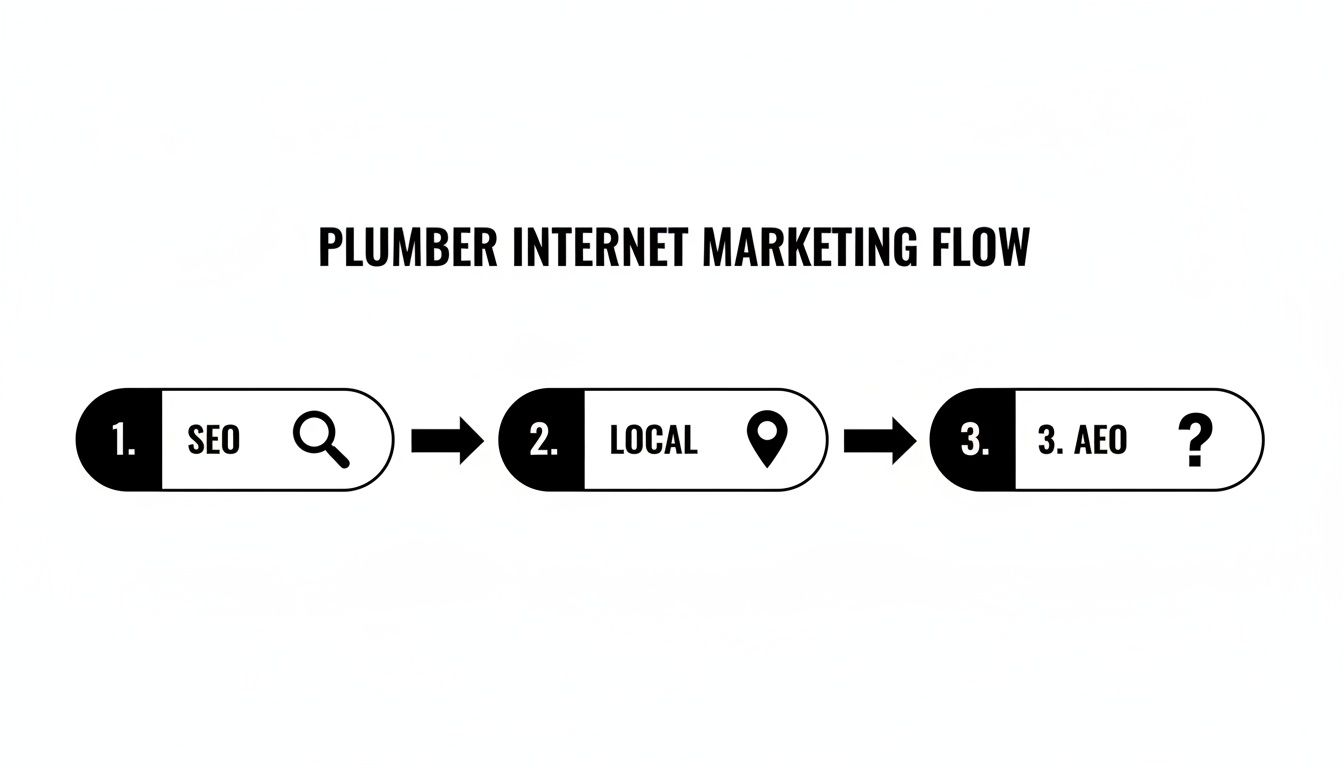
As you can see, a solid SEO foundation is crucial, but it’s the local (GEO) and answer-focused (AEO) strategies that really drive qualified plumbing leads right in your service area.
Nail Your Google Business Profile Optimization
Your Google Business Profile is your digital storefront. If you neglect it, you might as well leave the front door of your shop boarded up. Claiming the listing is just the first step; the real magic happens when you optimize the heck out of it.
Here’s a story: we had a small plumbing client in Texas whose emergency calls had flatlined. They were great plumbers, but their online presence was a ghost town. We focused on one thing: a complete GBP overhaul. They went from a bare-bones profile to a powerhouse. We helped them add specific service areas, upload real photos from jobs (the gritty, authentic kind), fill out every possible field, and—most importantly—start actively responding to every single review, good or bad.
The result? Their emergency calls nearly doubled in one month. That simple effort pushed them into the 3-Pack for high-value keywords like "burst pipe repair," and the phone started ringing off the hook.
Key Takeaway: Google rewards completeness and activity. Don't think of your GBP as a static listing. Treat it like a living profile that tells the story of your business every single day. A fully optimized profile signals to Google that you're an active, reputable business ready to serve customers.
To make sure your profile is a lead-generating machine, you have to get the details right. This isn’t a "set it and forget it" task. It's an ongoing process of refinement.
Your Google Business Profile Optimization Checklist
Here's a quick checklist to make sure your GBP is in top shape. Go through your profile and tick these boxes—each one sends a powerful signal to Google and potential customers.
| Optimization Area | Action Item | Why It Matters |
|---|---|---|
| Business Name | Use your exact, legal business name. No keyword stuffing like "Best Dallas Plumbing." | Builds trust and avoids Google penalties. Consistency is key for local SEO. |
| Categories | Select "Plumber" as your primary category, then add relevant secondary ones (e.g., "Water Heater Installation"). | Helps Google understand the specific services you offer, matching you to more relevant searches. |
| Service Areas | Be hyper-specific. List every single town, zip code, and neighborhood you serve. | Tells Google exactly where you operate, ensuring you show up for "near me" searches in those locations. |
| Photos & Videos | Upload high-quality, real pictures of your team, branded vans, and completed jobs (with permission!). | Builds immense trust and credibility. Customers want to see who they're letting into their homes. |
| Services List | Detail every service you offer with descriptions and even pricing, if applicable. | Provides customers with instant answers and helps you rank for long-tail service-specific keywords. |
| Q&A Section | Proactively add and answer common questions (e.g., "Do you offer 24/7 service?"). | Positions you as an expert and addresses customer concerns before they even have to ask. |
| Google Posts | Regularly publish updates, offers, or tips using the Google Posts feature. | Shows Google your business is active and keeps your profile fresh, which can improve visibility. |
| Reviews | Actively request and respond to all reviews, both positive and negative. | Positive reviews are a massive ranking factor. Responding shows you care about customer service. |
Treat this checklist as your roadmap. A fully fleshed-out profile is one of the fastest ways to climb the local rankings and get more calls.
The Power of Consistent NAP and Local Citations
For local rankings, Google's algorithm values consistency above almost everything else. It needs to see the exact same Name, Address, and Phone Number (NAP) for your business everywhere online. Any inconsistencies create confusion and tank your credibility in Google's eyes.
Think of your NAP as a digital fingerprint. If that fingerprint is different across multiple websites, Google can't be sure it's really you.
This is where local citations come into play. A citation is simply a mention of your business on another website, like Yelp, Angi, HomeAdvisor, or the Better Business Bureau. Each consistent citation acts as a vote of confidence, verifying your business information and strengthening your local authority.
Turn Happy Customers Into Your Best Marketers
Finally, nothing influences a potential customer more than social proof. A steady stream of positive reviews is arguably one of the most critical ranking factors for the local 3-Pack. In fact, nearly 85% of homeowners use Google to vet a home service provider, and your star rating is the first thing they see.
Getting reviews doesn't have to be awkward. You just need a simple, repeatable process.
- Identify Happy Customers: Train your technicians to recognize the moment a customer is thrilled with their work. That's the perfect time to ask.
- Make the Ask Simple: Give your techs a simple script. Something like, "We're a small local business and reviews really help us out. Would you be willing to share your experience on Google?"
- Remove All Friction: Follow up immediately with a text or email containing a direct link to your Google review page. The easier you make it, the more likely they are to follow through.
By building a systematic approach to generating reviews, you create a powerful flywheel of social proof that continuously fuels your local visibility and drives more calls. For more strategies on this, our guide on how to get more plumbing leads offers additional proven tactics.
Turning Your Website Into a 24/7 Salesperson
Think of your website as your best employee—the one that never sleeps, never takes a vacation, and works tirelessly around the clock to bring in new jobs. Far too often, though, a plumber's website is just a digital brochure. It's time to transform it into a powerful, lead-generating machine.
This whole process starts with a shift in how you present your services. So many plumbers make the classic mistake of having a single, generic "Services" page that lists everything from drain cleaning to water heater repair. This approach is a massive missed opportunity for SEO and for connecting with customers.
From General to Specific Service Pages
Put yourself in the customer's shoes. A homeowner in San Diego whose tankless water heater just went out isn't searching for a "general plumber." They're frantically typing "tankless water heater installation in San Diego" into Google. If you've only got one catch-all services page, you’re simply not going to show up for that specific, high-intent search.
The solution? Create a dedicated page for every single service you offer. This is a fundamental principle of on-page SEO that really moves the needle.
We worked with a plumber who was getting plenty of traffic but was frustrated with the low quality of the leads. Their entire business was crammed onto one page. We broke it all down, creating individual pages for each of their core offerings:
- Emergency Leak Repair in [City]
- Sewer Line Inspection and Repair
- Kitchen Faucet Installation
- Gas Line Services
The result? Within three months, they saw a 40% increase in qualified leads. It worked because they started showing up for the exact problems people were searching for. Each page acted like a hyper-targeted landing page, speaking directly to a customer's specific need and location.
Essentials for a High-Converting Website
Once you get a visitor on the right page, you have to make it dead simple for them to take action. A stressed-out homeowner dealing with a flooded basement doesn't have the patience to click around a confusing website. User experience is everything.
Your website has to be built for conversion from the ground up. This means thinking about what a visitor needs and knocking down every possible barrier that could stop them from contacting you.
Pro Tip: Think like your customer. When your toilet is overflowing at 2 AM, what's the first thing you want to see on a plumber's website? A big, obvious phone number. Your goal is to make hiring you the easiest decision they can possibly make in that moment.
Focus on these non-negotiable elements to make sure your site actually turns visitors into paying customers:
- Click-to-Call Phone Number: Your phone number needs to be front and center at the top of every single page, and it absolutely must be clickable on a phone. It's shocking how many businesses still miss this.
- Mobile-First Design: Over 60% of searches for local services are happening on a smartphone. If your site is a pain to use on a phone, you're just handing business to your competitors. Period.
- Fast Load Times: A website that takes more than three seconds to load will lose nearly half its visitors. Speed is a huge factor for both user experience and how Google ranks you.
- Clear Calls-to-Action (CTAs): Use big, obvious buttons with action-oriented text like "Get a Free Estimate Now" or "Schedule Your Service Call." Don't make people hunt for a way to give you their money.
Getting these fundamentals right is the bedrock of a website that actually works. For a deeper dive into optimizing your site for action, our guide on how to improve website conversion rate covers more advanced strategies.
Engage Visitors and Capture Leads Instantly
Beyond the basics, you can add tools that actively engage visitors and grab their info before they click away. To consistently turn visitors into clients, it’s worth looking into the best lead generation chatbot solutions that can give your plumbing website a real boost.
A well-configured chatbot can answer common questions, qualify leads by asking about their issue, and even schedule appointments after hours. It basically acts as an interactive salesperson, making sure you never miss an opportunity, even when your office is closed. This simple addition can turn your website from a passive brochure into an active lead-capture tool.
Creating Content That Solves Problems (And Tells Your Story)
Okay, your website is live, your Google Business Profile is dialed in, and you're starting to see some action. Now it's time for the masterstroke: becoming the go-to plumbing authority in your town. This is where you shift from just being another service provider to being the ultimate problem solver. That switch in mindset is the real secret to effective internet marketing for plumbers, and it's the core of Answer Engine Optimization (AEO).
This isn't about running ads that scream about how great you are. It’s about being genuinely helpful and sharing your expertise with homeowners before they have a full-blown emergency. It’s about telling the story of how you help people.
From Plumber to Local Expert
Just think about the questions your techs answer every single day. That's pure gold. Instead of waiting for someone to search "plumber near me," you can catch their attention when they're still searching for the symptoms of a problem.
Here’s a story: we had a client up north who was getting lost in a crowded market. We suggested a simple idea: write a detailed, step-by-step blog post titled "How to Prevent Frozen Pipes This Winter in [City Name]." It wasn't just a list; it was a story. It talked about the panic of a burst pipe, the damage it can cause, and then walked them through a simple checklist to protect their home.
The result? That one article didn't just hit #1 in their city; it became the definitive resource for local homeowners. They started getting calls from people saying, "I read your guide on frozen pipes, and I'd rather just have you guys handle it." They built trust and authority by telling a relatable story, turning free advice into paying customers.
By answering your customers’ questions before they become your customers, you position yourself as the only logical choice when they do need to hire a professional. This isn't just marketing; it's relationship-building at scale.
Your Content Playbook
Look, creating content doesn't need to be some complicated, expensive production. The goal is to be helpful and practical. Your expertise is your single most valuable asset here. Just start brainstorming the real-world problems your customers are actually dealing with.
- Blog Posts: Write short, simple guides answering common questions. Tell a story about a recent job (anonymously, of course) to illustrate a point.
- FAQ Pages: Build out a dedicated page that tackles the top 10-15 questions you hear all the time.
- Simple Videos: Grab your smartphone and record a 60-second video of a tech explaining a common issue, like how to find the main water shut-off valve. It's that easy.
Here are a few content ideas that consistently crush it for plumbers:
- Why Is My Garbage Disposal Humming but Not Working? (A Plumber's Diagnosis)
- 5 Signs Your Water Heater Is About to Fail (A Cautionary Tale)
- Is It Safe to Use Chemical Drain Cleaners? (The Real Story)
- A Homeowner's Checklist for Winterizing Plumbing
- How to Tell if You Have a Hidden Water Leak
Every piece of content you publish becomes a new digital asset, working 24/7 to bring potential customers straight to your digital doorstep.
How Content Drives GEO and SEO Results
This problem-solving strategy directly fuels both your local SEO (GEO) and your broader search (SEO) efforts. When you publish a blog post like "Low Water Pressure Solutions for [Your Neighborhood]," you're sending some powerful signals to Google.
First, you're naturally weaving in location-specific keywords, which is huge for boosting your local relevance (that's the GEO part). Second, you’re creating useful content that keeps people on your website longer—a critical ranking factor. Google sees that engagement and recognizes you as a credible authority (that’s the SEO part).
This creates a powerful feedback loop. Helpful content attracts links from local blogs or community forums, which builds your authority, which improves your search rankings, and ultimately drives more qualified traffic right back to your service pages. It’s a long-term play, but one that pays dividends for years.
Smart Advertising and Future-Proofing Your Growth
While a rock-solid SEO foundation is the best long-term play, sometimes you just need the phone to ring right now. This is where smart, targeted advertising comes in, giving you that immediate visibility while you also build for the future of search.
The goal isn’t to just throw money at ads; it’s to invest in a predictable system that brings in high-quality, exclusive leads. This approach sets you up for both quick wins today and sustainable growth for years to come.
Get Instant Trust with Google Local Services Ads
For any plumber, Google Local Services Ads (LSAs) are an absolute game-changer. These ads show up at the very top of the search results, sitting above the traditional ads and even the Google Maps pack. But their real magic is the "Google Guaranteed" badge.
That little green checkmark is a massive trust signal for homeowners in a panic. It tells them Google has already vetted your business—you're licensed, insured, and backed by a satisfaction guarantee. For a customer dealing with a burst pipe, that badge can be the single thing that makes them choose you over everyone else.
We had one client who was pretty hesitant to spend on ads, but the pay-per-lead model of LSAs was just too good to ignore. Instead of paying for clicks from tire-kickers, he only paid when a real customer actually contacted him through the ad. In his first month alone, he landed 15 high-quality emergency repair leads at a cost that was way lower than he ever imagined. It proved just how efficient the model is.
Local Services Ads work because they align perfectly with what a customer needs in an emergency: a fast, trustworthy, and pre-vetted solution. It cuts through the noise and positions you as the safest choice.
It’s really important to understand how LSAs are different from the standard Google Ads you might be used to (often called pay-per-click or PPC):
- LSAs (Pay-Per-Lead): You only pay when a customer calls or messages you directly from the ad. It's a direct line to a potential job.
- Google Ads (Pay-Per-Click): You pay every single time someone clicks your ad, whether they end up calling you or just browsing. This gives you more control over keywords and ad copy, but it can get expensive fast if it isn't managed perfectly.
For most plumbers just dipping their toes into paid ads, LSAs offer a lower-risk, higher-reward way to get the phone ringing immediately.
Preparing for the Future of Search and AI
While LSAs get you leads today, the way people find services is already shifting under our feet. Instead of just typing "plumber near me" into Google, customers are starting to ask AI assistants like ChatGPT or Gemini, "Who is the best plumber in my area to fix a leaky faucet?" This is the next frontier: Answer Engine Optimization (AEO).
To win in this new game, your online presence needs to be the definitive answer. These AI tools are constantly pulling information from websites, review platforms, and local directories to piece together their recommendations. They're on the hunt for clear signals of expertise, authority, and trust—all the things you've been building.
This is where all that hard work you've put in—creating detailed service pages, writing helpful blog posts that tell a story, and stacking up positive reviews—really starts to pay dividends. Every piece of quality content you create positions you as the expert source that AI tools will learn to rely on. The plumbing businesses that embrace this shift will be the ones recommended by these new digital gatekeepers.
The impact is already being felt. Artificial intelligence is fundamentally changing how plumbers acquire customers. Agencies are seeing massive traffic growth by optimizing for these new platforms. Some industry leaders have reported that traffic from AI-driven search has surged by an incredible 4,302%. This includes a 322% increase from Gemini and an 862% jump from ChatGPT, which signals a huge shift away from traditional search. Plumbers who effectively showcase their expertise in these new channels are poised to grab a ton of market share. You can discover more insights about these emerging plumbing marketing trends to stay ahead of your competition.
Plumber Marketing FAQ: Your Questions Answered
Jumping into internet marketing for your plumbing business can feel like staring at a complex schematic. You know it’s important, but it's tough to know where to even start.
Let's cut through the noise and get straight to the most common—and pressing—questions we hear from plumbers just like you.
How Much Should I Really Budget for Online Ads?
This is the big one, and the honest-to-God answer is: it depends. There’s no magic number, but a smart approach is to think in terms of percentages and goals, not just random dollar amounts.
A good starting point is allocating 5% to 10% of your target revenue to your overall marketing budget.
A brand-new plumbing business hustling to get its name out will need to invest more aggressively than an established company with a solid local reputation. A fantastic place for almost anyone to start is with Google Local Services Ads (LSAs). Why? Because you only pay per lead, not per click. This makes your budget way more predictable.
For example, you could kick things off with a modest $500 to $1,000 per month on LSAs and just see what happens. Track the lead volume it generates. Once you have real data on your cost per lead and how many of those leads turn into actual jobs, you can scale up with confidence. The key is to start small, track everything, and only pour more gas on the fire once you've proven it works.
How Long Does SEO Actually Take to Work?
This is where you need a little patience. SEO isn't like flipping a switch; it's more like planting a tree. You won't see a massive oak overnight, but with consistent effort, you’ll build a powerful, long-term asset for your business.
Generally, you can expect to see some initial movement—small wins—within 3 to 6 months. This might look like ranking for less competitive, "long-tail" keywords (like "tankless water heater repair in south Austin") or just seeing a steady climb in your Google Maps visibility.
Think of the first few months as building your foundation. You're dialing in your Google Business Profile, creating detailed service pages, and fixing technical glitches on your website. This groundwork is absolutely critical for long-term success, even if it doesn't bring a flood of calls on day one.
The significant, game-changing results—like ranking on the first page for super-competitive terms like "plumber in [your city]"—typically take closer to 6 to 12 months of sustained effort. The payoff for this patience is huge: a steady stream of "free" organic leads that you don't have to pay for with ads, month after month.
Is Social Media a Waste of Time for a Plumber?
For most plumbers, the answer is a qualified "yes," it's worth it—but not in the way you might think. You don't need to be creating viral TikTok dances of you fixing a faucet. Your real goal on social media, especially Facebook, is to build community trust and stay top-of-mind.
Think of it as the digital version of sponsoring the local little league team. It's all about being a visible, trusted part of the community you serve.
Here’s where it actually helps your business:
- Building Social Proof: Sharing photos of your clean, branded vans, your uniformed techs on the job, and screenshots of 5-star customer reviews reinforces your professionalism and builds trust.
- Showcasing Your Expertise: Post simple video tips, like "How to find your main water shut-off valve," to position yourself as the helpful expert people can count on.
- Hyper-Local Advertising: Facebook Ads allow you to target specific zip codes or even neighborhoods, making it a super cost-effective way to promote seasonal services like pipe winterization or water heater check-ups.
Don't overcomplicate it. A few posts a week focused on your team, your work, and helpful tips is all you really need to build a solid local presence.
I Have a Limited Budget. What's the Absolute First Thing I Should Do?
If you only have the time or money to do one thing, make it this: Completely and obsessively optimize your Google Business Profile (GBP).
This is, without a doubt, the single highest-impact, lowest-cost marketing activity a plumber can possibly do.
Your GBP is your digital storefront for local customers. It's free to claim and manage, and it directly influences your ranking in the all-important Google Maps 3-Pack—that's where the majority of emergency calls come from.
Your first step is to treat your profile like it's the most important page on the internet for your business. Fill out every single section. Upload at least 10-20 real photos of your team and your work (not stock photos!). List every single service you offer. Define your precise service areas.
Then, create a dead-simple system to consistently ask every happy customer for a review. A well-optimized profile with a steady stream of fresh, positive reviews is the fastest path to getting your phone to ring more often. Period.
Ready to stop guessing and start growing? The team at Jackson Digital builds data-driven internet marketing strategies that deliver predictable leads for plumbers. We combine expert SEO, smart advertising, and compelling content to make you the go-to choice in your service area. Request a free performance audit and see what's possible at https://jackson-digital.com.