Managing a PPC campaign is about more than just buying traffic—it's about building a predictable revenue engine by telling the right story to the right person at the right time. That process starts with a solid strategic foundation. It involves carefully separating campaigns by user intent and mapping keywords to tightly themed ad groups. This ensures your budget is spent on clicks that actually convert.
Getting this initial structure right is often the difference between a profitable campaign and a cash drain, creating a strong base for both your paid and organic search engine presence.
Building a Foundation for Profitable PPC Management
Before you ever pay for a single click, the real work begins. Too many businesses make the mistake of jumping straight into keyword lists and ad writing, treating paid search like a vending machine. They feed it money, pick a few keywords, and expect customers to pop out.
Spoiler alert: This almost never works. Profitable campaigns are built on a bedrock of thoughtful structure and a crystal-clear understanding of user intent.
Think of it like building a house. You wouldn't just start hammering nails without a blueprint, right? In PPC, your account structure is that blueprint. It dictates where your budget flows, which messages users see, and ultimately, how you measure success. A disorganized account is like a house with no rooms—everything is jumbled together, making it impossible to manage effectively or tell a coherent story to your audience.
Structuring for Clarity and Control
The core principle here is segmentation. Not all search queries are created equal. Someone searching for "emergency plumber near me" has a drastically different—and far more urgent—need than someone searching for "bathroom remodel ideas." This is where GEO (geographic targeting) and understanding local intent becomes critical for service businesses.
Lumping them into the same campaign is a recipe for wasted ad spend. The emergency searcher needs a phone number, now. The remodeler needs inspiration and project galleries. Their mindsets are worlds apart.
This is exactly why we structure campaigns around specific services and user intent. For a local plumbing company, a smart structure might look something like this:
- High-Intent Emergency Services: Campaigns targeting keywords like "burst pipe repair" or "24/7 plumber." These are high-stakes searches where users are ready to act immediately. The story here is one of speed and reliability.
- General Plumbing Services: Campaigns focused on terms such as "drain cleaning" or "water heater installation." The user has a clear need but might be comparing options. The narrative shifts to quality and value.
- Research & Consideration: Campaigns for broader queries like "cost to replace faucet" or "tankless water heater benefits." These users are earlier in their journey and need information, not a hard sell. This is where you tell a story of expertise and build trust.
By separating these, you gain incredible control. You can bid much more aggressively for those emergency keywords because a single lead is incredibly valuable. At the same time, you can bid less for the research-oriented terms, knowing they're part of a longer game. This level of strategic control is simply impossible without a segmented structure.
A well-structured account doesn't just organize your keywords; it organizes your thinking. It forces you to map every dollar of ad spend directly to a specific business goal and customer need, turning abstract data into clear, actionable insights that can even inform your long-term SEO strategy.
The Power of Themed Ad Groups
Once your campaigns are separated by service or intent, the next layer is creating tightly themed ad groups. Think of an ad group as a small container for a closely related set of keywords and the specific ads that correspond to them.
The goal is to create a perfect "message match" between what someone searches for, the ad they see, and the landing page they visit. This relevance is a key ranking factor in the ad auction, similar to how relevance is a pillar of SEO. You can learn more about how all the pieces of paid search advertising fit together in our detailed guide.
Let's stick with our plumber example. Within your "Emergency Services" campaign, you could have ad groups like:
- Ad Group 1: Leak Repair
- Keywords: "emergency leak repair," "water leak fix," "leaking pipe help"
- Ad Headline: Urgent Leak Repair – 24/7 Service
- Ad Group 2: Clogged Drains
- Keywords: "emergency drain unblocking," "sewer backup service"
- Ad Headline: Fast Clogged Drain & Sewer Service
This hyper-specific approach means the person desperately searching for a leak sees an ad about leaks, not a generic "Plumbing Services" message. This relevance is rewarded by search engines like Google with higher Quality Scores, which can lead to lower costs per click and better ad positions. It’s the first critical step in a successful management process.
To give you a practical blueprint, here’s how this structure might look for that local plumber.
Campaign Structure Blueprint for a Local Service Business
| Campaign | Ad Group Example | Keyword Example | Primary Goal |
|---|---|---|---|
| Emergency Services | Burst Pipe Repair | "emergency plumber for burst pipe" | Immediate Leads (Calls) |
| General Services | Water Heater Install | "water heater installation cost" | Scheduled Appointments |
| Drain Cleaning | Sewer Line Cleaning | "sewer line cleaning near me" | Service Bookings |
| Branded | Company Name | "acme plumbing reviews" | Protect Brand & Capture Intent |
This table shows how a logical structure aligns everything from the high-level campaign goal down to the specific keyword, ensuring every click has a purpose.
This simple diagram illustrates the foundational flow, moving from the account structure to the keywords, and finally to the ad creative itself.
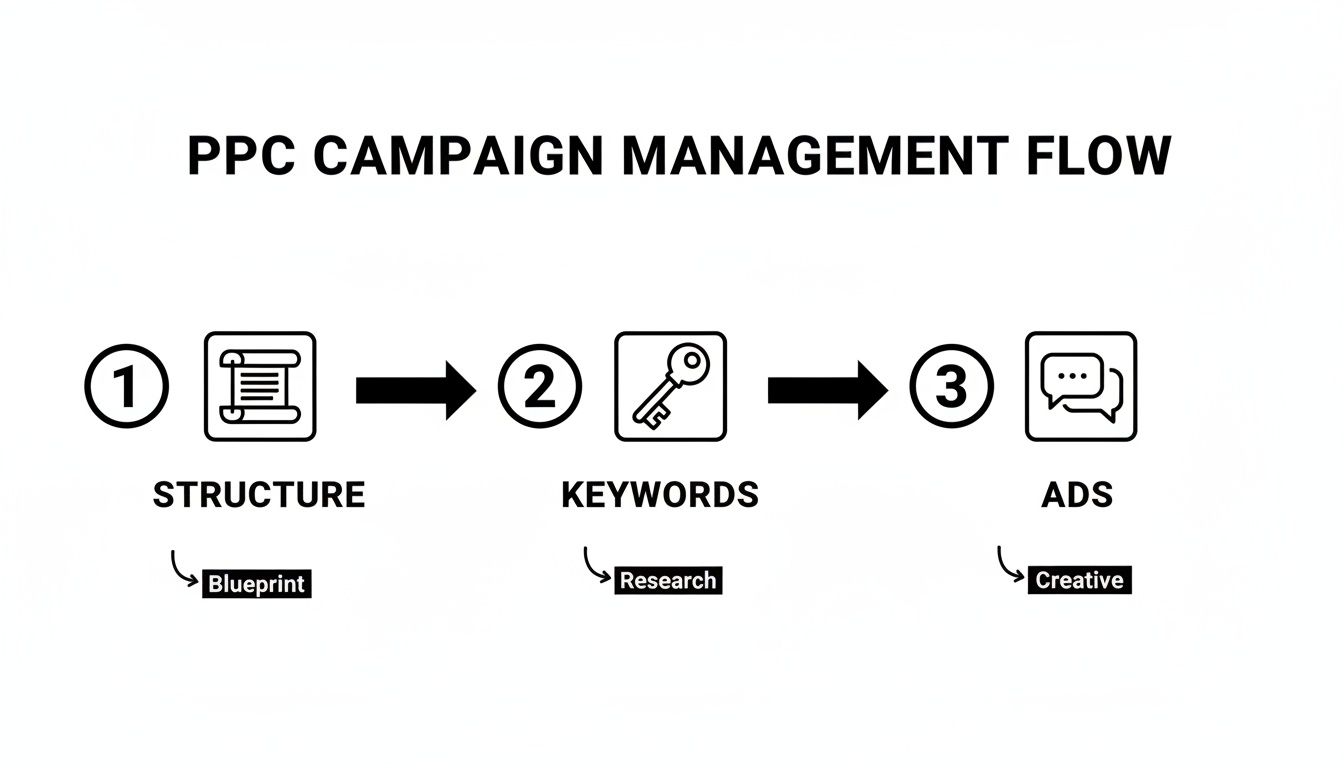
This visual reinforces a key takeaway: a logical structure is the non-negotiable first step. It’s what makes effective keyword targeting and compelling ad creation even possible.
Crafting Ad Copy and Landing Pages That Convert
A perfectly structured account gets your ads in front of the right eyeballs, but it's the ad copy and the landing page experience that actually turn a click into a customer. This is where storytelling comes to life. Get it wrong, and you're just lighting your budget on fire for some temporary, expensive traffic.
The ad itself is the first promise you make to a potential customer.
With Responsive Search Ads (RSAs), you're not just writing one ad; you're giving Google a whole toolbox of headlines and descriptions. The Answer Engine Optimization (AEO) goal here is to provide the best, most relevant snippets that Google's algorithm can use to assemble the perfect answer for a user's query. The trick is writing assets that not only stand strong on their own but also tell a cohesive story in any configuration.
The Art of Responsive Search Ads
Think of your RSA assets as building blocks for a conversation. A common mistake I see is writing a dozen headlines that all say basically the same thing. That defeats the whole purpose. You need variety that speaks to different user motivations and pain points.
Let's say you're selling high-end running shoes. Your RSA assets could look something like this:
- Benefit-Driven Headline: "Run Farther, Hurt Less" (The emotional story)
- Feature-Driven Headline: "Lightweight Carbon-Plated Soles" (The technical story)
- Trust-Building Headline: "Free Shipping & 90-Day Returns" (The confidence story)
- Call-to-Action Headline: "Shop The New Collection Now" (The action story)
This mix gives the system options to serve the most relevant message at the right time. You can also pin headlines to certain positions. For instance, I almost always pin the brand name to Headline 1. It’s a simple way to guarantee brand consistency across every single ad variation. Don't underestimate pinning; it's a powerful lever for controlling your core message.
Your ad copy should feel like an answer, not just an advertisement. It needs to directly address the problem or desire implied by the search query, creating an immediate sense of relevance and trust. This is the essence of AEO—being the best answer.
Ensuring a Flawless Message Match
The single biggest conversion killer is a disconnect between your ad and your landing page. It’s jarring. Imagine clicking an ad for "emergency leak repair" and landing on a generic homepage listing all of a company's plumbing services. You're gone in a second. That's a classic failure of message match.
Your landing page absolutely must be a direct continuation of the ad's promise. The headline on the page should echo the ad's headline. The images need to be relevant, and the call-to-action should feel like the obvious next step. This consistency is crucial for both user experience and achieving a high Quality Score, which directly impacts your ad rank.
Back to our running shoe example: if the winning ad combination highlights "Lightweight Carbon-Plated Soles," the landing page better feature those exact shoes front and center. A big hero image and a headline that reinforces that specific feature confirms to the visitor that they're in the right place, which is huge for keeping bounce rates down.
Driving Conversions on the Landing Page
Once the user arrives, that page has one job: get the conversion. This is where so many campaigns fall apart. In fact, a staggering 68% of PPC traffic requires dedicated landing pages to convert effectively, not just the homepage.
On these pages, small tweaks can lead to huge wins.
- Adding a video can boost conversions by up to 86%.
- Improving page load speed can deliver a 37% lift.
- Even something as simple as reducing form fields has been shown to increase conversions by anywhere from 29% to 120%.
To get your page optimized for action, stick to these core CRO principles:
- Simplify the Ask: Make your primary call-to-action (CTA) impossible to miss. Use a button color that pops and clear, action-oriented text like "Get My Free Quote," not a passive "Submit."
- Leverage Social Proof: People trust other people. Include customer testimonials, reviews, or trust badges (like "As Seen On…" or security seals) to build credibility and ease any hesitation. Tell the story of your happy customers.
- Reduce Form Fields: Seriously, only ask for what you absolutely need to get the ball rolling. Every extra field you add is another reason for someone to give up and leave.
Mastering the ad copy and landing page is a deep topic. If you really want to maximize your PPC investment, you need to dive into the complete playbook for how to increase website conversion rate. This is how you stop just buying traffic and start acquiring customers at scale.
Choosing Smart Bidding Strategies for Your Goals
Once your ads and landing pages are in sync, it's time to talk about the money. The next piece of the puzzle is telling Google how to spend your budget. This goes way beyond just setting a daily cap; it's about picking a bidding strategy that ties every dollar spent directly to a specific business outcome. The world of automated, or "smart," bidding is where effective PPC management helps your business rank for the most valuable searches.

Think of a bidding strategy as giving the algorithm a very specific job to do. Are you telling it to get as many leads as possible, no matter what they cost? Or are you telling it to only go after leads that keep you profitable? These are two completely different sets of instructions that, unsurprisingly, produce wildly different results.
Aligning Bidding with Business Objectives
The trick is to match the bidding strategy to what you're actually trying to achieve with the campaign. Not every business wants the same thing, and your bidding should reflect that. It's all about being intentional.
Let's break down the most common smart bidding strategies with some real-world examples:
-
Maximize Conversions: This one is straightforward. You're telling Google, "Get me the most conversions you possibly can within my daily budget." It's a fantastic fit for lead generation campaigns where volume is the name of the game. A SaaS startup launching a new demo, for instance, would use this to fill their sales pipeline fast and get that initial user feedback. The focus is squarely on quantity, not necessarily efficiency.
-
Target CPA (Cost Per Acquisition): This is a much more controlled approach. Here, you tell Google, "I want as many conversions as possible, but I absolutely refuse to pay more than X dollars for each one." An established local roofer might know that any lead is profitable as long as it costs less than $100. Setting a Target CPA of $100 keeps the campaign profitable and predictable.
-
Target ROAS (Return On Ad Spend): For e-commerce businesses, this is the holy grail. It’s laser-focused on revenue, not just the number of conversions. You're essentially telling Google, "For every $1 I give you for ads, I need to get back $4 in revenue." An online clothing store with tight margins lives and dies by this to make sure their campaigns are actually making money, not just driving sales at a loss.
Picking the wrong strategy is a classic misstep. An e-commerce store using Maximize Conversions might see sales shoot up, but their profit margins could get completely torched because the algorithm was never told to prioritize high-value orders.
A Story From a Multi-Location Practice
We once worked with a dental practice that had clinics in five different cities. Each location had its own set of campaigns, and the marketing director was tearing her hair out trying to manage bids for all of them. Some markets were hyper-competitive with sky-high CPCs, while others were much more relaxed. This is a classic GEO challenge.
Trying to manage each campaign's bids by hand was a total nightmare. This is the exact scenario where portfolio bid strategies shine.
Instead of setting individual bid strategies for each of the five "Dental Implants" campaigns, we bundled them all into a single portfolio. We then set one unified Target CPA for the entire portfolio, which gave the algorithm the flexibility it needed to succeed. It could bid more aggressively in the expensive city where a lead was more valuable, and pull back in the cheaper market—all while making sure the average CPA across all five campaigns hit our goal.
This approach didn't just streamline management; it made the whole operation more efficient. It let Google's algorithm make smarter, cross-campaign decisions that a human manager, juggling dozens of variables, would struggle to replicate in real-time. This is how you use automation to conquer complex GEO-targeting.
Managing Budgets and Pacing
Your bidding strategy and your daily budget are two sides of the same coin. A common fear is accidentally overspending, but Google Ads is designed to stay within your average daily limit over the course of a month. On some days, it might spend up to twice your daily budget if it spots a great opportunity, but it will balance that out by spending less on other days.
The key here is pacing. You have to keep an eye on your spend. If you're halfway through the month and have only spent 25% of your budget, your bids might be too low or your budget is too high for the available traffic. On the flip side, if you blow through your entire budget by noon every day, you're missing out on a huge chunk of potential customers searching in the afternoon and evening. Proper pacing is a vital, day-to-day part of managing PPC campaigns for sustained success.
Finding Your Rhythm with Optimization and Reporting
A winning PPC campaign is never a “set it and forget it” kind of deal. Far from it. Think of it as a living, breathing system that needs a consistent rhythm of analysis and tweaks to really hit its stride. This is where a lot of businesses stumble, either getting lost in vanity metrics or making panicked, reactive changes without a real strategy.
When you establish a practical cadence for managing your campaigns, you shift from constantly putting out fires to proactively building a growth engine. It’s all about knowing what to check and when, building momentum over time instead of just plugging leaks.
Establishing Your Optimization Cadence
Your campaign doesn't need constant babysitting, but it absolutely needs regular check-ins. A structured approach means you'll catch problems early, spot opportunities before your competitors do, and make decisions backed by solid data. This rhythm stops you from overreacting to normal daily fluctuations while keeping you dialed in on meaningful trends.
Here’s a practical schedule that works for most of the accounts we manage:
-
Daily Checks (5-10 minutes): This is your quick pulse check. You're looking for big, obvious red flags—a sudden nosedive in impressions, a crazy spike in spend, or a batch of disapproved ads. You aren't making any grand strategic moves here; you're just making sure the engine is still running.
-
Weekly Analysis (30-60 minutes): Now we're getting into the real work. Dive into your performance week-over-week. Are you on pace with your budget? How are your Click-Through Rate (CTR) and Conversion Rate trending? This is your prime time to adjust bids and, most importantly, dig into your search term reports.
-
Monthly Review (1-2 hours): Time to zoom out and see the forest for the trees. How did performance stack up against your monthly KPIs? This is when you make bigger strategic calls, like shifting budget between campaigns, brainstorming new ad copy themes, or adjusting your overall bidding strategy based on a much larger data set.
This simple, structured approach turns potential chaos into a manageable process. You’ll find you're working on the account, not just in it.
Uncovering Gold in Search Term Reports
The Search Term Report is, without a doubt, the most valuable tool in your optimization arsenal. It shows you the exact queries people typed into Google right before clicking your ad. This is pure, unfiltered customer insight, and mining it weekly is non-negotiable for both PPC and SEO.
Your goals here are pretty straightforward:
- Find Money-Wasting Keywords: Hunt for irrelevant search terms that are triggering your ads and torching your budget. If you sell "men's leather boots" and see clicks coming from "repair leather boots," you've just found a perfect negative keyword. Adding "repair" to your negative list immediately stops that wasted spend in its tracks.
- Discover Hidden Keyword Opportunities: You'll almost always find high-converting search terms you hadn't even thought of. These are golden nuggets for your SEO strategy. If a user might search for "waterproof work boots for construction sites" and it converts, you now have a proven long-tail keyword to target with a blog post or a dedicated product page to rank organically.
Neglecting your Search Term Report is like trying to navigate a ship without a map. You're letting random search currents dictate your destination, wasting fuel on journeys that lead nowhere productive for your business.
Data-Driven Testing and Adjustments
Once you have a steady stream of data flowing in, you can graduate from basic maintenance to real strategic growth. This is all about systematically testing different campaign elements to figure out what truly clicks with your audience.
A huge part of this is making smart bid adjustments. Don't just set a bidding strategy and let the algorithm run wild without any guidance. Use your data to see how performance differs across key segments:
- Device: Are mobile users converting way better than desktop users? If so, you might apply a +15% bid adjustment for mobile to get in front of more of that high-value traffic.
- Location: For a local business, this is where GEO optimization gets powerful. You might find that one zip code converts at double the rate of another. Slapping a positive bid adjustment on that top-performing area focuses your budget where it actually works to rank higher in local searches.
- Audience: You can (and should) layer audiences onto your search campaigns. If you notice users in your "Past Purchasers" audience have a much higher conversion rate, you can tell Google to bid more aggressively when they're the ones searching.
Knowing what a "good" conversion rate looks like is also vital for context. For instance, the average Google Ads conversion rate is 7.52%, but that number varies wildly by industry. The Animals & Pets sector might see 13.07%, while Apparel/Fashion is way down at 3.99%. This data, which you can find in more detail in these industry-specific PPC benchmarks on WordStream, highlights why a one-size-fits-all approach just doesn't work.
Ultimately, your reporting needs to tie all these efforts together. Focus on the metrics that actually matter to the business—leads, sales, and return on ad spend. To get a better sense of what a truly meaningful dashboard looks like, check out our insights on paid search analytics and start building reports that measure real growth.
How to Scale Your Wins with Retargeting and Automation
Hitting profitability with your PPC campaigns is a huge first step. But don't stop there. Profitability isn't the finish line; it's the launchpad for smart, sustainable growth. Once you've got a formula that works, it's time to pour some fuel on the fire with the powerful duo of retargeting and automation.

This is the point where you shift from just chasing new customers to nurturing the valuable traffic you’ve already paid for. It's about turning those near-misses into loyal clients and letting smart systems handle the tedious stuff so you can focus on strategy.
Beyond the Bounce with Strategic Retargeting
A lot of people hear "retargeting" and think it means blasting the same ad at someone who visited their website. That's not a strategy—it's just annoying. Real, strategic retargeting is much more nuanced; it's about delivering specific messages based on what a user actually did on your site.
Think about a local roofer. Someone lands on their "Free Roof Inspection" page but leaves without filling out the form. A basic campaign would just show them a generic "Best Roofer in Town" ad. A smart campaign, however, would continue the story by serving up something different, like an ad highlighting their expertise in "Hail Damage Repair" with a testimonial from a local homeowner.
This approach acknowledges the user’s specific interest. The follow-up ads should continue the conversation, not hit the reset button.
Retargeting isn't about chasing bounced traffic. It's about guiding interested prospects through a thoughtful journey, providing them with the right information at the right time to build trust and move them closer to a decision.
To pull this off, you need to build powerful remarketing lists for search ads (RLSAs). These let you customize your search campaigns for people who have already been to your site. For example, you could bid 25% higher on your main keywords for anyone who previously visited your pricing page. You know their intent is sky-high, so it's worth the investment.
The results from a well-executed retargeting strategy speak for themselves. The difference in performance compared to a standard, non-retargeting campaign is often stark.
Retargeting Impact vs. Standard Campaigns
| Metric | Standard Campaign | Retargeting Campaign |
|---|---|---|
| Conversion Rate | 1-2% | 5-10% |
| Click-Through Rate (CTR) | 2-5% | 10-15% |
| Cost Per Acquisition (CPA) | Varies (Higher) | Often 30-50% Lower |
| User Intent | Cold/Warm | Hot |
As you can see, by re-engaging users who are already familiar with your brand, you dramatically improve your key performance metrics and get a much better return on your ad spend.
Designing a Sequential Ad Funnel
The real magic happens when you start designing ad sequences. You can build different audience lists based on how recently someone visited, allowing you to tell a story over time instead of just repeating yourself.
Here’s what a simple sequence might look like:
- Days 1-7: Hit them with ads focused on a specific offer tied to the page they saw. (e.g., "Get Your Free Roof Inspection Before the Next Storm Hits.")
- Days 8-14: Switch gears to building trust. Show them ads with customer testimonials, five-star reviews, or industry awards.
- Days 15-30: Create a little urgency or introduce a final, compelling offer to nudge them into action before they go cold.
This sequential method respects the customer journey and prevents ad fatigue. You become a helpful guide, not a digital pest.
Putting Routine Tasks on Autopilot
As your campaigns get bigger, so does the daily grind. Manually tweaking bids, pausing duds, and pulling weekly reports will eat up all your strategic thinking time. This is where automation becomes your new best friend.
Google Ads has a whole suite of built-in automation rules that can handle this grunt work. These aren't complex scripts; they’re simple "if-then" commands that run based on criteria you define.
Here are a few killer automation rules you can set up right now:
- Pause Loser Keywords: If a keyword has spent over $50 in the last 30 days with zero conversions, automatically pause it.
- Boost Winning Bids: If a keyword's conversion rate is above 4% and its average position is below 2, automatically bump its max CPC bid by 10%.
- Control Overspenders: If a keyword's cost-per-acquisition (CPA) is 50% higher than the ad group average, automatically cut its bid by 15%.
Setting up rules like these takes just a few minutes but will save you hours every single week. It guarantees your campaigns are always optimizing based on real-time data, which is essential for managing PPC at scale. Knowing how to calculate customer lifetime value can make these rules even smarter, helping you bid the right amount for your most valuable audiences. As you look to scale, exploring the world of AI-powered advertising can open up even more sophisticated ways to grow. This is how you build a system that works for you, not the other way around.
Common Questions About Managing PPC Campaigns
Even with a killer strategy, jumping into paid advertising brings up a ton of questions. Over the years, we've heard them all from business owners and marketers just trying to figure out if their campaigns are actually working.
Most of the time, the concerns boil down to three things: the money going out, the results coming in, and how long it takes to connect the dots. Getting a grip on these is the key to setting realistic expectations and building a campaign that doesn't just fizzle out.
How Much Should My PPC Budget Be?
This is the big one, and the only honest answer is: it completely depends on your industry, your location, and what you're trying to achieve. There’s no magic number. A plumber in a hyper-competitive market like Los Angeles is going to need a much bigger budget than a roofer in a small town, simply because the cost-per-click (CPC) for their keywords is through the roof.
Instead of guessing, the smart move is to work backward from your goals.
- What’s your target cost-per-acquisition (CPA)? How much can you afford to pay for one qualified lead or a single sale?
- What’s your estimated conversion rate? If your landing page typically converts at 2%, you’ll need 50 clicks to land one conversion.
- What are the average CPCs? Use a tool like Google's Keyword Planner to get a feel for what clicks actually cost in your market.
Let's run the numbers. Say your target CPA is $100, your conversion rate is 2%, and the average click costs $4. The math is pretty simple: 50 clicks x $4/click = $200 per conversion. Right away, you can see your initial $100 CPA goal might be a stretch. This kind of data-driven thinking gives you a realistic starting point for your budget, not just a number pulled from thin air.
When Will I Start Seeing Results?
PPC is definitely faster than SEO, but it isn't instant. You can start getting traffic within hours of launching a campaign, sure, but real "results"—the kind that are profitable and predictable—take more time. There's always a data collection phase where the ad platform's algorithm is learning who your audience is and which ads actually get them to click.
Think of the first month of a new campaign as an investment in data. You're spending money not just on clicks, but on the crucial insights needed to optimize for long-term profitability and success.
Generally, you can expect things to unfold something like this:
- Week 1-2: The first trickle of data comes in. The focus here is on technical checks—making sure tracking is working and all your ads get approved.
- Week 3-4: You should have enough data to start making the first round of optimizations. This is when you'll start adding negative keywords to cut wasted spend and pausing ad copy that's falling flat.
- Month 2-3: Things start to stabilize. With consistent tweaks, your CPA should begin trending downward as you dial in your targeting and messaging.
Patience is everything. Making drastic changes too early, before the algorithm has enough data to make smart decisions, can actually throw your whole campaign off course.
How Do I Know If My Campaign Is Successful?
Success isn't about getting a flood of clicks. Real success in PPC is measured by actual business outcomes, not vanity metrics. Your click-through rate (CTR) can be amazing, but if none of those people are turning into customers, the campaign is a failure. Period.
To get a true read on success, you need to be tracking these key performance indicators (KPIs):
- Cost Per Acquisition (CPA): This is your north star. It tells you exactly how much you're shelling out for each new lead or sale.
- Conversion Rate: This number shows you how good your ads and landing pages are at convincing people to actually do something.
- Return On Ad Spend (ROAS): For any e-commerce business, this is non-negotiable. It measures the total revenue you're generating for every single dollar you spend on ads.
- Lead Quality: This is huge for service businesses. Not all leads are created equal. You have to track how many of those form fills or phone calls actually turn into paying customers.
When you focus on these bottom-line metrics, you get a clear, honest picture of how your campaign is performing and the real impact it’s having on your business.
Ready to stop guessing and start growing with a data-driven PPC strategy? The team at Jackson Digital builds, manages, and scales paid media campaigns that deliver predictable results. Request your free performance audit today!