Let's cut right to the chase. In simple terms, search engine optimization (SEO) is everything you do to make your website more visible when people search for your products or services on search engines like Google.
It’s about turning your website from a lonely billboard in the desert into the first store people see when they walk down Main Street. And more importantly, it's about telling a story that connects with real people looking for real solutions.
What Is Search Engine Optimization For Business Owners
Forget the technical jargon for a minute. SEO is the art and science of making your digital storefront the most inviting, helpful, and visible shop on Google’s massive, bustling high street.
Think of your website as a brand-new local cafe. Good SEO is like having the clearest sign out front (your website's title), the most helpful barista ready to answer any question (your content), and glowing reviews in the local paper (links from other sites). It’s all the little things that ensure customers searching for "best coffee near me" find you first.
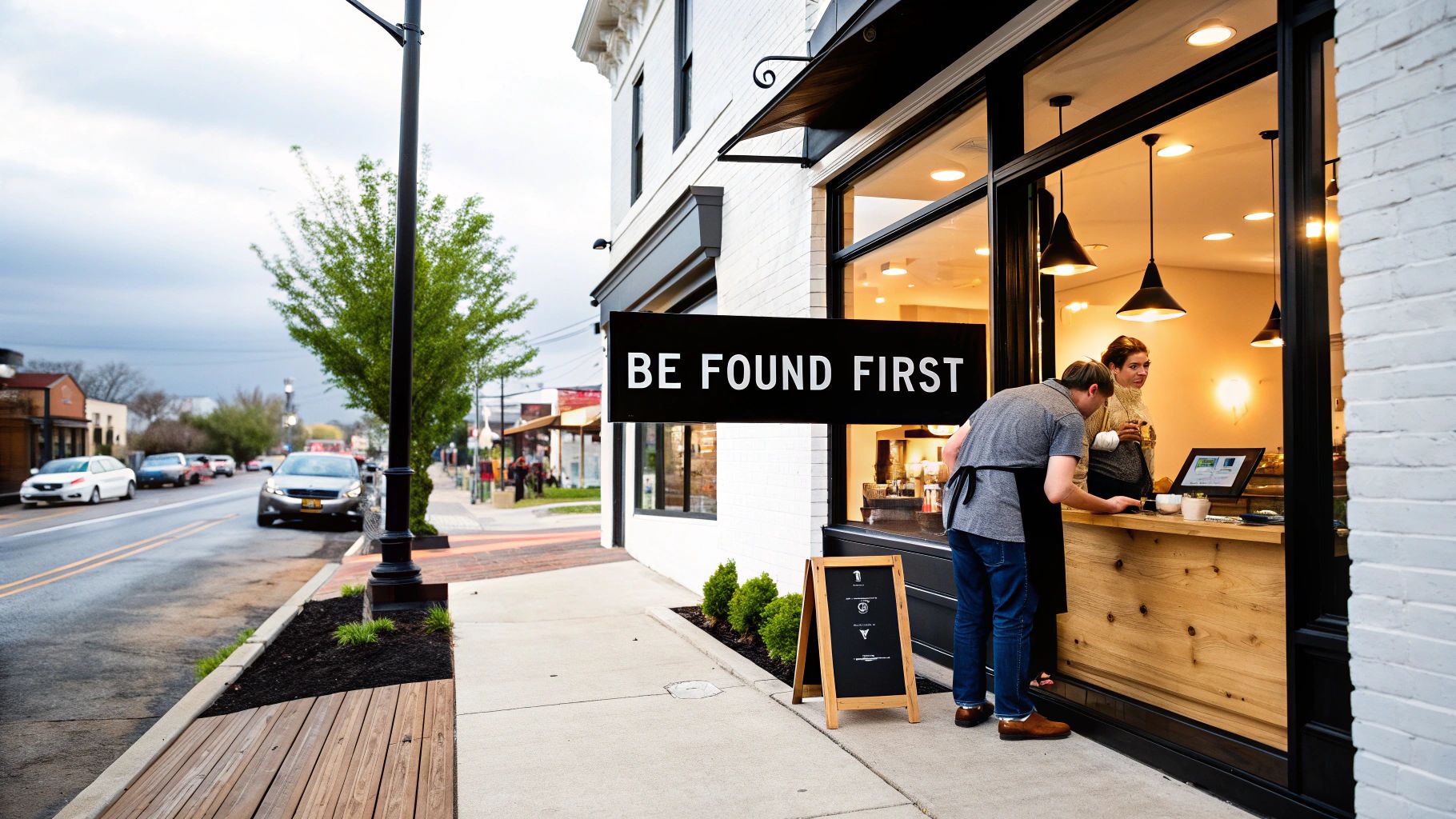
This isn't about gaming the system with cheap tricks. It's about earning your spot by telling a better story and becoming the most trusted, authoritative answer in your field. When you consistently deliver clear, valuable, and relevant information, search engines take notice and reward you by showing your site to more potential customers.
The real secret? It’s less about keywords and more about deeply understanding what your customers are struggling with—and then giving them the solution wrapped in a compelling narrative.
From Invisible To In-Demand: A Plumber's Story
Let me tell you a story that shows the power of this approach. Imagine a local plumber whose website is buried on page ten of Google. He's great at his job, but his phone isn't ringing because nobody can find him online. His problem isn't his service; it's his visibility.
He decided to put himself in his customers' shoes. What were their immediate, frustrating problems? He realized they weren't just searching for "plumber." They were typing specific, urgent questions into Google, like "why is my drain clogged" or "how to fix a leaky faucet."
That's when the lightbulb went off. He started creating simple blog posts and service pages that answered these exact questions, telling the story of each problem and its solution. He wasn't just selling anymore; he was positioning himself as a helpful expert, explaining the common causes of plumbing issues and offering a few DIY tips. He was building trust.
Within a few months, things started to change. His phone began to ring. People were finding his articles, connecting with his helpful approach, and calling him when the job was too big to handle themselves. He went from being practically invisible to getting daily calls, all because he focused on telling the right story to answer what his customers were already asking.
That, right there, is the heart of modern SEO.
Answering Questions Is The Key
That plumber's success story gets to the core of what it takes to get found online. A huge piece of the puzzle is effective content optimization—which is really just a fancy way of saying you're refining your website's content to perfectly meet the needs of both search engines and, more importantly, your human visitors. This strategy is also known as Answer Engine Optimization (AEO), and it's about providing the best, most direct answer to a user's query.
The goal is to stop thinking like a business owner selling a product and start thinking like a customer looking for a solution. What words do they use? What questions are they asking? Your website needs to provide those answers, plain and simple.
To really nail this, you have to understand the different ways people search online. By grasping the intent behind what they type into that search bar, you can create content that perfectly matches what they need in that exact moment.
Understanding customer intent is one of the most critical ideas in our guide to SEO basics for small business owners, because it’s the foundation for everything else you’ll do.
Decoding The Four Types Of Customer Searches
When a user types something into Google, they have a goal in mind. Understanding that goal, or "search intent," allows you to create content that gives them exactly what they're looking for. This table breaks down the four main types.
| Search Intent Type | What the User Wants | Business Example |
|---|---|---|
| Informational | To learn something or find an answer. | A user searches for "how to choose the right running shoes." Your sporting goods store has a blog post that explains different shoe types for different foot arches. |
| Navigational | To find a specific website or page. | Someone searches for "Jackson Digital blog." They already know who we are and are trying to get directly to a specific section of our site. |
| Transactional | To buy something or complete an action. | A search for "buy Nike Air Max size 11" shows clear intent to make a purchase. Your e‑commerce product page should appear for this search. |
| Commercial | To research a product or service before buying. | A user searches for "best SEO agency in Orange County." They plan to hire someone soon and are comparing their options. A page showcasing your agency's reviews and case studies would be perfect here. |
By tailoring your content to these different intents, you meet your customers where they are in their journey. You become the helpful guide, not just another billboard.
How SEO Evolved from Keywords to Conversations
To really get what SEO is today, you have to know where it came from. SEO wasn’t dreamed up in a boardroom. It was born in the digital wild west of the mid-1990s as the internet was first exploding into our lives. Back then, pioneers were just figuring out how to get websites noticed on early search engines like AltaVista and Yahoo.
That first era was a total free-for-all. The rules were simple because there basically weren't any.
Success often boiled down to crude tactics like keyword stuffing—just repeating a search term over and over—and tweaking invisible meta tags. If you wanted to rank for "Orange County plumber," you just crammed that phrase onto your page as many times as you could. It was a numbers game, plain and simple, with no real thought for quality.
This "Stone Age" of SEO was defined by how basic it was. The term 'search engine optimization' was officially coined in 1997, giving a name to a practice that would soon change marketing forever. But the game was about to get flipped on its head when Google launched in 1998 with its game-changing PageRank algorithm, which treated backlinks like votes of confidence. You can dive deeper into the early history of SEO and its key milestones on amsive.com.
The Rise of Quality and The Fall of Tricks
As Google grew to dominate the search world, its mission got clearer: organize the world's information and make it useful for everyone. The old tricks like keyword stuffing and spammy links ran completely counter to that mission. They just cluttered up the internet with junk pages, frustrating people who were looking for real answers.
So, Google started fighting back.
This kicked off a series of huge algorithm updates that became turning points, completely reshaping what it means to "do" SEO. Two of the most famous were:
- Google Panda (2011): This update went straight for "thin" or low-quality content. Websites that were churning out shallow articles just to grab keywords got hammered, often disappearing from the first page overnight. Panda was Google’s first major shot across the bow, signaling that quality content was no longer optional.
- Google Penguin (2012): A year later, Penguin took aim at spammy and manipulative link-building. Websites that bought links or used automated programs to create thousands of garbage backlinks watched their rankings tank. This update forced everyone to start earning links through real relationships and valuable content.
These updates weren't just small tweaks; they were a declaration of intent. Google was making it crystal clear that the future of SEO belonged to those who put the user experience first.
From Keywords to Intent: The Modern SEO Mindset
The story of these updates is so important because it explains why modern SEO works the way it does. The focus has completely shifted from "what keywords am I ranking for?" to "what problem is my customer trying to solve?"
Today’s search engines are incredibly sophisticated. They understand synonyms, context, and the real intent behind what someone types into the search bar. They know that a search for "running shoe fit guide" is someone in research mode, while a search for "buy Nike Pegasus size 10" is someone ready to pull out their wallet.
This evolution brings us to the core of modern strategy, which revolves around a concept Google now calls E-E-A-T:
- Experience: Do you have firsthand, real-world experience with the topic?
- Expertise: Do you have deep knowledge and skill in your field?
- Authoritativeness: Are you a recognized, go-to source in your industry?
- Trustworthiness: Is your site secure, transparent, and reliable?
Focusing on E-E-A-T isn't some hack; it's the only sustainable path to ranking well. It means creating genuinely helpful content, proving your real-world expertise, and building a brand that people can trust. This approach is how you build a powerful online presence that pays off for years, helping you improve your overall marketing ROI by building a real asset, not just renting traffic.
Understanding The Four Pillars Of Modern SEO
Search engine optimization can feel like a mountain of confusing tasks, but it really boils down to four core pillars. Getting a grip on these concepts is the key to understanding SEO in a practical way. Think of them as the foundation, walls, curb appeal, and local reputation of your digital business.
When these four pillars work together, they create a powerful, cohesive strategy that drives real growth, attracting the right customers at the right time.
Let's break them down.
On-Page SEO: The Quality of Your Storefront
On-page SEO is everything you do on your website to make it clear, helpful, and valuable to both users and search engines. It’s the quality of your digital storefront—the content you write, the headlines you use, and how you structure your pages. It is the home of your AEO (Answer Engine Optimization) efforts, ensuring your pages directly answer customer questions.
Imagine an e-commerce store that sells handmade leather bags. Strong on-page SEO means each product page has crystal-clear photos, a detailed description answering questions about size and materials, and a title like "Handcrafted Italian Leather Tote Bag," not just "Brown Bag." It’s about making your products and services shine by presenting them perfectly.
The goal is to answer a searcher's question so thoroughly they have no reason to hit the "back" button. This pillar is all about quality, relevance, and creating an excellent user experience from the moment someone lands on your site.
Technical SEO: The Foundation and Wiring
Technical SEO is the work you do behind the scenes to make sure your website's foundation is solid, secure, and fast. It’s the plumbing, wiring, and structural integrity of your building. Users might not see it, but they definitely feel it when it’s broken.
This covers things like:
- Site Speed: Ensuring your pages load in a snap so visitors don't get frustrated and leave.
- Mobile-Friendliness: Making sure your site looks and works great on a smartphone.
- Crawlability: Helping search engines easily find and understand all the pages on your site.
A slow, clunky, or broken website sends all the wrong signals to Google and drives potential customers away. It's the invisible force that makes everything else possible, and you can dive deeper into the science behind Technical SEO to see just how much it impacts your rankings.
Off-Page SEO: Building Your Reputation Around Town
Off-page SEO is all about building your website's reputation and authority across the web. Think of it as word-of-mouth marketing for the digital age. When other reputable websites link to yours, they’re essentially vouching for your credibility, telling search engines you're a trustworthy source.
This is where building relationships and creating genuinely shareable content becomes critical. The primary way to build this authority is through backlinks—links from other sites pointing to yours. It’s not about quantity, but quality. One link from a respected industry publication is worth more than a hundred from low-quality directories.
The evolution of search has placed a massive emphasis on these quality signals. In the past, manipulative link schemes were common, but that all changed with a few landmark updates. The 2011 Google Panda update was a seismic shift, impacting around 12% of all search queries by penalizing sites with thin, low-quality content. This was followed by the 2012 Penguin update, which targeted spammy link building and forever changed the industry.
This history lesson shows why it's so important to focus on modern, effective SEO link building strategies that build genuine authority.
Local SEO (GEO): Winning The Neighborhood
For any business with a physical location or a service area, Local SEO—often called GEO-targeting—is non-negotiable. This pillar focuses on optimizing your online presence to attract customers in your specific geographic area. It’s how a local bakery in Austin dominates searches for "best cupcakes near me."
GEO ensures that when a potential customer is standing on a street corner searching for a solution on their phone, your business is the one that pops up first on the map.
Key actions here include:
- Claiming and optimizing your Google Business Profile.
- Gathering positive customer reviews.
- Ensuring your business name, address, and phone number (NAP) are consistent everywhere online.
This is the most direct way to connect your digital marketing efforts to real-world foot traffic and phone calls. It’s about turning online visibility into local customers walking through your door.
To help you see how these pieces fit together, here’s a quick summary.
A Quick Look at the Four Pillars of SEO
| Pillar | Primary Goal | Key Action Item for Your Business |
|---|---|---|
| On-Page SEO | Make your content clear, relevant, and valuable to users and search engines. | Write a detailed, helpful blog post that answers a common customer question. |
| Technical SEO | Ensure your website is fast, secure, and easy for search engines to crawl. | Check your website's loading speed with Google's PageSpeed Insights tool. |
| Off-Page SEO | Build your website's authority and credibility through external signals. | Get a link from a local business partner's website or a relevant industry blog. |
| Local SEO (GEO) | Dominate search results for customers in your specific geographic area. | Fully complete your Google Business Profile with photos, hours, and services. |
Each pillar supports the others, and a strong SEO strategy needs all four working in concert to deliver the best results.
The infographic below shows just how far SEO has come, shifting from spammy old tactics to the sophisticated, user-focused approach we use today.
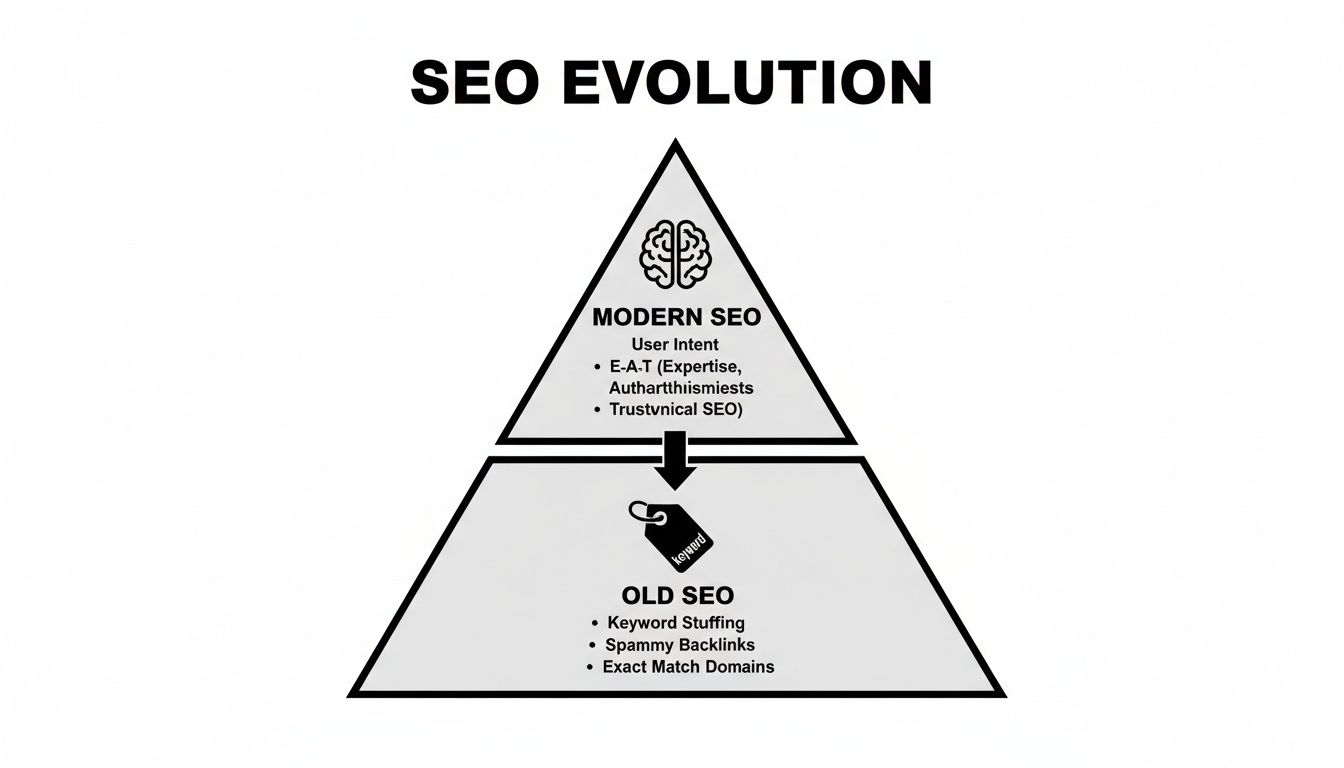
As you can see, old SEO was built on a simple foundation of keywords. Modern SEO, however, prioritizes a much deeper, more "human" understanding of what users actually need and want.
Why SEO Is Your Most Valuable Business Asset
Most business owners lump marketing into two buckets: stuff you pay for and stuff you don't. Paid ads obviously fall into the first category, and SEO often gets tossed into the second. But that simple view misses the most critical distinction—the difference between renting your audience and actually owning it.
It’s time to stop looking at SEO as just another line item on your marketing budget. Start treating it for what it is: a strategic, revenue-generating business asset. An asset that, unlike any paid campaign, actually grows more valuable over time.
To really get why, let’s tell a quick story about two competing businesses.
The Renter vs. The Owner: A Tale of Two Strategies
Picture two local roofing companies, "Flash Ads Roofing" and "Evergreen Exteriors."
Flash Ads Roofing goes all-in on paid search ads. They pay Google for every single click, and when they flip the budget on, the phone starts ringing. It feels great—instant gratification. But the second they turn that budget off, they vanish. Their lead flow slams to a halt. They are constantly renting their audience from Google, paying a daily toll just to stay in front of potential customers.
Evergreen Exteriors plays the long game. They invest in SEO. They spend time telling a helpful story with an article called "How to Spot a Leaky Roof Before It's Too Late." For the first few months, not much happens. But slowly, over six months, that article starts climbing the ranks. Before they know it, it's on the first page of Google.
Now, every single day, homeowners in their area find that article, absorb their expert advice, and feel like they already trust them enough to call for an inspection. This traffic doesn't cost them a penny per click. That single article, a one-time investment, has become a permanent, 24/7 lead-generation machine. Evergreen Exteriors owns their audience, and that asset works for them day and night, building predictable, long-term growth.
Paid ads are like renting a home—your security disappears the moment you stop paying rent. SEO is like buying a home—you build equity over time, creating a valuable asset that provides long-term stability and return.
Getting this shift in perspective right is fundamental to building a sustainable business. SEO isn't just about rankings; it's about building a piece of digital real estate that directly feeds your bottom line.
The Compounding Power of Organic Growth
Paid campaigns give you a linear return: spend more, get more. SEO, on the other hand, delivers compounding growth. A single article that ranks well doesn't just bring in leads today; it can keep bringing them in for years.
As that article earns links from other websites and proves its value to Google's users, its authority grows. That authority then lifts your entire website, helping you rank for other related keywords. It's a powerful snowball effect that steadily lowers your overall customer acquisition cost (CAC) and makes your business more profitable.
The industry's explosive growth tells the same story. SEO has ballooned into a massive global industry, projected to be worth a staggering $86.8 billion by 2025. This isn't just hype. It’s because organic search is still the most dominant force online, driving over 50% of all website traffic in major markets. As search engines get smarter with AI Overviews and an intense focus on user intent, having a strong organic foundation has never been more important. You can dig deeper into the impact of SEO on modern business at martech.zone.
Connecting SEO Directly to Your Bottom Line
At the end of the day, any business investment has to deliver a positive return, and this is where SEO truly proves its worth. It does more than just drive traffic; it establishes your brand as an authority, building trust long before a potential customer ever picks up the phone.
Let's break down the tangible benefits:
- Increased Qualified Traffic: SEO doesn't just bring you more visitors; it brings you the right visitors. These are people actively searching for your solutions, meaning they're much closer to making a buying decision.
- Lower Customer Acquisition Costs: Once you achieve a solid ranking, the cost per lead from organic search plummets compared to the relentless cost-per-click of paid ads.
- Sustainable, Predictable Leads: A strong SEO foundation creates a consistent stream of leads that isn't chained to a daily ad budget. It’s always on.
When you invest in what is search engine optimization, you aren't just buying clicks for today. You are building a durable, long-lasting asset that cements your position in the market, builds unshakable brand trust, and delivers a predictable flow of qualified customers for years to come. For any business serious about real, sustainable success, it’s simply non-negotiable.
Your First Practical SEO Action Plan
Knowing what SEO is is one thing. Actually doing it? That's where the magic happens. Theory is nice, but putting that knowledge into practice is what gets results. This is your tangible, step-by-step game plan, built for busy business owners who want to see real movement without getting lost in the weeds.
This isn't about becoming an SEO wizard overnight. It's about grabbing a few quick wins to build momentum for the long haul. We'll walk through three foundational tasks that can deliver an immediate impact and set you up for future success.
Action 1: Capture Local Customers with Google Business Profile (GEO)
If your business serves a specific geographic area, your Google Business Profile (GBP) is your single most important GEO-targeting tool. Full stop. It's that free listing that pops up in Google Maps and the "local pack" in search results. Neglecting it is like hiding your storefront from people walking right down your street.
Let me tell you a quick story. Maria, a dentist, had a beautiful office but an empty waiting room because her online presence was a ghost town. When a potential patient searched "dentist near me," they saw all her competitors—complete with photos, reviews, and a map pin. Maria's practice was totally invisible.
One weekend, she decided to fix it. She claimed her free GBP listing and filled out every single section: services, hours, photos of her spotless office and friendly staff. Then, she asked a few happy patients to leave a review. Within a month, her phone started ringing with calls from people who found her right on Google Maps. That’s the power of this first step.
Your quick-win checklist for GBP:
- Claim and Verify: Head over to google.com/business and claim your listing. Just follow the steps to verify your address.
- Complete Every Field: Don't skip a thing. Add your services, hours, business description, and plenty of photos. The more complete your profile, the more Google trusts you.
- Gather Reviews: Actively ask your happy customers for reviews. Positive reviews are a massive trust signal for both new customers and for Google.
Action 2: Discover What Your Customers Are Asking (AEO)
You don't need a wallet full of cash for expensive tools to figure out what your customers want. They're already telling you exactly what they need to know through the questions they type into Google every single day. Your job is to listen and then be the one with the answer. This is the core of Answer Engine Optimization (AEO).
Imagine you're a roofer. You might assume customers search for "roofing company." And sure, some do. But way more people are asking specific questions like, "what are the first signs of a roof leak?" or "how long does a shingle roof last?" Answering these questions on your website is the very foundation of effective on-page SEO.
A simple shift in mindset—from selling your services to solving their problems—is the secret to creating content that ranks. This is where SEO meets Answer Engine Optimization.
Here's how to find these golden-nugget questions for free:
- Go to Google and type in a broad term for your service, like "kitchen remodeling."
- Scroll down to the "People also ask" box. This is a goldmine of the exact questions people are asking.
- Use a free tool like AnswerThePublic. Pop in your service, and it will spit out dozens of questions your potential customers are searching for.
Once you have a list of 3-5 strong questions, you've got your topics for your next few blog posts or service page updates. Easy.
Action 3: Perform a Simple On-Page SEO Audit
Alright, let's put that customer research into action on your most important service page. An on-page "audit" sounds intimidating, but the basics are surprisingly straightforward. This is all about making sure your page clearly communicates its topic to both people and search engines.
Pick one page on your site—let's say it's your "Residential Plumbing Services" page. Now, let's do a quick check based on a key customer question you found, like "emergency plumber for clogged drains."
- Page Title: Does the title at the very top of the browser tab include your main service and location? It should be something like "Emergency Plumber for Clogged Drains | Anytown, USA" instead of a generic "Services."
- Main Heading (H1): Is the big headline on the page clear and descriptive? It should match the page title and instantly tell visitors they've landed in the right spot.
- Content: Does the actual text on the page answer the customer's question? Tell a brief story about a time you solved this problem. Mention the problem ("clogged drains") and your solution ("emergency service") within the first couple of paragraphs.
Making these small tweaks signals to Google precisely what your page is about, which can dramatically increase its chances of ranking for the right searches. By taking these three practical steps, you've officially moved from just understanding what search engine optimization is to actively doing it.
Knowing When to Partner with an SEO Expert
Taking the first few steps in search engine optimization yourself is a great way to build a solid foundation. But sooner or later, almost every business hits a ceiling with their DIY efforts. Professional expertise is what you need to smash through it and get to the next level of growth.
Knowing when you've reached that point is the key to scaling your success.
This isn't about giving up control. It’s about gaining a powerful ally. Partnering with an expert is a strategic move to bring in specialized knowledge, advanced tools, and a dedicated team focused on one thing: helping your business win on search engines.
Telltale Signs It Is Time to Hire an Agency
So, how do you know when you've hit that tipping point? The signals are usually pretty clear. Your growth has likely stalled, or you’re running into challenges that the basic tactics just can't solve.
See if any of these common scenarios sound familiar:
- Your Growth Has Plateaued: You saw some nice initial success, but now your traffic and leads have been flat for months. An expert can diagnose the deeper issues and roll out advanced strategies to get things moving again.
- You Lack Technical Skills: You're hitting complex problems like slow site speed, crawl errors, or even manual penalties from Google that are way outside your comfort zone. Technical SEO is a minefield where one wrong move can do more harm than good.
- You Are in a Competitive Market: You’re up against established players with deep pockets. An agency brings proven playbooks and the resources needed to compete head-on and carve out your own market share.
- You Don’t Have the Time: Let's be honest, you're a business owner, not a full-time marketer. SEO demands consistent, focused effort, and if you can’t dedicate the hours, your results will flatline.
Here's a quick story. A custom home builder we know was managing their own SEO and getting modest results. After partnering with an agency, they were able to get back to what they do best—building homes. The agency completely overhauled their technical SEO and launched a targeted content strategy. The result? They tripled their qualified leads in just nine months, completely transforming their sales pipeline.
This really highlights the value an expert partner brings to the table. They don’t just check off a list of tasks; they build a strategic framework for growth, using data to make informed decisions that directly fatten your bottom line.
They also have access to enterprise-level tools that provide much deeper insights, allowing for campaigns that are far more precise and effective than what you can do on your own.
Ultimately, hiring an SEO expert is an investment in efficiency and results. It frees you up to run your business while a dedicated specialist works to build your most valuable asset: a predictable, sustainable stream of organic leads. When you're ready to stop just competing and start dominating your market, a strategic partnership is the next logical step.
A Few Common Questions About SEO
Getting your head around search engine optimization can feel like a lot at first. Most business owners we talk to have the same handful of questions, so let's clear those up right now and get you moving forward with some confidence.
How Long Does It Take to See SEO Results?
This is the big one, and the honest answer is: it's a marathon, not a sprint. You'll likely start to see some initial movement in your rankings and a bit more traffic within 3 to 6 months. But for those really competitive, high-value keywords? Getting onto that coveted first page often takes a solid 6 to 12 months of consistent work.
Think of it like planting a tree. You have to water it, make sure it gets sunlight, and give it time to grow strong roots before it really starts providing shade. The exact timeline always depends on how competitive your market is, your website's history, and how consistently you're putting in the work.
Can I Do SEO Myself, or Do I Need an Agency?
You can absolutely get the ball rolling yourself. In fact, you should. Simple things like claiming your Google Business Profile, writing blog posts that answer common customer questions, and making some basic on-page tweaks are fantastic first steps every business owner can—and should—take.
But when you're ready to get serious about growth, that's when things get more complicated. A good agency brings specialized expertise to the table, along with advanced tools and a team that lives and breathes this stuff. They handle the heavy lifting like technical audits, deep competitive strategy, and link building, which are often the keys to truly scaling your results and owning your market.
What’s the Difference Between SEO and SEM?
This is a super common point of confusion, but it's actually pretty simple. Think of it like this:
- SEO (Search Engine Optimization): This is all about earning unpaid, organic traffic from search results. It’s the long game of building genuine authority and trust with Google.
- SEM (Search Engine Marketing): This is the bigger umbrella term that covers both SEO and paid search ads (like Google Ads, often called PPC).
So, SEO is just one piece—albeit a huge one—of a complete search engine marketing strategy.
Does My Business Really Need a Blog for SEO?
For the vast majority of businesses, the answer is a huge "yes." A blog is one of the most powerful tools in your SEO arsenal. It’s your chance to answer very specific customer questions, target a massive range of keywords you couldn't otherwise, and position yourself as the go-to expert.
Every single blog post you publish becomes a new digital asset for your company. It's another hook in the water, another chance to show up on Google when a potential customer is actively searching for the exact solutions you provide.
Ready to stop wondering and start ranking? Jackson Digital builds custom SEO strategies that drive predictable leads and sales. Request your free performance audit today and discover how our expert team can turn your visibility into sustainable growth.