Digital marketing for a medical practice is all about using online channels—search engines, your website, social media—to connect with new patients and earn their trust. It’s the difference between having a static online brochure and a dynamic digital front door that meets patients exactly where and when they’re looking for care. For modern practices, it's absolutely essential for growth.
Why Your Practice Needs a Digital Front Door
Picture this: a parent is up at 2 AM, frantically searching "emergency pediatric care near me" because their child has a fever. Or think about a professional using their lunch break to research the "best cardiologists in [Your City]."
Their journey no longer starts with a phone call to a friend for a referral. It starts online, with a search engine. This is the new reality in healthcare, and whether your practice shows up in that critical moment means everything.
Good digital marketing for medical practices isn't about running flashy ads or getting bogged down in technical jargon. It’s simply about being the clear, compassionate, and accessible answer when someone needs help.
Think of your website, your Google Business Profile, and your online articles as the digital equivalent of your practice's front door. It has to be welcoming, easy to find, and immediately helpful.
This digital-first mindset is quickly becoming the standard, not the exception. In fact, healthcare ad spending in the U.S. is on track to hit $29.2 billion by 2028. A massive 79% of providers are now prioritizing their websites and SEO to bring in new patients, a focus that far outweighs social media or email. You can dig into how providers are shifting their budgets in this healthcare marketing statistics report.
The modern patient's path, from a health concern to a booked appointment, is surprisingly predictable. The flowchart below maps out this common journey.
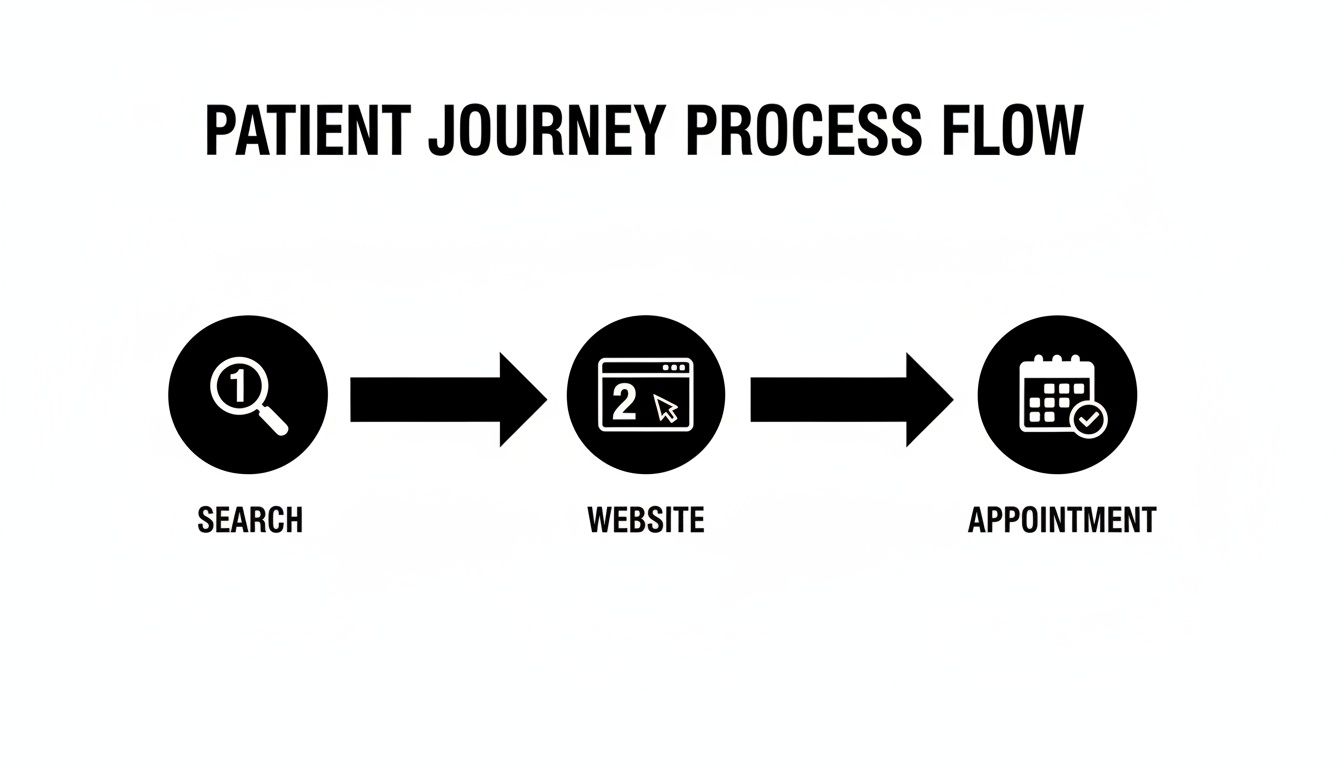
As you can see, without a strong presence in search results, your practice is completely invisible during the most important step of a patient's decision-making process. The same core ideas that help local businesses grow apply directly to medical clinics, which is why a solid online strategy is no longer optional.
Our guide on digital marketing for local businesses covers many of these foundational strategies. This guide will give you a complete roadmap for building your practice’s digital front door.
To get started, it helps to break down your strategy into a few core pillars. Each one plays a unique role in attracting and converting new patients.
Core Pillars of Digital Marketing for Medical Practices
| Marketing Pillar | Primary Focus | Key Goal |
|---|---|---|
| Local & Technical SEO | Showing up in local search results and ensuring your website is technically sound. | Be the first practice potential patients find when they search for care. |
| Content Strategy | Creating helpful, educational content that answers patient questions. | Build trust and establish your practice as a leading authority. |
| Paid Media (PPC) | Running targeted ads on platforms like Google to reach high-intent patients. | Generate immediate appointment inquiries for key services. |
| Reputation Management | Gathering and responding to patient reviews on Google, Healthgrades, etc. | Create social proof that reassures prospective patients. |
| Conversion Optimization | Making it easy for website visitors to book an appointment or contact you. | Turn website traffic into actual, scheduled patients. |
| Analytics & Reporting | Tracking key metrics to measure what’s working and what’s not. | Make data-driven decisions to improve your marketing ROI. |
Think of these as the essential building blocks. Get them right, and you'll create a powerful, patient-attracting system that works for your practice around the clock.
Winning Local Search and Becoming the Go-To Clinic
When a potential patient searches for "cardiologist near me," their journey starts with a simple goal: find the best local care, and find it fast. This is where your practice’s story begins online. The key to winning these critical moments isn't about some complicated technical wizardry; it’s about making your clinic the most visible and trusted option in your community.
This process is called local search engine optimization (SEO), and it’s the art of making sure your practice shows up for all those "near me" searches. It's about being the first and best answer when someone in your area needs medical help. Think of it as putting up the brightest, most helpful billboard right where your future patients are already looking.
Today's patients are glued to their smartphones for immediate health needs. In fact, mobile searches for things like 'GP near me' have shot up by 58% over the past year alone. This isn't just a trend; it's a fundamental shift in how people find healthcare, proving that patients demand instant access to nearby providers.
Your Most Important Digital Billboard
At the very heart of local SEO is your Google Business Profile (GBP). This free listing is what you see in Google Maps and the "Local Pack"—that box with three businesses that pops up at the top of many search results. A well-tended profile acts as your practice's digital front door and is often the very first interaction a patient has with your clinic.
Claiming and optimizing your profile is non-negotiable. It gives patients everything they need to make a decision at a glance: your address, phone number, hours, services, and of course, those all-important patient reviews.
A simple action plan for optimizing your GBP:
- Fill Out Everything: Don't skip any fields. Add your services, accurate hours, high-quality photos of your office (inside and out), and your team.
- Use Google Posts: Share updates about your practice, introduce a new staff member, or link to a new blog post. This shows Google your profile is active.
- Enable Messaging: Allow potential patients to send you a message directly from your profile, but be ready to respond quickly.
- Answer Questions: Proactively answer common questions in the Q&A section to provide immediate value.
The Power of Digital Breadcrumbs
Beyond your GBP, Google looks for consistency across the entire web to verify that your practice's information is legit. Think of it like leaving a trail of digital breadcrumbs. Every single time your practice is mentioned online, it must have the exact same Name, Address, and Phone number (NAP).
These online mentions are called citations, and they show up in directories like Yelp, Healthgrades, and Zocdoc. When your NAP information is identical everywhere, it sends a powerful signal to search engines that your practice is legitimate and located right where you say it is. Inconsistent information, on the other hand, creates confusion and can seriously ding your local search rankings.
A consistent NAP across the web is the foundation of local authority. It reassures search engines that your information is reliable, making them more likely to recommend your practice to local patients.
This consistency is especially crucial for practices with multiple locations. Each clinic needs its own unique trail of breadcrumbs to ensure patients find the right office. If this sounds like you, check out our guide on how to approach local SEO for multiple locations to manage each profile effectively.
A simple action plan for getting your NAP in order looks like this:
- Audit Your Listings: Search for your practice online and start a list of any directories with incorrect or outdated information. You might be surprised what you find.
- Establish a Standard: Decide on one official format for your practice name, address, and phone number. Is it "Street" or "St."? "Suite" or "Ste."? Pick one and stick to it everywhere.
- Update Manually or with Tools: Go down your list and correct any inconsistencies you find. You can do this one by one or use a listing management service to streamline the process.
By mastering your Google Business Profile and ensuring your practice's information is rock-solid across the web, you lay the groundwork to dominate local search. This strategy makes you the obvious choice for patients in your area, turning their urgent searches into your next scheduled appointments.
Building a Patient-First Website That Converts
If your Google Business Profile is the digital front door, your website is the reception area, exam room, and doctor’s office all rolled into one. It’s the central hub where potential patients make the critical decision about their care. A great site isn't just about looking good; it’s about creating a space that’s both technically solid for search engines and incredibly helpful for real people.
Think of technical SEO as the foundation of your clinic's building. A patient will never see the concrete, rebar, or electrical wiring, but without them, the entire structure is unstable. In the same way, things like page speed, mobile-friendliness, and clean code are invisible to most users, yet they are absolutely critical for a stable, high-ranking website.

Design for Mobile First, Always
Let's be clear: the vast majority of patients start their search for a doctor on a smartphone. Research consistently shows that over 80% of internet traffic now comes from mobile devices. This isn't a trend; it's the standard. Your website must be designed for a small screen first and a desktop screen second.
A mobile-first approach ensures that critical information—your phone number, address, and an "Book an Appointment" button—is immediately accessible without any awkward pinching or zooming. If a stressed parent can't easily find your contact info on their phone, they're gone. They'll just move on to the next practice in the search results.
Speed Is a Critical Trust Signal
Imagine a patient walking into your office only to be completely ignored at the front desk for several minutes. They’d likely turn around and leave, right? Your website's loading speed creates that exact same first impression online. If a page takes forever to load, visitors will bail before they ever read a single word.
In healthcare, speed equals trust. A fast, responsive website communicates efficiency and respect for a patient’s time, while a slow one creates frustration and doubt before the relationship has even begun.
Tools like Google's PageSpeed Insights can show you exactly how your site performs and what needs fixing. Practical steps include compressing image files, using a good hosting provider, and minimizing heavy code that can slow things down.
Help Google Understand Your Services with Schema
Beyond just speed, you need to give search engines a crystal-clear picture of what your practice does. The best way to do this is with schema markup. Think of it as a special set of labels you add to your website's code. It tells Google specific details, like:
- What type of practice you are: (e.g.,
MedicalClinic,Physician,Dentist) - Your specific services: (e.g.,
Cardiology,Annual Check-Up,Pediatric Care) - Your location and hours: This reinforces the information in your Google Business Profile, making your local signals even stronger.
By labeling this information, you make it much easier for Google to feature your practice in rich results, like knowledge panels or service carousels. This gives you a huge visibility boost right in the search results.
Structure Your Site to Answer Patient Questions
At the end of the day, a high-converting medical website is one that anticipates and answers a patient's most urgent questions. Your site's structure needs to guide them intuitively from a simple search to a booked appointment. Organize your website logically to address their main concerns from the get-go.
- Services: Have dedicated pages for each core service you offer. Don't just list them; explain the condition, the treatment process, and what a patient can expect.
- Our Team: Feature professional bios and friendly photos of your physicians and staff. This humanizes your practice and starts building that all-important personal connection.
- Insurance & Billing: Be upfront and clear about the insurance providers you accept. This is a practical, make-or-break question for almost every patient.
- Contact & Booking: Make your phone number clickable on mobile devices and place obvious "Request an Appointment" buttons on every single page. Don't make them hunt for it.
By building your website on a solid technical foundation and designing it around the patient's needs, you create a powerful asset that doesn't just rank well—it effectively turns curious searchers into scheduled patients.
Creating Content That Connects and Educates
A technically perfect website is a great starting point, but it's the content on that site that truly builds trust and brings patients through your doors. Think of your content as the bridge that turns a curious Googler into a confident patient—someone who feels understood and cared for before they even schedule an appointment.
Effective content marketing for a medical practice isn't about churning out generic health articles. It’s about answering the real, often unspoken, questions your community is asking. The goal is to transform your website from a simple online brochure into the go-to health resource in your area.

Uncovering What Patients Really Want to Know
The best content almost always addresses the specific anxieties and curiosities of potential patients. They aren't just searching for "cardiologist near me." They're typing much more personal, detailed questions into Google's search bar.
This is where keyword research becomes your most powerful tool. Instead of guessing what patients want to know, you can find out exactly what they're asking.
Think of keyword research as digital empathy. It's how you listen to the collective voice of your community to understand their fears, questions, and needs. Then, you create the content that serves as the answer.
Here are the types of patient-focused keywords you should be hunting for:
- Procedural Questions: "what to expect during first cardiology visit"
- Symptom-Based Searches: "is shoulder pain a sign of a heart attack"
- Cost and Insurance Queries: "how much does an MRI cost with my insurance"
- Treatment Comparisons: "benefits of physical therapy vs surgery for back pain"
Tools like Google Keyword Planner or even the "People also ask" section in Google search results are goldmines for these insights. When you build content around these real-world queries, you meet patients at their exact moment of need.
From Topics to Trusted Content
Once you have a list of patient questions, the real work begins: creating content that answers them with both expertise and humanity. This isn't just about listing facts; it's about walking a patient through a process, calming their nerves, and showing you understand.
Let’s imagine Dr. Evans, a cardiologist. She notices a lot of local searches for "what happens during a stress test." Instead of a dry, clinical page, she decides to create a blog post that tells a story.
Her post could be structured like this:
- An Empathetic Opening: She starts by acknowledging that it's normal to feel anxious before a test like this.
- A Step-by-Step Walkthrough: She explains the process from check-in to completion, using simple, non-medical language.
- Meet the Team: She includes a photo and a brief bio of the technician who performs the test, putting a human face to the experience.
- Answer FAQs: She directly addresses common worries like "Does it hurt?" and "How long does it take?"
- A Clear Next Step: She ends with a gentle call-to-action to schedule a consultation if they have concerns.
This approach transforms a basic service page into a compassionate guide. It proves that Dr. Evans' practice gets it—they understand patient anxiety and are committed to making the experience as comfortable as possible. This is how you build genuine authority and trust.
And don't worry, if you're not a natural writer, there are many simple frameworks that can teach you how to create great web content for your business, even without a marketing background.
Content That Builds Your Practice's Brand
Every article, video, or FAQ page is a chance to show what makes your practice different. It’s where you introduce your staff, explain your philosophy of care, and build a connection that goes far beyond a simple transaction.
Here are a few actionable ideas to get started:
- Service Pages as Patient Guides: For each service, create a page that explains the "who, what, when, where, and why." Who is this for? What does it treat? When is it necessary? This provides immense value.
- "Meet the Provider" Videos: A short, two-minute video where a physician answers a common question can be far more impactful than a page of text. It builds immediate rapport and trust.
- Patient Success Stories (with consent): Share anonymized stories that show how your care helped someone overcome a health challenge. This offers powerful social proof and gives hope to others facing similar issues.
By consistently creating educational and empathetic content, you’re doing more than just optimizing for search engines—you’re building a community around your practice. You become the go-to resource people turn to for trusted health information and, ultimately, a provider they can’t wait to book with.
Managing Your Online Reputation and Building Trust
In healthcare, trust is everything. It's the entire foundation of the patient relationship. Long before a new patient even considers booking an appointment, they’re already forming an opinion of you based on what others are saying online. This digital word-of-mouth is your reputation, and learning how to actively manage it is one of the most important parts of digital marketing for medical practices.
Think of your online reputation as a living story told through patient reviews, star ratings, and public comments. A staggering 90% of patients now use online reviews to check out and choose their doctors. This means your profiles on sites like Google, Healthgrades, and Vitals aren't just a box to check; they're a direct reflection of your practice's perceived quality of care.
A strong reputation acts as powerful social proof, giving potential patients the confidence that they're making the right choice. On the flip side, just a few unaddressed negative reviews can scare off even the most qualified leads.
Encouraging Positive Reviews Ethically
The best way to get a steady stream of positive reviews is simple: provide exceptional care and then make it incredibly easy for happy patients to share their stories. But there’s a right way and a wrong way to ask. You should never, ever offer incentives for reviews. This violates the terms of service for most platforms and, more importantly, completely erodes trust.
Instead, build a simple, low-pressure system to ask for feedback.
- Timing is Everything: The golden window to ask is shortly after a positive interaction, like a successful follow-up call or visit. The great experience is still fresh in their mind.
- Make It Simple: Nobody wants to jump through hoops. Send a direct link to your preferred review platform (your Google Business Profile is a great place to start) in a follow-up email or text. The fewer clicks it takes, the more likely they are to do it.
- Personalize the Ask: A quick, heartfelt message from the doctor or office manager can make all the difference. Something as simple as, "We value your feedback, and your insights help other patients find the right care," feels genuine, not pushy.
Navigating Negative Reviews with Compassion
Let's be real—negative reviews are going to happen. But they don't have to be a disaster for your reputation. In fact, a thoughtful response can turn a public complaint into a powerful demonstration of your commitment to patient care. The key is to respond with empathy, professionalism, and, most critically, strict adherence to HIPAA.
Here’s a look at a typical Healthgrades profile. It's a key platform where patients share their feedback, good and bad.

When a negative review pops up, follow this HIPAA-compliant game plan:
- Acknowledge and Empathize: Always start by thanking them for their feedback and acknowledging their frustration. A simple, "We're sorry to hear your experience did not meet your expectations," shows you're actually listening.
- Do Not Confirm Patient Status: This is non-negotiable. Never confirm the reviewer is a patient or mention any specifics about their visit, treatment, or appointment. Doing so is a clear HIPAA violation.
- Take the Conversation Offline: The goal is to resolve the issue privately. Provide a direct, offline channel for follow-up. Say something like, "We take patient feedback very seriously. Please contact our practice manager, [Name], at [Phone Number] or [Email] so we can better understand and address your concerns."
- Keep it Professional and Brief: Remember, your public response isn't just for the unhappy reviewer; it's for every potential patient who will read it. It should show that you're responsive and caring, without getting dragged into a defensive back-and-forth.
By responding with compassion and moving the specific issue to a private channel, you protect patient privacy while publicly showing that your practice values feedback and is committed to improvement.
This proactive approach to reputation management tells a powerful story. It shows you not only deliver excellent care but also listen and respond when things don't go perfectly—and that builds the deep, lasting trust every successful medical practice is built on.
Marketing Ethically with HIPAA Compliance in Mind
When you’re marketing a medical practice, patient trust is everything. It’s the bedrock of your reputation. But that trust isn't just about providing top-notch care inside your office; it extends to how you handle their most sensitive information online. This is where the Health Insurance Portability and Accountability Act (HIPAA) steps onto the stage.
HIPAA isn't just a mountain of regulations to memorize. Think of it as a promise you make to your patients: their privacy is sacred. Looking at it this way—as a framework for ethical communication—makes it much easier to navigate. Every single marketing action you take, from a simple website contact form to a sophisticated ad campaign, has to be viewed through the lens of patient protection.
Protecting Patient Data in Your Digital Strategy
Your website is usually the first place a potential patient interacts with you online, so securing any information they submit is non-negotiable. This goes way beyond basic security—you need specific safeguards for what's known as Protected Health Information (PHI).
Take your average website contact form, for example. Out of the box, these are almost never HIPAA-compliant. They often just send the submitted information over a standard, unencrypted email, which is a massive violation waiting to happen.
Think of a standard web form like sending a postcard. Anyone who handles it along the way can read the message. A HIPAA-compliant form is like a sealed, armored envelope, ensuring only the intended recipient ever sees what's inside.
To stay on the right side of the law, you must use secure, encrypted forms built specifically for healthcare. It doesn't stop there. Any third-party marketing tool that could potentially touch PHI—like an email marketing platform or an online appointment scheduler—must provide you with a Business Associate Agreement (BAA). This is a legally binding contract that holds them to the same strict privacy rules you have to follow.
The Pitfalls of Ad Targeting and Remarketing
Paid advertising platforms like Google Ads are incredibly effective, but they also come with their own set of HIPAA challenges. One of the biggest landmines is remarketing, the practice of showing ads to people who have already visited your website.
Imagine someone visits a page on your site about "managing diabetes." A standard remarketing campaign would then follow them around the internet, showing them ads for diabetes care. This could inadvertently expose their potential health condition to others, which is a serious breach of their privacy.
The official HHS.gov website is an indispensable resource for getting a handle on these complex rules.
It’s the go-to hub for understanding the nitty-gritty of the Privacy, Security, and Breach Notification Rules that govern every patient interaction. To avoid violations, you have to disable all remarketing and interest-based ad targeting for any campaigns related to specific health conditions. You can still run ads based on general location and keywords, just never based on an individual’s browsing history or their inferred health status.
Common Questions on Medical Practice Marketing
Diving into digital marketing often brings up a lot of questions. That’s perfectly normal. We're going to tackle some of the most common ones we hear from physicians and practice managers.
Think of this as a quick-start guide to clear up the confusion. We'll give you straightforward answers so you can move forward with confidence.
How Much Should a Medical Practice Spend on Marketing?
There’s no one-size-fits-all answer here, as your budget really depends on your goals and how competitive your local market is. That said, a solid rule of thumb is to set aside 5% to 10% of your practice's annual revenue for marketing.
If you’re a newer practice trying to get your name out there, or you're located in a crowded city, you’ll likely need to lean closer to that 10% figure to make an impact. For more established practices in smaller towns, 5-7% is often enough to keep a steady stream of new patients coming through the door.
Don't look at your marketing budget as just another expense. It's an investment in creating a predictable system that attracts the right patients and fuels your practice's long-term health.
How Long Does It Take for SEO to Work?
SEO is definitely a marathon, not a sprint. While you might see a few small victories early on, it typically takes a good 6 to 12 months of consistent effort to see truly meaningful results.
The first few months are all about laying the groundwork—fixing technical glitches on your website, beefing up your Google Business Profile, and publishing foundational patient education content. Around the six-month mark, you should start to see your rankings and organic traffic begin to climb. The real magic, where growth starts to compound, usually kicks in after about a year.
Can I Handle Marketing Myself or Do I Need an Agency?
This really boils down to your time, your existing skills, and how much you're willing to learn. Lots of physicians do a great job managing certain parts of their marketing, like posting on social media or writing the occasional blog post.
But for the more technical stuff—like technical SEO, managing a paid ad budget, or navigating HIPAA-compliant analytics—you’ll probably want an expert in your corner.
Here’s a simple way to think about it:
- DIY Approach: This can work if your budget is tight, you genuinely enjoy this stuff, and you can carve out several hours a week to dedicate to it.
- Hiring an Agency: This is the way to go if your time is best spent on patient care and you want a specialized team to handle the heavy lifting and get you results faster.
At the end of the day, the best digital marketing for medical practices is the marketing that actually gets done right, and consistently. Choose whichever path makes that happen for your clinic.
Ready to create a predictable system for attracting new patients? The team at Jackson Digital builds custom growth strategies that combine expert SEO, paid media, and analytics to help medical practices stand out. Request a free performance audit to see your opportunities.