Imagine your business has something incredible to offer, but you're trying to explain it in a crowded, noisy stadium. Your voice gets lost in the chaos. This is where SEO and content marketing services come in. They give you a powerful megaphone to reach the right people and a compelling story that makes them stop and listen. This guide focuses on practical steps you can take to rank your business on search engines while telling stories that build trust and drive growth.
How SEO and Content Marketing Work Together
Let's break it down. Think of content marketing as crafting the perfect story—the valuable, problem-solving information that makes your audience trust you. This could be a detailed how-to guide, an insightful blog post, or a case study that shows you get results. It's the core narrative that answers your customer's questions.
SEO (Search Engine Optimization) is the technical and strategic process of making sure that story reaches the exact people who are searching for it. It’s the megaphone that broadcasts your message across the stadium.
These two aren't separate strategies you can pick and choose from; they're two sides of the same coin. One is almost useless without the other. Fantastic content without SEO is like a brilliant book with no distribution plan—it's just going to sit on a shelf, undiscovered. SEO without great content is like having a state-of-the-art sound system but nothing meaningful to say.
The Engine and The Fuel Analogy
Here's another way to look at it. Content is your high-performance engine, built to engage your audience and drive them to act. SEO is both the premium fuel that makes the engine run and the GPS that guides you to your destination.
- Content (The Engine): Your articles, videos, and guides are the core machinery. They're engineered to answer questions, solve nagging problems, and tell your brand’s story in a way that connects.
- SEO (The Fuel & The Map): Keyword research is the fuel, telling you exactly what your audience is searching for. Technical SEO and link building are the map, guiding search engines to your content and proving it’s the best answer out there.
This powerful combination is what turns a simple blog post into a consistent source of qualified leads. To get a more detailed look at how this works in practice, check out our guide on producing content for SEO offers a complete integration plan.
Core Components of an Integrated Strategy
The real magic happens when SEO and content are woven together into a unified plan. To see this in action, it helps to look at examples of integrated marketing communications, which show how different marketing channels can work in harmony. When you get this right, you start to dominate search results for topics that matter to your business and answer the specific questions your ideal customers are asking.
SEO gets you found. Content gets you trusted. Together, they get you customers. The goal isn’t just to rank; it’s to rank for the right reasons with content that builds a genuine connection.
This table breaks down how the two disciplines work separately and together to drive real business growth.
Core Components of an Integrated Strategy
| Component | SEO Role (The Megaphone) | Content Marketing Role (The Story) | Combined Goal |
|---|---|---|---|
| Keyword Research | Identifies high-intent search terms and audience questions. | Uses keywords to create relevant, targeted articles and pages. | Capture qualified traffic from search engines. |
| On-Page Optimization | Structures content with titles, headers, and meta tags for search engines. | Ensures the content is readable, engaging, and answers the user's query. | Improve rankings and user experience. |
| Link Building | Builds authority and trust signals by acquiring backlinks from reputable sites. | Creates high-quality, 'link-worthy' assets that others want to reference. | Boost domain authority and referral traffic. |
| Technical SEO | Ensures the website is fast, secure, and crawlable by search engines. | Provides a seamless platform for users to consume and engage with content. | Enhance site performance and search visibility. |
Ultimately, a truly integrated strategy ensures every piece of content has a purpose and a pathway to its intended audience, creating a sustainable system for growth.
Your Strategic Blueprint for Growth
Signing on for SEO and content marketing services is about more than just watching your traffic numbers creep up. It’s about following a clear, methodical plan that leads to predictable growth. This isn't some black box process. From day one, every successful engagement follows a path designed to connect our work directly to your business goals.
The whole thing is built on a solid foundation of understanding your business and getting perfectly aligned. We start broad, looking at the big picture, and then drill down into the specifics, making sure every single thing we do has a clear purpose.
The First 90 Days: A Phased Approach
Think of the first three months as building a high-performance engine. We start with the core components, assemble them with care, and then begin fueling it up for the long haul. This disciplined approach is all about creating sustainable success, not chasing quick, temporary wins.
Your journey with us will generally move through four distinct, but interconnected, phases.
-
Discovery and Audit: This is our deep dive into your entire digital world. We'll analyze your website’s technical health, see how you stack up against the competition, and evaluate your current content. It’s a lot like a doctor running a full diagnostic before writing a prescription—we need to understand every last detail before we can make things better.
-
Strategy and Planning: Once we have a crystal-clear picture of the landscape, we build your custom roadmap. This is where we define who we're trying to reach, map out the key topics we need to own, and create a content calendar. We don't guess. We use real data to outline the exact content needed to pull in your ideal customers and plan the SEO tactics that will get it in front of them.
-
Implementation and Execution: Here's where the plan sparks to life. Our team gets to work, tackling everything from fixing critical technical SEO problems to creating and publishing top-notch, optimized content. This phase is all about consistent, disciplined work that builds momentum week after week.
-
Reporting and Refinement: Growth is a process of constant improvement. We keep a close eye on performance with detailed dashboards, tracking the metrics that really matter, like keyword rankings, organic traffic, and leads. This data lets us fine-tune the strategy, doubling down on what’s working and tweaking tactics to maximize your return on investment.
This timeline gives you a simple visual of how foundational keyword research feeds content creation, which is what ultimately drives those ranking improvements.
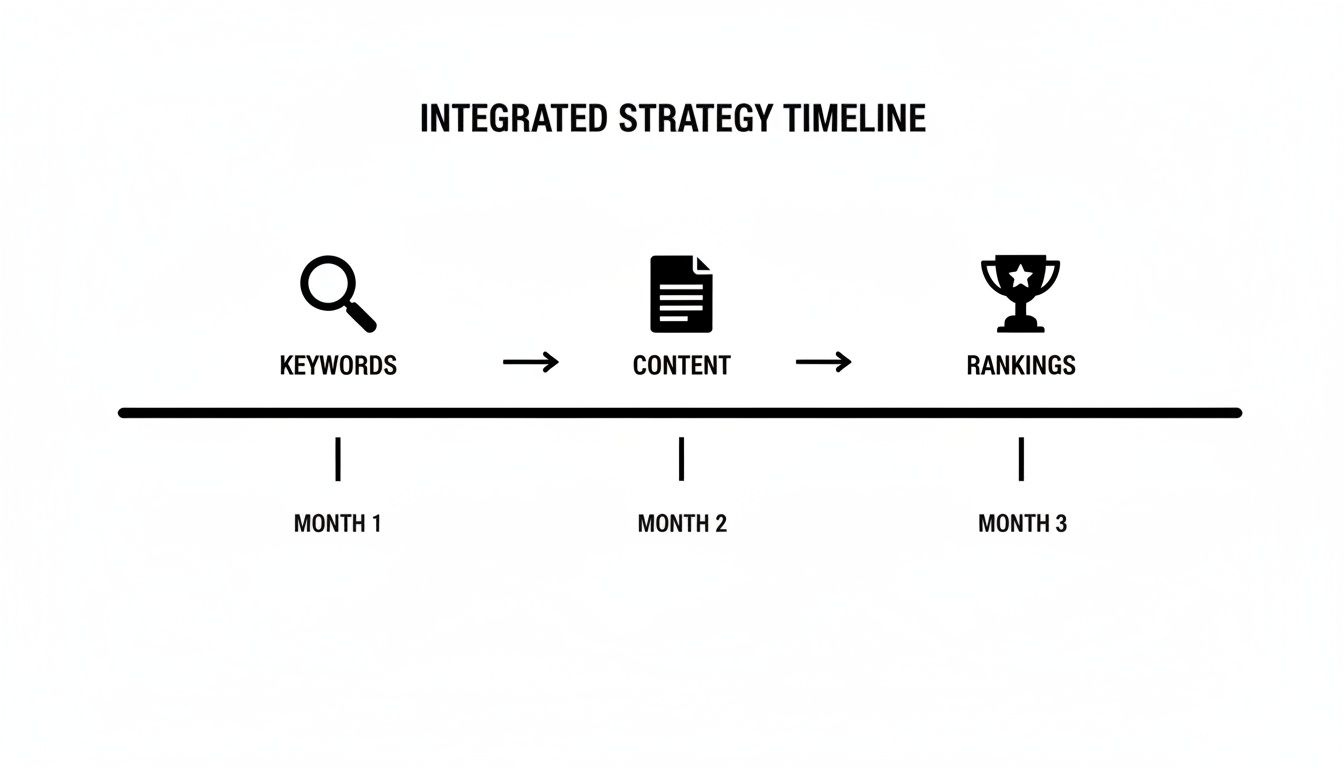
The key takeaway here is that results happen in a sequence. You can't jump straight to rankings without first creating the right content, which itself has to be informed by smart keyword discovery.
Key Deliverables You Can Expect
Throughout our partnership, you’ll receive real, tangible deliverables that give you clarity and show our progress. These aren't just fluffy reports; they're the actual building blocks of your growth and the tools we use to hold ourselves accountable.
A great strategy isn't some dense document that collects dust on a shelf. It's a living blueprint that guides daily decisions, gets the whole team on the same page, and draws a clear line from your investment to the results you want.
Here are a few of the core deliverables that form the backbone of our work together:
- Technical SEO Audit: A thorough report pinpointing issues with site speed, mobile-friendliness, and crawlability that could be holding back your search performance.
- Competitor Content Gap Analysis: A detailed breakdown of what your competitors are ranking for and, more importantly, where your biggest content opportunities are hiding.
- Content Calendar: A forward-looking schedule that maps out the topics, formats, and publishing dates for all new content, guaranteeing a steady stream of valuable information for your audience. If you want a head start on organizing your own plan, our digital marketing strategy template can be a useful guide.
- Performance Dashboards: Custom, easy-to-read reports that track the Key Performance Indicators (KPIs) that actually matter to your business, connecting our day-to-day activities directly to your bottom line.
The Three Pillars of Modern Content That Ranks
Trying to get your content to rank on Google can feel like you're chasing a moving target. But the secret isn't about gaming the algorithm or finding some hidden hack. It all comes down to building a solid foundation on three core pillars: Authority, Relevance, and Experience. When these three elements work together, you create content that doesn't just appease search engines—it connects with real people and tells a compelling story.
Think of it like a three-legged stool. If one leg is wobbly or missing entirely, the whole thing comes crashing down. Your content strategy is no different.

This is precisely why businesses are pouring serious money into their content efforts. The global content marketing market is expected to explode to $2 trillion by 2032, a staggering leap from where it stood in 2022. And with around 90% of organizations already in the game, it's clear that mastering these pillars is non-negotiable. You can dig into more of these content marketing statistics and trends to see just how big this shift is.
Pillar 1: Authority
Authority is all about proving you're the real deal—a genuine expert in your field. It's your content's way of standing up and saying, "Hey, listen up. I actually know what I'm talking about." Google wants to send its users to the most credible sources out there, and it rewards content that oozes expertise.
So how do you build it? You don't just state facts; you show your work. You create content that puts your expertise on full display.
- Original Research: Run your own surveys or studies and publish what you find. This instantly makes you a primary source of information, not just another voice repeating what others have said.
- In-Depth Case Studies: Walk readers through a client's journey from A to Z. Tell the story of the problem, the solution you implemented, and the results you delivered. Nothing proves expertise like a success story.
- Expert Interviews: Bring other recognized leaders from your industry onto your platform. By association, their authority rubs off on you.
When you consistently put out content that is meticulously researched and packed with real insight, you become the go-to resource that both people and search engines learn to trust.
Pillar 2: Relevance
Relevance is about meeting your audience right where they are, with the exact answer they're looking for. This pillar is the bridge between your deep expertise and their immediate problems. It’s what makes your knowledge useful to them.
You can't be relevant if you don't truly know who you're talking to. This goes way beyond simple keyword research; it's about getting inside your customer's head and understanding what makes them tick.
Great content doesn’t just answer a question; it anticipates the next one. It understands the user's intent so deeply that it feels like a conversation, guiding them from one insight to the next.
To nail relevance, you need to be focused on:
- Audience Personas: Create detailed profiles of your ideal customers. What keeps them up at night? What are their goals? What kind of language do they use?
- Keyword Intent: Look past the search term and figure out the why behind it. Is someone trying to learn something, compare products, or make a purchase right now?
- Customer Journey Mapping: Your content needs to address questions at every stage, from the moment someone realizes they have a problem to the point they're ready to buy a solution.
When your content is highly relevant, it speaks directly to a user's pain points. It makes them feel like you completely get them.
Pillar 3: Experience
Experience is the final, and arguably most overlooked, pillar. It’s all about how easy and enjoyable it is for someone to actually consume your content. You could write the most authoritative, relevant article on the planet, but if it’s buried on a clunky, slow-loading website or presented as a giant wall of text, people will hit the back button without a second thought.
This pillar is all about user-centric design. It's the packaging that makes your expert message digestible, engaging, and accessible.
A great user experience boils down to a few key things:
- Website Performance: Your site has to be fast, mobile-friendly, and secure. No excuses.
- Content Structure: Break things up! Use clear headings, short paragraphs, bullet points, and bold text to make your content scannable and easy to follow.
- Visual Appeal: Nobody wants to read an endless sea of black and white text. Use high-quality images, videos, and charts to illustrate your points and keep readers engaged.
When you bring Authority, Relevance, and Experience together, you get something powerful. Your expert insights become easy to find and genuinely enjoyable to read. This is the foundation of any successful SEO and content marketing services strategy that’s built to last.
How SEO Transforms Your Online Visibility
Getting to the top of Google isn't about finding a secret loophole or some magic trick. It's about a practical, intentional process. A powerful SEO strategy is built on three distinct, interconnected disciplines that work together to earn your visibility and tell your story the right way.
Think of it like building a house. You wouldn't even think about putting up walls or a roof without first pouring a solid, stable foundation. In the world of search, that non-negotiable foundation is Technical SEO.
Building a Strong Digital Foundation
Technical SEO is all the work done behind the scenes to make sure search engines can find, crawl, and understand your website without hitting any roadblocks. If Google’s crawlers—think of them as digital librarians—can’t easily read the pages on your site, even the most brilliant, persuasive content will stay invisible.
This foundational work is all about creating a seamless experience for both search engines and actual human users. We're talking about things like:
- Site Speed: Making sure your pages load in a snap, because nobody waits around for a slow website.
- Mobile-Friendliness: Ensuring your site looks and works perfectly on smartphones and tablets, where most people are searching.
- Secure Connection (HTTPS): Protecting user data is a must-have for building trust.
- Clean URL Structure: Creating simple, logical web addresses that are easy for both people and crawlers to understand.
Without a solid technical foundation, any other marketing efforts are built on shaky ground from the start.
Optimizing Every Page for a Purpose
Once the foundation is solid, the next layer is On-Page SEO. This is where the art and science of optimizing individual web pages comes in, all with the goal of ranking higher and pulling in more relevant traffic. It involves weaving targeted keywords into your content in a natural, compelling way that satisfies both search algorithms and, more importantly, human readers.
This isn't about stuffing keywords wherever they can fit. It's about crafting a clear, helpful, and engaging story for each page. This includes writing compelling title tags and meta descriptions that make people want to click, and structuring your content with logical headings (like H2s and H3s) that make it a breeze to read.
Every single page on your website should have a job. On-Page SEO is how you give each page the tools and instructions it needs to do that job effectively, whether it's to inform, engage, or convert a visitor.
This methodical approach makes sure that when someone lands on your page, they immediately know they’re in the right place.
Earning Trust Across the Web
The final piece of the puzzle is Off-Page SEO, which is all about building your website's authority and reputation online. The biggest part of this is link building—the process of earning links from other reputable websites. Think of each link as a vote of confidence or a referral from a trusted source.
When an authoritative site in your industry links to your content, it sends a powerful signal to Google that you are a credible and valuable resource. This is absolutely critical for establishing your expertise and climbing the search rankings. These "votes" tell search engines that other people trust your story and find it worth sharing.
The Power of Local SEO (GEO)
For service-area businesses like plumbers, roofers, or dentists, there's a specialized discipline that's an absolute game-changer: Local SEO, or geo-targeting. This is all about helping you dominate the search results within your specific community.
The centerpiece of any local strategy is the Google Business Profile (GBP). Optimizing your GBP helps you show up in the coveted "map pack"—that box of three local listings that appears at the very top of search results for queries like "dentist near me." In fact, an incredible 72% of consumers use Google Search to find local businesses. This makes a well-managed GBP one of the most powerful tools out there for attracting nearby customers who are ready to buy. You can discover more about how people use search engines and other valuable SEO stats you should know.
By combining a solid technical base, meticulous on-page optimization, and an authoritative off-page presence, a comprehensive SEO and content marketing services strategy transforms your website from a forgotten digital brochure into a powerful, lead-generating machine.
Using AI to Amplify Your Marketing Efforts
Let's be clear: technology isn't just a nice-to-have anymore; it's baked into the core of any marketing strategy that actually works and scales. When we talk about our seo and content marketing services, we're not using AI to replace human creativity. Far from it. We use it as a powerful assistant that turbocharges every single step of the process. This marriage of human expertise and machine-learning speed is how we build strategies that deliver predictable, data-driven results.
Think of AI as an answer engine optimizer (AEO) tool. It helps us understand user questions on a deeper level and craft content that directly answers them, making your brand the go-to source for information. It handles the grunt work, freeing up our experts to focus on the nuanced, creative storytelling that makes your brand stand out.

Accelerating Research and Strategy
The research phase is absolutely critical, but it can be a massive time sink. This is where AI first comes into play. It can tear through competitor strategies, pinpoint keyword opportunities, and uncover hidden content gaps at a speed no human team could ever hope to match. This gives us a huge head start right out of the gate.
Instead of burning weeks manually slogging through data, we get a complete picture of the competitive landscape in a matter of hours. This lets us jump right into the fun part: crafting a unique angle for your brand and figuring out how to tell your story in a way that truly connects with your ideal customer.
From there, AI helps us generate detailed content briefs and rough first drafts. This doesn't replace our writers; it empowers them. It frees them up to do what they do best: injecting your brand’s unique voice, personality, and expertise into every piece of content.
A Human-Centered, AI-Powered Approach
Our philosophy on this is simple. Use AI for what it's good at—processing massive amounts of data with incredible speed. Use humans for what they're good at—creativity, critical thinking, empathy, and storytelling. It’s this combination that’s really changing the game.
The numbers don't lie. Across the industry, 68% of companies are seeing a higher ROI from their content marketing after bringing AI into the mix, and 78% of marketers say the quality of their content has shot up because of it. It's no surprise that content creation is the number one use for AI in marketing today.
AI gives us the blueprint and the raw materials. Our team of strategists and writers are the master builders who turn it all into something exceptional—content that connects with people, persuades them, and pushes them to act.
This balance is everything. We don't just push a button, "generate," and call it a day. We use AI to build a solid foundation, and then our experts get to work refining, polishing, and perfecting it until it meets our ridiculously high standards for quality and authenticity.
Driving Performance with Advanced Analytics
Getting more out of your marketing also means being smart about repurposing content. A single, in-depth webinar, for instance, can be sliced and diced into a dozen different assets. AI makes this incredibly efficient. We can use a long-to-short video converter to quickly chop up that webinar into clips perfect for Instagram Reels or YouTube Shorts, squeezing every last drop of value out of it.
Of course, none of this matters if you can't measure it. Everything we do is tracked. We use advanced analytics platforms to keep a close eye on your key performance indicators and measure the return on your investment, ensuring your strategy is constantly being fine-tuned for better results. By tracking these numbers, you’ll get a much clearer picture of how to improve marketing ROI with data-driven insights. This data-first approach lets us pivot on a dime, doubling down on what’s working and fixing what isn't.
Choosing Your Partner and Measuring True Success
Picking an agency to handle your SEO and content marketing services is one of the most critical business decisions you’ll make. This isn't just about hiring a vendor; it’s about finding a growth partner who gets your long-term vision.
The market is flooded with agencies promising the world—quick fixes and guaranteed first-page rankings. A real partner, though, is focused on something else entirely: sustainable, profitable growth. To find the right fit, you have to ask the right questions and look beyond the surface-level promises.
Key Questions to Ask Potential Agencies
When you're vetting a potential partner, their answers to a few specific questions will tell you everything you need to know about their philosophy. A great agency will welcome this kind of scrutiny and have clear, data-backed answers ready to go.
Here are a few essential questions to kick off the conversation:
- How do you measure success beyond traffic and rankings? Their answer should immediately pivot to business outcomes like lead quality, conversion rates, and revenue. If they just talk about clicks, that’s a red flag.
- Can you share case studies or examples from our industry? This proves they understand the unique challenges and search habits of your audience, not just a generic one.
- What does your process for communication and reporting look like? You're looking for transparency, regular check-ins, and reports that clearly connect their work to your business goals.
- How do you adapt your strategy when something isn't working? A strong partner isn’t afraid to change course based on data. They see it as a normal part of the process, not a failure.
Measuring What Truly Matters
Real success in SEO and content isn't just about seeing your website at the top of Google. It's about what that visibility actually does for your business. It’s time to forget vanity metrics like impressions or broad traffic numbers. The real story is told by the Key Performance Indicators (KPIs) that directly impact your bottom line.
The ultimate goal of any SEO and content strategy is not just to be found, but to be chosen. This happens when visibility drives meaningful business actions—qualified leads, sales, and a measurable return on your investment.
These are the metrics a genuine growth partner will obsess over:
- Qualified Leads Generated: How many new, high-intent prospects are actually coming through the door?
- Conversion Rate: What percentage of your organic traffic is taking a valuable action, like filling out a form or hitting "buy now"?
- Customer Acquisition Cost (CAC): How much does it cost, really, to acquire a new customer through your organic efforts?
- Return on Investment (ROI): For every dollar you put in, how many dollars in revenue are you getting back?
Focusing on these KPIs is how you hold your agency accountable and see the tangible, bottom-line value your investment creates. It’s the difference between just getting traffic and actually growing your business.
A Few Common Questions
If you're exploring SEO and content marketing services, you probably have some questions. Getting straight answers is the first step to making a smart decision for your business. Let's tackle a few of the most common ones we hear.
How Long Until We See Results?
This is the big one, and the honest answer is: it takes time. While some quick technical fixes might give you a small, immediate bump, a real, comprehensive strategy starts showing meaningful results in about 4 to 6 months.
Think of it like this: the first couple of months are for laying the foundation—audits, strategy development, and creating that initial wave of core content. Then, you'll start to see early signs of life, like keyword rankings beginning to climb and a little more traffic trickling in. As that momentum builds, those rankings and traffic turn into actual leads and sales. It’s an investment in a predictable growth channel, not a magic bullet.
What's the Difference Between Local and National SEO?
Figuring this out is key, as it completely changes the game plan.
- Local SEO (GEO) is all about your specific geographic area. It's for businesses targeting searches like "plumber in Dallas." The strategy is laser-focused on optimizing your Google Business Profile, getting listed in local directories, and racking up customer reviews to show up in that coveted local map pack.
- National SEO is for businesses without geographic borders, like an e-commerce store or a SaaS company. Here, the goal is to cast a much wider net by creating content with broad appeal, earning links from high-authority websites, and targeting general keywords to capture a much larger audience.
The right play depends entirely on your business and where your customers are searching from.
How Much Should We Budget?
There’s no one-size-fits-all answer here. The right budget really depends on how competitive your industry is, where you're starting from online, and what your growth goals are. A local service business might see great results investing a few thousand dollars a month, whereas a national e-commerce brand will need to invest significantly more to move the needle.
A true agency partner won’t sell you a pre-packaged plan. They’ll work with you to build a budget that ties directly back to your revenue goals. That investment covers all the strategic, technical, and creative work required to drive real business growth and deliver a return you can see.
Ready to build a strategy that turns your online visibility into predictable growth? The team at Jackson Digital is here to help. Request a free performance audit to uncover your biggest opportunities today.