
Think of a marketing audit as a complete, top-to-bottom physical for your business's marketing efforts. It's a deep dive into your strategies, your day-to-day activities, and the results you're getting. The whole point is to systematically uncover what's actually working, what's just draining your budget, and where your biggest growth opportunities are hiding in plain sight—especially in how you rank on search engines and tell your brand's story.
Your Marketing Engine Deserves a Health Checkup

I like to compare it to a master mechanic inspecting your car. They aren't just looking for what's broken; they're looking for ways to boost performance, improve fuel efficiency, and make sure every single part is working in perfect harmony. That's exactly what a marketing audit does for your visibility on search engines and the stories you tell.
Instead of just glancing at surface-level numbers, this process gets its hands dirty. It’s not about pointing fingers or finding fault; it’s about gaining crystal-clear clarity. You get a complete, unbiased picture of your marketing health, which lets you make much smarter decisions about where to invest your time and money to rank higher and connect better with customers.
From Vague Guesses to a Clear Ranking Strategy
Without a regular audit, most businesses are just guessing. They might feel like their social media is telling a good story or assume their local listings are correct, but they rarely have the full picture backed by hard data. A marketing audit replaces those assumptions with a concrete, actionable roadmap for better search engine rankings and more compelling brand narratives.
This kind of systematic review helps you:
- Pinpoint Wasted Spend: Finally see which campaigns or channels are duds and shift your budget to the ones that are actually driving results.
- Strengthen Your Brand Story: Find out if your messaging is truly connecting with your target audience—the kind that makes them remember you—or if it's completely missing the mark.
- Uncover Hidden SEO and GEO Wins: Identify the technical issues or local listing inconsistencies that are holding back your search engine rankings and preventing customers from finding you.
The idea isn't new. It really started gaining steam back in the 1950s when marketing legend Philip Kotler formalized it as a way to sync up marketing activities with bigger business goals. It's essentially a performance review for your marketing, much like a financial audit, but focused on growth and efficiency. You can find more on the history of marketing analysis from top-tier research firms.
For a quick overview, here's a simple breakdown of what a marketing audit is all about.
Marketing Audit At a Glance
| Core Question | What It Does | Primary Goal |
|---|---|---|
| How are we really doing? | Provides a comprehensive, unbiased review of all marketing activities, strategies, and results. | To identify strengths, weaknesses, and hidden growth opportunities. |
| What's working and what's not? | Analyzes performance data across all channels (SEO, GEO, content) to pinpoint inefficiencies and successes. | To optimize budget allocation, improve search rankings, and maximize return on investment (ROI). |
| Are we set up for future growth? | Assesses alignment between marketing efforts and business objectives to build a strategic roadmap. | To create a clear, data-driven plan for sustainable growth and a stronger brand story. |
This table shows how an audit moves you from uncertainty to a place of strategic confidence, ensuring every marketing dollar is working as hard as it can to help you rank and resonate.
Why It's More Than Just Numbers
At the end of the day, a marketing audit is really about understanding your customers on a much deeper level. It forces you to see your business through their eyes—how they find you on search engines, what stories they actually care about, and what makes them decide to buy from you… or from your competitor.
This process is foundational for telling more compelling brand stories that resonate and convert. By knowing precisely what works, you can refine your strategies to improve everything from your website's SEO to your local GEO visibility, ensuring every marketing dollar pushes your business forward.
The Core Components of a Comprehensive Marketing Audit
To really get what a marketing audit is, you have to look under the hood. Think of it like a master mechanic diagnosing a car problem. They don't just stare at the engine and guess. They check the electrical system, inspect the fuel line, listen to the exhaust, and test the brakes—each part is examined to see how it contributes to the car's overall health.
A good marketing audit works the exact same way. It breaks down your entire marketing ecosystem into distinct, manageable pieces, focusing on what helps you rank on search engines (SEO, GEO) and what helps you tell compelling stories (Brand, AEO). By looking at each component on its own, you can spot specific weaknesses and opportunities that are impossible to see when you're just looking at the big picture.
The Six Pillars of a Marketing Health Check
Every business has its own quirks, but a truly thorough audit will always focus on six critical areas. Each piece of this puzzle gives you a different angle on your marketing's performance. When you put them all together, you get a complete, actionable roadmap for growth.
These are the core components we look at:
- Strategy and Goals: Is there a clear, documented plan, or are you just "doing marketing"? This first step checks if your daily activities are actually pushing you toward your real business objectives.
- Search Engine Optimization (SEO): How easy is it for people to find you on Google? This goes way beyond simple keyword rankings to uncover the technical roadblocks that might be making your site invisible to search engines.
- Paid Media Performance: Are your ad dollars actually working for you? We dig into your campaigns to see if you're hitting the right audience with the right message or just burning cash on clicks that go nowhere.
- Analytics and Data Integrity: Can you even trust your numbers? This is where we examine how you track performance, making sure your data is accurate and telling you the real story about what your customers are doing.
- Brand Story and Creative (AEO): Does your message actually connect with people? We review your messaging, your visuals, and your overall brand voice to see if it resonates with your ideal customers or falls flat. This is the heart of Answer Engine Optimization (AEO)—crafting content that directly answers customer questions.
- Geographic Presence (GEO): Can local customers find you when it matters? This is absolutely crucial for service-area businesses. This audit uncovers inconsistencies in online business listings that can kill your map rankings.
For example, a paid media audit might discover you're spending 80% of your budget on a keyword that has never once led to a sale. An SEO audit could find a simple technical error that's preventing Google from indexing your most important service pages.
A marketing audit shifts your thinking from "Are we spending enough?" to "Are we spending smart?" It's about making sure every single piece—from your local GEO listings to your core brand story—is fine-tuned to drive real growth.
To show how these pieces fit together, it's helpful to see what each one looks at and, more importantly, what fixing it can do for your bottom line.
Key Audit Components and Their Business Impact
| Audit Component | What It Examines | Potential Business Outcome |
|---|---|---|
| Strategy & Goals | Marketing plans, KPIs, target audience definitions, and competitor analysis. | Aligns marketing spend with revenue goals, eliminating wasted effort on low-impact activities. |
| SEO | Technical site health, on-page content, backlink profile, and keyword rankings. | Increases organic traffic and lead generation by improving visibility on search engines. |
| Paid Media | Ad campaign structure, targeting, ad copy, landing pages, and return on ad spend (ROAS). | Drives more qualified leads for less money by optimizing ad spend and improving conversion rates. |
| Analytics | Data collection setup, tracking accuracy, reporting dashboards, and goal configurations. | Provides trustworthy data for making smarter, faster business decisions. |
| Brand & Creative (AEO) | Messaging consistency, visual identity, content that answers questions, and brand story. | Builds a stronger, more memorable brand that ranks for conversational queries and fosters loyalty. |
| Geographic Presence (GEO) | Local business listings (Google Business Profile, etc.), online reviews, and map rankings. | Boosts local foot traffic and service calls by making it easier for nearby customers to find you. |
Looking at the audit through this lens makes it clear: this isn't just about checking boxes. It's about connecting specific marketing actions—like improving your local GEO signals or refining your brand's story—to tangible business results.
A Deeper Look into SEO Audits
The SEO component is often one of the most eye-opening parts of a marketing audit. It's not just about what keywords you rank for; it's about the fundamental health of your website and its ability to be found and understood by search engines. A proper SEO audit shines a bright light on the technical gremlins that could be secretly sabotaging your rankings.
This screenshot from Ahrefs' Site Audit tool shows a dashboard that gives you a "Health Score" and breaks down errors by how serious they are.
A visual like this immediately tells you where the biggest fires are—like broken links or missing page descriptions—so you can prioritize the fixes that will give you the biggest boost in search visibility.
Connecting the Dots for Maximum Impact
None of these pillars exist in a bubble. A great marketing audit connects the dots between each area to tell a cohesive story. For instance, your analytics audit might reveal that visitors from organic search (SEO) spend twice as long on your site as visitors from paid ads. That single insight tells you your content story is really clicking with searchers, and maybe your paid ad messaging needs a tweak to attract a more engaged crowd.
In today's market, this kind of structured analysis is non-negotiable. Global digital marketing spend is projected to jump by 9-12% in 2025, but just throwing more money at the problem isn't a strategy. Only a structured audit gives you the clarity to spend smarter.
For example, a post-audit strategy might involve reallocating 20% of your budget to short, 12-week experiments, a tactic known to produce higher clickthroughs and conversions. This is especially critical since paid search already dominates 39.5% of the digital ad market. You can find more insights on these digital marketing benchmarks and trends.
Understanding these components is how businesses we work with at Jackson Digital—in tough industries like construction, automotive, and ecommerce—turn raw data into a powerful, predictable engine for growth.
A Step-by-Step Framework for Your Marketing Audit
Knowing what goes into a marketing audit is one thing, but actually doing one is a whole different ballgame. The real power comes from a structured, repeatable process that turns a mountain of data into a clear plan for growth. Think of it like a recipe. If you just throw ingredients in a bowl, you’ll probably end up with a mess. But if you follow the steps, you get something effective and predictable every time.
This framework breaks the whole audit down into five manageable stages. It’s designed to take you from a place of uncertainty to one of clarity and confident decision-making. Following these steps ensures you don’t just collect numbers—you uncover the story your data is trying to tell you about how to rank higher and connect better.
Step 1: Set Clear Objectives
Before you even think about looking at a single report, you have to define what success looks like. An audit without clear goals is just an aimless scavenger hunt. Are you trying to boost qualified leads by 20%? Do you need to slash your customer acquisition cost? Is the main goal to completely dominate the local search results (GEO) for your service area?
Setting a specific, measurable objective is your North Star. It guides every other step, helping you zero in on the metrics and channels that actually move the needle for your business's search ranking and brand story. A local plumber who needs more phone calls will have totally different audit goals than an e-commerce store trying to sell nationwide.
Step 2: Gather Your Tools and Data
With your objectives locked in, it’s time to gather your raw materials. This means getting access to the key platforms that hold the story of your customer’s journey. Don’t get overwhelmed here; just focus on the primary sources of truth for SEO and GEO performance.
You’ll need to pull information from a few key places:
- Google Analytics 4 (GA4): This is the central hub for understanding how people actually behave on your website.
- Google Search Console (GSC): Your direct line to Google, showing exactly how your site is performing in search results.
- Google Business Profile Insights: Absolutely critical for any local business to see how customers are finding them on Maps and in local search.
- Paid Media Platforms: Think Google Ads or Facebook Ads Manager. This is where you analyze ad performance and spend.
The key is to look past vanity metrics like total traffic. Instead, dig for the numbers that tell a story. For example, a sky-high bounce rate on a key service page is a clear sign that the page isn't giving visitors what they expected, hurting both your brand story and your SEO.
Step 3: Analyze Each Marketing Channel
Now, the real detective work begins. Go through each of your marketing channels one by one—SEO, GEO, AEO (Content), Paid Media—and see how it’s performing against the objectives you set in Step 1. This is where you conduct mini-audits within the larger framework to pinpoint specific strengths and weaknesses.
For your SEO, you'll examine technical health, on-page optimization, and your backlink profile. For your GEO presence, you’ll audit the consistency of your business name, address, and phone number (NAP) across every online directory. For your brand story (AEO), you'll assess if your content actually answers the questions your customers are asking. Each channel gets its own thorough inspection. For those looking to get granular with their blog posts and articles, a solid content audit template can provide an excellent starting point.
This is where you start with the big picture and drill down into the details.
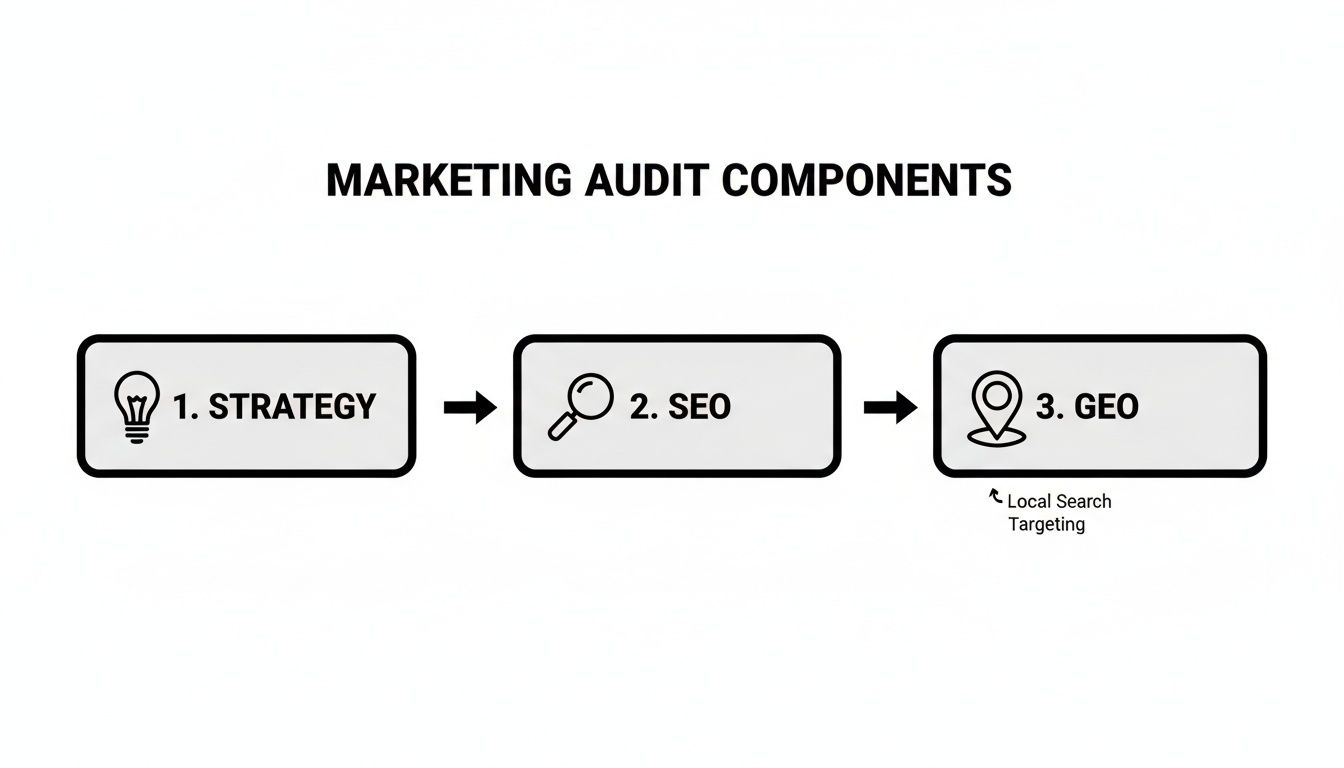
As the visual shows, a successful audit always starts with a clear strategy, which then informs the detailed analysis of things like search engine performance (SEO), local visibility (GEO), and your brand's narrative.
Step 4: Connect the Dots and Identify Insights
This is the most important step of all. Data by itself is just noise; insights are what drive real growth. Your job now is to weave your findings from each channel into a single, cohesive story. Don’t just list off problems—connect them to show cause and effect.
For instance, you might find that your paid ads have a fantastic click-through rate (Insight 1), but your landing pages have a terrible conversion rate (Insight 2). The story here isn't just "the landing pages are bad." The real insight is that there’s a massive disconnect between the story your ad promises and the story your page delivers. Now that is a powerful, actionable insight for improving your ranking and conversions.
The goal is to move from observation ("our local rankings are low") to diagnosis ("our local rankings are low because our business information is inconsistent across 25 different directories, confusing search engines").
Step 5: Build Your Action Plan
Finally, it’s time to turn those insights into a prioritized action plan. Not all problems are created equal, so you need to organize your fixes based on two simple factors: impact on ranking/storytelling and effort to implement. What tasks will deliver the biggest results for the least amount of work? Start there.
Create a straightforward document that outlines:
- The Task: What specifically needs to be done (e.g., "Fix all 404 errors on the website").
- The 'Why': The insight that justifies this task (e.g., "Broken pages hurt user experience and waste SEO authority").
- Priority Level: High, Medium, or Low, based on that impact vs. effort calculation.
- Ownership: Who is on the hook for getting it done.
This turns your audit from a report that collects dust on a shelf into a living, breathing roadmap for improving your marketing. If you need a hand structuring this final step, our comprehensive digital marketing strategy template can guide you in creating a clear, actionable plan that gets results.
Essential Tools and Metrics for Your Audit
A powerful audit runs on solid data. Without the right tools and a clear understanding of what the numbers mean, you’re just navigating in the dark. We'll break down the essential tools and metrics you'll need, making the technical side of a marketing audit feel much more manageable.
Think of it this way: a doctor wouldn’t diagnose a patient without a stethoscope or blood pressure cuff. Similarly, you can’t get a clear picture of your marketing health without the right instruments to measure your SEO, GEO, and AEO performance. These tools provide the raw data, but your real job is to interpret that data and uncover the story it’s telling about your business.
Tools for SEO and Website Health
To understand how you stack up on search engines like Google, you need tools that can see your website the way a search crawler does. These platforms reveal your site's technical foundation and how it's perceived online, which is the bedrock of ranking well.
- Google Search Console (GSC): This is your direct line to Google, and using it is non-negotiable for any serious SEO audit. GSC tells you exactly which keywords people are using to find you, flags technical issues that hurt rankings, and shows your click-through rates straight from the search results.
- Ahrefs or Semrush: Think of these as the Swiss Army knives of SEO. They let you analyze your backlink profile, track keyword rankings over time, and spy on competitor strategies to find gaps you can exploit to rank higher.
- Screaming Frog SEO Spider: This tool crawls your website just like Googlebot would, creating a detailed report of technical hiccups like broken links, duplicate content, and missing meta descriptions that can kill your rankings.
Tools for GEO and Local Visibility
For any business with a physical location or service area—plumbers, dentists, restaurants—local visibility is everything. A GEO audit focuses on making sure local customers can find you at the exact moment they need you, which is key to winning local search.
The primary tools here are:
- Google Business Profile (GBP) Insights: This is the dashboard for your most important local asset. It shows how many people called you directly from your listing, requested directions, or visited your website after finding you on Google Maps. It’s pure gold for local SEO.
- Moz Local or BrightLocal: These platforms are essential for managing your citations—the mentions of your business name, address, and phone number (NAP) across the web. They scan hundreds of online directories and flag inconsistencies that confuse search engines and tank your local rankings.
The Central Hub: Google Analytics 4
While other tools are specialists, Google Analytics 4 (GA4) is the central command center for understanding user behavior. It tells you what happens after someone lands on your site, which is arguably the most important part of your brand's story.
Here is an example of a GA4 dashboard showing user acquisition data.
This report doesn't just show traffic numbers; it tells you where your most valuable visitors come from. This insight helps you decide whether to double down on your SEO efforts, pour more budget into paid ads, or refine the story on your social media channels.
A metric is never just a number; it's a narrative. A high bounce rate, for instance, is a story that your landing page promise doesn't match the user's expectation. Interpreting these stories is the core of a successful audit.
Key Metrics and What They Really Mean
Data is useless without interpretation. The goal is to connect these numbers to real business outcomes, especially how they impact your ability to rank on search engines and tell a compelling story.
Here are a few critical metrics and the stories they tell:
- Organic Traffic: This shows how many people find you through search engines without you paying for an ad. A steady increase means your SEO strategy and content story are paying off.
- Conversion Rate: This is the percentage of visitors who take a desired action, like filling out a form or making a purchase. A low conversion rate is a huge red flag that your website's story isn't persuasive enough.
- Customer Acquisition Cost (CAC): This metric tells you how much you spend, on average, to gain one new customer. Understanding and lowering this number is fundamental to profitable growth. You can explore our free customer acquisition cost calculator to see how different marketing channels impact this crucial figure.
- Bounce Rate: This represents the percentage of visitors who leave your site after viewing only one page. A high bounce rate on a key service page often means there's a disconnect between the user's search query and the story your page actually delivered.
How Marketing Audits Create Real-World Wins
Theory is one thing, but seeing how a marketing audit actually drives tangible results is what really matters. An audit isn't just some report that collects dust on a shelf; it’s a strategic tool that shines a light on specific, fixable problems in your SEO, GEO, and brand story, turning them into measurable business growth.
These stories show how a deep-dive analysis can completely change a company’s trajectory just by focusing on the right issues. Let's look at three quick, real-world examples of how different types of audits created some serious wins. Each case study is simple: the problem, what the audit found, and the powerful outcome.

The Local HVAC Company That Tripled Its Calls
First up, a local HVAC company was struggling to stand out in a jam-packed market. They felt totally invisible on Google Maps and couldn’t figure out why competitors were getting all the service calls.
- The Problem: An inconsistent and confusing online presence, killing their local search ranking.
- The Audit's Discovery: A GEO (Geographic Presence) audit revealed their business name, address, and phone number were listed differently across more than 30 online directories. This inconsistency was confusing Google and absolutely tanking their local search authority.
- The Outcome: By systematically correcting every single listing to be uniform, their local search ranking skyrocketed. The result? A 250% jump in qualified phone calls coming directly from their Google Maps listing within three months.
The E-commerce Store That Boosted Sales by 22%
Next, picture an e-commerce store with solid website traffic but seriously disappointing sales. Customers were adding items to their carts but bailing before checkout, and the owners were completely baffled.
- The Problem: High cart abandonment and frustratingly low conversions.
- The Audit's Discovery: An in-depth SEO and user experience audit identified a critical culprit—slow page load times. Their product and checkout pages took over six seconds to load, causing nearly 40% of users to leave. This poor experience was damaging their search rankings and their brand story.
- The Outcome: After they implemented technical fixes to optimize image sizes and streamline code, the site's speed improved dramatically. This simple change led directly to a 22% increase in completed sales, proving that technical SEO and revenue are joined at the hip.
The B2B Software Firm That Doubled Demo Sign-Ups
Finally, a B2B software firm was attracting traffic from industry professionals but just couldn't get them to sign up for a product demo. Their message simply wasn't connecting.
- The Problem: Low engagement and poor lead generation because the brand story was wrong.
- The Audit's Discovery: A comprehensive brand and content audit (AEO) showed their homepage messaging was crammed with overly technical jargon. It spoke to engineers, not the decision-makers who held the budget. The story was confusing and failed to answer the fundamental question: "How does this make my life easier?"
- The Outcome: They rewrote their homepage, simplifying the story to focus on solving the customer’s main pain point. That clarification alone resulted in a 50% increase in demo sign-ups in just one quarter.
These examples all point to one core truth: a well-executed marketing audit gives you a clear, data-backed roadmap to success. By diagnosing the root cause of a problem—whether it’s in SEO, GEO, or brand messaging—you can implement precise fixes that generate real returns.
Ultimately, the goal of a marketing audit is to pinpoint these opportunities and provide actionable strategies on how to improve marketing efficiency across all your campaigns. Exploring our full suite of digital marketing audits can help you uncover similar wins for your own business.
DIY Audit vs Hiring an Agency
Alright, we’ve walked through the framework and the tools you can use. This brings us to the big question: should you roll up your sleeves and do this yourself, or is it time to call in the pros?
There’s no single right answer here. It really boils down to your business's current situation, the resources you have on hand, and how fast you want to improve your search rankings and brand story.
The Do-It-Yourself (DIY) route is a fantastic place to start, especially for newer businesses. It costs you time, not money, and the hands-on experience is priceless. Digging into your own Google Business Profile or Search Console data gives you a real feel for what actually moves the needle with your local and organic search results.
But hiring a professional agency brings a completely different kind of firepower to the table. Agencies offer deep, specialized expertise in SEO, GEO, and storytelling, plus a fresh, unbiased perspective. They also have access to premium analytics tools that are often too expensive for a single business. They’ve seen what works for ranking and what doesn’t across hundreds of different companies.
Making the Right Choice for Your Business
The decision often becomes clear when you look at specific scenarios. A brand-new startup, for instance, can get a ton of value from a focused DIY audit of their Google Business Profile. This hands-on approach helps them understand their local market without a hefty upfront investment.
On the other hand, think about an established company in a cutthroat market. They need a sharper edge. For them, a comprehensive, professional review from an agency can uncover subtle opportunities in SEO and paid media that a DIY audit would almost certainly miss. This isn't just about spotting problems; it's about hitting the accelerator on your growth.
An expert partner like Jackson Digital acts as a strategic accelerator for businesses serious about growth. We turn the complex data from a marketing audit into a clear, prioritized roadmap designed to increase your search engine rankings and drive predictable revenue.
Ultimately, the choice is between learning the ropes yourself or investing in specialized expertise to get results faster. The DIY path builds your knowledge, while an agency leverages its own to build your bottom line.
Common Questions About Marketing Audits
To wrap things up, let's tackle a few of the most common questions that come up when businesses start thinking about what a marketing audit really involves. These quick answers should clear up the most important points.
How Often Should I Run a Marketing Audit?
Think of it like a personal health check-up. We always recommend a deep, comprehensive audit at least once a year. This gives you a full, 360-degree view of your entire marketing engine and how well it’s actually driving your business goals.
Alongside that big annual review, it's smart to run smaller, channel-specific check-ups every quarter. This approach keeps you nimble and lets you adapt quickly to market shifts, making sure your SEO, local (GEO), and paid media efforts are always pulling their weight and helping you rank.
What's the Biggest Mistake People Make With Audits?
The most common pitfall we see is getting completely lost in the data and missing the human story behind it. An audit isn't just about crunching numbers; it’s about understanding why your customers behave the way they do and what stories will resonate with them.
Another huge mistake is gathering incredible insights but failing to create a prioritized action plan. An audit's real value comes from the changes it inspires to improve your ranking and storytelling, not the report itself. Without clear next steps, it's just an expensive research project with no ROI.
The goal is to move from data collection to strategic action. An audit should always end with a clear, prioritized roadmap that shows you exactly what to do next to improve your search rankings and tell a better story.
Can an Audit Really Improve My Local Rankings?
Absolutely. For any local service business, a GEO-focused audit is one of the most powerful tools in your arsenal for climbing the local search and map rankings.
It works by systematically finding and fixing all the little inconsistencies in your business listings scattered across the web. From there, it's about optimizing your Google Business Profile to match what local customers are searching for and building stronger local signals that search engines love. This whole process is designed to make sure local customers find you first, not your competition.
Ready to stop guessing and start growing with a strategy backed by data? The expert team at Jackson Digital can conduct a comprehensive marketing audit to uncover your biggest growth opportunities. Get your free performance audit today!