An SEO report is your digital marketing scoreboard, but it's also your business's growth story. It’s a document that cuts through the noise of complex performance data and tells a clear narrative about your website's health online. At its core, it tracks crucial metrics like organic traffic, keyword rankings, and conversions to show you exactly how your investment in search engine optimization, local search (GEO), and even answer engine optimization (AEO) is paying off.
What Is An SEO Report? Your Digital Scoreboard
Think of your business as a team competing in a huge digital arena. Your SEO report is that big scoreboard in the stadium—it tells you if you're winning, losing, or just holding steady. It goes beyond raw numbers, weaving together a narrative of your progress and showing how well your strategies are connecting with your audience on Google and other search platforms.
Without this report, you’re essentially flying blind. You could be sinking time and money into new content and technical website fixes, but you’d have no real way to know if any of it is actually helping you rank and tell your story. This report is your tool for clarity, accountability, and strategic direction.
The Story Beyond the Numbers
A good SEO report doesn't just list metrics. It connects them to tell a story that justifies your marketing budget and helps you make smarter decisions. It draws a straight line from a specific action—like optimizing a service page for local search or earning a new backlink—to a real business result, like more phone calls, online orders, or qualified leads.
This is where data becomes a powerful narrative. You can see this transformation in action across all kinds of businesses, whether you're a local plumber tracking "near me" searches (GEO) or an e-commerce brand watching your organic revenue climb through better product visibility (SEO). The goal is to move from just collecting data to understanding its meaning, which is the heart of marketing analytics.
To see how the pros do it, it's worth checking out how modern search engine marketing reporting turns piles of raw data into genuinely useful strategic insights.
Proving Your ROI in a Competitive Market
Ultimately, an SEO report is all about proving your return on investment (ROI) and telling the story of your growth. With Google projected to handle 8.5 billion searches every day and holding nearly 90% of the market share in 2026, being visible isn't just nice—it's essential for survival and growth.
For the small and medium-sized businesses we work with—from dentists to construction companies—this report isn't just a collection of charts. It's the hard evidence that their digital marketing is fueling real-world growth, helping them rank higher and connect with their community.
Focusing on Metrics That Truly Matter for Growth
A great SEO report isn't about throwing every piece of data at the wall to see what sticks. It's about telling a story—your growth story. It cuts through the endless noise to spotlight the Key Performance Indicators (KPIs) that actually help you rank your business and drive it forward. After all, not all data is created equal.
Some metrics look impressive but don't really move the needle. Getting a thousand new website visitors is a "vanity metric" if none of them become customers. It's like having a restaurant packed with people who never order a thing. A truly useful report shifts the focus from "how many?" to "how valuable?" by telling a story of customer engagement and conversion.
Connecting SEO Data to Business Results
The real purpose of an SEO report is to draw a straight, undeniable line from your digital marketing efforts to your bottom line. It has to translate abstract ideas like "keyword rankings" into tangible business outcomes like "more qualified leads." This is what turns a spreadsheet of data into a compelling narrative for your strategy.
Here’s how core SEO metrics actually translate into real-world value and help you rank:
- Organic Traffic Growth: This isn't just a number going up. It's a direct measure of how many more potential customers, who are actively looking for what you offer, are finding your business. Every qualified visitor is a new opportunity to tell your story.
- Keyword Ranking Improvements: When you climb the ranks for your most important keywords, your brand's visibility and authority skyrocket. For a local plumber, ranking for "emergency plumber near me" (GEO) means their phone rings the moment a pipe bursts. That's real, immediate business.
- Quality Backlinks: Forget the numbers game. A single, authoritative backlink from a respected industry site is worth more than a hundred low-quality links. These are votes of confidence that tell Google your site is a credible source, boosting your ability to rank for competitive terms.
An effective report makes the link between your strategy and your revenue undeniable. It tells stakeholders the story of how optimizing a product page or publishing a new blog post led to a measurable increase in goal completions, form submissions, or sales.
Tailoring Metrics to Your Business Model
The most important metrics will always depend on your specific business goals. The story an e-commerce brand needs to tell is wildly different from what matters to a local service business.
Take a dentist in Dallas, for example. Their SEO report should be laser-focused on their Google Business Profile performance. They'll want to see clicks-to-call, direction requests, and how they’re ranking in the local Map Pack (GEO). Their story is all about dominating local search to fill their appointment book.
On the other hand, an online clothing store will fixate on KPIs like organic revenue, conversion rate by landing page, and the average order value from search traffic. Their report tells a story about turning search visibility into direct, profitable sales. Ultimately, a great report tells your unique growth story, using the right data to prove what's working and light the way forward.
How to Turn SEO Data Into Actionable Strategies
Data is only valuable when it inspires action. An SEO report isn't a history book of past performance; it’s a living roadmap telling you where to go next. The real skill is learning to read the data's story and transform raw numbers into your next strategic move to rank higher.
Think of yourself as a detective. If organic traffic suddenly drops, your report is the case file. You start by looking for clues: Was there a Google algorithm update? Did a high-value backlink disappear? Or did a competitor just release a major piece of content that knocked you out of a top spot? The data tells a story, and your job is to uncover the plot and write the next chapter.
Conversely, what if a cluster of keywords around a specific service starts gaining traction? This is a huge opportunity. The report is telling you there's unmet demand. Your immediate action is to capitalize on that momentum by creating more in-depth content—blog posts, case studies, or service pages—that directly addresses what those searchers are looking for. This is how you turn a small win into a major source of leads and improve your AEO (Answer Engine Optimization).
Distinguishing Signals From Noise
One of the biggest challenges for any marketer is telling the difference between a minor fluctuation and a significant pattern that requires a strategic pivot. A slight dip in traffic for one day is just noise. But a steady decline over three consecutive weeks? That's a clear signal that something is wrong. An SEO report helps you zoom out and see these long-term trends, providing the context for your story.
This process flow shows how key growth metrics are all connected.
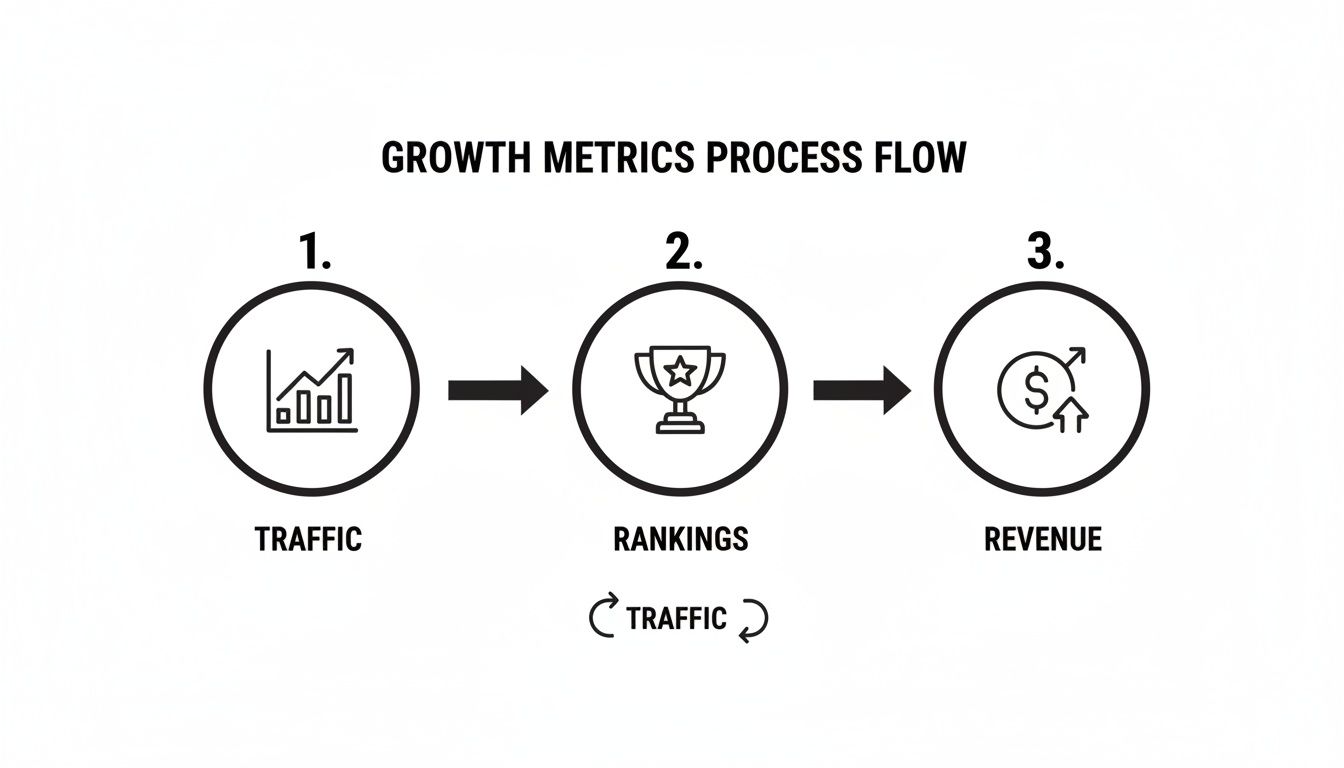
As you can see, it's a powerful feedback loop: increased traffic often leads to better rankings, which in turn can drive more revenue.
The goal is to shift your mindset from passively receiving data to actively using it as a guide. Your report becomes a prioritization tool for the next month's tasks, telling you exactly where your time and budget will have the biggest impact on ranking your business.
For a deeper dive into this approach, you can explore the principles of data-driven growth marketing.
Your SEO report should answer one simple question every month: "Based on this story, what is the single most important thing we should do next to grow our rankings and revenue?"
This proactive approach transforms the report from a simple update into your most powerful strategic asset. The ultimate goal of any report is not just to present data but to provide a clear path forward. This applies to all aspects of business, and you can learn more about the broader strategies for turning data into actionable insights for business growth. When you get this right, you're not just doing SEO; you're building a predictable engine for new business.
Customizing Reports for Different Business Goals
A generic, one-size-fits-all report tells a generic story. And generic stories don't get budgets approved or prove your worth. To really show the value of your SEO work and how it helps you rank, you have to customize your reports to reflect specific business goals and the unique quirks of each industry.
Think of it like this: a tailored suit versus one off the rack. One fits perfectly and highlights all the best features, while the other is just… passable. Your report's structure should change dramatically depending on the business model. This customization is what turns a pile of data into a compelling story that stakeholders can actually understand and act on.
Reports for Local Service Businesses
When you're dealing with local service businesses—think plumbers, roofers, or dentists—the entire game is about hyperlocal dominance (GEO). Success for them isn't about nationwide traffic; it's about how many people in their specific service area find them when they have an immediate need. A customized SEO report for them needs to tell this local story.
Their report must be laser-focused on:
- Google Business Profile Performance: We're talking clicks-to-call, requests for driving directions, and messages sent directly from their profile. These aren't just metrics; they are direct customer actions.
- Local Pack Rankings: How visible are they for critical "near me" and "service in [city]" searches? This is prime digital real estate for any local business.
- Geotagged Keyword Performance: Are they showing up for terms like "emergency HVAC in Denver"? You have to track the keywords that bring in paying customers and tell the story of their local search success.
Reports built this way prove tangible ROI. For example, for trades like construction and HVAC, a smart local SEO strategy can deliver a staggering 678-681% return on investment over three years. The break-even point can be as quick as five months. This makes sense when you see that 60% of their web traffic is mobile and 46% has local intent, making GEO a huge part of their success story. You can dig into more of these industry-specific returns on semrush.com.
Reports for E-commerce and B2B Brands
The narrative completely flips when you’re working with businesses that operate on a national or global scale. An e-commerce brand’s report is all about one thing: turning organic visibility into direct sales. Their report needs to tell the full story of the customer journey, from the initial search right through to the checkout.
Key metrics for an e-commerce report should include:
- Organic Revenue: The bottom line. How much money did our efforts to rank higher bring in?
- Product Page Traffic: Are people landing on the pages that actually sell things?
- Conversion Rate by Channel: How does organic search stack up against paid ads, social media, and other channels in our growth story?
For B2B companies, which often have much longer sales cycles, the report tells a story of lead generation and building authority. It should highlight metrics like the number of qualified leads from organic search, downloads of whitepapers, and where they rank for high-intent, problem-solving keywords (AEO). This targeted approach ensures the report always speaks the language of the business it serves.
Essential Tools and Templates for Building Your Report

Putting together a clear and comprehensive SEO report doesn't require a data science degree. The real skill is knowing which tools to use and how to frame the data into a compelling story. With the right setup, you can turn a pile of complex information into a powerful narrative of growth and opportunity.
The trick is to pull the most meaningful data from a few industry-standard platforms. Each tool gives you a unique piece of the puzzle, and when you combine them, you get a complete picture of your performance and ranking progress. If you need a hand structuring your thoughts, our free digital marketing strategy template is a great place to start.
Core Data Collection Tools
Your reporting toolkit should include a mix of platforms to cover all your bases, from what’s happening on your site to how you stack up against the competition.
- Google Analytics 4 (GA4): Think of this as your inside source on user behavior. It tells you everything about what visitors do after they land on your site—tracking organic traffic, goal completions, and user engagement.
- Google Search Console (GSC): This is your direct line to Google, revealing exactly how the search engine sees your site. It’s packed with crucial data on keyword rankings, click-through rates, and technical health issues like indexing errors.
- Ahrefs or Semrush: These all-in-one SEO platforms are indispensable for competitive analysis. They let you track keyword movements, analyze your backlink profile, and get a clear view of what your competitors are doing to rank.
An SEO report demystifies your return on investment, painting a vivid picture of how SEO fuels business growth. With Google's projected 94.35% mobile search dominance by 2026 and users spending hours on their devices, modern reports must emphasize mobile metrics to capture the 60% mobile traffic share and tell a mobile-first story.
A Flexible Report Template
While every report needs to be customized for its audience, having a solid structure ensures you never miss the essentials. Start with a simple framework like this and adapt it to fit any business story.
- Executive Summary: Kick things off with a one-paragraph overview of the key takeaways. What was the chapter of this month's story? What were the biggest wins and most pressing challenges? Keep it short and to the point.
- KPI Dashboard: This is your visual snapshot. Use charts and graphs to show trends for your most important metrics like organic traffic, keyword rankings, and conversions. Make it easy to digest at a glance.
- Narrative Analysis: Here's where you tell the story behind the numbers. Don't just show a chart going up; explain why it went up and what that means for the business's ability to rank and attract customers. This is where your expertise shines.
- Forward-Looking Action Plan: Based on this month's chapter, what's next? Outline the top 2-3 priorities for the coming month to show you’re not just reporting on the past, but actively shaping the future.
How to Communicate SEO Success to Stakeholders
Even the most detailed, data-packed SEO report is completely useless if it doesn't land with your audience. The last and most critical step is turning all those numbers and charts into a story that actually connects with the people signing the checks and setting the strategy. This is less about data science and more about the art of communication.
Presenting your findings is never a one-size-fits-all deal. You have to learn to speak the language of your audience, framing the narrative around what they truly care about—ranking their business and seeing a return. A report is only a success if it sparks action and builds confidence in your SEO efforts.
Tailoring Your Narrative for Different Audiences
Your story needs a different angle depending on who’s in the room. Trying to explain the nuances of keyword clustering to your CEO is just as pointless as showing your marketing team a high-level ROI chart with no tactical details. The real key is matching the message to the listener.
- For the C-Suite (CEOs, CFOs): Keep your focus on the big picture and the bottom line. They care about market position, revenue, and return on investment. You'll want to frame your results in terms of competitive market share gained, organic revenue growth, and the cost-effectiveness of SEO compared to other channels. Tell them the story of business growth.
- For Your Marketing Team: This is where you can go deep on tactical performance. It’s your chance to dig into channel-specific metrics, figure out what’s working, and strategize about what comes next. Highlight things like conversion rate by landing page, backlink velocity, and technical site health improvements that will help you rank higher.
The goal is to transform your SEO report from a simple data dump into a powerful tool for building trust. It should tell a compelling story about the immense value of your SEO program and secure the buy-in needed to keep growing.
Establishing a Consistent Reporting Cadence
Consistency is the bedrock of good storytelling. A regular reporting schedule builds anticipation and makes SEO a core part of the business conversation, not just a random update. This rhythm helps stakeholders spot trends over time, letting them see the difference between a one-off traffic spike and real, sustainable growth.
Pick a format and stick with it. This builds familiarity and makes each new report easier to digest than the last. Whether it's a monthly PDF, a live dashboard, or a formal presentation, a consistent structure helps everyone know exactly where to find the info that matters most to them. This simple practice turns reporting from a chore into a trusted, strategic ritual.
Frequently Asked Questions About SEO Reports
Jumping into the world of SEO often brings up more questions than answers. An SEO report is a huge piece of that puzzle, but it's natural to have some practical concerns about how they work and what you should really expect from one. This section is all about clearing up those common questions business owners like you ask every day.
We've pulled together the top queries to give you direct, no-fluff answers. The goal is to help you get a better handle on what a genuinely useful SEO report delivers and how it should slot into your overall growth strategy.
How Often Should I Get an SEO Report?
For most businesses, a monthly report is the industry standard for a good reason. It's the sweet spot. This cadence is frequent enough to track momentum and make smart adjustments, but it's also long enough to see real trends emerge from the day-to-day noise. Think of it as the perfect interval for the story of your SEO efforts to unfold chapter by chapter.
A monthly review gives you a clear picture of what your strategies are actually achieving and lets you plan the next month with confidence. While a quick peek at weekly data can be useful for specific campaigns, the full, strategic narrative of an SEO report is best told month by month.
What Is the Difference Between a Report and a Dashboard?
Great question. Here’s a simple way to think about it: a dashboard is the live scoreboard during the game, while a report is the detailed post-game analysis with expert commentary.
A dashboard, like the one in your Google Analytics account, gives you real-time data. It's fantastic for keeping a finger on the pulse day-to-day. But a formal SEO report adds the two most critical layers: narrative and insight. It doesn't just show you the numbers; it explains the "why" behind them, interprets the story the data is telling, and lays out a strategic game plan for how to rank better. Any solid SEO strategy uses both—the dashboard to stay informed and the report to drive decisions.
My Traffic Is Up but Leads Are Down. What Should a Report Tell Me?
This is exactly where a great SEO report proves its worth by telling the full story. It should go way beyond just traffic volume and start analyzing the quality of that new audience. The report needs to pinpoint which specific keywords and pages are bringing in all those new visitors.
For instance, maybe you're suddenly ranking for informational keywords (like "how to fix a leaky faucet") instead of commercial-intent keywords ("plumber near me"). The report should connect that finding to on-page metrics like conversion rates, showing that while your visibility is up, the new traffic isn't made up of qualified customers. The story is that you're attracting the wrong audience.
The report's job is to diagnose this mismatch. It should wrap up with a clear recommendation to refocus your strategy on keywords that attract people who are ready to buy, ensuring your traffic growth actually translates into leads, sales, and a happier ending to your business story.
Ready to see how a clear, customized SEO report can tell the story of your business's growth? Jackson Digital creates data-driven strategies that turn insights into revenue. Get your free performance audit and start making smarter marketing decisions today at https://jackson-digital.com.