Data-driven marketing isn't some complex, futuristic concept. At its core, it's the practice of using real customer information—not guesswork—to shape and sharpen your marketing strategy. It’s about listening to the stories your data tells you to rank higher on search engines and connect with your audience.
It’s all about making smarter decisions. Decisions that ensure every message connects, every ad dollar is put to good use, and every campaign nudges you closer to your business goals.
Why Data-Driven Marketing Matters Now
Imagine you're a chef who never tastes their own cooking. You follow a recipe, send the dish out to the dining room, and just hope for the best. For a long time, that's how marketing worked—it was based on assumptions and gut feelings.
Data-driven marketing completely flips that script. It’s like being a chef who constantly tastes, gets real-time feedback from diners, and tweaks the recipe on the fly to create the perfect meal.
Instead of casting a wide, expensive net and hoping to catch a few customers, you use actual insights to connect with the right people, at the right time, with the right message. This is how marketing stops being a cost center and becomes a predictable engine for growth.
Before we dive deeper, let's look at a quick comparison that really highlights the shift.
Traditional vs Data-Driven Marketing Approaches
| Aspect | Traditional Marketing ('Guesswork') | Data-Driven Marketing ('Informed Decisions') |
|---|---|---|
| Strategy | Based on assumptions, gut feelings, and past experiences. | Based on customer data, behavior analysis, and real-time feedback. |
| Audience | Broad, generic segments (e.g., "women aged 25-40"). | Highly specific, micro-segmented audiences (e.g., "previous buyers who viewed X but didn't purchase"). |
| Messaging | One-size-fits-all communication. | Personalized, relevant messages tailored to individual needs and behaviors. |
| Measurement | Difficult to track ROI; relies on vanity metrics like impressions. | Clear, measurable KPIs tied directly to business goals (e.g., conversion rate, customer lifetime value). |
| Optimization | Campaigns are set and run, with adjustments made after the fact. | Campaigns are continuously tested and optimized in real-time using A/B tests and analytics. |
| Budgeting | Often allocated based on historical spending or intuition. | Allocated dynamically to the channels and campaigns delivering the best results. |
This table makes it crystal clear: one approach is like throwing darts in a dimly lit room, while the other is like using a laser-guided system. The results, unsurprisingly, are worlds apart.
The Shift from Guesswork to Growth
The core idea is refreshingly simple: every click, purchase, and website visit tells a story about what your audience wants. By actually listening to these stories, you can build campaigns that feel personal and genuinely helpful, not intrusive and annoying.
This approach is becoming fundamental, yet a surprising number of businesses are still struggling to get it right. In fact, nearly 20% of marketers say that adopting data-driven strategies is one of their biggest hurdles. This highlights a huge gap between knowing it's important and actually putting it into practice. You can discover more insights about these marketing challenges on improvado.io.
This data-informed mindset is also critical for modern search visibility, which has evolved way beyond old-school SEO. It's the foundation for ranking in:
- SEO (Search Engine Optimization): Understanding user search data to create content that perfectly matches what they're looking for.
- GEO (Generative Engine Optimization): Providing clear, authoritative data that AI-powered search engines, like Google's SGE, use to generate direct answers.
- AEO (Answer Engine Optimization): Structuring your information so it becomes the go-to source for voice assistants like Alexa and Siri.
In essence, data-driven marketing isn’t just another buzzword. It's a strategic shift toward understanding your customers so deeply that you can anticipate their needs and become the undeniable answer to their questions, no matter how they ask. This approach isn't optional anymore; it's the new standard for building sustainable visibility and telling a brand story that truly connects.
The Core Components of a Data-Driven Strategy
To shift your marketing from guesswork to a predictable growth engine, you have to understand the essential parts. A solid data-driven marketing strategy isn't about a single tool or tactic; it's a machine with four interconnected components all working in sync. When you master each one, you can turn raw information into compelling brand stories that actually get people to act.
This visual shows that simple but powerful shift—moving away from intuition and toward using data to fuel real, measurable growth.
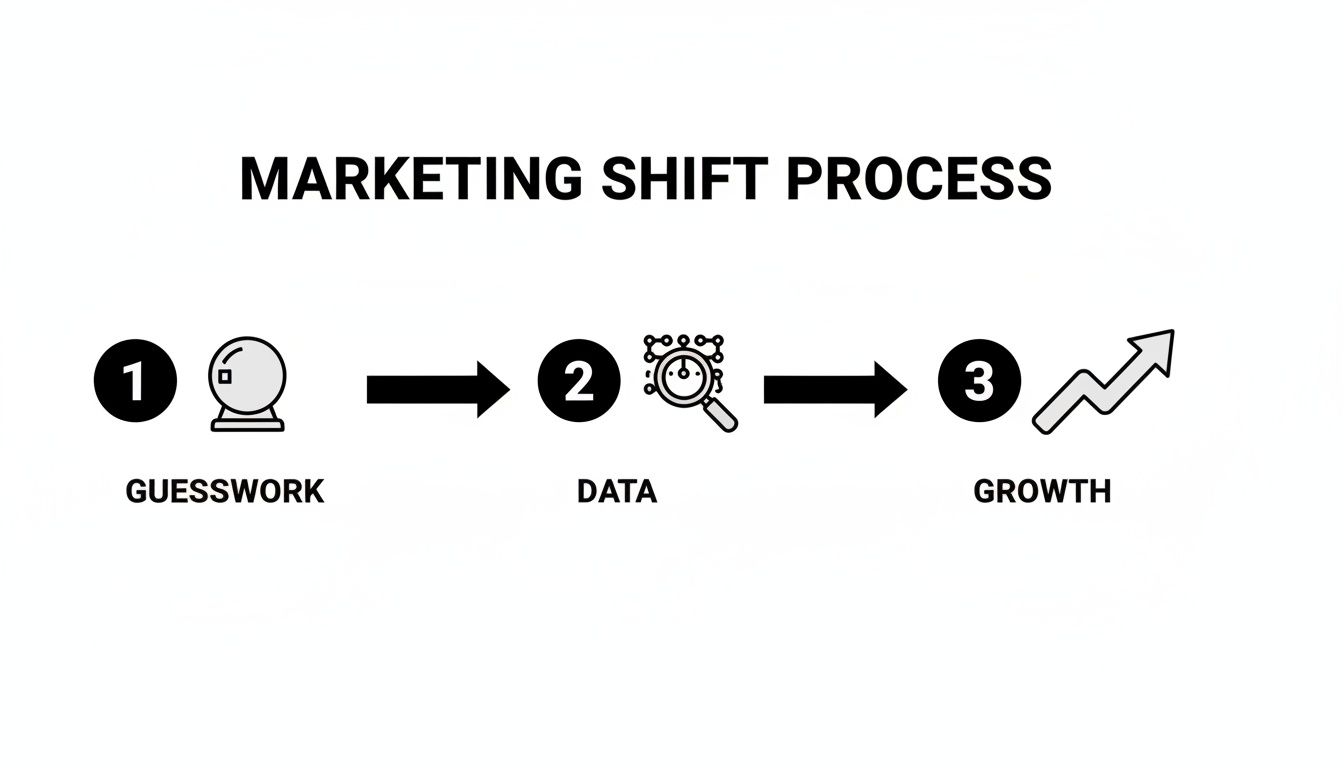
The main takeaway here is that data is the bridge. It turns uncertain marketing efforts into a clear path toward tangible business results.
Uncovering Your Data Sources
First things first, you need to know where to find your marketing "gold." This data comes from a bunch of different places, and each one offers another piece of the customer story. Think of it like a detective gathering clues from multiple locations to solve a case.
Your most valuable intel often comes from first-party data—the information you own and collect directly from your audience. This is the bedrock of your strategy.
- Website Analytics: Tools like Google Analytics show you which pages people visit, how long they stick around, and what actions they take. This tells the story of what content is hitting the mark with your audience.
- CRM Systems: Your Customer Relationship Management software tracks every interaction, from that first "hello" to the final sale. It’s a goldmine for understanding the entire customer journey.
- Email and Social Media Platforms: These platforms give you direct feedback on engagement. They show you which messages, headlines, and offers are actually grabbing your audience's attention.
By pulling these sources together, you can start building a complete, 360-degree view of your customer.
From Numbers to Narratives with Analytics
Once you have the data, you have to translate it into insights you can actually use. This is where analytics tools come in—they’re your interpreter. Raw data is just a pile of numbers; analytics tools turn those numbers into a story about your customer’s behavior.
Platforms like SEMrush or Adobe Analytics help you spot patterns. You might discover that most of your high-value customers come from organic search, or that visitors who watch a specific video are 50% more likely to buy something. These are the plot points in your customer’s story that tell you what to do next.
The goal isn't just to collect data, but to ask questions of it. Analytics helps you find the "why" behind the "what," transforming your SEO and content strategy from reactive to proactive.
The Power of Audience Segmentation
With clear insights in hand, you can finally move beyond one-size-fits-all messaging. Audience segmentation is the art of grouping your customers based on shared characteristics, behaviors, or interests. It’s the difference between shouting into a crowd and having a meaningful, one-on-one conversation.
For instance, you could create segments like:
- New Visitors: People who just landed on your site for the first time.
- Lapsed Customers: Previous buyers who haven't made a purchase in six months.
- High-Value Guests: The top 10% of your customers based on their total spending.
This lets you create super-targeted campaigns. You can send a welcome offer to new visitors, a re-engagement discount to lapsed customers, and an exclusive preview to your VIPs. This level of personalization makes your marketing feel helpful, not intrusive. To dive deeper into this topic, explore our insights on data-driven growth marketing.
Refining Your Strategy with Testing and Optimization
Finally, a data-driven strategy is never "finished." It’s a living system that you constantly refine through testing and optimization. This involves making small, controlled changes to see what performs best—a process you probably know as A/B testing.
You can test almost anything: email subject lines, website headlines, button colors, or ad copy. By showing two different versions to separate audiences, the data will tell you which one is the winner. This methodical approach takes ego and guesswork out of your decisions, making sure every part of your strategy is working as hard as possible to hit your goals.
Adapting Your SEO for an AI Driven World
The old playbook for search engine optimization is officially being torn up. Thanks to the rise of AI-powered search, from Google's SGE to conversational tools like ChatGPT, the way people find information and connect with businesses is changing fast.
For years, SEO was a game of ranking for specific keywords. Now, the goal is much, much bigger: you need to become the answer your customers are looking for, no matter how or where they ask their questions. This is where a smart, data-driven marketing strategy becomes your roadmap for navigating the future of search.
Introducing Generative Engine Optimization
To really win in this new world, businesses have to embrace something called Generative Engine Optimization (GEO). At its core, GEO is a strategy focused on creating authoritative, incredibly comprehensive content that AI models can trust, understand, and use as a source in their generated answers.
Artificial intelligence is completely reshaping how brands find and talk to their customers. A staggering 83% of global consumers use Google and/or YouTube every single day, and AI-powered search is increasingly the middleman in that process. This massive shift in behavior—driven by tools like ChatGPT, Perplexity, and Gemini—means that old-school, keyword-stuffed SEO just won't cut it anymore.
GEO isn't about trying to trick an algorithm. It's about genuinely proving your expertise through high-quality, well-structured, and trustworthy information.
Building Topic Clusters to Showcase Expertise
One of the most powerful GEO strategies you can use is building topic clusters. Instead of just pumping out standalone blog posts, you create a central "pillar" page that covers a broad topic. Then, you surround it with multiple "cluster" articles that dive deep into all the related subtopics.
Let's say you're a local roofing company.
- Your pillar page could be "The Ultimate Guide to Roof Replacement."
- Your cluster content would then be articles like "How to Choose the Best Shingles for Your Climate," "Signs You Need a Roof Inspection," and "Financing Options for a New Roof."
This structure sends a powerful signal to search engines (and their AI models) that you are a true authority on roofing. Every piece of content reinforces the others, creating a web of expertise that makes your brand the most credible source for answers.
By organizing your content this way, you're not just targeting individual keywords. You're building a library of knowledge that directly addresses the entire customer journey, from initial curiosity to final purchase decision.
Helping AI Understand Your Content with Structured Data
Another absolutely critical piece of the puzzle is using structured data, also known as Schema markup. Think of it as a "translator" that helps search engines understand the exact context of your content without having to guess.
It's a snippet of code you add to your website that labels specific information, like:
- Business Details: Your address, phone number, and hours of operation.
- Product Information: Prices, reviews, and stock availability.
- Article Details: The author, publication date, and main topic.
This kind of clarity is pure gold for AI, which needs unambiguous data to generate accurate and helpful answers. For a local service business, the right Schema can get you featured in AI-generated local packs. For an ecommerce store, it helps your products show up with rich details like star ratings and prices.
Creating People-First Content
At the end of the day, the best way to future-proof your SEO is to create "people-first" content. This means moving beyond just stuffing keywords into a page and focusing on directly answering the user's real questions and solving their actual problems. Your data—from website analytics, customer surveys, and even feedback from your sales team—is your guide to figuring out what people truly want.
This approach makes your content valuable to both humans and AI models. To really get a handle on adapting your strategies, check out a practical guide to AI Search Engine Optimization that dives into the hands-on techniques for getting your brand seen in AI-powered searches.
When you align your data insights with a people-first content strategy, you can seriously improve your marketing ROI and make sure your brand's voice is heard loud and clear in this new, AI-driven world.
Practical Data-Driven Marketing Examples for Your Business
Theory is useful, but seeing how data-driven marketing translates into actual business growth is what truly matters. Instead of just talking about concepts, let's walk through a few real-world stories that show how businesses like yours can turn simple data points into powerful, profitable actions.
These examples will show you how digging into your data is the key to improving your visibility across all forms of search—SEO, local GEO-search, and even voice-assistant Answer Engine Optimization (AEO).

Each of these mini-case studies follows a clear narrative: the problem, the data used for insight, the action taken, and the measurable outcome.
The Local Plumber Optimizing for Clicks and Calls
The Problem: A local plumbing company was running Google Ads around the clock. While they were getting leads, their ad spend was sky-high. Worse, many calls came in late at night for non-emergency services, leading to a wasted budget and frustrated on-call staff.
The Data: The team analyzed their Google Business Profile (GBP) Insights. The data told a clear story: phone calls and direction requests spiked between 8 AM and 11 AM on weekdays. After 6 PM, calls dropped off a cliff, and the few that came in rarely led to profitable jobs.
The Action: Armed with this simple insight, they completely changed their Google Ads schedule. Instead of running ads 24/7, they concentrated their budget during those peak morning hours, running from 7 AM to 5 PM, Monday through Friday.
The Measurable Outcome: Within a month, the plumber saw a 30% reduction in their monthly ad spend, and the quality of their leads improved dramatically. By focusing their budget when high-intent customers were actively searching, they boosted their return on investment and stopped burning cash on low-value clicks. This approach also helps their local SEO, as Google's algorithms tend to favor businesses that provide a good, responsive user experience.
The Ecommerce Store Boosting Customer Lifetime Value
The Problem: An online store selling skincare products was stuck in a cycle of one-off purchases. Customers would buy a single item but rarely returned, making it incredibly expensive to constantly find new shoppers.
The Data: They dove into their purchase history data from their ecommerce platform (like Shopify or BigCommerce). The data told a compelling story: customers who bought their best-selling vitamin C serum were 70% more likely to purchase a specific hydrating moisturizer within the next 30 days if prompted.
The Action: The store set up a simple, automated email campaign. Two weeks after a customer purchased the vitamin C serum, they received a personalized email. The message didn't just sell; it explained how the hydrating moisturizer complements the serum and included a small 10% discount to nudge them toward that second purchase.
The Measurable Outcome: This single, data-informed automation increased their repeat purchase rate by 22%. By understanding the natural product pairings their customers were already making, they successfully increased Customer Lifetime Value (CLV) and started building a much more loyal customer base.
This is a perfect example of what data-driven marketing is in practice. It's not about complex algorithms; it's about listening to the simple stories your sales data is already telling you.
The B2B Tech Company Identifying Hot Leads
The Problem: A B2B tech company offered a library of downloadable resources—e-books, whitepapers, and case studies—on their website. Their sales team had a massive list of contacts but no way to tell who was genuinely interested versus who was just casually browsing.
The Data: They used their CRM and marketing automation platform (like HubSpot) to track content downloads. By connecting downloads to specific contacts, they uncovered a powerful pattern: leads who downloaded both the "Beginner's Guide" e-book and a specific "Pricing Comparison" whitepaper were four times more likely to request a demo.
The Action: They created a "hot lead" segment in their CRM that automatically flagged anyone who downloaded that specific combination of assets. The sales team was instructed to prioritize these contacts immediately, reaching out with a personalized message within 24 hours.
The Measurable Outcome: The sales team's efficiency skyrocketed. By focusing on behaviorally qualified leads, they increased their demo booking rate by a massive 45% and shortened their average sales cycle. This data-driven approach ensured the sales team spent their valuable time telling the right story to the most engaged audience.
To bring this home for your own business, here's a quick look at what kind of data you might focus on depending on your industry.
Actionable Data Points for Different Business Types
| Business Type | Key Data Point to Track | Actionable Marketing Strategy |
|---|---|---|
| Local Service Provider | Peak call times from Google Business Profile | Adjust ad schedule to match peak demand hours and maximize ad spend ROI. |
| Ecommerce Store | Product purchase combinations | Create automated email cross-sell campaigns offering complementary products. |
| SaaS/B2B Startup | Content download patterns (e.g., specific whitepapers) | Build a lead scoring system to identify sales-ready leads for the sales team. |
| Restaurant/Cafe | Online reservation times or foot traffic data | Run social media ads for daily specials just before peak lunch or dinner hours. |
These examples just scratch the surface, but they all share a common thread: using accessible data to make smarter, more profitable marketing decisions.
Measuring Success with KPIs That Actually Matter
In a world drowning in data, it’s easy to get lost in numbers that look impressive but don't actually move the needle. Vanity metrics—think social media likes, page views, and impressions—can give you a warm, fuzzy feeling, but they don't tell you a thing about the health of your business. Real data-driven marketing cuts right through that noise. It zeroes in on Key Performance Indicators (KPIs) that directly track growth and profitability.
These are the numbers that tell a clear story about your return on investment (ROI). They’re the compass that guides your strategy, ensuring every move you make is tied to a real business outcome.

Customer Acquisition Cost (CAC)
Your Customer Acquisition Cost (CAC) is one of the most critical metrics you can track. It’s simple: it tells you exactly how much you spend, on average, to land one new customer. Just divide your total marketing and sales spend over a certain period by the number of new customers you brought in during that same timeframe.
Knowing your CAC is the key to making smarter budget decisions. If it's creeping too high, that’s a flashing red light telling you that your targeting, messaging, or channel mix needs a serious rethink.
Customer Lifetime Value (CLV)
While CAC tells you what it costs to get a customer through the door, Customer Lifetime Value (CLV) tells you how much that customer is worth to your business over their entire relationship with you. This forward-looking KPI is absolutely essential for understanding the long-term health of your business.
CLV shifts the focus from chasing short-term sales to building long-term loyalty. Once you know your CLV, you can figure out precisely how much you can afford to spend on CAC while staying profitable. For a deeper dive, check out our detailed guide on the customer lifetime value calculation.
The golden rule of sustainable growth is simple: your CLV must be significantly higher than your CAC. A healthy ratio, often cited as 3:1 (your customer's value is three times the cost to acquire them), is a strong indicator of a profitable marketing engine.
Conversion Rate
Your Conversion Rate is the percentage of people who take the action you want them to take. That "action" could be anything from making a purchase or filling out a form to downloading a guide. It's a direct measure of how persuasive and effective your marketing actually is.
A low conversion rate often points to a problem in the customer journey. Maybe your landing page is confusing, your call-to-action is weak, or your offer just isn't compelling enough. Tracking this KPI is fundamental to optimizing every single touchpoint. To get the full picture of your campaign performance, you have to get a handle on social media analytics and reporting.
Common Pitfalls to Avoid on Your Data Journey
Shifting to a data-driven marketing approach is a powerful move, but the journey isn’t without its speed bumps. Knowing where things can go wrong is the first step to making sure they go right.
Honestly, most businesses don't stumble because their data is bad. They stumble because they don't have a clear plan for using it. This is where storytelling becomes critical. If you can’t turn your numbers into a clear narrative that informs your SEO, GEO, and AEO strategies, you’ll struggle to connect with your audience.
The goal isn't to get bogged down; it's to build a nimble system that fuels real growth.
Analysis Paralysis: Drowning in Data
One of the biggest hurdles we see is “analysis paralysis.” This is what happens when you’re so overwhelmed by the sheer volume of data that you just… freeze. With endless dashboards and reports, it’s all too easy to get lost chasing metrics that don’t actually matter, which leads to doing nothing at all.
The fix? Focus. Instead of trying to track every single thing, just identify one primary KPI that aligns with your biggest business goal right now. Whether that’s boosting your conversion rate or slashing your customer acquisition cost, a single point of focus makes every decision simpler and more effective.
Key Takeaway: Don’t let perfect be the enemy of good. Start small by picking one key metric to obsess over. Once you've got a handle on that, you can slowly broaden your horizons. This keeps you moving forward instead of getting stuck.
Ignoring the Story Behind the Numbers
Numbers tell you what is happening, but they almost never tell you why. A classic mistake is relying only on quantitative data—like click-through rates and traffic numbers—while completely ignoring the human element. This is where qualitative data becomes your secret weapon.
To get the full picture, you need to dig into:
- Customer Reviews: What specific words are your customers using to talk about their problems and how you solve them?
- Surveys and Feedback Forms: Are you seeing the same pain points or compliments pop up over and over again?
- Support Tickets: What questions are your customers constantly asking your support team?
This kind of qualitative feedback gives you the context that raw numbers can’t. It helps you get inside your customers' heads and understand their intent, which is the key to creating content that actually resonates and ranks. When you combine the "what" with the "why," your marketing becomes exponentially more persuasive.
Common Questions About Data-Driven Marketing
Diving into data-driven marketing usually sparks a few questions. It's a shift in thinking, after all. Here are some clear, straight-to-the-point answers to the questions we hear most often from businesses ready to let data guide their growth.
How Can I Start If I Have a Small Budget?
You don't need a massive budget or fancy enterprise software to get started. Honestly, the best first step is to really get to know the powerful, free tools you probably already have access to.
- Google Analytics: Spend some time in the Audience and Behavior reports. These will tell you exactly who is coming to your site and what content they actually care about.
- Google Business Profile Insights: This is an absolute goldmine for local businesses. It shows you when customers are calling and searching for you, which helps you fine-tune everything from your ad schedules to your business hours.
The trick is to start small. Pick one key data point—like your most visited blog post or the time of day you get the most calls—and build a simple, focused strategy around just that one thing.
What Is the Difference Between Data and Insights?
This is a fantastic question, and the distinction is crucial. Data is just the raw numbers, the raw material. Insights are the actionable stories you pull from that data.
Think of it this way: Data is knowing that 70% of your website visitors bounce after seeing just one page. An insight is figuring out why they're leaving—maybe the page is slow to load, or the call-to-action is buried—and then creating a concrete plan to fix it. The whole point is to go from collecting numbers to understanding the real human behavior driving them.
An insight is that "aha!" moment when a data point suddenly reveals a business opportunity. It's the story that tells you exactly what to do next to improve your SEO, local presence, and customer experience.
Is Data-Driven Marketing Only for Big Companies?
Not at all. In fact, smaller businesses often have an edge here. You're closer to your customers, which means you can spot trends and act on insights much faster than a large corporation can. A local plumber can look at their Google Business Profile call data in the morning and adjust their ad schedule for that same afternoon.
The core principles don't change with company size. It all comes down to listening to your audience—whether you have one hundred customers or one million—and using what you hear to make smarter decisions that drive better search rankings and, ultimately, more sales.
Ready to stop guessing and start growing with a marketing strategy built on real data? The team at Jackson Digital specializes in turning analytics into actionable growth plans for businesses of all sizes. Request a free performance audit today and discover the story your data is waiting to tell.